
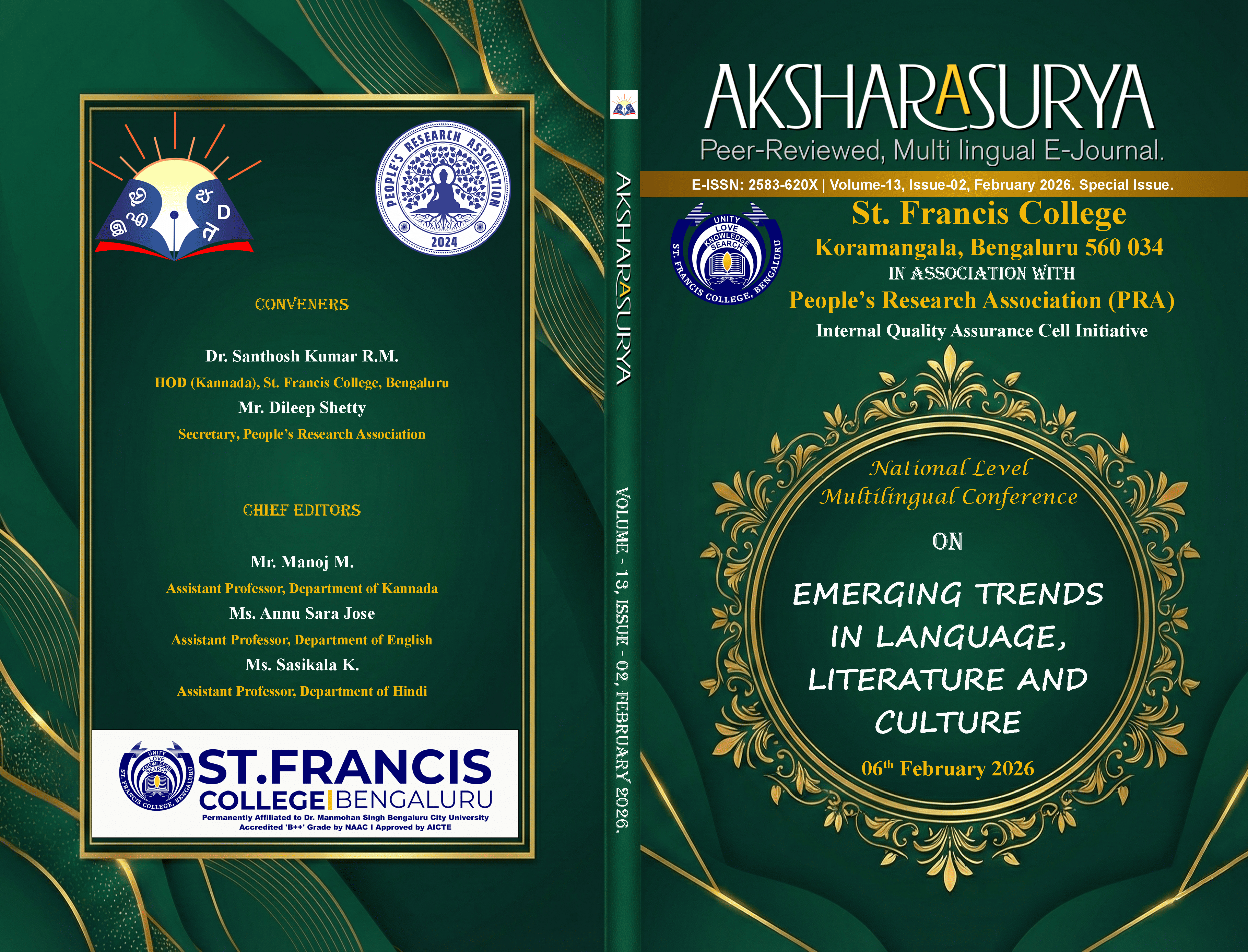
Published: 2026-02-28
Table of Contents
Research Articles
ಕಾವ್ಯ ಸಾಹಿತ್ಯದಲ್ಲಿ ಪರಿಸರ ಮತ್ತು ಹಸಿರು ಚಿಂತನೆ
01 to 10
ಸೃಷ್ಟಿಯ ದೃಷ್ಟಿಯೇ ಬ್ರಹ್ಮಾಂಡವಾಗಿದೆ. ಭೂಮಿಯಲ್ಲಿ ಜೀವಿಸಲು ಯೋಗ್ಯವಾದ ಸುವ್ಯವಸ್ಥೆಯಿದೆ. ಎಲ್ಲ ಜೀವ ಸಂಕುಲಗಳು ಬದುಕಿ ಬಾಳಲು ಸೃಷ್ಟಿಯ ಅದ್ಭುತವಾದ ಕಾರ್ಯವಾಗಿದೆ. ಭೂಮಿಯಲ್ಲಿ ನೀರು, ಅಗ್ನಿ, ವಾಯು, ಪ್ರಾಣಿ, ಪಕ್ಷಿ, ಸಸ್ಯಗಳು ಸಹ ಬದುಕುತ್ತಿವೆ. ಮನುಷ್ಯರು ಕೂಡಾ ಜೀವಿಸುತ್ತಿದ್ದಾರೆ. ಪರಿಸರದಲ್ಲಿನ ಗುಡ್ಡ, ಬೆಟ್ಟ, ಅರಣ್ಯ ಪ್ರದೇಶದಲ್ಲಿನ ಗಿಡಮರಗಳು, ವನ್ಯಜೀವಿಗಳು, ಕೆರೆ, ನದಿ, ವಾಸಿಸಲು ಇರುವ ಅಗತ್ಯತೆಗಳು ಕಂಡು ಬರುತ್ತವೆ. ಹೀಗೆ ನಾಗರಿಕತೆಯ ಸೃಷ್ಟಿ, ಸೌಲಭ್ಯಗಳು, ಅನುಕೂಲಗಳು ಕಾಣಬಹುದಾಗಿದೆ. ಕೃಷಿ ಉತ್ಪನ್ನಗಳ ವ್ಯವಸಾಯ ರೈತನ ಜೀವನದ ಸಾಧನೆಯೇ ದೇಶದ ಹೆಮ್ಮೆಯತನವಾದ ವಿಷಯವಾಗಿದೆ. ಔಷಧಿಗಳು ಹೊಂದಿರುವ ಗಿಡಮರಗಳು, ಗದ್ದೆಯಲ್ಲಿನ ಬೆಳೆಗಳು, ವೈಜ್ಞಾನಿಕ ಸಂಶೋಧನೆಯ ಫಲಿತಗಳು ಸಾರ್ವಜನಿಕರಿಗೆ ಅನುಕೂಲಗಳಾಗಿವೆ. ಹಸಿರು ಪರಿಸರದ ಮುಂಗಾರು ಮಳೆಯ ವಸಂತ ಕಾಲದ ರಮಣೀಯತೆ ಕಾಣಬಹುದಾಗಿದೆ.
ಕನ್ನಡ ಸಾಹಿತ್ಯ ಪ್ರಕಾರಗಳಲ್ಲಿಯೂ ಸಹ ಪರಿಸರ, ನಿಸರ್ಗ, ಹಸಿರಿನ ವರ್ಣನೆ, ಬಣ್ಣನೆ, ಮಲೆನಾಡು, ಕರಾವಳಿಯ ತೀರದ ಸಮುದ್ರದ ಅನುಭವಗಳು ಉಲ್ಲೇಖಗೊಂಡಿವೆ. ಅಷ್ಟೇ ಅಲ್ಲ ಹಳಗನ್ನಡ, ನಡುಗನ್ನಡ, ಹೊಸಗನ್ನಡದಲ್ಲಿಯೂ ಸಹ ಪರಿಸರ ಹಸಿರು ಚಿಂತನೆಗಳು ರಚನೆಗೊಂಡಿರುವ ವಿಷಯಗಳು ಅಧ್ಯಯನದಿಂದ ತಿಳಿಯಬಹುದಾಗಿದೆ. ಭೂಮಿಯಲ್ಲಿನ ಭೌಗೋಳಿಕ ಖನಿಜ ಸಂಪನ್ಮೂಲಗಳು ಒಳಗೂ ಮತ್ತು ಹೊರಗೂ ಇರುವುದನ್ನು ಕಾಣಬಹುದಾಗಿದೆ. ವಿಜ್ಞಾನ, ವೈಜ್ಞಾನಿಕ ಚಿಂತನೆಗಳು, ವೈದ್ಯಕೀಯ ಮಾರುಕಟ್ಟೆಯ ಉತ್ಪನ್ನಗಳು, ತರಕಾರಿ, ಸಸ್ಯಗಳು, ನೀರು, ವಾಯುವಿನ ಅಗತ್ಯತೆ ತಿಳಿಸುತ್ತವೆ. ಬದುಕಲು ಸಕಲ ಸೌಲಭ್ಯಗಳು ಪರಿಸರದ ಕೊಡುಗೆಯಾಗಿದೆ. ಪರಿಸರ, ಹಸಿರು ಚಿಂತನೆಗೆ ಸಂಬಂಧಿಸಿದಂತೆ, ಹಲವಾರು ಕೃತಿಗಳು ರಚನೆಗೊಂಡಿವೆ. ಸಮಸ್ಯೆಗಳು ಎದುರಾದಾಗ ಪರಿಹಾರಗಳು ಕಂಡು ಹಿಡಿಯುವ ಪ್ರಯತ್ನಗಳಿವೆ.
ಬಿ.ಜಿ.ಎಲ್. ಸ್ವಾಮಿಯವರ ‘ಹಸಿರು ಹೊನ್ನು’, ಕೆ.ಎಸ್.ನಿಸಾರ್ ಅಹಮ್ಮದರ ‘ನಿತ್ಯೋತ್ಸವ’, ನಾರಾಯಣ ಶೇವಿರೆ- ‘ಪರಿಸರ ಪರ’, ಡಾ.ಎಚ್.ಆರ್.ಕೃಷ್ಣಮೂರ್ತಿ- ‘ಪರಿಸರ ಅಧ್ಯಯನ’, ಪ್ರೊ.ಕೆ.ಬೈರಪ್ಪ- ‘ಪರಿಸರ ಪ್ರಜ್ಞೆ’, ಪೂರ್ಣಚಂದ್ರ ತೇಜಸ್ವಿಯವರ ‘ಪರಿಸರದ ಕಥೆ’, ಮುಂತಾದ ಕೃತಿಗಳನ್ನು ಸಹ ಕಾಣಬಹುದಾಗಿದೆ. ಕರ್ನಾಟಕದಲ್ಲಿ ಅಪೂರ್ವ ಪಶ್ಚಿಮಘಟ್ಟ, ಕಾಡು, ತೋಟ, ಕಾಡು ಹಣ್ಣುಗಳು ಇತ್ಯಾದಿಗಳು ಕಾಣಬಹುದಾಗಿದೆ. ಪರಿಸರದಲ್ಲಿನ ಹಸಿರು ಬೆಳೆಗಳು, ಆರ್ಥಿಕ ಸ್ಥಿತಿ, ಉತ್ಪನ್ನಗಳು, ಮಾರುಕಟ್ಟೆ, ಜಾನುವಾರುಗಳು, ವಿಜ್ಞಾನ, ಸಂಶೋಧನೆ, ಹಲವಾರು ವಲಯಗಳನ್ನು ವಿಸ್ತಾರವನ್ನು ಪಡೆದುಕೊಂಡಿದೆ. ಕನ್ನಡ ಸಾಹಿತ್ಯಲೋಕದಲ್ಲಿ ಪರಿಸರ, ಹಸಿರು ವಿಷಯ ವಸ್ತುವಾಗಿ ಜೀವಂತ ನಿದರ್ಶನಗಳು ಕಂಡು ಬರುತ್ತವೆ. ಒಟ್ಟಾರೆಯಾಗಿ ಮಾನವ ಪರಿಸರದ ಕೂಸು; ಸಂರಕ್ಷಣೆ ನಮ್ಮೆಲ್ಲರ ಹೊಣೆಯಾಗಿದೆ. ನಿಸರ್ಗದ ಲಾಲನೆ ಪಾಲನೆಯನ್ನು ಪ್ರತಿಯೊಬ್ಬರು ಮಾಡಬೇಕು. ಪರಿಸರವನ್ನು ಉಳಿಸಿ ಬೆಳೆಸಬೇಕಾಗಿದೆ.
ಭಾರತೀಯ ಧರ್ಮದಲ್ಲಿ ಮಹಿಳೆ ಮತ್ತು ಧರ್ಮ
11 to 19
ಭಾರತೀಯ ಸಂಸ್ಕೃತಿಯಲ್ಲಿ ಮಹಿಳೆಯ ಸ್ಥಾನಮಾನವು ಅನಾದಿ ಕಾಲದಿಂದಲೂ ಬದಲಾವಣೆಗಳಿಗೆ ಒಳಪಡುತ್ತಲೇ ಬಂದಿದೆ. ನಾಗರಿಕತೆಯ ಆರಂಭದ ಮಾತೃಪ್ರಧಾನ ವ್ಯವಸ್ಥೆಯಲ್ಲಿ ಪೂಜ್ಯಭಾವನೆ ಹೊಂದಿದ್ದ ಸ್ತ್ರೀ, ಕಾಲಕ್ರಮೇಣ ಪುರುಷ ಪ್ರಧಾನವಾದ ಧಾರ್ಮಿಕ ಚೌಕಟ್ಟಿನಲ್ಲಿ ಶೋಷಣೆಗೆ ಒಳಗಾದ ಐತಿಹಾಸಿಕ ಹಿನ್ನೆಲೆಯನ್ನು ಇಲ್ಲಿ ಗುರುತಿಸಲಾಗಿದೆ. ವೈದಿಕ, ಬೌದ್ಧ, ಜೈನ, ಇಸ್ಲಾಂ ಮತ್ತು ಕ್ರೈಸ್ತ ಧರ್ಮಗಳು ಮಹಿಳೆಯರ ಸ್ವಾತಂತ್ರ್ಯವನ್ನು ನಿಯಂತ್ರಿಸಿದ ಬಗೆ ಹಾಗೂ ಮನುಸ್ಮೃತಿಯಂತಹ ಗ್ರಂಥಗಳು ವಿಧಿಸಿದ ನಿರ್ಬಂಧಗಳನ್ನು ವಿಶ್ಲೇಷಿಸಲಾಗಿದೆ. ಸ್ಥಾಪಿತ ಧರ್ಮಗಳ ಈ ಕಟ್ಟುಪಾಡುಗಳನ್ನು ಧಿಕ್ಕರಿಸಿ, ವಚನ ಚಳವಳಿ ಹಾಗೂ ಭಕ್ತಿ ಪಂಥದ ಮೂಲಕ ಅಕ್ಕಮಹಾದೇವಿ ಮತ್ತು ಮೀರಾಬಾಯಿಯಂತಹ ಸಾಧಕಿಯರು ಕಂಡುಕೊಂಡ ಆಧ್ಯಾತ್ಮಿಕ ಬಿಡುಗಡೆ ಮತ್ತು ಸಮಾನತೆಯ ಮಾರ್ಗಗಳನ್ನು ಪ್ರಮುಖವಾಗಿ ಚರ್ಚಿಸಲಾಗಿದೆ.
ಮಹಾಸತಿ ಆಚರಣೆ ಮತ್ತು ಜನಪದ ನಂಬಿಕೆಗಳು
20 to 25
ಕರ್ನಾಟಕದ ಸಾಂಸ್ಕೃತಿಕ ಚರಿತ್ರೆಯಲ್ಲಿ ಮಹಾಸತಿ ಆಚರಣೆಯು ಒಂದು ಸಂಕೀರ್ಣ ಸಾಮಾಜಿಕ ಪದ್ಧತಿಯಾಗಿದೆ. ಶಾಸನಗಳಿಗಿಂತ ಹೆಚ್ಚಾಗಿ ಜನಪದ ಗೀತೆಗಳು ಈ ಆಚರಣೆಯ ಕುರಿತು ಜನಸಾಮಾನ್ಯರಲ್ಲಿದ್ದ ಆತಂಕ ಮತ್ತು ಭಕ್ತಿಭಾವದ ದ್ವಂದ್ವ ನಿಲುವುಗಳನ್ನು ಸ್ಪಷ್ಟವಾಗಿ ಅನಾವರಣಗೊಳಿಸುತ್ತವೆ. ಯುದ್ಧದಲ್ಲಿ ಪತಿಯ ಮರಣದ ನಂತರ ಪತ್ನಿಯು ಸಹಗಮನ ಅಥವಾ ಅನುಗಮನದ ಮೂಲಕ ಪ್ರಾಣತ್ಯಾಗ ಮಾಡುವ ಕ್ರಿಯೆಯು, ಕಾಲಾಂತರದಲ್ಲಿ ಅವಳನ್ನು ಕೇವಲ ಮೃತ ಪತ್ನಿಯಾಗಿರದೆ, ಫಲವಂತಿಕೆ ಮತ್ತು ರಕ್ಷಣೆ ನೀಡುವ ಶಕ್ತಿದೇವತೆಯಾಗಿ ಪರಿವರ್ತಿಸಿದೆ. ಕರ್ನಾಟಕದಲ್ಲಿ ಈ ಪದ್ಧತಿಯು ಕೇವಲ ಮೇಲ್ವರ್ಗಕ್ಕೆ ಸೀಮಿತವಾಗಿರದೆ, ಶೂದ್ರ ಸಮುದಾಯಗಳಲ್ಲಿಯೂ ವ್ಯಾಪಕವಾಗಿತ್ತೆಂಬ ಐತಿಹಾಸಿಕ ಸತ್ಯವನ್ನು ಇಲ್ಲಿ ಗುರುತಿಸಲಾಗಿದೆ. ಪಿತೃಪ್ರಧಾನ ವ್ಯವಸ್ಥೆಯ ಒತ್ತಡದ ನಡುವೆಯೂ, ತ್ಯಾಗದ ಮೂಲಕ ದೈವೀಕರಣಗೊಂಡ ಮಹಿಳೆಯ ಆರಾಧನಾ ಪರಂಪರೆ ಮತ್ತು ಜನಪದ ನಂಬಿಕೆಗಳ ವಿಶಿಷ್ಟತೆಯನ್ನು ಇಲ್ಲಿ ವಿಶ್ಲೇಷಿಸಲಾಗಿದೆ.
ಅನುಭಾವಿಕ ಹಿನ್ನೆಲೆಯಲ್ಲಿ ಮಾಸ್ತಿಯವರ ಸಣ್ಣ ಕತೆಗಳು ಮತ್ತು ಸಮಕಾಲೀನತೆ
26 to 32
ಕನ್ನಡ ಸಣ್ಣಕಥಾ ಸಾಹಿತ್ಯಕ್ಕೆ ಭದ್ರ ಬುನಾದಿ ಹಾಕಿಕೊಟ್ಟ ಮಾಸ್ತಿ ವೆಂಕಟೇಶ ಅಯ್ಯಂಗಾರರು, ತಮ್ಮ ವಿಶಿಷ್ಟ ಕಥನ ಕಲೆಯ ಮೂಲಕ ‘ಸಣ್ಣಕಥೆಗಳ ಜನಕ’ ಎನಿಸಿಕೊಂಡಿದ್ದಾರೆ. ಅವರು ರಚಿಸಿದ ಸಾಮಾಜಿಕ, ಐತಿಹಾಸಿಕ ಮತ್ತು ಪೌರಾಣಿಕ ಕಥೆಗಳು ಕೇವಲ ಮನರಂಜನೆಗೆ ಸೀಮಿತವಾಗದೆ, ಬದುಕಿನ ಗಂಭೀರ ಮೌಲ್ಯಗಳನ್ನು ಮತ್ತು ಮಾನವೀಯತೆಯ ಘನತೆಯನ್ನು ಎತ್ತಿಹಿಡಿಯುತ್ತವೆ. ಸರಳ ನಿರೂಪಣೆ ಮತ್ತು ಆಪ್ತವಾದ ಪಾತ್ರಗಳ ಮೂಲಕ ಸಮಕಾಲೀನ ಬದುಕಿನ ಸಂಕೀರ್ಣತೆಗಳಿಗೆ ಪರಿಹಾರ ಕಂಡುಕೊಳ್ಳುವ ಬಗೆಯನ್ನು ಇಲ್ಲಿ ವಿಶ್ಲೇಷಿಸಲಾಗಿದೆ. ಜಾತಿ, ಮತ ಮತ್ತು ಕಾಲದ ಹಂಗಿಲ್ಲದೆ, ಮನುಷ್ಯತ್ವಕ್ಕೆ ಮೊದಲ ಆದ್ಯತೆ ನೀಡುವ ಮಾಸ್ತಿಯವರ ಜೀವನದೃಷ್ಟಿ ಇಂದಿನ ಸಮಾಜಕ್ಕೆ ಅತ್ಯಂತ ಪ್ರಸ್ತುತವಾಗಿದೆ. ಸಾಂಪ್ರದಾಯಿಕ ಚೌಕಟ್ಟನ್ನು ಮೀರಿ ನಿಲ್ಲುವ ಅವರ ಕಥಾ ಪಾತ್ರಗಳು ಮತ್ತು ಅವುಗಳ ಅನುಭಾವಿಕ ನೆಲೆಗಳನ್ನು ಇಲ್ಲಿ ಗುರುತಿಸಲಾಗಿದೆ.
ಅನುವಾದ ಸಾಹಿತ್ಯ: ಒರಿಯಾದ ಮನೋಜ್ ದಾಸ್ರವರ ಸಣ್ಣಕತೆಗಳು
33 to 40
ಕನ್ನಡ ಸಾಹಿತ್ಯದ ಹೊಸ ಪ್ರವೃತ್ತಿಯಾಗಿ ಅನುವಾದ ಸಾಹಿತ್ಯವನ್ನು ಪರಿಗಣಿಸುವುದು ವರ್ತಮಾನದ ಅಗತ್ಯವಾಗಿದೆ. ಒಂದು ಸಾಹಿತ್ಯವು ಕಾಲಾತೀತವಾಗಿ ಹಾಗೂ ಭಾಷಾತೀತವಾಗಿ ಚಲಿಸಬೇಕೆಂದಾಗ ಭಾಷಾಂತರದ ಪಾತ್ರ ಬಹಳ ಮುಖ್ಯವಾದುದು. ಒಂದು ಸಮುದಾಯದ ಸಾಂಸ್ಕೃತಿಕ ಮಜಲುಗಳು ಇತರ ದೇಶ, ಪರಿಸರ, ಸಮುದಾಯದ ಸಂಸ್ಕೃತಿಯೊಂದಿಗೆ ಸಾಮ್ಯತೆ ಹಾಗೂ ಭಿನ್ನತೆಗಳನ್ನು ಹೊಂದಿರುವುದು ಅರಿವಿಗೆ ಬರುವುದು ತೌಲನಿಕ ಅಧ್ಯಯನದಿಂದ ಎಂದರೆ ತಪ್ಪಾಗಲಾರದು. ಅನುವಾದ ಸಾಹಿತ್ಯದ ಭಾಗವಾಗಿ ತೌಲನಿಕ ಸಾಹಿತ್ಯವನ್ನು ಗುರುತಿಸಬಹುದಾಗಿದ್ದು, ಇದು ಭಾಷೆ, ಕುಲ, ಸಂಸ್ಕೃತಿ, ಧರ್ಮ ಇವುಗಳ ಆಚೆಗಿನ ಸಾಹಿತ್ಯದ ನೆಲೆಯನ್ನು ವಿಸ್ತರಿಸುತ್ತದೆ. ಈ ಹಿನ್ನೆಲೆಯಲ್ಲಿ ಸ್ವಾತಂತ್ರ್ಯ ನಂತರದ ಭಾರತದ ಸಾಮಾಜಿಕ ಹಾಗೂ ರಾಜಕೀಯ ರಂಗದ ಏಳು-ಬೀಳನ್ನು ವಿವರಿಸುವ ಸಂದರ್ಭದಲ್ಲಿ ಕನ್ನಡದ ಸಣ್ಣಕತೆಗಳ ಆಶಯಗಳನ್ನು ಮನೋಜ್ ದಾಸ್ ಅವರ ‘ಕಾಣೆಯಾದ ಟೋಪಿಯ ರಹಸ್ಯ ಮತ್ತಿತರ ಕತೆಗಳು’ ವ್ಯಕ್ತಪಡಿಸುವುದರಿಂದ ಪ್ರಸ್ತುತ ಅಧ್ಯಯನದಲ್ಲಿ ಕೆಲವು ಕತೆಗಳನ್ನು ತೌಲನಿಕವಾಗಿ ಗ್ರಹಿಸಲಾಗಿದೆ.
ಭಾರತೀಯ ಸಮಾಜವು ಬಹಳ ಹಿಂದಿನಿಂದಲೂ ಊಳಿಗಮಾನ್ಯ ಹಾಗೂ ಜಮೀನ್ದಾರಿಕೆಯ ಸಂಪ್ರದಾಯದಲ್ಲಿ ಬೆಳೆದು ಬಂದಿದ್ದು, ಸ್ವಾತಂತ್ರ್ಯದಿಂದ ಈ ವ್ಯವಸ್ಥೆಯ ಹಠಾತ್ ಅಂತ್ಯವು ಸಮಾಜವನ್ನು ಪಲ್ಲಟಕ್ಕೆ ಗುರಿ ಮಾಡಿತು. ಪಾಶ್ಚಿಮಾತ್ಯ ಮಾದರಿಯ ಪ್ರಜಾಪ್ರಭುತ್ವವು ಭಾರತೀಯರ ಜೀವನದಲ್ಲಿ ಊಳಿಗಮಾನ್ಯತೆಯನ್ನು ನಿರ್ಮೂಲನೆ ಮಾಡಿ ಪರಿವರ್ತನೆಯ ಪಥವನ್ನು ಪರಿಚಯಿಸಿತು. ಇದರಿಂದಾಗಿ ರಾಜರು, ಜಮೀನ್ದಾರರು, ಭೂಮಾಲೀಕರು ಹಾಗೂ ಸಾಮಾನ್ಯ ಜನರು ತಮ್ಮ ಜೀವನದಲ್ಲಿ ಇದುವರೆವಿಗೂ ಅಳವಡಿಸಿಕೊಂಡಿದ್ದ ಅಭ್ಯಾಸಗಳಿಗೆ ಮತ್ತು ಮನಸ್ಥಿತಿಗೆ ಅನ್ಯವಾದ ವ್ಯವಸ್ಥೆಯನ್ನು ಮುಖಾಮುಖಿಯಾದರು. ಈ ಬಗೆಯ ಸಾಮಾಜಿಕ ಹಾಗೂ ರಾಜಕೀಯ ಬದಲಾವಣೆಯನ್ನು ಮನೋಜ್ ದಾಸ್ರ ಮುಸ್ಸಂಜೆಯ ಹಕ್ಕಿಗಳು, ಮೊಲದ ಮನಸ್ಸು ಕತೆಗಳು ಕಟ್ಟಿಕೊಡುತ್ತವೆ.
ಸಾಮಾಜಿಕ ನ್ಯಾಯಕ್ಕಾಗಿ ಮಿಡಿದ ಕೊಲ್ಹಾಪುರದ ರಾಜರ್ಷಿ ಶಾಹು ಮಹಾರಾಜ
41 to 54
ನಾಲ್ವಡಿ ಕೃಷ್ಣರಾಜ ಒಡೆಯರ ಸಮಕಾಲೀನರಾದ ಕೊಲ್ಹಾಪುರದ ರಾಜರ್ಷಿ ಶಾಹು ಮಹಾರಾಜರು ಭಾರತೀಯ ಸಾಮಾಜಿಕ ಇತಿಹಾಸದಲ್ಲಿ ‘ಸಾಮಾಜಿಕ ನ್ಯಾಯ’ದ ಹರಿಕಾರರಾಗಿ ಗುರುತಿಸಿಕೊಂಡಿದ್ದಾರೆ. ವೈಯಕ್ತಿಕವಾಗಿ ಅನುಭವಿಸಿದ ‘ವೇದೋಕ್ತ’ ಪ್ರಕರಣದ ಅವಮಾನವನ್ನೇ ಸಾಮಾಜಿಕ ಕ್ರಾಂತಿಯನ್ನಾಗಿ ಪರಿವರ್ತಿಸಿದ ಇವರು, ಬ್ರಾಹ್ಮಣೇತರ ಮತ್ತು ದಲಿತ ವರ್ಗಗಳ ವಿಮೋಚನೆಗಾಗಿ ಶಿಕ್ಷಣವನ್ನು ಪ್ರಬಲ ಅಸ್ತ್ರವನ್ನಾಗಿ ಬಳಸಿದರು. ತಮ್ಮ ಸಂಸ್ಥಾನದಲ್ಲಿ ಉಚಿತ ಮತ್ತು ಕಡ್ಡಾಯ ಶಿಕ್ಷಣ, ವಿದ್ಯಾರ್ಥಿವೇತನ ಹಾಗೂ ಹಿಂದುಳಿದ ವರ್ಗಗಳಿಗೆ ಮೀಸಲಾತಿಯನ್ನು ಜಾರಿಗೊಳಿಸುವ ಮೂಲಕ ಸಮಸಮಾಜದ ನಿರ್ಮಾಣಕ್ಕೆ ಬುನಾದಿ ಹಾಕಿದರು. ಅಸ್ಪೃಶ್ಯತೆ ನಿವಾರಣೆ, ಮಹಿಳಾ ಹಕ್ಕುಗಳ ರಕ್ಷಣೆ, ದೇವದಾಸಿ ಪದ್ಧತಿ ನಿಷೇಧ ಹಾಗೂ ಅಂತರ್ಜಾತಿ ವಿವಾಹಗಳಿಗೆ ಕಾನೂನಿನ ಮಾನ್ಯತೆ ನೀಡುವ ಮೂಲಕ, ಡಾ. ಬಿ.ಆರ್. ಅಂxಬೇಡ್ಕರ್ ಅವರ ಸಂವಿಧಾನಾತ್ಮಕ ಮೀಸಲಾತಿ ಮತ್ತು ಸಾಮಾಜಿಕ ಸಮಾನತೆಯ ಆಶಯಗಳಿಗೆ ಇವರು ಮುನ್ನುಡಿ ಬರೆದರು.
‘ಪರಿಸರದ ಕತೆ’ ಕೃತಿಯಲ್ಲಿ ಮನುಷ್ಯ ಮತ್ತು ಪ್ರಕೃತಿಯ ಸಂಬಂಧಗಳು
55 to 65
ಕೆ.ಪಿ. ಪೂರ್ಣಚಂದ್ರ ತೇಜಸ್ವಿಯವರು ಕನ್ನಡದಲ್ಲಿ ಪರಿಸರ ಸಾಹಿತ್ಯ ಪ್ರಕಾರಕ್ಕೆ ಭದ್ರ ಬುನಾದಿ ಹಾಕಿದವರು. ಅವರ ‘ಪರಿಸರದ ಕತೆ’ ಕೃತಿಯನ್ನು ಆಧರಿಸಿದ ಈ ಲೇಖನವು, ಮನುಷ್ಯ ಮತ್ತು ಪ್ರಕೃತಿಯ ನಡುವಿನ ಸಂಕೀರ್ಣ ಸಂಬಂಧಗಳನ್ನು ವೈಜ್ಞಾನಿಕ ಮತ್ತು ಅನುಭಾವಿಕ ನೆಲೆಗಳಲ್ಲಿ ವಿಶ್ಲೇಷಿಸುತ್ತದೆ. ಲೇಖಕರು ‘ಸುಸ್ಮಿತಾ ಮತ್ತು ಹಕ್ಕಿಮರಿ’, ‘ಕಿವಿ’ ಹಾಗೂ ಇತರೆ ಕಥೆಗಳ ದೃಷ್ಟಾಂತಗಳ ಮೂಲಕ, ಪ್ರಕೃತಿಯಲ್ಲಿ ಮಾನವನ ಅತಿಯಾದ ಹಸ್ತಕ್ಷೇಪ ಮತ್ತು ಅಜ್ಞಾನದಿಂದಾಗುವ ಅನಾಹುತಗಳನ್ನು ಗುರುತಿಸಿದ್ದಾರೆ. ಜೀವವಿಕಾಸದ ನಿಯಮಗಳು, ಪ್ರಾಣಿ ಪ್ರಪಂಚದ ವಿಸ್ಮಯ ಮತ್ತು ಪರಿಸರ ಸಂರಕ್ಷಣೆಯ ಕುರಿತು ತೇಜಸ್ವಿಯವರು ಮೂಡಿಸಿರುವ ಎಚ್ಚರಿಕೆಯ ಧ್ವನಿಯನ್ನು ಹಾಗೂ ಸಹಜ ಜೀವನಶೈಲಿಯ ಮಹತ್ವವನ್ನು ಇಲ್ಲಿ ಚರ್ಚಿಸಲಾಗಿದೆ.
ಜನಪದ ಸಾಹಿತ್ಯದ ಮೇಲೆ ಆಧುನಿಕ ಮಾಧ್ಯಮಗಳ ಪ್ರಭಾವ
66 to 71
ಜನಪದ ಸಾಹಿತ್ಯವು ಸಂಸ್ಕೃತಿಯ ಮೂಲ ಬೇರಾಗಿದ್ದು, ಆಧುನಿಕ ಮಾಧ್ಯಮಗಳ ಪ್ರಭಾವದಿಂದಾಗಿ ಮಹತ್ವದ ಪಲ್ಲಟಗಳನ್ನು ಕಾಣುತ್ತಿದೆ. ಮುದ್ರಣ, ದೃಶ್ಯ ಮತ್ತು ಸಾಮಾಜಿಕ ಜಾಲತಾಣಗಳು ಜನಪದ ಕಲೆಗಳನ್ನು ಜಾಗತಿಕ ಮಟ್ಟಕ್ಕೆ ತಲುಪಿಸಿ, ಕಲಾವಿದರಿಗೆ ಆರ್ಥಿಕ ಮತ್ತು ಪ್ರಚಾರದ ನೆರವು ನೀಡಿವೆ. ಆದರೆ, ಅವಿಭಕ್ತ ಕುಟುಂಬಗಳ ವಿಘಟನೆ ಮತ್ತು ಮೊಬೈಲ್ ಸಂಸ್ಕೃತಿಯಿಂದಾಗಿ ‘ಹೇಳುಗ-ಕೇಳುಗ’ ಪರಂಪರೆ ನಶಿಸಿ, ‘ನೋಡುಗ’ ಪರಂಪರೆ ಬೆಳೆದಿದೆ. ಯಕ್ಷಗಾನದಂತಹ ಕಲೆಗಳು ವ್ಯಾಪಾರೀಕರಣಗೊಂಡು ತಮ್ಮ ಮೂಲ ಸ್ವರೂಪ ಹಾಗೂ ಪ್ರಾದೇಶಿಕ ವೈಶಿಷ್ಟ್ಯಗಳನ್ನು ಕಳೆದುಕೊಳ್ಳುವ ಆತಂಕವನ್ನು ಇಲ್ಲಿ ಚರ್ಚಿಸಲಾಗಿದೆ. ಪರಂಪರೆ ಮತ್ತು ಆಧುನಿಕತೆಯ ನಡುವೆ ಸಮನ್ವಯ ಸಾಧಿಸುವ ಮೂಲಕ ಜನಪದದ ಮೌಲ್ಯಗಳನ್ನು ಉಳಿಸಿಕೊಳ್ಳುವ ಅಗತ್ಯವನ್ನು ಲೇಖನ ಪ್ರತಿಪಾದಿಸುತ್ತದೆ.
ಹರಿದಾಸ ಸಾಹಿತ್ಯಕ್ಕೆ ಮಾಧ್ವ ಯತಿಗಳ ಕೊಡುಗೆ
72 to 78
ಹರಿದಾಸ ಸಾಹಿತ್ಯ ಪರಂಪರೆಯು ಮಾಧ್ವ ಯತಿಗಳ ಕೊಡುಗೆಯಿಂದಾಗಿ ಅತ್ಯಂತ ಶ್ರೀಮಂತಗೊಂಡಿದೆ. ದ್ವೈತ ಸಿದ್ಧಾಂತದ ಕ್ಲಿಷ್ಟಕರ ತತ್ವಗಳನ್ನು ಜನಸಾಮಾನ್ಯರಿಗೆ ಅರ್ಥವಾಗುವಂತೆ ಕನ್ನಡದಲ್ಲಿ ಪ್ರಚುರಪಡಿಸುವುದು ಈ ಯತಿಗಳ ಪ್ರಮುಖ ಉದ್ದೇಶವಾಗಿತ್ತು. ಹರಿದಾಸ ಪಂಥದ ಮೂಲಪುರುಷರಾದ ನರಹರಿತೀರ್ಥರು, ಪಿತಾಮಹರೆನಿಸಿದ ಶ್ರೀಪಾದರಾಜರು, ದಾಸಕೂಟವನ್ನು ಸಾಂಸ್ಥೀಕರಿಸಿದ ವ್ಯಾಸತೀರ್ಥರು, ವಾದಿರಾಜರು ಹಾಗೂ ವ್ಯಾಸತತ್ವಜ್ಞತೀರ್ಥರಂತಹ ಮಹಾನ್ ಯತಿಗಳು ಕೀರ್ತನೆ, ಸುಳಾದಿ ಮತ್ತು ಉಗಾಭೋಗಗಳ ಮೂಲಕ ಭಕ್ತಿಮಾರ್ಗವನ್ನು ತೋರಿಸಿಕೊಟ್ಟರು. ಸಂಸ್ಕೃತದಲ್ಲಿದ್ದ ವೇದ-ಉಪನಿಷತ್ತುಗಳ ಸಾರವನ್ನು ಸರಳ ಕನ್ನಡದಲ್ಲಿ ನೀಡುವ ಮೂಲಕ ಭಾಷೆ ಮತ್ತು ಸಂಸ್ಕೃತಿಯನ್ನು ಇವರು ಬೆಳೆಸಿದರು. ಹರಿಭಕ್ತಿ, ನೈತಿಕ ಮೌಲ್ಯಗಳು ಮತ್ತು ಸಾಮಾಜಿಕ ಕಳಕಳಿಯನ್ನು ಒಳಗೊಂಡ ಇವರ ಸಾಹಿತ್ಯವು ದಾಸಸಾಹಿತ್ಯದ ಬುನಾದಿಯಾಗಿದೆ. ಹರಿದಾಸ ಸಾಹಿತ್ಯದ ಉಗಮ ಮತ್ತು ವಿಕಾಸದಲ್ಲಿ ಈ ಪ್ರಮುಖ ಮಾಧ್ವ ಯತಿಗಳು ವಹಿಸಿದ ನಿರ್ಣಾಯಕ ಪಾತ್ರ ಹಾಗೂ ಅವರ ಸಾಹಿತ್ಯಿಕ ಕೊಡುಗೆಗಳ ವಿಶಿಷ್ಟತೆಯನ್ನು ಇಲ್ಲಿ ವಿಶ್ಲೇಷಿಸಲಾಗಿದೆ.
ಕೆ. ಷರೀಫಾರವರ ಕಾವ್ಯದಲ್ಲಿ ಬಂಡಾಯದ ನೆಲೆಗಳು ಮತ್ತು ಸ್ತ್ರೀ ಅಸ್ಮಿತೆಯ ಶೋಧ
79 to 89
ಎಪ್ಪತ್ತು-ಎಂಬತ್ತರ ದಶಕದ ದಲಿತ-ಬಂಡಾಯ ಸಾಹಿತ್ಯ ಚಳವಳಿಯ ಪ್ರಮುಖ ಕವಯಿತ್ರಿ ಕೆ. ಷರೀಫಾ ಅವರ ಕಾವ್ಯಗಳಲ್ಲಿನ ಬಂಡಾಯದ ನೆಲೆಗಳು ಮತ್ತು ಸ್ತ್ರೀ ಅಸ್ಮಿತೆಯ ಹುಡುಕಾಟವನ್ನು ಈ ಲೇಖನವು ವಿಶ್ಲೇಷಿಸುತ್ತದೆ. ಮುಸ್ಲಿಂ ಸಂವೇದನೆಯ ಹಿನ್ನೆಲೆಯಿಂದ ಬಂದರೂ, ಸಮಸ್ತ ಸ್ತ್ರೀ ಸಮುದಾಯದ ನೋವು, ಶೋಷಣೆ ಮತ್ತು ದಮನಿತ ಬದುಕನ್ನು ಇವರ ಕವಿತೆಗಳು ಒಕ್ಕೊರಲಿನಿಂದ ಪ್ರಶ್ನಿಸುತ್ತವೆ. ಪಿತೃಪ್ರಧಾನ ವ್ಯವಸ್ಥೆಯು ನಿರ್ಮಿಸಿದ ಚರಿತ್ರೆ, ಧಾರ್ಮಿಕ ಕಟ್ಟುಪಾಡುಗಳು ಮತ್ತು ಸಾಮಾಜಿಕ ಅಸಮಾನತೆಗಳ ವಿರುದ್ಧ ಸಿಡಿದೇಳುವ ಇವರ ಕಾವ್ಯವು, ಮೌನವನ್ನು ಮುರಿದು ಹಕ್ಕೊತ್ತಾಯ ಮಾಡುವ ಪ್ರಬಲ ಅಭಿವ್ಯಕ್ತಿಯಾಗಿದೆ. ವರದಕ್ಷಿಣೆ, ಸತಿ ಪದ್ಧತಿಯಂತಹ ಅನಿಷ್ಟಗಳ ವಿರುದ್ಧದ ಆಕ್ರೋಶ ಮತ್ತು ಲಿಂಗ ಸಮಾನತೆಯ ಆಶಯಗಳು ಇವರ ಬರಹಗಳ ಮುಖ್ಯ ತಿರುಳಾಗಿರುವುದನ್ನು ಇಲ್ಲಿ ಚರ್ಚಿಸಲಾಗಿದೆ.
ಸ್ತ್ರೀವಾದಿ ಸಾಹಿತ್ಯ ವಿಮರ್ಶೆ - ಒಂದು ವಿವೇಚನೆ
90 to 95
ಕನ್ನಡ ಭಾಷೆ ಅಗಾಧ ಶ್ರೀಮಂತಿಕೆಯನ್ನು ಹೊಂದಿದ್ದು ಪೂರ್ವ ಹಳಗನ್ನಡ, ಹಳಗನ್ನಡ, ನಡುಗನ್ನಡ ಮತ್ತು ಹೊಸಗನ್ನಡ ಎಂಬ ಹಲವು ಬಗೆಗಳಾಗಿ ರೂಪುಗೊಂಡು, ಹಲವು ಅವಸ್ಥೆಗಳ ತದನಂತರ ತಂತ್ರಜ್ಞಾನವನ್ನು ತನ್ನ ಜೊತೆ ಮೇಳೈಸಿಕೊಂಡು ಸಾಹಿತ್ಯ ಕೃಷಿ ನಡೆಯುತ್ತಾ ಓದುಗರನ್ನು ಅತೀ ಸುಲಭವಾಗಿ ಮುಟ್ಟುವ ಹಂತಕ್ಕೆ ಬಂದಿದೆ. ಅದರಲ್ಲೂ ‘ಸ್ತ್ರೀವಾದಿ ಸಾಹಿತ್ಯ ವಿಮರ್ಶೆ’ ಎಂಬುದು ಕನ್ನಡ ಲೇಖಕಿಯರ ಪಾಲಿಗೆ ಒಂದು ಸವಾಲಾಗಿದ್ದು, ಅವರು ತಮ್ಮ ಕೃತಿಗಳಲ್ಲಿ ಹೆಣ್ಣನ್ನು, ಅವಳ ಸ್ಥಿತಿಗತಿಯನ್ನು ವಿವರಿಸಿರುವ ಹಂತಗಳನ್ನು ನನ್ನ ಈ ಪ್ರಬಂಧದಲ್ಲಿ ವಿವರಿಸಬಯಸುತ್ತೇನೆ. ಸ್ತ್ರೀವಾದಿ ವಿಮರ್ಶೆ ಇದುವರೆವಿಗೂ ಮಹಿಳೆಯನ್ನು ತಿರುಚಿ ನೋಡಿರುವ ವಿಚಾರ, ಅದರ ಕಾರಣ, ಅಲ್ಲದೇ ಆಕೆಗೆ ಸಿಗಬೇಕಾದ ಸರಿಯಾದ ಸ್ಥಾನಮಾನದ ಬಗ್ಗೆ ಪ್ರಶ್ನೆ ಮಾಡುತ್ತಾ ನೈಜ ಸ್ಥಿತಿಯನ್ನು ಅರ್ಥ ಮಾಡಿಸುವ ಪ್ರಯತ್ನ ಈ ಸಂಶೋಧನಾ ಪ್ರಬಂಧದಲ್ಲಿದೆ.
ಶಿವಶರಣೆಯರ ಸ್ತ್ರೀ ಸಂವೇದಿ ನೆಲೆಗಳು
96 to 102
12ನೇ ಶತಮಾನದ ವಚನ ಚಳುವಳಿಯು ಸಾಮಾಜಿಕ ಕ್ರಾಂತಿಯ ಜೊತೆಗೆ ಸ್ತ್ರೀ ಸಮಾನತೆ ಮತ್ತು ಅಭಿವ್ಯಕ್ತಿ ಸ್ವಾತಂತ್ರ್ಯಕ್ಕೆ ಭದ್ರ ಬುನಾದಿ ಹಾಕಿತು. ಅನುಭವ ಮಂಟಪದ ಪ್ರಭಾವದಿಂದ ಮಹಿಳೆಯರು ಕೌಟುಂಬಿಕ ಚೌಕಟ್ಟನ್ನು ಮೀರಿ ಆಧ್ಯಾತ್ಮಿಕ ಮತ್ತು ಬೌದ್ಧಿಕ ಎತ್ತರಕ್ಕೇರಿದರು. ಬಸವಣ್ಣನವರ ಧರ್ಮಪತ್ನಿ ನೀಲಮ್ಮನ ತಾತ್ವಿಕ ನಿಲುವು, ಮುಕ್ತಾಯಕ್ಕನ ವೈಚಾರಿಕ ಪ್ರಜ್ಞೆ ಮತ್ತು ಅಕ್ಕಮ್ಮನ ಕಾಯಕ ನಿಷ್ಠೆಗಳು ವಚನ ಸಾಹಿತ್ಯದಲ್ಲಿ ಸ್ತ್ರೀ ಸಂವೇದನೆಯ ವಿಶಿಷ್ಟ ನೆಲೆಗಳನ್ನು ಅನಾವರಣಗೊಳಿಸುತ್ತವೆ. ಮೂಢನಂಬಿಕೆಗಳ ನಿವಾರಣೆ, ನಡೆ-ನುಡಿಗಳ ಶುದ್ಧತೆ ಮತ್ತು ಕಾಯಕದ ಮಹತ್ವವನ್ನು ಸಾರುವಲ್ಲಿ ಈ ಶರಣೆಯರ ಪಾತ್ರ ಹಿರಿದು. ಪಿತೃಪ್ರಧಾನ ವ್ಯವಸ್ಥೆಯ ನಡುವೆಯೂ ಮಹಿಳೆಯರು ತಮ್ಮ ಸ್ವಂತಿಕೆ ಹಾಗೂ ಅಸ್ಮಿತೆಯನ್ನು ರೂಪಿಸಿಕೊಂಡ ಬಗೆ ಮತ್ತು ಅವರ ಸಾಹಿತ್ಯಿಕ ಕೊಡುಗೆಯ ಮಹತ್ವವನ್ನು ಇಲ್ಲಿ ವಿಶ್ಲೇಷಿಸಲಾಗಿದೆ.
ಹವ್ಯಾಸಿ ರಂಗಭೂಮಿ ಹುಟ್ಟು ಮತ್ತು ಬೆಳವಣಿಗೆ
103 to 106
ವೃತ್ತಿ ರಂಗಭೂಮಿ ನಾಟಕ ಲೋಕವನ್ನು ಅಕ್ಷರಶಃ ಒಂದು ಶತಮಾನಗಳ ಕಾಲ ಆಳಿತು. ʼಉತ್ತರ ಕರ್ನಾಟಕ ವೃತ್ತಿ ರಂಗಭೂಮಿಯ ತವರುʼ ಎಂದೆನಿಸಿದೆ. ತನ್ನದೇ ಆದ ವೈಭೋಗದಿಂದ ಸಿನಿಮಾ ನೋಡಿದ ಹಾಗೇ ಜನರನ್ನು ರಂಜಿಸುತ್ತಿತ್ತು. ಹೊಸತರಲ್ಲಿ ಹೊಸ ಹೊಸ ನಾಟಕಗಳಿಂದ ಗಟ್ಟಿಗೊಳ್ಳುತ್ತಾ ಹೋಯಿತು. ಸಾಮಾಜಿಕ, ಪೌರಾಣಿಕ, ಐತಿಹಾಸಿಕ ನಾಟಕಗಳಲ್ಲಿ ತನ್ನದೇ ಛಾಪನ್ನು ವಿಸ್ತಾರಗೊಳಿಸಿತು. ಹೀಗೆ ವೃತ್ತಿ ರಂಗಭೂಮಿ ವೇಗವಾಗಿ ಬೆಳೆಯುತ್ತಿದ್ದ ಸಂದರ್ಭದಲ್ಲಿ ಆರಂಭಗೊಂಡಿದ್ದೇ ಹವ್ಯಾಸಿ ರಂಗಭೂಮಿ. ಇಂಗ್ಲಿಷ್ ನಾಟಕಗಳನ್ನು ಕನ್ನಡಕ್ಕೆ ಅನುವಾದಿಸಿ ಆಡಿದರು. ಗ್ರೀಕ್, ಮರಾಠಿ, ಪಾರ್ಸಿ… ಹೀಗೆ ಬಹಳ ದೊಡ್ಡ ಮಟ್ಟದಲ್ಲಿ ಅನುವಾದ ನಾಟಕ ಸಾಹಿತ್ಯ ಬೆಳೆಯಿತು.
ಹರಿದಾಸರು: ಆತ್ಮಶೋಧನೆ ಹಾಗೂ ತತ್ವ ಪ್ರತಿಪಾದನೆ
107 to 118
ಕನ್ನಡ ಸಾಹಿತ್ಯ ಚರಿತ್ರೆಯಲ್ಲಿ ಹರಿದಾಸ ಸಾಹಿತ್ಯವು ಭಕ್ತಿ ಆಂದೋಲನವಾಗಿ ಮಾತ್ರವಲ್ಲದೆ, ಸಾಮಾಜಿಕ ಮತ್ತು ವೈಚಾರಿಕ ಕ್ರಾಂತಿಯ ಪ್ರಬಲ ಮಾಧ್ಯಮವಾಗಿದೆ. ಹರಿದಾಸರು ಕೇವಲ ದೈವಸ್ತುತಿಗೆ ಸೀಮಿತವಾಗದೆ, ಮನುಷ್ಯನ ಅಂತರಂಗದ ಶುದ್ಧೀಕರಣ ಮತ್ತು ಆತ್ಮಶೋಧನೆಯ ಮಾರ್ಗವನ್ನು ಸ್ಪಷ್ಟವಾಗಿ ತೋರಿದ್ದಾರೆ. ಪುರಂದರದಾಸರು, ಕನಕದಾಸರು, ವಿಜಯದಾಸರು ಹಾಗೂ ಜಗನ್ನಾಥದಾಸರು ತಮ್ಮ ಕೀರ್ತನೆಗಳ ಮೂಲಕ ಅರಿಷಡ್ವರ್ಗಗಳನ್ನು ಗೆದ್ದು, ಅಹಂಕಾರವನ್ನು ತ್ಯಜಿಸಿ ಪರಮಾತ್ಮನಿಗೆ ಶರಣಾಗುವ ಬಗೆಯನ್ನು ವಿವರಿಸಿದ್ದಾರೆ. ಮಧ್ವಾಚಾರ್ಯರ ದ್ವೈತ ಸಿದ್ಧಾಂತ ಮತ್ತು ವೇದೋಪನಿಷತ್ತುಗಳ ಕ್ಲಿಷ್ಟಕರ ಸಾರವನ್ನು ಜನಸಾಮಾನ್ಯರ ಭಾಷೆಯಲ್ಲಿ ಸರಳೀಕರಿಸಿರುವುದು ಇವರ ವೈಶಿಷ್ಟ್ಯವಾಗಿದೆ. ಬಾಹ್ಯ ಆಚರಣೆಗಿಂತ ಅಂತರಂಗದ ನಿಷ್ಕಾಮ ಭಕ್ತಿ, ಗುರುಭಕ್ತಿ ಹಾಗೂ ನೈತಿಕ ಮೌಲ್ಯಗಳೇ ಮೋಕ್ಷಕ್ಕೆ ದಾರಿ ಎಂದು ದಾಸರು ಪ್ರತಿಪಾದಿಸಿದ್ದಾರೆ. ಈ ಸಾಹಿತ್ಯವು ಮನುಷ್ಯನನ್ನು ಲೌಕಿಕ ಮೌಢ್ಯದಿಂದ ಪಾರುಮಾಡಿ, ಆಧ್ಯಾತ್ಮಿಕ ಮತ್ತು ನೈತಿಕ ಉನ್ನತಿಯತ್ತ ಕೊಂಡೊಯ್ಯುವಲ್ಲಿ ದಾರಿದೀಪವಾಗಿದೆ.
Resistance Against Patriarchy and Islamophobia: Fostering Peace in Heart Lamp
119 to 127
The collection of short stories, Eedeya Hanathe (1990), written by Banu Mushtaq and translated into English by Deepa Bhasthi as Heart Lamp, addresses the living experiences and day-to-day challenges of Muslim women. The stories revolve around the patriarchal and religious violence against women in the Muslim community; however, it transcends that and becomes a similar story of all women from different religions and castes. At the time of surging Islamophobia in India and other parts of the world, which dehumanizes Muslims, Heart Lamp sheds true light on the realities of the Muslim women and their community and resists all forms of oppression with peace and love. The early marriage of girls, the mechanical form of relationship between husband and wife, the abandonment by husbands, the suffocating patriarchal ecosystem and many other themes reveal the sufferings and forced submissive nature of women. These narratives sensitize the minds and social consciousness to develop empathy towards other human beings, especially women from all walks of life. It tackles hate and prejudice that are sown in the minds of people against other communities. Therefore, this paper substantiates Mushtaq’s critical-insider role in promoting reformation, empathy, and peace in a broken society.
Ancient Voices, Modern Echoes: The Mahabharata
128 to 136
Folk literature reflects the shared memory, values, and lived experiences of a society. The Mahabharata stands as one of the most powerful examples of how folk tradition and classical literature exist together in Indian culture. Although it is preserved today as a written epic, the Mahabharata was transmitted for centuries through oral storytelling, folk theatre, and regional narrations. These forms allowed the epic to reach people across social, linguistic, and educational boundaries and become part of everyday cultural life.
The lasting relevance of the Mahabharata lies in its portrayal of human complexity. Its characters face moral dilemmas, emotional conflicts, and difficult choices that closely resemble real life. Rather than presenting clear divisions between good and evil, the epic explores ethical uncertainty and human weakness. This quality helped people relate to the epic and apply its lessons to their own social realities.
In modern times, the Mahabharata continues to be reinterpreted through literature, theatre, and popular media. Modern retellings have focused on marginalized voices, especially women, offering new perspectives on familiar narratives. Such reinterpretations connect ancient tradition with contemporary concerns while preserving the spirit of the original epic. This paper examines the Mahabharata as a product of folk tradition, its preservation through oral culture, and its transformation through modern retellings, highlighting its enduring cultural significance.
Language and Storytelling as Strategic Enablers of Organizational Culture and Brand Identity: An Indian Perspective
137 to 144
Language and narratives are currently seen to be key symbolic resources for today’s organizations with regard to the shape of cultural life inside them as well as from outside under the brand label. Against the background of a cultural plurality, multilingualism, and a rich tradition of storytelling culture in Indian society (where work contexts are rarely exempted), organizational storytelling gains particular relevance for management. The paper discusses the strategic role of language and storytelling in facilitating organizational culture and brand identity communication in Indian firms. Built wholly on secondary sources from management, organizational communication, cultural theory and branding literatures, the paper is a showcase of interdisciplinary insights that are put together to develop a conceptual framework connecting organizational language and narrative practices with cultural coherence and brand identity. The paper provides a contribution to management and cultural studies by raising the awareness of storytelling as an embedded-in-culture managerial capacity rather than a peripheral mode for communication. Theoretical implications of this model and possible suggestions for managers working in such a culturally mixed environment are presented.
Nature as A Living Presence in Gill Lewis’ Eagle Warrior: An Eco-Critical Perspective
145 to 153
Ecocriticism is a literary theory that describes an interdisciplinary and environmentally oriented critical approach and examines the relationships between human beings and the natural world. Gill Lewis’ novel Eagle Warrior (2020) explores nature and blends fast-paced adventure with strong environmental themes. The novel portrays nature as an active force rather than a static backdrop. The study explores how Lewis represents the Scottish Highland landscape and the golden eagle as an active agent that destabilizes anthropocentric ideologies, foregrounding nonhuman vitality within the natural world. Putting forth ecocritical theories, the study analyses the novel’s representation of wildlife and eco-centric ethics. The study contends how Eagle Warrior amplifies ecological voices by endowing nonhuman existence with moral and narrative value, positioning the child protagonist as a mediator who connects human society with nature. Ultimately, the novel illustrates how children’s literature serves as an effective medium for fostering environmental awareness and ecological responsibility through a detailed portrayal of natural landscapes.
Exploring Ecocritical Trajectory from Rachel Carson to Amitav Ghosh
154 to 159
This paper follows the footprints of ecocriticism from Rachel Carson’s ‘Silent Spring’ (1962) to Amitav Ghosh’s ‘The Great Derangement’ (2016). Carson sounds the alarm about pesticide buildup in the ecosystem and takes on the split between nature and culture, laying the groundwork for Western environmentalism (Buell, 1995). On the other hand, Ghosh addresses the issues with postcolonial perspectives in his climate fictions and non-fictions. He brings nonhuman voices to the front and casts light on the climate struggles faced by the Global South (Ghosh, 2016; Huggan & Tiffin, 2010). This paper identifies three major shifts: first, from the dangers of chemicals to the larger issue of climate change; second, from a Western perspective to an ethics of the Global South; and third, from stories that focus on humans to a more ecocentric perspective. The overall message is that literature is constantly changing the way we think about and respond to environmental issues.
Instagram Reels – The contemporary social media tool for dissemination of Kashmiri culture and language Learning
160 to 170
Social Media, the third space that has acquired all the space belonging to humans today, has transcended the year-long boundaries creating the new public sphere altogether. Facebook, YouTube, Twitter and then finally Instagram, produced an endless loop that no one could escape from reacting – the extremely engaging Instagram Reels. And with every video seen and shared on the social media app, Instagram reels became an important aspect to share diverse cultures all over the earth, making millions know the existence of each other without even having a common language to do so. And today, while videos and reels belonging to different languages and cultures are common to be commented on, reels in Kashmiri language are making their place well lit, making people know about the meaning of distinctively beautiful Kashmiri words otherwise unknown to them before, thus making non-indigenous people interested in Kashmiri culture and language learning. In this research paper, qualitative analysis of one such popular Kashmiri Instagram account namely ‘Historeel’ has been explored showcasing language learning through code-mixing, code-switching and viewer’s reaction to unique names of folklore characters and its symbolism in Kashmiri language and cultural dissemination between different ethnicities has been studied.
Gender Perspectives in Dalit Literature: A Study of Daya Pawar’s Baluta
171 to 178
Dalit literature has emerged as a powerful literary and socio-political movement that challenges caste-based hierarchies by foregrounding the lived experiences of historically marginalized communities. Among the various literary forms adopted by Dalit writers, autobiography occupies a central position as it enables self-representation, resistance, and the articulation of social realities. Daya Pawar’s Baluta (1978), one of the earliest Dalit autobiographies in Marathi, is widely regarded as a foundational text in Dalit literary studies. While the autobiography has been extensively analysed as a narrative of caste oppression and identity formation, its gender dimensions have received relatively limited scholarly attention. This paper argues that Baluta also demands a sustained gender-based analysis. Using the theoretical frameworks of intersectionality and Dalit feminist criticism, the study examines how caste and patriarchy intersect in shaping the lives of Dalit women represented in the text. Although the narrative voice remains male-centred, Baluta implicitly reveals women’s labour, domestic responsibilities, emotional endurance, and social vulnerability. The paper also explores constructions of Dalit masculinity and the functioning of patriarchy within oppressed communities. It concludes that a gender-sensitive reading of Baluta enriches Dalit literary criticism and highlights the necessity of integrating feminist perspectives into the study of male-authored Dalit texts.
Narrative Strategies as Feminist Resistance: A Study of Personal and Political Self in the Novels of Shashi Deshpande and Nayantara Sahgal
179 to 185
This article examines how narrative strategies function as forms of feminist resistance in select novels of Shashi Deshpande and Nayantara Sahgal. Focusing on That Long Silence and The Dark Holds No Terrors by Deshpande, and Rich Like Us and Storm in Chandigarh by Sahgal, the study explores how women protagonists negotiate personal identity within oppressive domestic, social, and political structures. Drawing on feminist and postcolonial theoretical perspectives, the article argues that narrative techniques such as silence, memory, interior monologue, psychological realism, and political contextualization enable women to articulate both personal and political selfhood. The selected novels demonstrate that women’s private experiences are deeply embedded in broader power structures, thereby challenging the traditional separation between the personal and the political in Indian English fiction.
Artificial Intelligence in Multilingual Communication: Opportunities and Challenges
186 to 197
Artificial Intelligence (AI) has emerged as an important tool in transforming multilingual communication in today’s digitally connected world. Advances in Natural Language Processing, machine translation, speech recognition, and conversational systems have enabled effective communication across languages in multilingual and culturally diverse societies. This paper examines the key opportunities and challenges associated with the use of AI in multilingual communication.
AI-based language technologies such as real-time translation tools, voice assistants, and multilingual chatbots have improved access to education, public services, and digital platforms. These tools support regional and minority languages and promote digital inclusion, particularly for non-native speakers in educational and administrative contexts.
Despite these benefits, challenges remain. AI systems often face issues related to data bias, inaccurate translations, cultural misinterpretation, and limited datasets for low-resource languages. Ethical concerns related to privacy and fairness further affect responsible AI deployment.
The study emphasizes the need for inclusive and ethically designed AI models and highlights the importance of interdisciplinary collaboration. It concludes that while AI offers strong potential to enhance multilingual communication, human oversight and ethical governance are essential for sustainable and responsible use.
Cultural Conflict and Impact of Social Change in Kamala Markandaya’s The Golden Honeycomb
198 to 203
Kamala Markandaya’s The Golden Honeycomb is an epic novel set during the British Raj, which chronicles the relationship between Indian princely state heir, Prince Rabi, and Sophie, the daughter of a British official, exploring themes of forbidden love, cultural clashes, and the intense Indian Independence movement against a backdrop of political intrigue and social change. The Golden Honeycomb (1977), a stupendous work of 469 pages, portrays the decline and fall of the Indian Prince. This novel is considered her magnum opus. This book examines British imperial rule, deferential Indian princes, and the hypocrisy of both societies, showing how their “golden” lives are built on the struggles of the common people. This paper tries to seek to examine the aspects of cultural conflict and the impact of modernization on Indian society. This novel uses the personal story of Rabi and Sophie to illustrate the larger political and social transformation of India as it moves from a subjugated colonized territory towards independence.
Existential Philosophy in Hilary Mantel’s Novel Bring Up the Bodies
204 to 212
Contemporary literature is increasingly shaped by existential concerns such as uncertainty, freedom, moral responsibility, and the instability of meaning. The paper examines these trends through the historical novels of Hilary Mantel. The Tudor trilogy redefines historical fiction as an existential mode of inquiry, rather than presenting history as a coherent narrative governed by causality. Mantel foregrounds subjective consciousness, contingency, and ethical ambiguity as cardinal doctrines of her writings. Through the interior perspective of Thomas Cromwell, Mantel dramatizes the existential condition of the individual acting within oppressive political and ideological systems. Her use of narrative technique is apparently unique; the narration, psychological depth, and revisionist historiography align her work with existential philosophy, particularly its emphasis on lived experience over abstract moral frameworks.
The paper aims to read the novel Bring Up the Bodies encapsulating the historiographic metafiction, narrative interiority, and moral uncertainty, while demonstrating how her fiction transforms the past into a space for reflecting on modern anxieties about agency, power, and responsibility. Mantel’s work ultimately suggests that history, like existence itself, is shaped by choice, risk, and irreducible uncertainty. Although Hilary Mantel is best known as a writer of historical fiction, her work participates fully in this existential turn. Her Tudor trilogy-Wolf Hall, Bring Up the Bodies, and The Mirror & the Light-rejects deterministic history and instead portrays history as lived experience shaped by fear, choice, and moral risk. The paper argues that Bring Up the Bodies can be productively read through the philosophy of Jean-Paul Sartre, particularly his concepts of freedom, responsibility, and action under contingency. Mantel’s Cromwell embodies Sartrean existential agency: he acts without guarantees, constructs meaning through choice, and bears responsibility for outcomes he cannot fully control. By foregrounding interiority, ethical ambiguity, and the burden of decision-making, Mantel transforms historical fiction into an existential mode of inquiry, using the Tudor past to confront modern anxieties about power, agency, and moral responsibility.
Hilary Mantel exemplifies new trends in contemporary literature by transforming historical fiction into an existential exploration of agency, power, and responsibility. Through Cromwell, Mantel articulates a deeply modern vision of existence: individuals act without certainty, construct meaning through choice, and bear responsibility for outcomes they cannot fully control. In doing so, Mantel situates the past as a powerful medium for confronting the existential anxieties of the present.
Psychological Scripts and Gender Roles in Perumal Murugan’s Narratives
213 to 219
This study examines the influence of society’s gender roles and the deep-seated cultural norms followed by communities in India, and how these factors affect the psyche of individuals living in closely knit communities. The study will closely analyse the chosen texts, One Part Woman, A Lonely Harvest and Trial by Silence, using Transactional Analysis Theory. Drawing on Dr. Eric Berne’s Transactional Analysis theory, the paper will explore the Adult, Parent and Child ego states of the characters and how they affect their behaviours, to show that these behaviours are a result of deeply rooted belief systems followed by cultures and also study the influence that they have in shaping Adult, Child and Parent ego states. The life scripts of the characters are analysed using sex-role scripting introduced by Hogie Wycoff. The paper focuses on understanding Perumal Murugan’s selected texts as representations of psychological conditioning that normalise their endurance.
Influence of Social Media on Language
220 to 227
Social Media has become one of the most influential forces shaping the use of contemporary language. Platforms such as WhatsApp, Instagram, Facebook, Threads, and X (Formerly Twitter) have transformed how people write, speak, and express identity in everyday communication. This paper examines the influence of social media on language by focusing on changes in vocabulary, grammar, discourse patterns, and multilingual practices. Drawing from sociolinguistic and media theories, the study examines how social media encourages abbreviation, code-mixing, use of emojis, memes, and hashtags (#). They have become a part of regular communication. Special attention is given to the Indian context, as multilingual users creatively blend English with regional languages like Hindi, Kannada, Tamil, and Malayalam. The paper argues that social media does not lead to the decline of language but represents a natural process of language change driven by technology and culture. By viewing digital communication as an emerging linguistic domain, this study contributes to current discussion on language evolution in the digital era.
Enhancing Employability Through Business Communication and Translation Skills in Higher Education
228 to 240
In the current globalized competitive job market, higher education institutions are rapidly expected to prepare students with employability-oriented skills. Among these, business communication and translation skills play an important role in enhancing graduates’ professional competence and workplace readiness. This paper examines the significance of business communication and translation skills in higher education and their impact on students’ employability. It examines how effective communication supports professional interactions, while translation skills accelerate cross-cultural understanding and international business operations.
By using a descriptive research approach, this study drew on both primary data from students and faculty and secondary data such as academic and curriculum documents. The findings disclose that the combination of translation training and business communication in higher education programs advances students’ confidence, adaptability, and employment prospects. This study finds that integrating these skills into academic programs bridges the gap between education and industry expectations and contributes significantly to graduate employability.
Language, Technology, and Artificial Intelligence
241 to 250
The swift progress of technology has significantly altered the essence of human language, communication, and the creation of knowledge. Among these advancements, Artificial Intelligence (AI) has surfaced as a crucial element transforming the processing, generation, and application of language in various fields. This research paper explores the interplay between language, technology, and artificial intelligence, focusing specifically on AI-based language technologies and their effects on society. It examines the development of language in conjunction with technological advancements, emphasizing the importance of Natural Language Processing (NLP) in allowing machines to comprehend and generate human language. The research additionally examines the effects of AI on communication, education, creativity, and cultural expression, illustrating how smart language systems improve efficiency, accessibility, and worldwide interaction. Concurrently, the article examines the ethical issues related to AI language technologies, such as data privacy, bias in algorithms, misinformation, and the possible decline of linguistic diversity. This paper emphasizes the importance of responsible and inclusive AI development by merging insights from linguistics, computer science, and social theory. The article wraps up by highlighting the necessity of interdisciplinary cooperation to guarantee that developments in language-oriented AI technologies align with human values, foster fair communication, and maintain the vibrancy of linguistic and cultural diversity in a progressively digital environment.
New Trends in Contemporary Literature in the Select Works of Anita Desai
251 to 269
Anita Desai’s fiction marks a pivotal shift in Indian English literature, transitioning from traditional social realism to profound psychological introspection. Through a textual analysis of Cry, the Peacock, Voices in the City, and Clear Light of Day, the research highlights her use of fragmented narratives, non-linear time, and interior monologues to articulate complex female consciousness. These works depict the intense alienation and emotional isolation inherent in modern domestic and urban life, prioritizing subjective experience over external action. Ultimately, Desai’s validation of the “inner climate” establishes her as a significant architect of contemporary narrative trends and feminist sensitivity.
The Gaming Adaptation of Shakespeare’s Play Hamlet in the Documentary Grand Theft Hamlet
270 to 277
This paper examines the gaming adaptation of Shakespeare’s play Hamlet in the documentary Grand Theft Hamlet, focusing on how Shakespearean tragedy is reimagined within the hyperreal digital environment of Grand Theft Auto Online. The documentary presents an experimental performance of Hamlet staged inside a violent, open-world gaming platform, where avatars enact Shakespeare’s text amid gunfire, chaos, and player interruptions. This study explores how such a setting reshapes the themes of Hamlet, particularly revenge, surveillance, madness, and moral conflict, aligning them with contemporary digital culture and interactive media. Drawing on theories of adaptation, hyperreality, and game studies, the paper argues that Grand Theft Hamlet transforms Shakespeare’s play from a scripted literary text into a participatory, unstable performance that reflects the fragmented realities of modern life. The hyperreal space of the game amplifies Hamlet’s existential uncertainty, where questions of action, inaction, and identity are constantly disrupted by violence and unpredictability. Moreover, the documentary challenges traditional hierarchies between “high” literature and popular gaming culture, demonstrating how video games can function as serious platforms for cultural and literary engagement. By situating Hamlet within a virtual world defined by aggression and spectacle, Grand Theft Hamlet offers a provocative commentary on contemporary modes of storytelling, spectatorship, and performance. Ultimately, the paper highlights how gaming adaptations open new critical possibilities for understanding Shakespeare in the age of digital media and interactive hyperreality.