
Artificial Intelligence in Multilingual Communication: Opportunities and Challenges
Article Sidebar
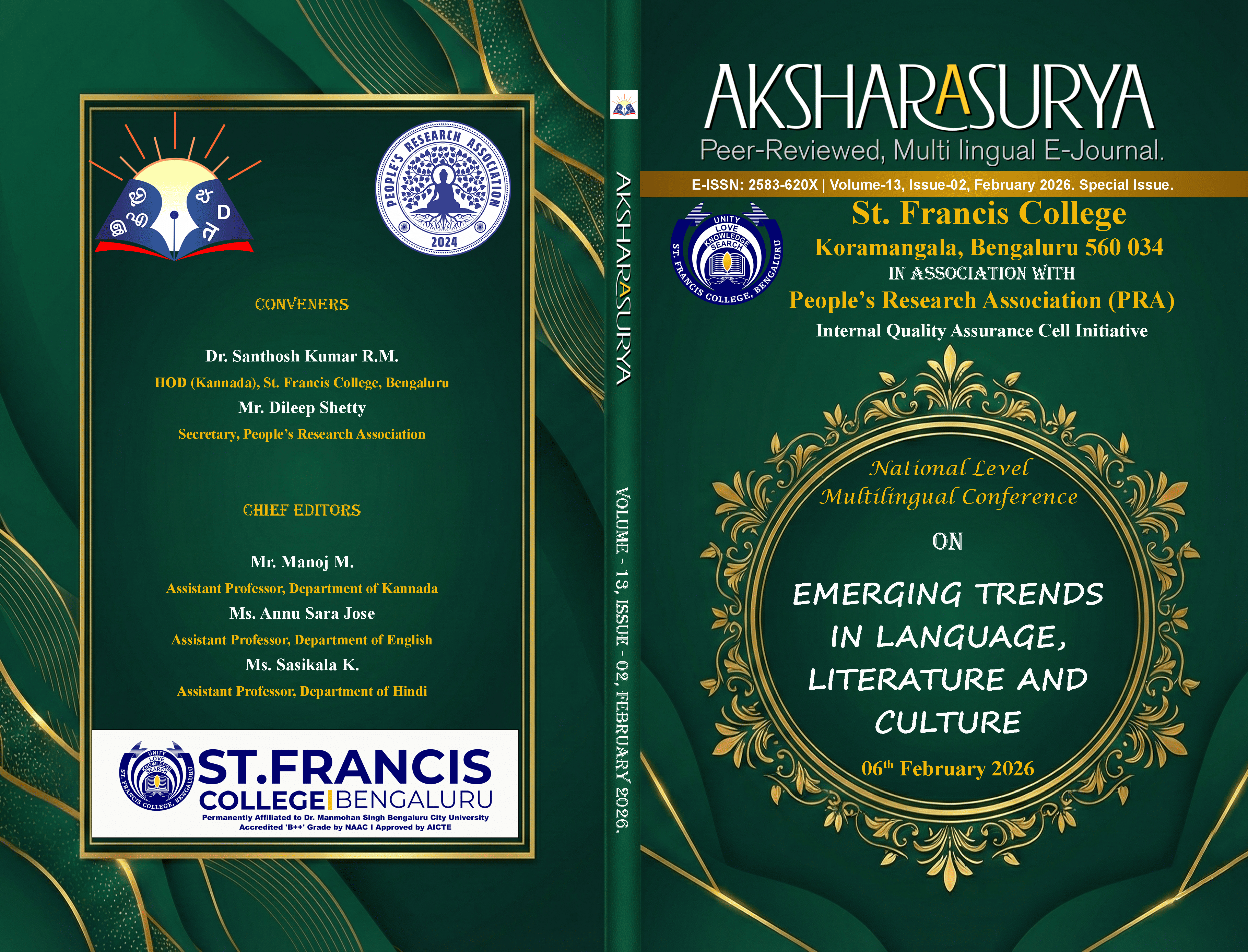
Main Article Content
Abstract
Artificial Intelligence (AI) has emerged as an important tool in transforming multilingual communication in today’s digitally connected world. Advances in Natural Language Processing, machine translation, speech recognition, and conversational systems have enabled effective communication across languages in multilingual and culturally diverse societies. This paper examines the key opportunities and challenges associated with the use of AI in multilingual communication.
AI-based language technologies such as real-time translation tools, voice assistants, and multilingual chatbots have improved access to education, public services, and digital platforms. These tools support regional and minority languages and promote digital inclusion, particularly for non-native speakers in educational and administrative contexts.
Despite these benefits, challenges remain. AI systems often face issues related to data bias, inaccurate translations, cultural misinterpretation, and limited datasets for low-resource languages. Ethical concerns related to privacy and fairness further affect responsible AI deployment.
The study emphasizes the need for inclusive and ethically designed AI models and highlights the importance of interdisciplinary collaboration. It concludes that while AI offers strong potential to enhance multilingual communication, human oversight and ethical governance are essential for sustainable and responsible use.
Article Details
Section

This work is licensed under a Creative Commons Attribution-NonCommercial-ShareAlike 4.0 International License.
How to Cite
References
Vaswani, A., Shazeer, N., Parmar, N., Uszkoreit, J., Jones, L., Gomez, A. N., Kaiser, Ł., & Polosukhin, I. (2017). Attention is all you need. Advances in Neural Information Processing Systems, 30, 5998–6008.
Devlin, J., Chang, M. W., Lee, K., & Toutanova, K. (2019). BERT: Pre-training of deep bidirectional transformers for language understanding. Proceedings of NAACL-HLT, 4171–4186.
Wu, Y., Schuster, M., Chen, Z., Le, Q. V., Norouzi, M., Macherey, W., … Dean, J. (2016). Google’s neural machine translation system: Bridging the gap between human and machine translation. arXiv preprint arXiv:1609.08144.
Koehn, P., & Knowles, R. (2017). Six challenges for neural machine translations. Proceedings of the First Workshop on Neural Machine Translation, 28–39.
Koehn, P. (2020). Neural machine translation. Cambridge University Press.
Baevski, A., Zhou, Y., Mohamed, A., & Auli, M. (2020). wav2vec 2.0: A framework for self-supervised learning of speech representations. Advances in Neural Information Processing Systems, 33, 12449–12460.
Radford, A., Kim, J. W., Xu, T., Brockman, G., McLeavey, C., & Sutskever, I. (2022). Robust speech recognition via large-scale weak supervision. arXiv preprint arXiv:2212.04356.
Joshi, P., Santy, S., Budhiraja, A., Bali, K., & Choudhury, M. (2020). The state and fate of linguistic diversity and inclusion in the NLP world. Proceedings of ACL, 6282–6293.
Bender, E. M., Gebru, T., McMillan-Major, A., & Shmitchell, S. (2021). On the dangers of stochastic parrots: Can language models be too big? Proceedings of the ACM Conference on Fairness, Accountability, and Transparency, 610–623.
Bird, S. (2020). Decolonising speech and language technology. Proceedings of the 28th International Conference on Computational Linguistics, 3504–3519.