
Existential Philosophy in Hilary Mantel’s Novel Bring Up the Bodies
Article Sidebar
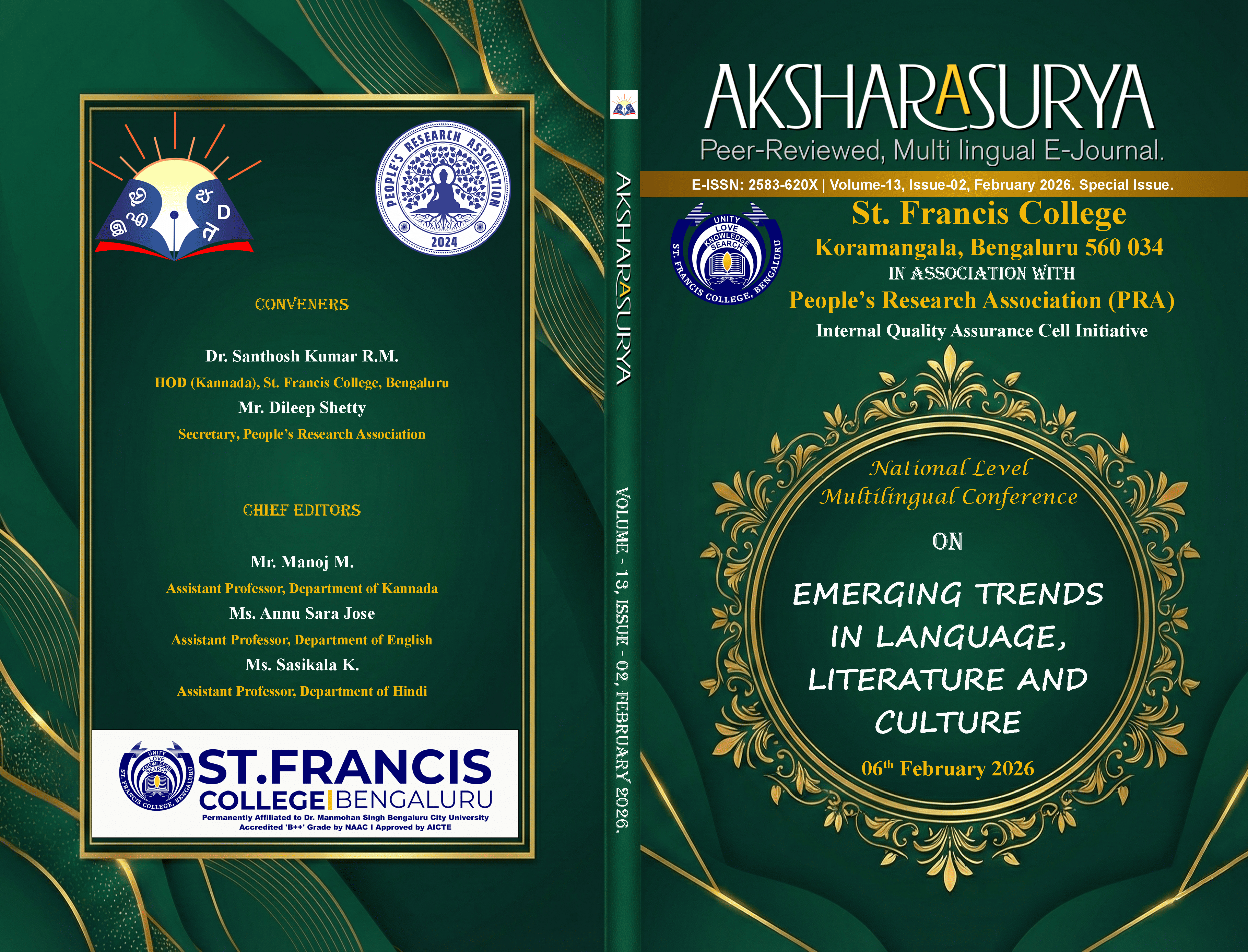
Main Article Content
Abstract
Contemporary literature is increasingly shaped by existential concerns such as uncertainty, freedom, moral responsibility, and the instability of meaning. The paper examines these trends through the historical novels of Hilary Mantel. The Tudor trilogy redefines historical fiction as an existential mode of inquiry, rather than presenting history as a coherent narrative governed by causality. Mantel foregrounds subjective consciousness, contingency, and ethical ambiguity as cardinal doctrines of her writings. Through the interior perspective of Thomas Cromwell, Mantel dramatizes the existential condition of the individual acting within oppressive political and ideological systems. Her use of narrative technique is apparently unique; the narration, psychological depth, and revisionist historiography align her work with existential philosophy, particularly its emphasis on lived experience over abstract moral frameworks.
The paper aims to read the novel Bring Up the Bodies encapsulating the historiographic metafiction, narrative interiority, and moral uncertainty, while demonstrating how her fiction transforms the past into a space for reflecting on modern anxieties about agency, power, and responsibility. Mantel’s work ultimately suggests that history, like existence itself, is shaped by choice, risk, and irreducible uncertainty. Although Hilary Mantel is best known as a writer of historical fiction, her work participates fully in this existential turn. Her Tudor trilogy-Wolf Hall, Bring Up the Bodies, and The Mirror & the Light-rejects deterministic history and instead portrays history as lived experience shaped by fear, choice, and moral risk. The paper argues that Bring Up the Bodies can be productively read through the philosophy of Jean-Paul Sartre, particularly his concepts of freedom, responsibility, and action under contingency. Mantel’s Cromwell embodies Sartrean existential agency: he acts without guarantees, constructs meaning through choice, and bears responsibility for outcomes he cannot fully control. By foregrounding interiority, ethical ambiguity, and the burden of decision-making, Mantel transforms historical fiction into an existential mode of inquiry, using the Tudor past to confront modern anxieties about power, agency, and moral responsibility.
Hilary Mantel exemplifies new trends in contemporary literature by transforming historical fiction into an existential exploration of agency, power, and responsibility. Through Cromwell, Mantel articulates a deeply modern vision of existence: individuals act without certainty, construct meaning through choice, and bear responsibility for outcomes they cannot fully control. In doing so, Mantel situates the past as a powerful medium for confronting the existential anxieties of the present.
Article Details
Section

This work is licensed under a Creative Commons Attribution-NonCommercial-ShareAlike 4.0 International License.
How to Cite
References
Mantel, H. (2009). Wolf Hall. London, UK: Fourth Estate.
Mantel, H. (2012). Bring Up the Bodies. London, UK: Fourth Estate.
Mantel, H. (2020). The Mirror & the Light. London, UK: Fourth Estate.
Sartre, J.-P. (2007). Existentialism is a Humanism (C. Macomber, Trans.). New Haven, CT: Yale University Press. (Original work published 1946)
Hutcheon, L. (1988). A Poetics of Postmodernism: History, Theory, Fiction. New York, NY: Routledge.
Camus, A. (1991). The Myth of Sisyphus (J. O’Brien, Trans.). New York, NY: Vintage.