
Exploring Ecocritical Trajectory from Rachel Carson to Amitav Ghosh
Article Sidebar
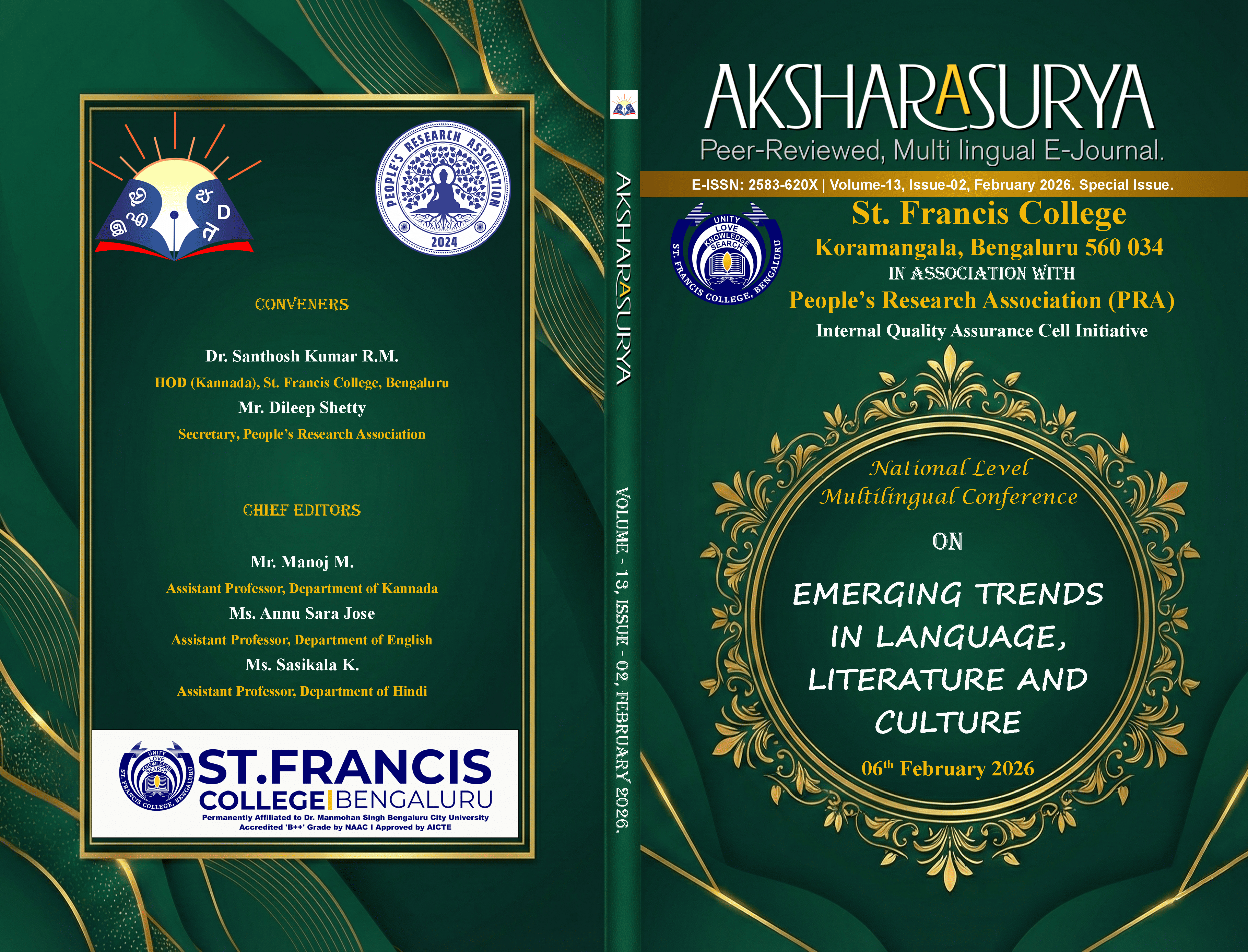
Main Article Content
Abstract
This paper follows the footprints of ecocriticism from Rachel Carson’s ‘Silent Spring’ (1962) to Amitav Ghosh’s ‘The Great Derangement’ (2016). Carson sounds the alarm about pesticide buildup in the ecosystem and takes on the split between nature and culture, laying the groundwork for Western environmentalism (Buell, 1995). On the other hand, Ghosh addresses the issues with postcolonial perspectives in his climate fictions and non-fictions. He brings nonhuman voices to the front and casts light on the climate struggles faced by the Global South (Ghosh, 2016; Huggan & Tiffin, 2010). This paper identifies three major shifts: first, from the dangers of chemicals to the larger issue of climate change; second, from a Western perspective to an ethics of the Global South; and third, from stories that focus on humans to a more ecocentric perspective. The overall message is that literature is constantly changing the way we think about and respond to environmental issues.
Article Details
Section

This work is licensed under a Creative Commons Attribution-NonCommercial-ShareAlike 4.0 International License.
How to Cite
References
Buell, L. (1995). The Environmental Imagination: Thoreau, Nature Writing, And The Formation Of American Culture. Harvard University Press.
Carson, R. (1962). Silent Spring. Houghton Mifflin Publishers.
Chakrabarty, D. (2009). The Climate Of History: Four Theses. Critical Inquiry. The University of Chicago Press. https://www.journals.uchicago.edu/doi/10.1086/596640
Cronon, W. (Ed.). (1995). Uncommon Ground: Rethinking The Human Place In Nature. W. W. Norton & Company.
Ghosh, A. (2004). The Hungry Tide. HarperCollins Publishers.
Ghosh, A. (2016). The Great Derangement: Climate Change And The Unthinkable. University of Chicago Press.
Glotfelty, C., & Fromm, H. (Eds.). (1996). The Ecocriticism Reader: Landmarks In Literary Ecology. University of Georgia Press.
Haraway, D. J. (2016). Staying With The Trouble: Making Kin In The Chthulucene. Duke University Press.
Huggan, G., & Tiffin, H. (2010). Postcolonial Ecocriticism: Literature, Animals, Environment. Routledge.
Hynes, H. P. (1989). The Recurring Silent Spring. Pergamon Press.
Johns-Putra, A. (2019). Climate Change and the Contemporary Novel. Cambridge: Cambridge University Press.
Johns-Putra, A. (2016). Climate Change In Literature And Literary Studies: From Cli-Fi, Climate Change Theatre And Ecopoetry To Ecocriticism And Climate Change Criticism. WIREs Climate Change, 7(2), 266–282. https://doi.org/10.1002/wcc.385
Lear, L. (1997). Rachel Carson: Witness For Nature. Henry Holt.
Lytle, M. H. (2007). The Gentle Subversive: Rachel Carson, Silent Spring, And The Rise Of The Environmental Movement. Oxford University Press.
Karigar Ajit, M. (2025). Ecocritical Perspectives On Amitav Ghosh’s The Hungry Tide. Akshara Surya: Peer-Reviewed, Multilingual E-Journal. DOI: https://doi.org/10.5281/zenodo.17259312
O’Grady, J. P. (2003). How sustainable is the idea of sustainability? ISLE: Interdisciplinary Studies in Literature and Environment, 10(1), 1–10. https://doi.org/10.1093/isle/10.1.1
Marland, P. (2013). Ecocriticism. Literature Compass 10/11 (2013): 846–868. https://doi.org/10.1111/lic3.12105
Nixon, R. (2011). Slow Violence And The Environmentalism Of The Poor. Harvard University Press.
Parui, D. (2022). Handcuffed To Nature: An Ecocritical Approach To Amitav Ghosh’s The Great Derangement: Climate Change And The Unthinkable. Literary Oracle, 6(1), 104-113. Google Scholar
Smith, A. (2020). The Role Of Nature In Literary Imagination. Journal of Creative Writing, 10(1), 1–10. Google Scholar
Sheenam. (2013). Critiquing Anthropocentrism In Amitav Ghosh’s The Hungry Tide And J.M. Coetzee’s Disgrace (Doctoral dissertation). https://kr.cup.edu.in/items/b164f137-d778-41cd-9f05-97626f5a40dc
Taylor, M. (2018). American Nature Writing: A Historical Perspective. Environmental Humanities, 10(1), 20–35. Google Scholar
White, L. (1967). The historical roots of our ecologic crisis. Science, 155(3767), 1203–1207.