
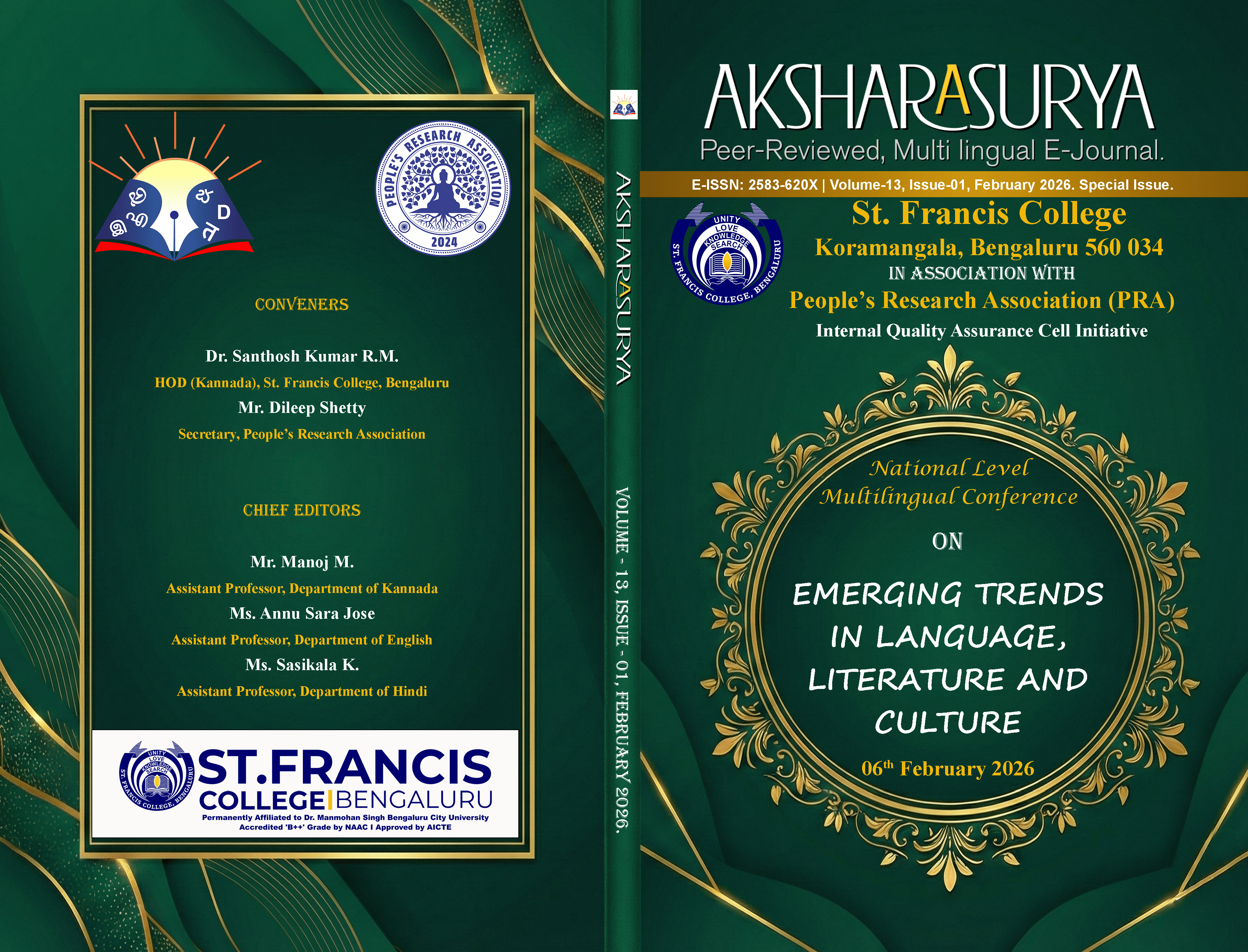
Published: 2026-02-28
Table of Contents
Research Articles
ಜನಪದ ಕಥೆಗಳ ಒಂದು ಸಾಂಸ್ಕೃತಿಕ ಅಧ್ಯಯನದ ನೆಲೆ
01 to 09
ಜನಪದ ಕಥೆಗಳು ಮಾನವನ ಪುರಾತನ ಸಂಸ್ಕೃತಿ ಮತ್ತು ಸಂಪ್ರದಾಯದ ಬೆಳಕನ್ನು ಬೀರುತ್ತವೆ. ಇವು ಬಾಯಿಂದ ಬಾಯಿಗೆ ಹರಿದು ಬಂದ ಸಾಹಿತ್ಯ ಪ್ರಕಾರವಾಗಿದೆ. ಮಾನವ, ಅವನ ಸಮಾಜ ಮತ್ತು ಸಂಸ್ಕೃತಿ ಹಾಗೂ ನಾಗರಿಕತೆ ಬಗ್ಗೆ ಅಧಿಕ ಪುರಾವೆ ಒದಗಿಸುತ್ತದೆ. ಅಲ್ಲದೆ ಪ್ರಾಮಾಣಿಕ ವಿಜ್ಞಾನವು ಆಗಿದೆ. ಪರಂಪರಾಗತವಾಗಿ ಬಂದ ಈ ಕಥೆಗಳಿಗೆ ಮನೋರಂಜನೆ ಒಂದು ಮುಖ್ಯವಾಗಿದೆ. ವಿವಿಧ ದೃಷ್ಟಿಕೋನಗಳ ಮೂಲಕ ಮನುಷ್ಯ ವರ್ಗದ ತಿಳುವಳಿಕೆ ಮತ್ತೊಂದು ಮುಖವಾಗಿದೆ. ಅಧ್ಯಯನವು ಜಾನಪದ ಕಥೆಗಳ ಮೇಲೆ ಕೇಂದ್ರೀಕರಿಸುತ್ತದೆ. ಮೌಖಿಕ ಸಂಪ್ರದಾಯದ ಮೂಲಕ ಒಂದು ಸಂಸ್ಕೃತಿಯ ಒಂದು ಪೀಳಿಗೆಯಿಂದ ಮತ್ತೊಂದು ಪೀಳಿಗೆಗೆ ರವಾನಿಸಲಾದ ನಿರೂಪಣೆಗಳು ಅಥವಾ ಕಥೆಗಳು. ಜಾನಪದ ಕಥೆಗಳು ಒಂದು ಸಂಸ್ಕೃತಿಯ ಆಚರಣೆಗಳು, ನಂಬಿಕೆಗಳು, ಜೀವನಶೈಲಿಗಳು, ಆದ್ಯತೆಗಳು ಮತ್ತು ಭಾಷೆಯಿಂದ ತುಂಬಿರುವುದರಿಂದ, ಅವುಗಳನ್ನು ಓದುವ ಮೂಲಕ ನಾವು ಹಿಂದಿನ ಮತ್ತು ವರ್ತಮಾನದ ಸಂಸ್ಕೃತಿಗಳ ಬಗ್ಗೆ ಬಹಳಷ್ಟು ಕಲಿಯಬಹುದು. ಆದ್ದರಿಂದ ಜಾನಪದ ಶಾಸ್ತ್ರಜ್ಞರು ಮೂಲತಃ ಒಂದು ರೀತಿಯ ಮಾನವಶಾಸ್ತ್ರಜ್ಞರು.
ಜಾನಪದವು ಪ್ರತಿಯೊಂದು ಸಂಸ್ಕೃತಿಯಲ್ಲೂ ಪ್ರತಿ ಕಾಲ ಮತ್ತು ಪ್ರತಿ ಸ್ಥಳದಿಂದ ಅಸ್ತಿತ್ವದಲ್ಲಿದೆ. ಆದಾಗ್ಯೂ, ವೈಯಕ್ತಿಕ ಕಥೆಗಳು ಸ್ಥಳದಿಂದ ಸ್ಥಳಕ್ಕೆ ಅಥವಾ ಪೀಳಿಗೆಗೆ ಪೀಳಿಗೆಗೆ ಚಲಿಸುವಾಗ ಬದಲಾಗುತ್ತವೆ. ಈ ಬದಲಾವಣೆಗಳು ಒಂದೇ ಕಥೆಯ ವಿಭಿನ್ನ ಆವೃತ್ತಿಗಳನ್ನು ಸೃಷ್ಟಿಸಿದವು. ಕಥೆಗಳನ್ನು ರಚಿಸುವ ಮತ್ತು ಹೇಳುವ ಸಾಮರ್ಥ್ಯವು ಒಂದು ಜಾತಿಯಾಗಿ ಮಾನವರಿಗೆ ವಿಶಿಷ್ಟವಾಗಿದೆ ಮತ್ತು ಇದು ನಮ್ಮ ಬೆಳವಣಿಗೆ ಮತ್ತು ಉಳಿವಿನಲ್ಲಿ ಪ್ರಮುಖ ಪಾತ್ರ ವಹಿಸುತ್ತದೆ. ಜಾನಪದ ಕಥೆಗಳನ್ನು ಸಾಂಪ್ರದಾಯಿಕವಾಗಿ ಮೌಖಿಕವಾಗಿ, ಪೀಳಿಗೆಯಿಂದ ಪೀಳಿಗೆಗೆ ಹೇಳಲಾಗುತ್ತದೆ, ಅಂತಿಮವಾಗಿ (ಕೆಲವೊಮ್ಮೆ ನೂರಾರು ವರ್ಷಗಳ ನಂತರ), ಅವುಗಳನ್ನು ಬರೆಯಲಾಗುತ್ತದೆ. ಜಾನಪದವು ಸಂಸ್ಕೃತಿಯ ಕೆಲವು ಅಂಶಗಳನ್ನು ಪ್ರತಿನಿಧಿಸುತ್ತದೆ, ಉದಾಹರಣೆಗೆ ಅದರ ನೀತಿಶಾಸ್ತ್ರ ಮತ್ತು ಸಾಮಾಜಿಕ ವರ್ಗಗಳು.
ಪುರಾಣಗಳಂತೆ, ಕಾಲ್ಪನಿಕ ಕಥೆಗಳು ಜಾನಪದದ ಒಂದು ರೂಪ. ಹೀಗಾಗಿ, ನಾವು ಒಂದು ಸಂಸ್ಕೃತಿಯ ಬಗ್ಗೆ ಅವರ ಜಾನಪದ ಕಥೆಗಳನ್ನು ಅಧ್ಯಯನ ಮಾಡುವುದರಿಂದ ಹೆಚ್ಚಿನದನ್ನು ಕಲಿಯಬಹುದು. ಆದಾಗ್ಯೂ, ಪುರಾಣಗಳಂತೆ, ಕಾಲ್ಪನಿಕ ಕಥೆಗಳು ಯಾವುದೇ ಧಾರ್ಮಿಕ ನಂಬಿಕೆಗಳ ಬಗ್ಗೆ ತಿಳಿಯಬಹುದು.
ಜನಪದ ಆರಾಧನೆ ಮತ್ತು ಆಧುನಿಕತೆ: ಭೂತಾರಾಧನೆಯನ್ನು ಅನುಲಕ್ಷಿಸಿ
10 to 18
ಕರಾವಳಿ ಕರ್ನಾಟಕದ ಸಾಂಸ್ಕೃತಿಕ ಅನನ್ಯತೆಯಾದ ಭೂತಾರಾಧನೆಯು ಕೇವಲ ಪೂಜಾ ವಿಧಾನವಾಗಿರದೆ, ಸಾಮಾಜಿಕ ನ್ಯಾಯ ಮತ್ತು ಧಾರ್ಮಿಕ ನಂಬಿಕೆಗಳನ್ನು ಒಳಗೊಂಡ ಸಂಕೀರ್ಣ ಜನಪದ ವ್ಯವಸ್ಥೆಯಾಗಿದೆ. ಜಾಗತೀಕರಣ ಹಾಗೂ ಆಧುನಿಕತೆಯ ಪ್ರಭಾವದಿಂದಾಗಿ ಈ ನೆಲಮೂಲದ ಆಚರಣೆಯ ಸ್ವರೂಪದಲ್ಲಿ ಆಗುತ್ತಿರುವ ಸ್ಥಿತ್ಯಂತರಗಳನ್ನು ಇಲ್ಲಿ ಚರ್ಚಿಸಲಾಗಿದೆ. ಯಕ್ಷಗಾನದ ಪ್ರಭಾವ, ವೈದಿಕ ಆಚರಣೆಗಳ ಸೇರ್ಪಡೆ, ವೇಷಭೂಷಣಗಳಲ್ಲಿನ ಮಾರ್ಪಾಡು ಮತ್ತು ತಾಂತ್ರಿಕತೆಯ ಅಬ್ಬರಗಳು ಮೂಲ ಆರಾಧನಾ ಪದ್ಧತಿಯನ್ನು ಹೇಗೆ ರೂಪಾಂತರಿಸುತ್ತಿವೆ ಎಂಬುದರ ಕುರಿತು ವಿಶ್ಲೇಷಿಸಲಾಗಿದೆ. ವಾಣಿಜ್ಯೀಕರಣ ಮತ್ತು ಪ್ರದರ್ಶನ ಕಲೆಯಾಗಿ ಬದಲಾಗುತ್ತಿರುವ ಪ್ರಸ್ತುತ ಸನ್ನಿವೇಶದಲ್ಲಿ, ಭೂತಾರಾಧನೆಯ ಮೂಲ ಆಶಯ, ಭಕ್ತಿ ಮತ್ತು ಪಾವಿತ್ರ್ಯವನ್ನು ಉಳಿಸಿಕೊಳ್ಳುವ ಅಗತ್ಯವನ್ನು ಪ್ರತಿಪಾದಿಸಲಾಗಿದೆ. ತುಳುನಾಡಿನ ಜನಜೀವನದಲ್ಲಿ ಹಾಸುಹೊಕ್ಕಾಗಿರುವ ಈ ಪರಂಪರೆಯು ಆಧುನಿಕ ಸವಾಲುಗಳನ್ನು ಎದುರಿಸುತ್ತಿರುವ ಬಗೆಯನ್ನು ಈ ಅಧ್ಯಯನವು ಎತ್ತಿ ತೋರಿಸುತ್ತದೆ.
ಶಿವಶರಣೆ ಅಕ್ಕಮಹಾದೇವಿ ವಚನಗಳಲ್ಲಿ ಕುಟುಂಬ
19 to 25
12ನೆಯ ಶತಮಾನದ ವಚನ ಚಳುವಳಿಯೊಂದು ಸಮಾಜದ ಪಿತೃಪ್ರಧಾನ ಧೋರಣೆ, ಯಜಮಾನಿಕೆ, ಜಾತಿ-ಮತ ಮತ್ತು ಸಾಂಸಾರಿಕ ಬಿಗುದಾಣಗಳನ್ನು ಪ್ರಶ್ನಿಸಿದ ಆಧ್ಯಾತ್ಮಿಕ-ಸಾಮಾಜಿಕ ಪ್ರತಿರೋಧ ಚಳುವಳಿಯಾಗಿದೆ. ಇದರೊಳಗೆ ಶಿವಶರಣೆ ಅಕ್ಕಮಹಾದೇವಿಯ ವಚನಗಳು ಮಹಿಳೆಯ ಬದುಕಿನ ಸಂಕಟ, ವಿವಾಹದ ಬಂಧನ, ಕುಟುಂಬದ ಒತ್ತಾಯ ಮತ್ತು ಪುರುಷ ಪ್ರಧಾನ ಮೌಲ್ಯಗಳ ವಿರುದ್ಧದ ತಾತ್ವಿಕ ನಿಲುವನ್ನು ಬಲವಾಗಿ ಪ್ರತಿಧ್ವನಿಸುತ್ತವೆ. ಸಂಸಾರ ಮತ್ತು ಕುಟುಂಬದ ಪರಿಕಲ್ಪನೆಗಳನ್ನು ಕೇವಲ ಸಮಾಜದ ನಿರ್ಮಿತ ವ್ಯವಸ್ಥೆಯಾಗಿಯೇ ನೋಡಿದ ಅಕ್ಕ, ಲೌಕಿಕ ಗಂಡನನ್ನು ನಿರಾಕರಿಸಿ ಆಧ್ಯಾತ್ಮಿಕ ಗಂಡನಾದ ಚನ್ನಮಲ್ಲಿಕಾರ್ಜುನನನ್ನು ಅರಸುವ ಮೂಲಕ ಹೊಸ ಸ್ತ್ರೀ-ಆಧ್ಯಾತ್ಮಿಕತೆಗಾಗಿ ಮಾರ್ಗ ತೆರೆದಳು.
ಕುಟುಂಬವು ವ್ಯಕ್ತಿಯ ವ್ಯಕ್ತಿತ್ವ ನಿರ್ಮಾಣಕ್ಕೆ ಆಧಾರವಾದರೂ, ಪಿತೃಪ್ರಧಾನ ಸಂರಚನೆಯಲ್ಲಿ ಕುಟುಂಬವು ಸ್ತ್ರೀಯನ್ನು ಗೃಹಾಚಾರ, ಮಾತೃತ್ವ ಮತ್ತು ಗಂಡಸಾಧೀನ ಬದುಕಿಗೆ ಕುಗ್ಗಿಸುವ ಸಾಧನವಾಗುತ್ತದೆ. ಈ ಹಿನ್ನೆಲೆಯಲ್ಲಿ ‘ಈ ಸಾವ ಕೆಡುವ ಗಂಡರ ನೊಯ್ದು ಒಲೆಯೊಳಗಿಕ್ಕು’ ಎಂಬ ಆಕ್ರೋಶದ ವಚನಗಳ ಮೂಲಕ ಅಕ್ಕ ಸಾಮಾಜಿಕ-ಪುರುಷಾಧಿಪತ್ಯವನ್ನು ವಿರೋಧಿಸಿ ತನ್ನ ಸ್ವಾತಂತ್ರ್ಯ, ಆಧ್ಯಾತ್ಮಿಕ ಹಕ್ಕು ಮತ್ತು ಜೀವದ ಸ್ವಮೌಲ್ಯವನ್ನು ಪ್ರತಿಪಾದಿಸುತ್ತಾಳೆ.
ಅಕ್ಕಮಹಾದೇವಿಯ ವಚನಗಳು ಸಂಸಾರದ ವಿರುದ್ಧದ ಪರಿತ್ಯಾಗಮಾರ್ಗವನ್ನು ಮಾತ್ರವಲ್ಲ, ಮಹಿಳೆಯ ಸ್ವಯಂಪ್ರತಿಷ್ಠೆಗಾಗಿ ಕುಟುಂಬದ ಮಿತಿ ಮೀರುವ ಅಗತ್ಯವನ್ನೂ ಸಮರ್ಥಿಸುತ್ತವೆ. ಸಮಾಜವು ನಿಯೋಜಿಸಿದ ಕುಟುಂಬ-ವಿವಾಹ ಮಾದರಿಗಳಿಗೆ ಪರ್ಯಾಯವಾಗಿ ‘ನಿಶ್ಚಲ ಚೈತನ್ಯ’ವನ್ನು ಗಂಡನಾಗಿ ಕೊಂಡಾಡಿದ ಅಕ್ಕ, ಆಧ್ಯಾತ್ಮವನ್ನು ಸ್ವಾತಂತ್ರ್ಯದ ವೇದಿಕೆ ಮಾಡಿಕೊಂಡಳು. ಹೀಗಾಗಿ ಅಕ್ಕಮಹಾದೇವಿಯ ವಚನಗಳಲ್ಲಿ ಕುಟುಂಬವು ಕೇವಲ ಲೌಕಿಕ ಸಂಸ್ಥೆಯಲ್ಲ, ಆತ್ಮಸ್ವಾತಂತ್ರ್ಯ ಮತ್ತು ಮುಕ್ತಿಯ ನಡುವೆ ಅಡ್ಡವಾಗುವ ಸಂರಚನೆಯಾಗಿ ಕಾಣುತ್ತದೆ.
ಜನಪದ ಪರಂಪರೆ ಮತ್ತು ಆಧುನಿಕ ಪ್ರಭಾವಗಳು
26 to 34
ಜನಪದ ಪರಂಪರೆ ಎನ್ನುವುದು ಒಂದು ಸಮಾಜದ ಸಾಂಸ್ಕೃತಿಕ ಗುರುತು. ಪೀಳಿಗೆಯಿಂದ ಪೀಳಿಗೆಗೆ ಮೌಖಿಕವಾಗಿ ಸಾಗಿಬಂದ ಆಚರಣೆಗಳು, ನಂಬಿಕೆಗಳು, ಕಲೆ, ಸಾಹಿತ್ಯ, ಸಂಗೀತ ಮತ್ತು ಜೀವನಶೈಲಿಯೇ ಜನಪದ ಪರಂಪರೆಯ ಮೂಲ. ಇದು ಜನಸಾಮಾನ್ಯರ ಬದುಕಿನ ಅನುಭವಗಳಿಂದ ಹುಟ್ಟಿ, ಸಮುದಾಯದ ಒಕ್ಕೂಟವನ್ನು ಪ್ರತಿಬಿಂಬಿಸುತ್ತದೆ. ಜನಪದ ಗೀತೆಗಳು, ಕಥೆಗಳು, ನೃತ್ಯಗಳು, ಹಬ್ಬಗಳು ಹಾಗೂ ಸಂಸ್ಕಾರಗಳು ಜನರ ದಿನನಿತ್ಯದ ಬದುಕಿನೊಂದಿಗೆ ನಿಕಟವಾಗಿ ಸಂಬಂಧವನ್ನು ಹೊಂದಿವೆ.
ಆಧುನಿಕ ಯುಗದಲ್ಲಿ ವಿಜ್ಞಾನ, ತಂತ್ರಜ್ಞಾನ, ಶಿಕ್ಷಣ, ನಗರೀಕರಣ ಮತ್ತು ಜಾಗತೀಕರಣವು ಸಮಾಜದಲ್ಲಿ ಮಹತ್ತರವಾದ ಬದಲಾವಣೆಗಳನ್ನು ತಂದಿವೆ. ಈ ಆಧುನಿಕ ಪ್ರಭಾವಗಳು ಜನಪದ ಪರಂಪರೆಯ ಮೇಲೂ ಪರಿಣಾಮ ಬೀರಿವೆ. ಒಂದು ಕಡೆ ಮಾಧ್ಯಮಗಳು ಮತ್ತು ಡಿಜಿಟಲ್ ತಂತ್ರಜ್ಞಾನಗಳ ಮೂಲಕ ಜನಪದ ಕಲೆಗಳಿಗೆ ಹೊಸ ವೇದಿಕೆಗಳು ದೊರೆತಿವೆ. ಜನಪದ ಸಾಹಿತ್ಯ, ಸಂಗೀತ ಮತ್ತು ನೃತ್ಯಗಳು ದಾಖಲೀಕರಣಗೊಂಡು ಅವುಗಳನ್ನು ಸಂರಕ್ಷಿಸುವ ಅವಕಾಶಗಳು ಹೆಚ್ಚಿವೆ. ಹೊಸ ಪ್ರಯೋಗಗಳ ಮೂಲಕ ಯುವಜನರಲ್ಲಿ ಜನಪದ ಪರಂಪರೆಯತ್ತ ಆಸಕ್ತಿ ಮೂಡುತ್ತಿದೆ. ಆದರೆ ಇನ್ನೊಂದು ಕಡೆ, ನಗರ ಜೀವನಶೈಲಿ ಮತ್ತು ಪಾಶ್ಚಾತ್ಯ ಸಂಸ್ಕೃತಿಯ ಪ್ರಭಾವದಿಂದ ಅನೇಕ ಜನಪದ ಆಚರಣೆಗಳು ನಿಧಾನವಾಗಿ ಕಣ್ಮರೆಯಾಗುತ್ತಿವೆ. ವಾಣಿಜ್ಯೀಕರಣದಿಂದ ಜನಪದ ಕಲೆಗಳ ಮೂಲ ಆತ್ಮ ಮತ್ತು ಮೌಲ್ಯಗಳಿಗೆ ಧಕ್ಕೆ ಉಂಟಾಗಿದೆ. ಸಮುದಾಯದ ಐಕ್ಯತೆಯ ಬದಲಿಗೆ ವೈಯಕ್ತಿಕತೆಯು ಹೆಚ್ಚಾಗುತ್ತಿರುವುದು ಜನಪದ ಸಂಸ್ಕೃತಿಗೆ ಸವಾಲಾಗಿದೆ.
ಆದುದರಿಂದ ಜನಪದ ಪರಂಪರೆಯನ್ನು ತಿರಸ್ಕರಿಸದೇ, ಆಧುನಿಕತೆಯೊಂದಿಗೆ ಸಮತೋಲನ ಸಾಧಿಸುವುದು ಅಗತ್ಯ. ಶಿಕ್ಷಣ ಕ್ಷೇತ್ರದ ಸಾಂಸ್ಕೃತಿಕ ಕಾರ್ಯಕ್ರಮಗಳಲ್ಲಿ ಸ್ಥಳೀಯ ಕಲಾವಿದರಿಗೆ ಬೆಂಬಲ ನೀಡುವುದರ ಮೂಲಕ ಜನಪದ ಪರಂಪರೆಯನ್ನು ಜೀವಂತವಾಗಿ ಉಳಿಸಬಹುದು. ಜನಪದ ಸಂಸ್ಕೃತಿಯ ಸಂರಕ್ಷಣೆಯು ನಮ್ಮ ಸಾಂಸ್ಕೃತಿಕ ಅಸ್ತಿತ್ವದ ರಕ್ಷಣೆಯಾಗಲಿದೆ.
ಆಧುನಿಕ ಪ್ರಭಾವಗಳು ಹೇಗೆ ಜನಪದ ಸಂಸ್ಕೃತಿಯನ್ನು ಹಿನ್ನೆಲೆಗೆ ಸರಿಯುವಂತೆ ಮಾಡಿವೆ ಎಂಬುದನ್ನು ಕುರಿತು ಗಂಭೀರವಾಗಿ ಇಂದು ಪರಿಗಣಿಸಬೇಕಾದ ಅಗತ್ಯತೆ ಇದೆ. ಪರಂಪರೆಯಿಂದ ನಡೆದುಕೊಂಡು ಬಂದ ಅನೇಕ ಆಚರಣೆಗಳನ್ನು ಅನುಸರಿಸುವುದು ಅವಮಾನದ ಸಂಗತಿ ಎಂಬಂತೆ ಈ ಪೀಳಿಗೆಯವರು ಭಾವಿಸಿರುವುದು ಜನಪದ ಪರಂಪರೆಯ ಅಳಿವಿಗೆ ಕಾರಣವಾಗಿದೆ. ಇಂತಹ ಸೂಕ್ಷ್ಮ ಅಂಶಗಳನ್ನು ಈ ಸಂಶೋಧನಾ ಲೇಖನದಲ್ಲಿ ಚರ್ಚಿಸಲಾಗುವುದು. ಅದರ ಜೊತೆಗೆ ಅದರ ಉಳಿವಿಗೆ ಅನುಸರಿಸಬೇಕಾದ ಕ್ರಮಗಳನ್ನು ವಿವೇಚಿಸಲಾಗುತ್ತದೆ.
ಉಷಾ ನವರತ್ನರಾಮ್ ಅವರ ಕಾದಂಬರಿಗಳಲ್ಲಿ ವೈದ್ಯಲೋಕ
35 to 40
ಕನ್ನಡ ಸಾಹಿತ್ಯದಲ್ಲಿ ವಚನ ಸಾಹಿತ್ಯದ ಕಾಲದಿಂದಲೂ ಮಹಿಳಾ ಸಾಹಿತಿಗಳು, ಬರಹಗಾರ್ತಿಯರು ಸಮಾಜದ ಅನೇಕ ವೈವಿಧ್ಯಮಯ ಆಯಾಮಗಳನ್ನು ತಮ್ಮ ಬರಹಗಳ ಮೂಲಕ ಚಿತ್ರಿಸಿದ್ದಾರೆ. ಹಾಗೆಯೇ ಹೊಸಗನ್ನಡ ಕಾಲಘಟ್ಟದಲ್ಲಿಯೂ ಮಹಿಳೆಯರು ಅನೇಕ ಕಥೆ, ಕಾದಂಬರಿ, ಕವನ, ಸಂಶೋಧನೆ, ವಿಮರ್ಶೆ, ಪ್ರವಾಸ ಕಥನ ಮುಂತಾದ ಅನೇಕ ಪ್ರಕಾರಗಳಲ್ಲಿ ತಮ್ಮ ಬರಹಗಳನ್ನು ಬರೆದಿದ್ದಾರೆ. 1970ರ ನಂತರ ಮಹಿಳಾ ಸಾಹಿತ್ಯದ ಕಾಲಘಟ್ಟವೆಂದೇ ಹೆಸರಾದ ಕನ್ನಡ ಸಾಹಿತ್ಯದ ಒಂದು ಕವಲಿನಲ್ಲಿ, ಅನೇಕ ಹೆಣ್ಣು ಮಕ್ಕಳು ತಮ್ಮ ಜೀವನದ ಅನುಭವಗಳನ್ನು, ಸಾಮಾಜಿಕ ಸಮಸ್ಯೆಗಳನ್ನು ಮತ್ತು ಅವುಗಳಿಗೆ ಇರುವ ಪರಿಹಾರಗಳನ್ನು ಕತೆ-ಕಾದಂಬರಿಗಳ ರೂಪದಲ್ಲಿ ಬರೆಯಲಾರಂಭಿಸಿದರು.
ಕೆಲವು ಬರಹಗಾರ್ತಿಯರು ಪ್ರೀತಿ-ಪ್ರೇಮ ಇತ್ಯಾದಿ ಒಂದೇ ವಿಷಯಕ್ಕೆ ಸಂಬಂಧಿಸಿದ ಏಕತಾನತೆಯ ವಿಷಯಗಳನ್ನು ಬರೆಯಲಾರಂಭಿಸಿದರೆ, ಹಲವರು ತಮ್ಮ ಕಾದಂಬರಿಗಳ ಹರಹನ್ನು ವಸ್ತುವಿನ ಹಿನ್ನೆಲೆಯಲ್ಲಿ ವಿಸ್ತರಿಸುತ್ತಾ ಸಾಗಿದರು. ಡಾ. ಅನುಪಮಾ ನಿರಂಜನ, ಎಂ.ಕೆ. ಇಂದಿರಾ, ತ್ರಿವೇಣಿ, ಉಷಾ ನವರತ್ನರಾಮ್ ಮುಂತಾದವರು ಹೀಗೆ ವೈವಿಧ್ಯಮಯ ವಿಷಯಗಳಿಗೆ ಸಂಬಂಧಿಸಿದ ಕಾದಂಬರಿಗಳನ್ನು ಬರೆದರು.
ಉಷಾ ನವರತ್ನರಾಮ್ ಅವರನ್ನು ವಿಮರ್ಶಕರು ಜನಪ್ರಿಯ ಕಾದಂಬರಿಗಾರ್ತಿಯರ ಸಾಲಿಗೆ ಸೇರಿಸಿದರೂ, ಅವರ ವಸ್ತುಗಳ ಆಯ್ಕೆಯಲ್ಲಿನ ವೈವಿಧ್ಯತೆ ಗಮನಿಸಿದರೆ ಅವರು ಬರಿಯ ‘ಜನಪ್ರಿಯ’ ಎಂಬ ವರ್ಗಕ್ಕೆ ಒಳಪಡುವ ಸರಳ ವಸ್ತು ವಿಷಯಗಳನ್ನು ಅಥವಾ ಮನೋರಂಜನೆ ನೀಡುವ ವಿಷಯಗಳನ್ನು ಮಾತ್ರವೇ ಆಯ್ಕೆಮಾಡಿಕೊಂಡು ಬರೆದಿಲ್ಲ ಎಂಬುದು ನಮ್ಮ ಗಮನಕ್ಕೆ ಬರುತ್ತದೆ. ಸಾಮಾಜಿಕ ಕಳಕಳಿಯುಳ್ಳ ಅನೇಕ ಕಾದಂಬರಿಗಳನ್ನು ಅವರು ಬರೆದಿದ್ದಾರೆ. ಅವರು ಬರೆದ ವೈದ್ಯ ವಿಜ್ಞಾನಕ್ಕೆ ಸಂಬಂಧಿಸಿದ ‘ಬಿನ್ನಹಕೆ ಬಾಯಿಲ್ಲ’, ‘ಹೊಂಬಿಸಿಲು’, ‘ಹ್ಯಾಪಿ ಬರ್ತ್ಡೇ’ ಮತ್ತು ‘ಅಂಗೈಯಲ್ಲಿ ಅರಮನೆ’ ಎಂಬ ನಾಲ್ಕು ಕಾದಂಬರಿಗಳನ್ನು ಇಲ್ಲಿ ವಿಶ್ಲೇಷಣೆಗೆ ಒಳಪಡಿಸುವ ಪ್ರಯತ್ನ ಮಾಡಲಾಗಿದೆ.
ನಾಟಕ ಮತ್ತು ಜನಪ್ರಿಯ ಸಂಸ್ಕೃತಿ
41 to 46
ನಾಟಕವು ಮಾನವ ಸಮಾಜದ ಸಾಂಸ್ಕೃತಿಕ ಮತ್ತು ಸಾಮಾಜಿಕ ಚರಿತ್ರೆಯೊಂದಿಗೇ ಬೆಳೆದು ಬಂದ ಅತ್ಯಂತ ಪ್ರಾಚೀನ ಹಾಗೂ ಪರಿಣಾಮಕಾರಿ ಕಲಾರೂಪವಾಗಿದೆ. ಜನಪ್ರಿಯ ಸಂಸ್ಕೃತಿ ಎನ್ನುವುದು ಜನಸಾಮಾನ್ಯರ ದೈನಂದಿನ ಬದುಕಿನಲ್ಲಿ ಸಹಜವಾಗಿ ರೂಪುಗೊಳ್ಳುವ ಆಚರಣೆಗಳು, ನಂಬಿಕೆಗಳು, ಭಾಷಾ ಬಳಕೆ, ಮನರಂಜನಾ ರೂಪಗಳು ಮತ್ತು ಚಿಂತನಾ ಧೋರಣೆಗಳ ಸಮೂಹವಾಗಿದೆ. ಈ ಸಂಶೋಧನಾ ಲೇಖನವು ನಾಟಕ ಮತ್ತು ಜನಪ್ರಿಯ ಸಂಸ್ಕೃತಿಯ ನಡುವಿನ ಪರಸ್ಪರ ಸಂಬಂಧವನ್ನು ಸೈದ್ಧಾಂತಿಕ, ಸಾಮಾಜಿಕ ಮತ್ತು ಸಾಂಸ್ಕೃತಿಕ ಚೌಕಟ್ಟಿನಲ್ಲಿ ವಿಸ್ತೃತವಾಗಿ ವಿಶ್ಲೇಷಿಸುತ್ತದೆ.
ನಾಟಕವು ಜನಪ್ರಿಯ ಸಂಸ್ಕೃತಿಯನ್ನು ಕೇವಲ ಪ್ರತಿಬಿಂಬಿಸುವ ಮಾಧ್ಯಮವಲ್ಲ; ಅದು ಸಮಾಜದ ಒಳಹೊಕ್ಕಿರುವ ಅಸಮಾನತೆಗಳು, ಸಂಘರ್ಷಗಳು ಮತ್ತು ಮೌಲ್ಯಸಂಕಟಗಳನ್ನು ವಿಮರ್ಶಾತ್ಮಕವಾಗಿ ಮರುಪರಿಶೀಲಿಸುವ ಶಕ್ತಿಯನ್ನೂ ಹೊಂದಿದೆ. ಜನಪ್ರಿಯ ಸಂಸ್ಕೃತಿಯ ಅಂಶಗಳಾದ ಜನಪದ ಕಥೆಗಳು, ಭಾಷೆ, ನುಡಿಗಟ್ಟುಗಳು, ಆಚರಣೆಗಳು ಮತ್ತು ಸಂಗೀತ ನಾಟಕದ ಕಥಾವಸ್ತು ಮತ್ತು ರೂಪವಿನ್ಯಾಸವನ್ನು ಸಮೃದ್ಧಗೊಳಿಸುತ್ತವೆ. ವಿಶೇಷವಾಗಿ ಕನ್ನಡ ನಾಟಕ ಪರಂಪರೆಯಲ್ಲಿ ಜನಪ್ರಿಯ ಸಂಸ್ಕೃತಿಯ ಪಾತ್ರ ಅತ್ಯಂತ ಪ್ರಮುಖವಾಗಿದೆ.
ಈ ಅಧ್ಯಯನವು ಜನಪ್ರಿಯ ಸಂಸ್ಕೃತಿಯ ಅರ್ಥ, ಸ್ವರೂಪ ಮತ್ತು ವ್ಯಾಪ್ತಿಯನ್ನು ವಿವರಿಸುವುದರ ಜೊತೆಗೆ, ನಾಟಕವನ್ನು ಸಾಮಾಜಿಕ ಮತ್ತು ಸಾಂಸ್ಕೃತಿಕ ಅಭಿವ್ಯಕ್ತಿಯ ಸಾಧನವಾಗಿ ವಿಶ್ಲೇಷಿಸುತ್ತದೆ. ಜನಪದ ಸಂಸ್ಕೃತಿ ಮತ್ತು ನಾಟಕದ ಸಂಬಂಧ, ಕನ್ನಡ ನಾಟಕ ಪರಂಪರೆಯಲ್ಲಿನ ಜನಪ್ರಿಯ ಸಂಸ್ಕೃತಿಯ ಪ್ರಭಾವ, ಸಮಕಾಲೀನ ಮಾಧ್ಯಮಗಳ ಸವಾಲುಗಳು ಹಾಗೂ ನಾಟಕದ ಪರಿವರ್ತನಶೀಲ ಸ್ವರೂಪಗಳನ್ನು ಈ ಲೇಖನ ಚರ್ಚಿಸುತ್ತದೆ. ಅಂತಿಮವಾಗಿ, ನಾಟಕವು ಜನಪ್ರಿಯ ಸಂಸ್ಕೃತಿಯನ್ನು ಮರು ರೂಪಿಸುವ ಮೂಲಕ ಸಮಾಜದಲ್ಲಿ ಚಿಂತನಾ ಜಾಗೃತಿಯನ್ನು ಉಂಟುಮಾಡುವ ಪ್ರಮುಖ ಸಾಂಸ್ಕೃತಿಕ ಮಾಧ್ಯಮವಾಗಿದೆ ಎಂಬುದನ್ನು ಈ ಸಂಶೋಧನೆ ಪ್ರತಿಪಾದಿಸುತ್ತದೆ.
ಅರವು ಭಾಷಿಕರ ಭಾಷೆ: ಕನ್ನಡ ಪ್ರಬೇಧಗಳು
47 to 54
ಮಾನವನ ಭಾವನೆಗಳ ಅಭಿವ್ಯಕ್ತಿಗೆ ಭಾಷೆ ಪ್ರಮುಖ ಮಾಧ್ಯಮವಾಗಿದ್ದು, ಬೆಂಗಳೂರಿನ ಆನೇಕಲ್ ತಾಲೂಕಿನಲ್ಲಿ ಪ್ರಚಲಿತದಲ್ಲಿರುವ ‘ಅರವು’ ಭಾಷೆಯು ಲಿಪಿಯಿಲ್ಲದ ಒಂದು ವಿಶಿಷ್ಟ ಆಡುಭಾಷೆಯಾಗಿದೆ. ಕನ್ನಡದ ಪ್ರಬೇಧವಾಗಿ ಗುರುತಿಸಲ್ಪಡುವ ಈ ಭಾಷೆಯ ಧ್ವನಿ ವ್ಯವಸ್ಥೆ, ಸ್ವರ-ವ್ಯಂಜನಗಳ ಬಳಕೆ ಹಾಗೂ ವ್ಯಾಕರಣಾಂಶಗಳನ್ನು ಕನ್ನಡ ಭಾಷೆಯ ಹಿನ್ನೆಲೆಯಲ್ಲಿ ಇಲ್ಲಿ ತೌಲನಿಕವಾಗಿ ವಿಶ್ಲೇಷಿಸಲಾಗಿದೆ. ಅನ್ಯ ಭಾಷೆಗಳ ಪ್ರಭಾವದ ನಡುವೆಯೂ ಈ ಮೌಖಿಕ ಭಾಷೆಯು ತನ್ನದೇ ಆದ ಪದ ಸಂಪತ್ತು ಮತ್ತು ಉಚ್ಚಾರಣಾ ವೈಶಿಷ್ಟ್ಯಗಳನ್ನು ಉಳಿಸಿಕೊಂಡಿದೆ. ಮುಖ್ಯವಾಗಿ ಅರವು ಮತ್ತು ಕನ್ನಡದ ನಡುವಿನ ವಿಭಕ್ತಿ ಪ್ರತ್ಯಯಗಳ ಸಾಮ್ಯತೆ ಹಾಗೂ ವ್ಯತ್ಯಾಸಗಳನ್ನು ಗುರುತಿಸುತ್ತಾ, ಲಿಪಿಯಿಲ್ಲದಿದ್ದರೂ ಕನ್ನಡ ಲಿಪಿಯನ್ನೇ ಆಶ್ರಯಿಸಿ ಇದು ಹೇಗೆ ಮಿಶ್ರಭಾಷೆಯಾಗಿ ಅಸ್ತಿತ್ವದಲ್ಲಿದೆ ಎಂಬುದನ್ನು ಈ ಅಧ್ಯಯನವು ನಿರೂಪಿಸುತ್ತದೆ.
ಸಂವಹನ, ಮಾಧ್ಯಮ ಮತ್ತು ಸಂಸ್ಕೃತಿಯ ಹೊಸ ಆಯಾಮಗಳು
55 to 61
ಮಾನವನ ಬದುಕಿನ ಅವಿಭಾಜ್ಯ ಅಂಗವಾದ ಸಂವಹನ, ಮಾಧ್ಯಮ ಮತ್ತು ಸಂಸ್ಕೃತಿಯ ನಡುವಿನ ಪರಸ್ಪರ ಸಂಬಂಧವನ್ನು ಈ ಲೇಖನವು ವಿವರಿಸುತ್ತದೆ. ಭಾಷೆಯು ಅತ್ಯಂತ ಪ್ರಬಲ ಸಂವಹನ ಮಾಧ್ಯಮವಾಗಿದ್ದು, ಸನ್ನೆಗಳಿಂದ ಆರಂಭವಾಗಿ ಆಧುನಿಕ ತಂತ್ರಜ್ಞಾನದವರೆಗೆ ಅದು ಬೆಳೆದು ಬಂದ ಬಗೆಯನ್ನು ಹಾಗೂ ಕ್ಲಾಡ್ ಶಾನನ್ ಮತ್ತು ವಾರೆನ್ ವೀವರ್ ಅವರ ಸಂವಹನ ಮಾದರಿಗಳನ್ನು ಇಲ್ಲಿ ಚರ್ಚಿಸಲಾಗಿದೆ.
ಅಶೋಕನ ಶಾಸನಗಳಿಂದ ಹಿಡಿದು ಆಧುನಿಕ ಸಾಹಿತ್ಯ (ಪಂಪ, ಕುವೆಂಪು) ಮತ್ತು ಸಮೂಹ ಮಾಧ್ಯಮಗಳವರೆಗೆ ಸಂಸ್ಕೃತಿಯು ಹೇಗೆ ಒಂದು ತಲೆಮಾರಿನಿಂದ ಇನ್ನೊಂದಕ್ಕೆ ಹರಿಯುತ್ತದೆ ಎಂಬುದನ್ನು ಲೇಖಕರು ವಿಶ್ಲೇಷಿಸಿದ್ದಾರೆ. ವ್ಯಕ್ತಿ ಮತ್ತು ಸಮಾಜದ ಪ್ರಗತಿಗೆ, ಸಾಂಸ್ಕೃತಿಕ ಮೌಲ್ಯಗಳ ವಿನಿಮಯಕ್ಕೆ ಮತ್ತು ಜ್ಞಾನದ ಹರಿವಿಗೆ ಪರಿಣಾಮಕಾರಿ ಸಂವಹನ ಅತ್ಯಗತ್ಯ ಎಂಬುದನ್ನು ಲೇಖನವು ಪ್ರತಿಪಾದಿಸುತ್ತದೆ.
ಜಾಗತೀಕರಣದ ಪ್ರಭಾವದಲ್ಲಿ ಐತಿಹಾಸಿಕ ನಾಟಕಗಳ ಪ್ರಸ್ತುತತೆ: ಒಂದು ಅಧ್ಯಯನ
62 to 67
ಜಾಗತೀಕರಣದ ಹಿನ್ನೆಲೆಯಲ್ಲಿ ಐತಿಹಾಸಿಕ ನಾಟಕಗಳ ಪ್ರಸ್ತುತತೆಯನ್ನು ಈ ಲೇಖನವು ವಿಶ್ಲೇಷಿಸುತ್ತದೆ. ಬ್ರಿಟಿಷರ ಆಳ್ವಿಕೆಯ ಕಾಲದಲ್ಲಿ ಭಾರತೀಯರಲ್ಲಿ ರಾಷ್ಟ್ರೀಯ ಪ್ರಜ್ಞೆ ಮತ್ತು ಆತ್ಮವಿಶ್ವಾಸ ಮೂಡಿಸುವಲ್ಲಿ ಚಾರಿತ್ರಿಕ ನಾಟಕಗಳು ವಹಿಸಿದ ಪಾತ್ರವನ್ನು ಇಲ್ಲಿ ಚರ್ಚಿಸಲಾಗಿದೆ. ‘ಸಂಸ’ರಿಂದ ಹಿಡಿದು ಕುವೆಂಪು, ಗಿರೀಶ್ ಕಾರ್ನಾಡ್ ಮತ್ತು ಆಧುನಿಕ ನಾಟಕಕಾರರವರೆಗೆ, ಇತಿಹಾಸದ ಸತ್ಯಾಂಶಗಳಿಗೆ ಚ್ಯುತಿ ಬಾರದಂತೆ ಹೇಗೆ ಮಾನವೀಯ ಮೌಲ್ಯಗಳು ಮತ್ತು ರಾಜಕೀಯ ಸಂಘರ್ಷಗಳನ್ನು ರಂಗರೂಪಕ್ಕೆ ತರಲಾಗಿದೆ ಎಂಬುದನ್ನು ವಿವರಿಸಲಾಗಿದೆ. ತುಘಲಕ್, ರಕ್ತಾಕ್ಷಿ, ಮತ್ತು ಕಿತ್ತೂರು ಚೆನ್ನಮ್ಮ ಮುಂತಾದ ನಾಟಕಗಳ ಮೂಲಕ ಇತಿಹಾಸದ ಪುನರ್ಮನನ ಮತ್ತು ಸಮಕಾಲೀನ ಸಮಾಜಕ್ಕೆ ಅವು ನೀಡುವ ಸಂದೇಶಗಳ ಮಹತ್ವವನ್ನು ಲೇಖನವು ಎತ್ತಿ ಹಿಡಿಯುತ್ತದೆ.
ಜನ ಸಮುದಾಯವನ್ನು ಸೆಳೆಯುವಲ್ಲಿ ರಂಗಭೂಮಿ ನಡೆದು ಬಂದ ದಾರಿ
68 to 71
ನಾಟಕ ಆಧುನಿಕ ಸಾಹಿತ್ಯದ ಒಂದು ಪ್ರಕಾರವಾಗಿದೆ. ಕವಿರತ್ನ ಕಾಳಿದಾಸನ ಪ್ರಕಾರ ಕಾವ್ಯಕ್ಕೆ ನಾಟಕದ ಗುಣವೂ ಇದೆ. ನಾಟಕವು ಭಿನ್ನ ಭಾವನೆಗಳನ್ನು ಮೂಡಿಸಿ ಏಕ ಕಾಲಕ್ಕೆ ವಿಭಿನ್ನ ಅಭಿರುಚಿಗಳ ಜನರನ್ನು ಆಕರ್ಷಿಸಲು ಶಕ್ತವಾಗಿದೆ. ಉತ್ತಮ ನಟನೆಯು ಖಂಡಿತವಾಗಿ ಜನರನ್ನು ಆಕರ್ಷಿಸುತ್ತದೆ. ಹಾಗಾದರೆ ನಟನೆ ಎಂದರೇನು? ಭರತನು ತನ್ನ ನಾಟ್ಯಶಾಸ್ತ್ರದಲ್ಲಿ “ನಾಟಕ ಎಂದರೆ ಲೋಕವ್ಯವಹಾರದ ಅನುಕರಣೆ” ಎಂದಿದ್ದಾನೆ. ಮೂಲದಲ್ಲಿ ಅದು ಅನುಕರಣೆ ಇದ್ದಿರಬಹುದು. ಆದರೆ ಕ್ರಮೇಣ ಅನುಕರಿಸುವವನ ಕಲ್ಪನಾ ಶಕ್ತಿ, ಬುದ್ಧಿವಂತಿಕೆ, ತೋರಿಕೆಯ ಸಹಜತೆ ಇವುಗಳಿಂದ ಅನುಕರಣೆಯೇ ಒಂದು ಕಲೆಯಾಗಿ ಬೆಳೆಯಿತು. ಅನುಕರಣ ಪ್ರವೃತ್ತಿ ಎಲ್ಲರಲ್ಲಿ ಇದ್ದರೂ ಅವರು ನಟರಾಗುವುದಿಲ್ಲ. ನಟನಾ ಪ್ರವೃತ್ತಿಯು ಒಂದು ವಿಶೇಷ ಶಕ್ತಿಯಾಗಿರುತ್ತದೆ.
ನಟನೆಗೆ ಸೂಕ್ತ ವೇಷಭೂಷಣಗಳಲ್ಲದೆ ಸಂಭಾಷಣಾ ಚಾಕಚಕ್ಯತೆ ಇರಲೇಬೇಕು. ನಟನಾದವನು ಲೋಕಾನುಭವ, ಭಾವಾನುಕರಣೆ ಎರಡನ್ನೂ ಹೊಂದಿರಬೇಕು. ಇದನ್ನೇ ಭರತ ‘ಆಂಗಿಕ’ ಎಂದಿದ್ದಾನೆ. ರಂಗಭೂಮಿಯು ಜನರ ಸಂಸ್ಕೃತಿಯೊಂದಿಗೆ ಆಳವಾಗಿ ಬೆಸೆದುಕೊಂಡಿದೆ. ಸಾಮಾಜಿಕ ಮೌಲ್ಯಗಳು, ನಂಬಿಕೆಗಳು ಮತ್ತು ನಂಬಿಕೆಗಳನ್ನು ಪ್ರತಿಬಿಂಬಿಸುವ ಕನ್ನಡಿಯಾಗಿದೆ. ಹಾಗಾಗಿ ನಮ್ಮ ಸುತ್ತಣ ಜಗತ್ತಿನ ಬದುಕು ಹಾಗೂ ಕ್ರಿಯೆಗಳ ಕಲಾತ್ಮಕ ಅನುಕರಣೆಯೇ ನಾಟಕ ಎನ್ನಬಹುದು. ಆಂತರಿಕ ಹಾಗೂ ಬಾಹ್ಯ ಜಗತ್ತಿನ ಒಳಗಡೆ ನಡೆಯುವ ಸಂಘರ್ಷಗಳು ನಾಟಕದ ವಿಶೇಷವಾಗಿರುತ್ತದೆ.
ಆಧುನಿಕ ನಾಟಕ ಪರಂಪರೆಗೆ ನೂರು ವರ್ಷಗಳ ಇತಿಹಾಸವಿದೆ. ಕನ್ನಡ ನಾಟಕ ಪರಂಪರೆಯಲ್ಲಿ ನವೋದಯ ಸಂದರ್ಭದ ಸಾಹಿತಿಗಳು ಇಂಗ್ಲಿಷಿನಿಂದ ಅನುವಾದ, ರೂಪಾಂತರಗಳನ್ನು ಮಾಡಿದರು. ಇದರಿಂದಾಗಿ ಇಂಗ್ಲಿಷ್ ಜನಜೀವನ, ರಾಜಕೀಯ, ಸಾಹಿತ್ಯಕ ಹಾಗೂ ಸಾಂಸ್ಕೃತಿಕ ಪ್ರೇರಣೆಗಳು ಕನ್ನಡದ ಮೇಲೆ ಉಂಟಾಯಿತು. ಇದರಿಂದ ಕನ್ನಡ ಸಾಹಿತ್ಯ ನೂತನ ರೂಪರೇಷೆಗಳನ್ನು ತಳೆಯಲು ಪಾಶ್ಚಾತ್ಯ ದೇಶಗಳು ಪ್ರಮುಖ ಶಕ್ತಿಯಾದವು. ಟಿ.ಪಿ. ಕೈಲಾಸಂ ಮತ್ತು ಶ್ರೀರಂಗರು ಮಧ್ಯಮ ವರ್ಗದ ಸಮಸ್ಯೆಗಳ ಕುರಿತು ರಂಗ ಚಿತ್ರಗಳನ್ನು ನಿರ್ಮಿಸಿ ಸಮಾಜದ ನಿಜ ಸ್ವರೂಪವನ್ನು ತಮ್ಮ ತೀಕ್ಷ್ಣ ನಾಟಕೀಯ ದೃಷ್ಟಿಯಿಂದ ಬಯಲಿಗೆಳೆದರು. ಒಟ್ಟಿನಲ್ಲಿ ಆಧುನಿಕ ನಾಟಕದ ಉಗಮದಿಂದಾಗಿ ಪೌರಾಣಿಕ ವಸ್ತು ವಿಷಯಗಳಿಗೆ ಮಾತ್ರ ಆದ್ಯತೆಯಿದ್ದ ಕಾಲದಲ್ಲಿ ಸಾಮಾಜಿಕ ವಸ್ತುವಿನಂತ ಸಾರ್ವಕಾಲಿಕ ವಿಷಯಗಳತ್ತ ನಾಟಕಕಾರರ ಗಮನ ಹರಿದಿದ್ದು ಅತ್ಯಂತ ಮಹತ್ವದ ವಿಚಾರವಾಗಿದೆ.
ರಂಗಭೂಮಿಯು ಕೇವಲ ಲಲಿತ ಕಲೆಗಳ ಬೆಳವಣಿಗೆ ಅಷ್ಟೇ ಅಲ್ಲ. ಲೋಕ ವ್ಯವಹಾರಗಳಲ್ಲಿ ಬರುವುದೆಲ್ಲವೂ ರಂಗಭೂಮಿಯ ಪರಿಕರಗಳಾಗಬಲ್ಲವು ಎಂಬುದನ್ನು ಮರೆಯಲಾಗದು. ರಂಗಭೂಮಿಯು ಸಮಾಜದ ಸರ್ವತೋಮುಖ ಅಭಿವೃದ್ಧಿಗೆ ಪೂರಕವಾಗಿದೆ. ಆಧುನಿಕ ಕನ್ನಡ ರಂಗಭೂಮಿಯಲ್ಲಿ ಹೊಸ ಅಲೆಯನ್ನು ಎಬ್ಬಿಸಿದವರು ರಂಗಕರ್ಮಿ ಬಿ.ವಿ. ಕಾರಂತರು. ಅವರು ರಂಗಭೂಮಿಯ ಪುನರುಜ್ಜೀವನಕ್ಕೆ ಕಾರಣರಾದರು. ನಾಟಕವನ್ನು ವೈಜ್ಞಾನಿಕ ದೃಷ್ಟಿಕೋನದಲ್ಲಿ ನೋಡುವುದು, ವೇದಿಕೆಯನ್ನು ಹೊಸ ರೀತಿಯಲ್ಲಿ ರಚಿಸಿ ಬಣ್ಣ ಬಣ್ಣದ ಪರದೆಗಳನ್ನು ಕಿತ್ತು ಸಾಂಕೇತಿಕತೆಯನ್ನು ಅಳವಡಿಸಿದರು. ವೃತ್ತಿ ರಂಗಭೂಮಿ, ಜನಪದ ರಂಗಭೂಮಿ ಮತ್ತು ಹವ್ಯಾಸಿ ರಂಗಭೂಮಿಗಳ ಸಮ್ಮಿಶ್ರ ಮಾದರಿಯ ನೂತನ ಸಂಪ್ರದಾಯವನ್ನು ಕಾರಂತರು ಪರಿಚಯಿಸಿ ನಾಟಕವು ಪ್ರಧಾನವಾಗಿ ಪ್ರದರ್ಶನ ಕಲೆ ಎಂಬುದನ್ನು ಎತ್ತಿ ಹಿಡಿದರು.
Representation of Gendered Identities in Contemporary Indian English Drama: A Study of Mahesh Dattani’s Plays, Tara and Dance Like a Man
72 to 82
Mahesh Dattani stands as one of the most significant voices in contemporary Indian English drama, particularly for his bold engagement with marginalized identities and socially silenced issues. Among the most persistent concerns in his dramatic oeuvre is gender - its construction, performance, and the systemic inequalities it produces. This research paper examines gender perspectives in two of Dattani’s most critically acclaimed plays, Tara (1990) and Dance Like a Man (1989). Through a close textual and thematic analysis, the study explores how patriarchal norms shape individual identities, familial relationships, and social expectations, often resulting in psychological trauma and emotional alienation.
Tara foregrounds gender discrimination within the family structure, revealing how female children are systematically devalued even by women themselves. The play exposes the internalization of patriarchy and critiques the cultural preference for male heirs through the tragic fate of the female protagonist. In contrast, Dance Like a Man interrogates gender roles by challenging traditional notions of masculinity and femininity, particularly through the lens of classical dance - a space culturally marked as feminine. The male protagonist’s struggle to assert his identity as a dancer highlights the rigid boundaries imposed by hegemonic masculinity.
By situating these plays within feminist and gender theory, this paper argues that Dattani does not merely depict gender inequality but actively destabilizes normative gender binaries. His characters resist, negotiate, and sometimes succumb to social prescriptions, making gender a dynamic and contested site. Ultimately, the study demonstrates that Dattani’s drama functions as a powerful critique of patriarchal ideology in Indian society while advocating for individual freedom and gender inclusivity.
Ecological Imperialism and Literary Counter-Discourses with Special Reference to Amitav Ghosh’s ‘The Living Mountain’
83 to 89
This paper examines Amitav Ghosh’s “The Living Mountain: A Fable for Our Times” to understand the interconnections between colonialism and climate change. Ghosh’s narrative explores the brutality, systematic exploitation of nature as well as indigenous naïve people’s lives, and the impacts of colonial expansion on the environment, revealing a historical continuity that links colonial practices with the contemporary climate crisis. By employing an ecocritical framework, the paper analyses how Ghosh critiques colonialism’s destructive impact on nature and challenges modern readers to reconsider the long-term environmental consequences of imperialist endeavours. The paper further delves into how the novella depicts human relationships with nature and advocates a symbiotic coexistence.
Interwoven Realities: Hyperlink Narrative and Postmodern Aesthetics in Super Deluxe
90 to 98
Thiagarajan Kumararaja’s Super Deluxe is a remarkable example of narrative experimentation in contemporary South Indian cinema. These include the emotional journey of Shilpa who returns as a transgender woman, the tense and chaotic situation faced by Vaembu and Mugilan after an unexpected death, the curiosity and mischief of a group of teenage boys, and the crisis of faith experienced by Arputham. No single character is treated as the central hero. All narratives exist side by side, creating a web of events connected through chance, coincidence, and shared themes rather than through direct interaction.
The film also reflects major ideas of postmodern cinema. It mixes different genres such as comedy, melodrama, crime, philosophy, and surreal elements. It uses intertextual references and self-aware moments that question traditional storytelling. This blending of styles creates a sense of unpredictability and emphasizes that reality is always shifting and open to interpretation. The film challenges established ideas about gender, morality, desire, and belief, encouraging viewers to question accepted truths. This paper examines how Super Deluxe uses a hyperlink narrative structure to create a network of interconnected stories that represent the fragmented nature of contemporary life.
A Study of Evolving Neo-Gothic Motifs and Cultural Anxiety in Matt Haig’s The Midnight Library
99 to 104
This article examines Matt Haig’s The Midnight Library (2020) as a Neo-Gothic text that reinterprets classical Gothic motifs to explore contemporary cultural anxieties surrounding identity, mental health, and selfhood. In contrast to traditional Gothic fiction, which externalises horror through supernatural elements, Haig’s novel internalises fear, presenting psychological fragmentation, existential uncertainty, and the burden of choice as central sites of Gothic tension. The Midnight Library functions as a liminal space suspended between life and death, where alternative lives emerge as haunting representations of rejected and unsuccessful identities. Engaging Julia Kristeva’s theory of abjection, the study highlights how depression, suicidal ideation, and encounters with “failed selves” destabilise the boundaries of identity, reflecting the abject dimensions of modern subjectivity (Kristeva 2). Michel Foucault’s concepts of disciplinary power and heterotopia further illuminate the library’s regulated structure, demonstrating how freedom, choice, and self-optimisation operate as subtle mechanisms of control and internalised surveillance (Foucault, Discipline and Punish 202; “Of Other Spaces” 24). By situating The Midnight Library within the evolving Neo-Gothic tradition, this study argues that Gothic motifs of liminality, confinement, and haunting are effectively adapted to interrogate late-modern anxieties, psychological distress, and socio-cultural regulation.
Gender Perspectives in Literature: A Critical Inquiry into Representation, Identity, and Power
105 to 118
Literature is a way for people to talk about ideas like gender and power. When we look at gender in literature, we can see how people think about men and women and how these thoughts change over time. This paper is about how gender is shown in books and stories. We use ideas from feminism and gender studies to see how stories show what people think about being a man or a woman. We look at books that say men should be in charge and at books that say this is not true. Some books show that gender is not one thing; it can be many things and it can change. Gender is not always the same; it can be different for people. We look at how literature shows this complexity of gender. Gender plays a significant role in shaping literary meaning and helps readers understand social inequalities and power relations. A gender-sensitive reading of literature reveals how language and narrative structures affect men and women differently. Literature not only reflects existing social norms but also contributes to changing the way people think about gender. By applying gender perspectives, scholars can offer more inclusive interpretations and give voice to women and marginalized identities. The paper emphasizes that examining gender in literature remains essential for understanding both literary texts and the changing social world.
Existing Within Confines: Ecology, Sustainability, and the Future Ecological Outlook in Amitav Ghosh’s The Hungry Tide
119 to 127
Amitav Ghosh’s The Hungry Tide portrays the Sundarbans not merely as a setting, but as a dynamic ecological force, challenging the concept of “Human Exceptionalism.” The narrative critiques “fortress conservation,” illustrating through the Morichjhapi massacre how environmental protection often disenfranchises marginalized communities. By contrasting scientific ecology with indigenous wisdom, the text argues that sustainability depends on reconciling these perspectives. It proposes a shift toward a “flat ontology,” viewing humans and nature as equal participants in a shared web of life. Ultimately, the novel asserts that ecological survival is inseparable from social justice and historical memory.
Cultural Transformations in the Digital Era: A Sociological Perspective
128 to 137
The digital age has initiated a significant transformation in the ways culture is created, experienced, and shared. This research explores “Cultural Transformations in the Digital Era” from a sociological viewpoint, focusing on how digital mediation impacts social structures, identity development, and group behaviour. By utilizing secondary data drawn from both global and Indian contexts, the study investigates the shift from traditional communal lifestyles to individualized networking. It highlights critical factors driving this change, such as social media, algorithmic governance, and democratized content creation. The analysis incorporates theoretical models from international scholars like Manuel Castells and Indian thinkers such as M.N. Srinivas (adapted for contemporary relevance) to examine the conflict between global uniformity and local resistance. Results indicate that while digital tools offer unparalleled opportunities for connection and cultural preservation, they also present challenges including “filter bubbles,” privacy concerns, and the commercialization of personal identity. In India specifically, issues surrounding the digital divide and emerging caste/class dynamics are critically assessed. The study concludes with recommendations for enhancing digital literacy and implementing policy measures aimed at protecting cultural identity while adapting to technological advancements.
Cultural Transformation: An Exploration of Sudha Murty’s Portrayal of Tradition and Modernity in Select Non-Fiction
138 to 146
Cultural transformation refers to the process of change and evolution in a society’s culture, values, practices, and beliefs. It is an ongoing process where cultural elements get adapted, merged, or sometimes clashed with new ideas or thoughts. This process of transformation is determined by factors like social movements, education, migration, technological advancement, globalization, etc., which influence modifications in societal attitudes, behaviors, and identities. Literature works as a mirror of cultural transformation. It captures the significant changes in the society’s beliefs, norms, values, and practices, etc. It always enables the transfer of ideas between cultures, which would lead to new cultural forms and identities. Literature often retains the core essence of culture as it evolves, bridging the cultural gaps for positive growth and prosperity. Sudha Murty’s writings explore the themes of cultural transformation, showcasing the blending of traditional Indian values with modern influences and also highlighting the interplay between tradition and modernity in Indian society. Murty in her writing captures the crux of change where tradition and culture meet progress, and humanity succeeds. Her stories aren’t simply about Indian cultural transformation; they are about the universal journey of stabilizing roots and growth. Through her perspective, we see cultural transformation not as a confrontation but as a harmonious blend of old and new.
Language, Technology and Artificial Intelligence
147 to 154
Language has always been fundamental to human interaction, enabling the exchange of ideas, emotions, knowledge, and cultural values across generations. In the contemporary world, rapid technological progress has transformed how language is created, shared, stored, and interpreted. Digital platforms, social media, and communication networks have reduced physical boundaries, allowing people from different regions and cultures to interact instantly and continuously. As a result, language today functions within dynamic, technology-driven environments. Artificial intelligence has further expanded the role of technology in language by enabling machines to process, understand, and generate human communication. Using techniques such as natural language processing, machine learning, and speech recognition, AI systems can analyse large volumes of linguistic data with remarkable speed and accuracy. These capabilities are applied in translation tools, virtual assistants, chatbots, voice interfaces, and automated content systems, improving efficiency and accessibility in many fields. The integration of language and artificial intelligence has created significant opportunities in education, healthcare, governance, and business. Intelligent language tools support personalized learning, assist individuals with communication disabilities, and provide instant access to information and services. At the same time, this technological shift raises important concerns related to ethical responsibility, data privacy, misinformation, bias in algorithms, and the preservation of linguistic diversity. The interaction between language, technology, and artificial intelligence is reshaping modern communication practices. Responsible design, inclusive development, and ethical use of these technologies are essential to ensure that technological progress strengthens human connection, promotes social equity, and supports sustainable cultural and technological growth worldwide, responsibly and effectively.
AI-Driven VLSI Chips for Multi-Language Detection, Identification, and Plagiarism Detection
155 to 160
This paper presents the design and implementation of AI-powered VLSI chips for multi-language detection, identification, and plagiarism detection. Leveraging machine learning algorithms and specialized hardware accelerators, our chips achieve high accuracy and efficiency, making them suitable for applications in language translation, content authentication, and intellectual property protection.
Artificial Intelligence, Social Marketing and Cultural Communication: A Study of Digital Culture in the Current Scenario
161 to 165
The emergence of artificial intelligence has significantly altered the ways language is produced, circulated, and interpreted within digital environments. Social media platforms, once regarded primarily as communication tools, have evolved into cultural spaces where narratives, identities, and social meanings are continuously constructed. Artificial intelligence now actively mediates these spaces through algorithms, automated text generation, sentiment analysis, and personalized content distribution.
This conceptual study examines artificial intelligence as a cultural and linguistic force shaping contemporary social media discourse. Drawing from perspectives in language studies, digital culture, and media theory, the paper explores how AI transforms modes of expression, narrative forms, and cultural representation. Based on an extensive review of secondary literature, the study argues that AI-driven social media communication represents a shift from human-centered storytelling to algorithmically influenced meaning-making. The paper highlights the implications of this shift for language evolution, literary expression, and cultural interpretation in the digital age.
Commerce as a driver of language standardization
166 to 173
Language standardization-the process by which a specific form of a language becomes codified and widely accepted-does not happen in a vacuum. Various sociopolitical, educational, and cultural factors contribute to the development of standardized languages, with commerce playing a crucial yet often overlooked role. This paper investigates how commercial interactions foster linguistic uniformity, facilitating effective communication across different geographic and social contexts. By examining both historical and modern examples, we highlight the ways in which market dynamics drive linguistic convergence, including the influence of trade networks, economic hubs, and the pressures of contemporary globalization.
सुरेंद्र शर्मा कृत ‘मुझसे भला न कोय’ निबंध संग्रह में व्यंग्य
174 to 179
सुरेंद्र शर्मा का निबंध-संग्रह ‘मुझसे भला न कोय’ हिंदी व्यंग्य साहित्य में एक विशिष्ट स्थान रखता है। इस संग्रह में लेखक ने हँसी और व्यंग्य के माध्यम से समाज के भीतर व्याप्त स्वार्थ, नैतिक पतन, और राजनीतिक दिखावे पर तीखी टिप्पणी की है। उनका व्यंग्य केवल मनोरंजन का माध्यम नहीं, बल्कि आत्मचिंतन और सामाजिक सुधार की दिशा में एक सार्थक पहल है। यह आलेख सुरेंद्र शर्मा की व्यंग्य-दृष्टि, उनकी भाषा-शैली और सामाजिक यथार्थ से उनके जुड़ाव का विश्लेषण करता है। ‘मुझसे भला न कोय’ के निबंध संग्रह में वे आधुनिक भारतीय समाज की जटिलताओं का सजीव चित्रण करते हैं। इनमें लेखक ने व्यक्ति और व्यवस्था दोनों पर व्यंग्य किया है। विषय चाहे राजनीति हो, शिक्षा, धर्म, या आम जीवन की छोटी-बड़ी घटनाएँ - हर प्रसंग में लेखक ने विसंगतियों को अत्यंत सहज ढंग से प्रस्तुत किया है। इस संग्रह के निबंधों में लेखक स्वयं को भी व्यंग्य का पात्र बनाते हैं। वह दूसरों पर हँसने के साथ स्वयं पर भी हँसते हैं, जिससे उनकी दृष्टि अधिक ईमानदार और आत्मविश्लेषणात्मक बन जाती है। निबंध का शीर्षक ‘मुझसे भला न कोय’ स्वयं में ही व्यंग्यात्मक है - यह आधुनिक मनुष्य के अहंकार, आत्ममुग्धता और आत्म-प्रशंसा की प्रवृत्ति पर प्रकाश डालता है।
भाषा-प्रौद्योगिकी और कृत्रिम बुद्धिमत्ता: अवधारणा, अनुप्रयोग, चुनौतियाँ एवं भारतीय परिप्रेक्ष्य
180 to 186
भाषा प्रौद्योगिकी को भाषा विज्ञान एवं कंप्यूटर विज्ञान के अंतरानुशासनिक संगम के रूप में परिभाषित किया जाता है, जो मानव भाषा को मशीन अनुकूल रूप में रूपांतरित कर संवाद, अनुवाद, शिक्षा एवं शोध में क्रांतिकारी परिवर्तन ला रही है। प्राचीन भारतीय विज्ञान परंपरा से प्रेरित होकर आधुनिक कृत्रिम बुद्धिमत्ता सक्षम प्राकृतिक भाषा संसाधन ने वाक् पहचान, मशीन अनुवाद, प्राकृतिक भाषा समझ (NLU) एवं जनन (NLG) जैसे अनुप्रयोगों को संभव बनाया है। संगणकीय भाषा विज्ञान के गणनात्मक मॉडलों से भाषा प्रौद्योगिकी उत्पादों का विकास हुआ है। भारत के बहुभाषी परिप्रेक्ष्य में BHASHINI जैसे राष्ट्रीय कृत्रिम बुद्धिमत्ता (AI) प्लेटफॉर्म भाषाई विविधता को डिजिटल सेवाओं से जोड़कर शासन, स्वास्थ्य, न्याय एवं शिक्षा में समावेशी पहुँच सुनिश्चित कर रहे हैं। कृत्रिम बुद्धिमत्ता (AI) सक्षम भाषा प्रौद्योगिकी ग्रामीण-शहरी विभाजन को कम कर रही है, किंतु संदर्भ-बोध, सांस्कृतिक संवेदनशीलता, डेटा पूर्वाग्रह एवं भारतीय भाषाओं में उच्च गुणवत्ता डेटा की कमी प्रमुख चुनौतियाँ बनी हैं। इस मुख्य विषय का लक्ष्य मानव-मशीन संचार को सहज बनाने के साथ नैतिक, समावेशी विकास सुनिश्चित करना है। भाषा प्रौद्योगिकी का भविष्य भाषाई-सांस्कृतिक विविधता के संरक्षण के साथ तकनीकी नवाचार पर निर्भर करता है।
पर्यावरण साहित्य और हरित चिंतन
187 to 193
प्रस्तुत आलेख ‘पर्यावरण साहित्य और हरित चिंतन’ में प्रकृति और मानव के अन्योन्याश्रित संबंधों तथा हिंदी साहित्य में निहित पर्यावरणीय चेतना का विश्लेषण किया गया है। लेखिका ने रेचल कर्सन की ‘साइलेंट स्प्रिंग’ के संदर्भ से लेकर हिंदी साहित्य के विभिन्न कालखंडों में व्याप्त प्रकृति प्रेम को रेखांकित किया है। इसमें तुलसीदास द्वारा वृक्षारोपण, रहीम द्वारा जल संरक्षण, सुमित्रानंदन पंत के सुकुमार प्रकृति चित्रण और कबीर के पारिस्थितिकीय चिंतन का विशेष उल्लेख है। आलेख यह स्थापित करता है कि प्राचीन साहित्य में प्रकृति संरक्षण के सूत्र गहरे निहित हैं और ‘हरित चिंतन’ को अपनाकर ही भावी पीढ़ियों के लिए सुरक्षित भविष्य सुनिश्चित किया जा सकता है।
हिन्दी का प्रचार सोशल मीडिया के साथ
194 to 199
हिन्दी भारत की राजभाषा है और भारतवर्ष के हिन्दी पढ़ने-लिखने और बोलने वाले ७०% लोग भी इस बात से अनभिज्ञ हैं। जिस देश को आजाद हुए ७९ साल से ऊपर हो गए, उस देश को आजादी के नाम पर एक राष्ट्रभाषा आज तक नहीं मिली। राजभाषा के रूप में लगातार हम हिन्दी का प्रयोग कर रहे हैं। हिन्दी के समाचार पत्र, हिन्दी की पत्र-पत्रिकाएँ, हिन्दी के न्यूज़ चैनल तथा हिन्दी भाषा पर आधारित तमाम चैनल हिन्दी के प्रचार में अपनी महत्वपूर्ण भूमिका निभा रहे हैं। लेकिन आज की यह हकीकत है कि पुस्तकालयों में पाठक संख्या दिनों-दिन कम होती जा रही है। वहाँ पर सिर्फ अब वही नजर आ रहा है जो शिक्षण से जुड़े हैं, जिनके पास मोबाइल नहीं है, जिन्हें वहां पर बैठकर अध्ययन करना है और उसी अध्ययन के आधार पर अपनी जिंदगी की गाड़ी को रफ़्तार देनी है।
सोशल मीडिया हिन्दी के प्रचार-प्रसार का एक शक्तिशाली माध्यम बन गया है, जो युवाओं और आम जनता को अपनी बात कहने, संस्कृति साझा करने और वैश्विक स्तर पर भाषा को बढ़ावा देने का मंच देता है, जिससे फेसबुक, ट्विटर, व्हाट्सएप और यूट्यूब जैसे प्लेटफॉर्म्स पर हिन्दी का प्रयोग तेजी से बढ़ रहा है और यह भाषा घर-घर तक पहुंच रही है, भले ही ‘अंग्रेजी’ का चलन हो।
भूमंडलीकरण के दौर में आदिवासी जीवन का यथार्थ
200 to 206
भारत तीसरी दुनिया का देश है। यहाँ अभी बहुत-सी जनसंख्या तमाम अभाव में जीवन गुजर-बसर करती है। अधिकतर जंगलों में रहने वाले जिन्हें हम ‘जनजातीय लोग’ के नाम से जानते हैं। भारत देश में कई राज्यों में आदिवासी पाए जाते हैं। उन राज्यों में प्रमुख हैं– उड़ीसा, मध्यप्रदेश, छत्तीसगढ़, राजस्थान, गुजरात, महाराष्ट्र, आंध्रप्रदेश, बिहार, झारखंड, केरल, पश्चिम बंगाल में ये अल्पसंख्यक हैं, जबकि भारतीय पूर्वोत्तर राज्यों में यह बहुसंख्यक हैं जैसे– मिजोरम राज्य। आदिवासी के लिए जल, जंगल तथा जमीन ही सब कुछ है। इनके लिए ये सब जीवन जीने के आधार हैं। इनका अपना पर्व और उत्सव होता है और इनका अपना कुल देवता होता है, जिसकी ये लोग पूजा करते हैं। कुल देवता की पूजा का विधि-विधान अलग-अलग आदिवासियों का अलग-अलग होता है। भारत में इनकी कुल जनसंख्या का 8.6 प्रतिशत (10 करोड़) जितना एक बड़ा हिस्सा आदिवासी का है।
भारत में 10 करोड़ जनसंख्या आदिवासियों की है। भारत ने संवैधानिक तौर पर 1991 से भूमंडलीकरण, उदारीकरण और निजीकरण की नीतियों को अपनाया है। तब से भूमंडलीकरण ने सबसे ज्यादा आदिवासियों को नुकसान पहुंचाया है। उनके रहन-सहन, उनकी संस्कृति और सभ्यता के नष्ट होने के पीछे उपनिवेशवाद और औद्योगिकीकरण है जोकि भूमंडलीकरण के अभिन्न अंग हैं। आदिवासियों को विभिन्न प्रकार के लुभावने लालच दिखा कर उनसे उनकी जमीन हथिया लेना, उस जमीन से कीमती वृक्ष, भू-खनिज पदार्थ निकाल कर खंडहरों में तब्दील कर देना और उसे उसी अवस्था में छोड़कर चला जाना कोई नई बात नहीं है। जिसके चलते आदिवासियों का जीवन नरक में तब्दील हो जाता है। प्रगति के नाम पर सरकार का एक फैसला उनके जीवन को तबाह कर देता है।