
Representation of Gendered Identities in Contemporary Indian English Drama: A Study of Mahesh Dattani’s Plays, Tara and Dance Like a Man
Article Sidebar
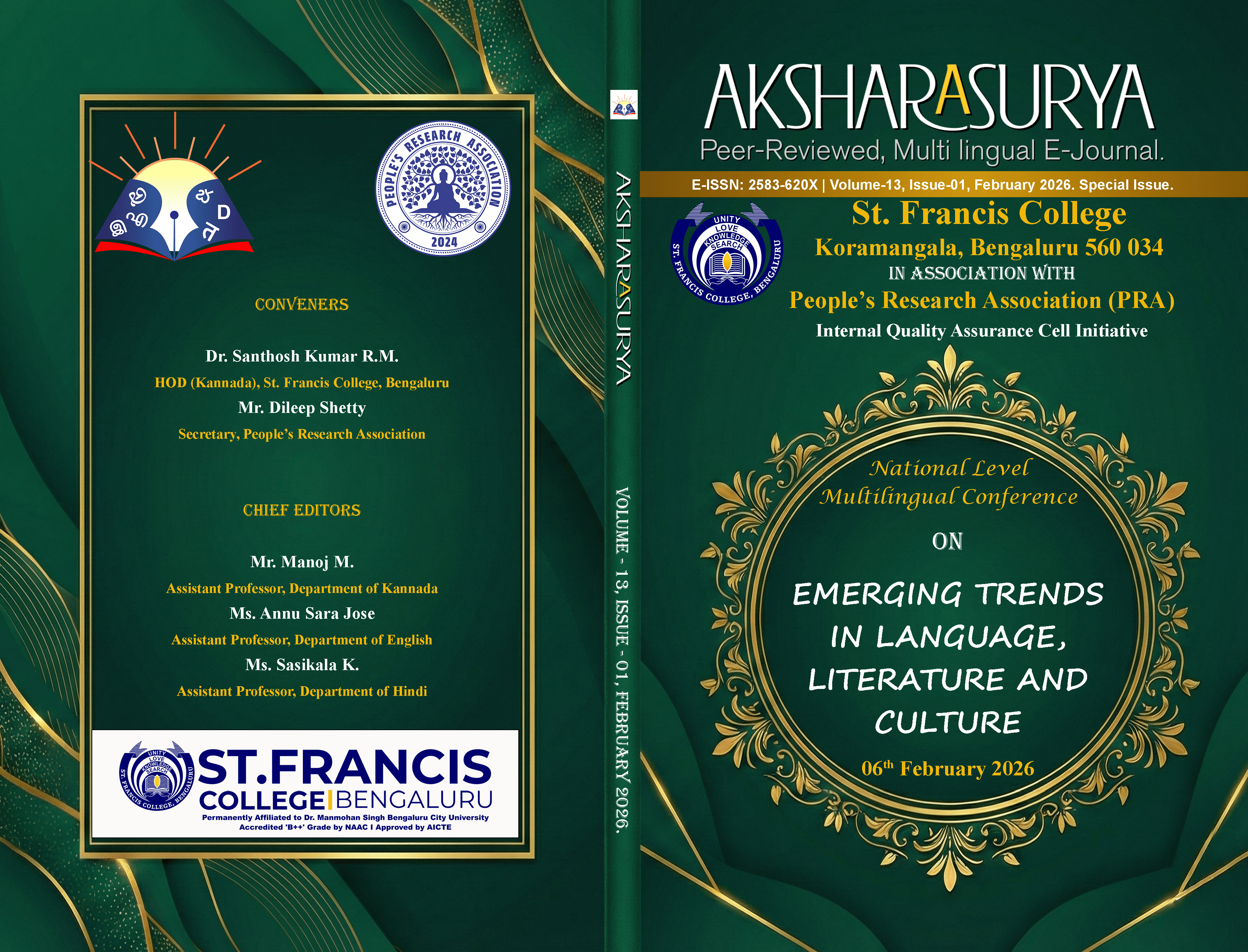
Main Article Content
Abstract
Mahesh Dattani stands as one of the most significant voices in contemporary Indian English drama, particularly for his bold engagement with marginalized identities and socially silenced issues. Among the most persistent concerns in his dramatic oeuvre is gender - its construction, performance, and the systemic inequalities it produces. This research paper examines gender perspectives in two of Dattani’s most critically acclaimed plays, Tara (1990) and Dance Like a Man (1989). Through a close textual and thematic analysis, the study explores how patriarchal norms shape individual identities, familial relationships, and social expectations, often resulting in psychological trauma and emotional alienation.
Tara foregrounds gender discrimination within the family structure, revealing how female children are systematically devalued even by women themselves. The play exposes the internalization of patriarchy and critiques the cultural preference for male heirs through the tragic fate of the female protagonist. In contrast, Dance Like a Man interrogates gender roles by challenging traditional notions of masculinity and femininity, particularly through the lens of classical dance - a space culturally marked as feminine. The male protagonist’s struggle to assert his identity as a dancer highlights the rigid boundaries imposed by hegemonic masculinity.
By situating these plays within feminist and gender theory, this paper argues that Dattani does not merely depict gender inequality but actively destabilizes normative gender binaries. His characters resist, negotiate, and sometimes succumb to social prescriptions, making gender a dynamic and contested site. Ultimately, the study demonstrates that Dattani’s drama functions as a powerful critique of patriarchal ideology in Indian society while advocating for individual freedom and gender inclusivity.
Article Details
Section

This work is licensed under a Creative Commons Attribution-NonCommercial-ShareAlike 4.0 International License.
How to Cite
References
Beauvoir, S. de. (2011). The second sex (C. Borde & S. Malovany-Chevallier, Trans.). Vintage. (Original work published 1949)
Bhasin, K. (2006). What is patriarchy? Kali for Women.
Bose, B. (2000). Gender and modernity in Indian English drama. Theatre India, 7(2), 45–58.
Butler, J. (1990). Gender trouble: Feminism and the subversion of identity. Routledge.
Butler, J. (2004). Undoing gender. Routledge.
Chakraborty, S. (2012). Body politics and gender bias in Mahesh Dattani’s Tara. Indian Journal of Gender Studies, 19(3), 421–435.
Chaudhuri, A. (2014). Performing gender: Masculinity in Indian theatre. Journal of South Asian Studies, 30(1), 67–82.
Connell, R. W. (1995). Masculinities. University of California Press.
Dattani, M. (2000). Collected plays (Vol. 1). Penguin Books India.
Dattani, M. (2005). Collected plays (Vol. 2). Penguin Books India.
Dharwadker, A. (2005). Theatres of independence: Drama, theory, and urban performance in India since 1947. University of Iowa Press.
Gandhi, L. (1998). Postcolonial theory: A critical introduction. Allen & Unwin.
Gokhale, S. (2010). Gender conflict and identity crisis in Mahesh Dattani’s plays. Indian Literature, 54(6), 98–110.
Kothari, R. (2011). Family, gender, and ideology in modern Indian drama. Theatre Research International, 36(2), 155–168.
Loomba, A. (2015). Colonialism/postcolonialism (3rd ed.). Routledge.
Mukherjee, T. (2006). Staging resistance: Gender politics in contemporary Indian theatre. Modern Drama, 49(3), 376–392.
Nayar, P. K. (2011). Contemporary literary and cultural theory: From structuralism to ecocriticism. Pearson.
Patel, V. (2003). Gender, family, and social change in India. Economic and Political Weekly, 38(42), 4460–4466.
Ramakrishna, N. (2014). Negotiating masculinity in Dance Like a Man. Journal of Commonwealth Literature, 49(2), 241–256.
Trivedi, M. (2003). Gender and identity in Mahesh Dattani’s plays. Indian Literature, 47(4), 123–132.
Walby, S. (1990). Theorizing patriarchy. Basil Blackwell.
Williams, R. (1977). Marxism and literature. Oxford University Press.
Worthen, W. B. (2003). Modern drama and the rhetoric of theater. University of California Press.
Zarrilli, P. B. (2000). Kathakali dance-drama: Where gods and demons come to play. Routledge.