
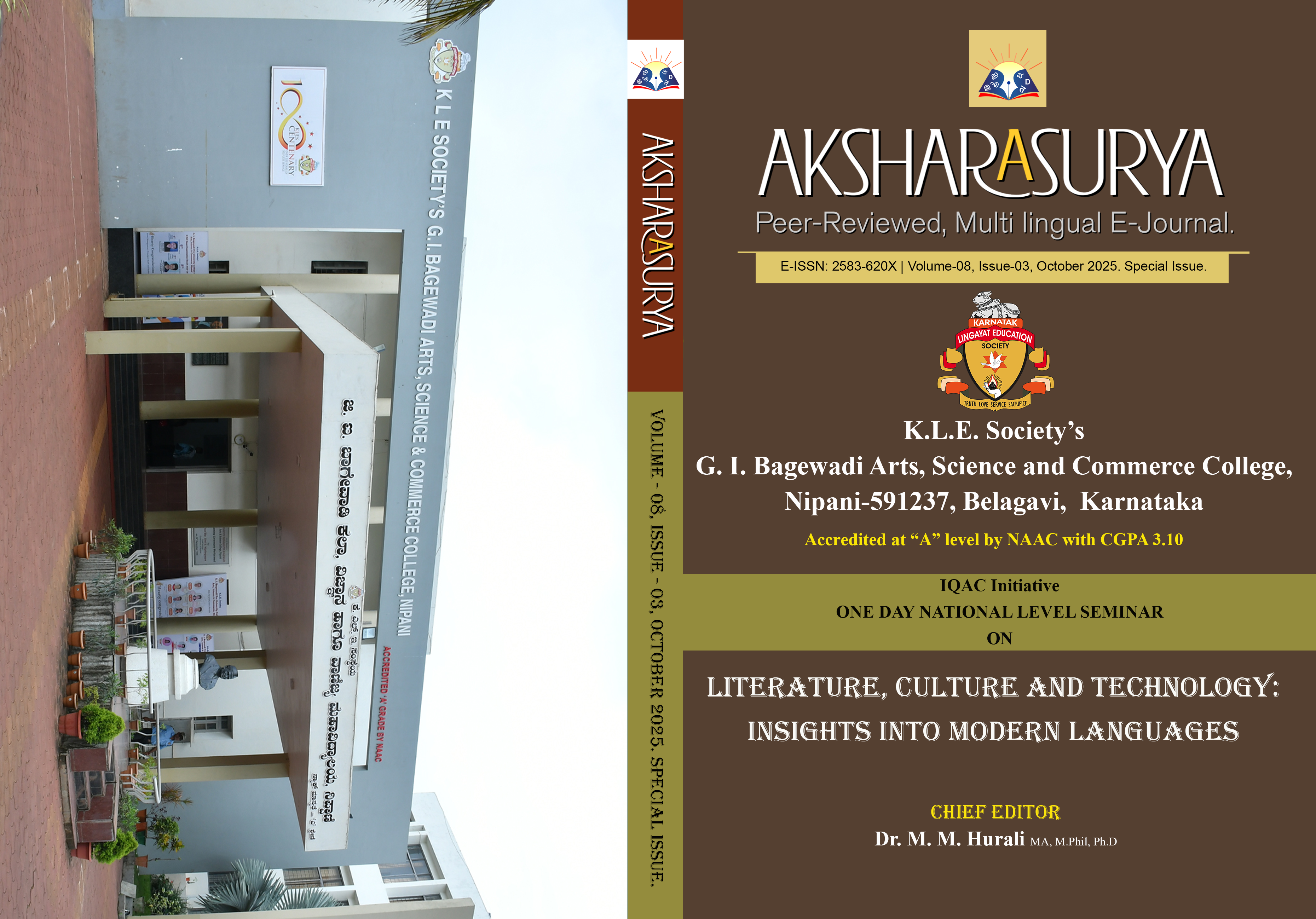
Published: 2025-10-12
Table of Contents
Research Articles
The Anthropocene and After: Eco-Criticism, Climate Change, and the Literary Imagination
01 to 10
This paper examines the intersections of eco-criticism, climate change discourse, and the literary imagination within the conceptual frame of the Anthropocene and its possible aftermath. The study investigates how literature functions not merely as a reflection of ecological crisis but as an active site of resistance, speculation, and ethical reorientation in an era defined by environmental precarity. It explores the ways in which narratives across genres—novels, poetry, and digital eco-texts—articulate both the vulnerabilities of the planet and the possibilities of sustainable futures. The methodology combines close textual analysis with eco-critical theory to interrogate how literary texts reshape human engagement with nature in the context of climate change. Through interpretive readings, the paper traces recurring motifs of ecological loss, resilience, and posthuman coexistence, showing how the Anthropocene becomes not only a geological epoch but also a cultural imagination that literature consistently mediates.
The study argues that literary narratives do more than mourn environmental collapse; they rehearse new forms of ecological consciousness that transcend human-centered perspectives. By situating literature at the heart of climate debates, the paper demonstrates how the imaginative power of storytelling provides critical frameworks for negotiating the Anthropocene and envisioning futures beyond it.
Marginalization and Social Exclusion: A Critical Analysis of Arundhati Roy’s Works
11 to 17
This research article critically examines Arundhati Roy’s non-fiction writings, particularly The Broken Republic (2011), The Algebra of Infinite Justice (2002), and Listening to Grasshoppers (2009), in order to analyze her engagement with marginalization and social exclusion in contemporary India. Roy exposes the contradictions of India’s neoliberal development model, interrogating the displacement of Dalits, Adivasis, women, and other vulnerable groups. Her works critique caste-based discrimination, the exploitation of tribal communities by multinational corporations, the state’s militarized responses to Maoist resistance, and the silencing of subaltern voices. Drawing on postcolonial theory and subaltern studies (Spivak; Said), as well as Dalit and Ambedkarite discourse, this study situates Roy within a larger intellectual tradition that foregrounds questions of justice, democracy, and resistance. By blending reportage, polemics, and literary craft, Roy crafts a counter-narrative that challenges dominant state and media discourses. This article argues that while Roy’s writings are sometimes criticized for rhetorical excess, they remain vital for understanding the ongoing struggles of marginalized communities in India and for rethinking the possibilities of inclusive democracy.
Artificial Intelligence in Literature, Culture, and Technology: Insights into Modern Language
18 to 23
Artificial Intelligence (AI) has become one of the most transformative forces in the 21st century, influencing multiple spheres including literature, culture, and technology. Its integration with modern language studies has not only reshaped how literature is produced, analyzed, and preserved, but has also broadened cultural narratives and redefined the way societies interact with knowledge. In literature, AI assists in text generation, translation, plagiarism detection, and literary analysis, offering new methodologies for students and scholars. In cultural contexts, AI fosters inclusivity by preserving endangered languages, digitizing manuscripts, and enabling cross-cultural dialogue through real-time translation. In technology, AI enhances human–computer interaction, content creation, and critical discourse, making it a vital tool for modern academic learning. For degree students, understanding the applications of AI in language-related domains is crucial, as it provides both critical insights and practical tools for research, creativity, and professional growth. This paper explores the intersections of AI with literature, culture, and technology while providing an academic lens into modern language use. Through charts, tables, and critical examples, it highlights AI’s role in shaping the intellectual landscape and provides degree students with a framework to critically engage with AI-driven advancements in the humanities and beyond.
Influence of Social Media on Literature
24 to 30
The rise of social media has reshaped literature by transforming how it is created, shared, and read. Platforms such as Facebook, Instagram, Twitter, and blogs have enabled writers to connect directly with audiences, through traditional publishing channels. This has democratized literary expression, allowing voices from diverse backgrounds to be heard and encouraging experimentation with form and content. Short-form writing, multimedia storytelling, and interactive narratives have gained popularity, expanding literary genres and styles. Social media communities foster collaboration, critique, and fanfiction, nurturing new creative ecosystems. However, the influence of algorithms, the pressure for instant visibility, and concerns around plagiarism creates challenges to the literary experience. Further viral popularity sometimes prioritizes entertainment over depth and critical engagement. Despite these drawbacks, social media has broadened access to literature, empowered marginalized voices, and enabled global conversations about identity, culture, and social justice. This article explores the various ways social media has impacted literary creation, distribution, and consumption. It examines both opportunities and threats, providing a understanding of how digital platforms are redefining literature in the 21st century, where authorship, readership, and interaction are constantly evolving in the age of connectivity.
Intersections of Caste and Gender in Indian English Writing: A Dalit Feminist Perspective
31 to 39
The study examines how Indian English literature reflects the lived realities of Dalit women, whose experiences are shaped by the combined forces of caste and gender oppression. In India, caste hierarchies and patriarchal structures deeply influence social relations, often marginalizing Dalit women doubly—first as members of oppressed castes and then as women within both their communities and the larger society. This research explores how Dalit feminist writers use literature not only as a space for storytelling but also as a powerful tool of resistance, identity assertion, and social transformation.
Focusing on P. Sivakami’s landmark novel The Grip of Change, the paper analyzes how Dalit feminist narratives confront entrenched systems of caste violence, patriarchal authority, and economic marginalization. Sivakami’s choice to self-translate her Tamil novel into English highlights the deliberate attempt to extend Dalit voices to a global readership and challenge dominant literary discourses that have historically excluded marginalized communities.
The study situates Dalit feminism as distinct from mainstream Indian feminism, arguing that upper-caste feminist discourse often overlooks the intersection of caste with gender, thereby silencing Dalit women’s narratives. By adopting a Dalit feminist theoretical lens, the research emphasizes the importance of intersectionality, representation, and authenticity in literary studies.
Cultural Hybridity and Displacement: A Postcolonial Reading of Diaspora Writings
40 to 46
Diaspora literature reflects the lives of people who have moved away from their homeland and are living in new countries. These writings explore the struggles, hopes, and identities of migrants, showing how they face cultural differences and feelings of belonging or not belonging. This paper focuses on two important ideas in diaspora writing: cultural hybridity and displacement. Cultural hybridity refers to how migrants create a mixed identity by combining elements of both their homeland and adopted culture.
Displacement shows their emotional and physical struggles as they live far from their roots. Postcolonial theory helps us understand these themes because it studies how migration, colonial history, and globalization affect identity. Diaspora authors like Salman Rushdie, Jhumpa Lahiri, and Bharati Mukherjee often write about the challenges of adjusting to a new land while maintaining connections with their heritage. Their works also highlight discrimination, nostalgia, and the search for self-identity. This study aims to show that diaspora literature is not only about loss but also about creativity, as migrants build new spaces for themselves. The paper argues that cultural hybridity gives strength, and displacement brings new perspectives, making diaspora literature an important part of postcolonial studies.
The Viral Muse: How Social Media Inspires a New Generation of Writers
47 to 55
In today’s digital world, social media has become a new platform to change for literary creativity, which completely changes how writers make parts and join. Social Media such as X, Instagram, Wattpad, Facebook, WordPress, Tumbler, YouTube, Pintrest and others have defined what is the importance of being a writer by giving writers to the global audience and immediate response. This new access levels not only the new platform for authors, but also encourages new forms of expression, such as micro-fiction, digital poetry and interactive storytelling. In this way, social media has become “viral muse”, which forms a new wave of writers who continue the boundaries of literature in the digital age. When seen as a trend, it should now be one for writers.
Social Reflection in Indian English Literature
56 to 62
Social reflection in Indian English literature explores how authors use literary works to examine societal issues such as caste, class, gender, religion, and political complexities, providing insights into India’s cultural and social fabric. The literature functions as a mirror, reflecting social realities, inequalities, and transformations while also acting as a catalyst for social change by challenging injustices and fostering progressive ideas. Through narratives, writers highlight the struggles of marginalized communities and comment on the evolution of national identity in a diverse and changing society, from colonial times to the post-colonial and contemporary eras My paper will focus on Indian English writing following are the topics such as English Literature as an image of the society, Trio of Indian English Literature and Post colonial and contemporary period of Indian English writers.
Diaspora Literature and Modernity
63 to 70
The term diaspora comes from an ancient Greek word meaning “to scatter about.” And that’s exactly what the people of a diaspora do they scatter from their homeland to places across the globe, spreading their culture as they go. The Bible refers to the Diaspora of Jews exiled from Israel by the Babyloniansor spread of any people from their original homeland in search of work, they were inclined to shift to some other place for the survival and livelihood. Diasporic Literature is written by the authors who lived outside their native land. Diasporic Literature is all about the Quest for Identity, Hybridization, Rootlessness and Nostalgia. Diaspora writers turn to their native land for many reasons. Diasporic Literature plays a vital role as it deals with the complexities of culture, roots and making adjustments with the other civilization.
According to Homi Bhabha Diaspora is, “Gathering of exile, immigrants and refugees in foreign culture and foreign land. Gathering of the past in ritual and revivals and that gathering in the present.”
The Intersection of Social Media and Contemporary Literature
71 to 78
This seminar explores the dynamic interplay between literature, culture, and technology, focusing specifically on the transformative impact of social media on modern literary forms within contemporary languages. In an era where digital platforms shape human communication and cultural exchange, social media has emerged as a powerful force redefining literary creation, dissemination, and engagement. The presentation examines how social media fosters innovative literary forms such as micro-fiction and digital poetry, democratizes access to literature by enabling diverse voices, and creates interactive communities of readers and writers worldwide. Simultaneously, it addresses challenges including the potential erosion of language quality, superficial literary engagement, and the influence of algorithm-driven content visibility. Through case studies and critical analysis, the seminar illuminates the multifaceted role social media plays as both a literary platform and cultural space. Ultimately, it highlights the necessity of balancing technological innovation with the preservation of literary depth and quality, underscoring the evolving nature of literature in the digital age.
Challenges of Translating Indigenous Proverbs, Idioms and Metaphors into English Language
79 to 87
India is a multilingual country, where all the regional languages exist simultaneously. It is the home of people speaking 22 recognised languages, hundreds of mother tongues and dialects. But the dominance of English continued over the years, English became the only means of communication. In political, economical, cultural and educational affairs, therefore it becomes essential to understand English and our mother tongues to connect to our communities. In Indian context the role of translation is very significant. It is through translation that we can communicate with one another. Indian languages have rich treasure of indigenous idioms, metaphors and proverbs. Translating these into English presents multifaceted challenges and these challenges are rooted in the interplay of cultural, social, linguistic worldview. Indian indigenous expressions are drawn from different languages like Hindi, Marathi, Kannada, Tamil, Bengali etc, as well as tribal tongues such as Santali, Gondi, Bhill, kolamikoraga, soliga etc.
Caste, Class, and Gender: Social Reflections in the Works of Mulk Raj Anand and R.K. Narayan
88 to 95
Indian English literature has long functioned as both a mirror to and critique of India’s complex socio-cultural fabric. Among its foundational voices, Mulk Raj Anand and R.K. Narayan offer distinct yet complementary portrayals of Indian society. This paper examines how issues of caste, class, and gender are reflected in their major works. Anand, influenced by Gandhian and Marxist ideologies, adopts a reformist and confrontational tone, foregrounding the struggles of the marginalized in novels such as Untouchable (1935) and Coolie (1936). His writing directly challenges social hierarchies and exposes systemic injustices related to caste discrimination, economic exploitation, and gender-based oppression. In contrast, Narayan’s narrative style is more subtle and introspective. Through works like The Guide (1958), The Painter of Signs (1976), and The Financial Expert (1952), he explores middle-class life in the fictional town of Malgudi, highlighting the nuances of human relationships, social expectations, and personal dilemmas within traditional structures.
By comparing Anand’s activist literature with Narayan’s humanistic realism, this study demonstrates how both authors contribute to the discourse on social inequality. The paper underscores literature’s dual role as a catalyst for reform and as a reflective medium capturing the complexities of everyday life in Indian society.
Digital Dimensions: Reimagining Language and Literature in the Age of Technology
96 to 103
The emergence of digital technologies has profoundly transformed the way humans communicate, learn, and create. Language and literature, traditionally bound to oral traditions and printed texts, are increasingly influenced by digital tools, platforms, and artificial intelligence. This paper examines how technology reshapes language learning, literary creation, and scholarly research. It highlights opportunities such as global access, interactive storytelling, and preservation of cultural heritage, while also addressing challenges like over-reliance on automated tools and superficial engagement with texts. By considering both practical applications and theoretical implications, this study argues that technology does not replace traditional methods but instead expands the possibilities for experiencing, analyzing, and sharing language and literature in contemporary society.
Poverty and Class Struggle in the Works of Arundhati Roy and Mahasweta Devi
104 to 112
Poverty and class struggle have been persistent concerns in Indian society, shaped by historical, social, and political factors. Indian literature, both in English and in translated regional languages, has served as a lens to examine these inequalities. Among contemporary writers, Arundhati Roy and Mahasweta Devi stand out for their deep engagement with issues of economic deprivation, social marginalization, and systemic oppression. Roy’s The God of Small Things (1997) explores poverty, caste discrimination, and gender oppression in Kerala, highlighting how social hierarchies and economic inequality affect the personal and psychological lives of her characters. Devi’s works, such as Chotti Munda and His Arrow (1990) and Draupadi (1989), depict the struggles of tribal and rural communities, foregrounding systemic exploitation, labor oppression, and gendered marginalization.
This paper examines how poverty and class struggle are represented in the works of Roy and Devi, focusing on their narrative techniques, thematic concerns, and socio-political commentary. Through a comparative analysis, the study demonstrates how these writers illuminate the multi-layered dimensions of poverty, revealing the intersections of class, caste, gender, and political marginalization, while asserting literature’s role as a vehicle for social awareness and ethical reflection.
The Digital Renaissance: The Impact of Social Media on Literature
113 to 119
The digital age has ushered in a seismic transformation in communication, culture, and creativity. Social media, in particular, has reshaped how information circulates and how communities engage with texts. Literature, traditionally mediated by publishers, critics, and academic institutions, now finds itself situated within a dynamic, participatory ecosystem. Platforms such as Instagram, TikTok, and X (formerly Twitter) not only allow new narrative forms to emerge but also blur distinctions between writer and reader, art and commodity, canon and popular culture (Murdock). These transformations raise vital questions: What becomes of literature in an age of shortened attention spans? How do democratization and visibility affect authorship? Does literature gain resilience or lose depth in its encounter with social media? This paper argues that social media represents not the decline but the *renaissance* of literature, as it expands the modes of creativity, alters the mechanisms of circulation, and redefines the experience of readership. At the same time, this renaissance is not without limits. Issues of algorithmic bias, market-driven authorship, and diminishing attention spans complicate the potential of digital literature. By examining shifts in literary forms, transitions in author-reader relationships, and critical challenges, this paper situates social media as both an enabler and disruptor of twenty-first-century literary culture.
The Impact of Digital Card games in English Grammar for Secondary School Students
120 to 127
Digital card games offer an engaging, effective, and interactive approach to learning English grammar by integrating game-based learning principles into vocabulary and grammar practice for learners, particularly ESL students, through platforms that allow for self-designed cards, puzzle completion, and collaborative card exchanges to foster motivation and improve grammar mastery. By transforming grammar learning into a game, these systems can boost student motivation and make the learning process more enjoyable, especially for those who find traditional methods challenging. Games like “Worchitect” are specifically designed to focus on parts of speech and other grammar rules, allowing learners to deductively attain and reinforce their understanding. Digital card games can improve secondary students’ English grammar by providing a contextualized, motivating, and engaging learning environment that reduces anxiety and encourages practice. Through repetition, feedback, and interactive elements, these games foster intrinsic motivation and allow students to apply grammar rules in meaningful contexts, ultimately enhancing their interest and overall language proficiency. Digital card games, by their nature, are engaging and can significantly boost student interest and motivation in learning English grammar. Games provide a practical context for applying grammar rules, making the learning process more relevant and useful for students. Games require students to use grammar components to advance, making the lear
Study of Intervention of English Sounds in Phonetics of Marathi: Emergence of ‘Anglicized’ Marathi Language
128 to 136
The present paper is an attempt to analyze what was the recurrent requirement to modify the phonetic sound system in Marathi language generally and adding two English vowel sounds; /æ/ & /ɔ/ particularly. Is this an unavoidability of translation theory? Or is it making of ‘Anglicized’ Marathi? Marathi speakers have to ponder it on with an interest in this phenomenon. This is definitely not a common lingual event if two English vowel sounds have been added to the Marathi language which is almost 2500 years old Indo – Aryan Language. Undoubtly, English is comparatively a new language in respect of age to Marathi. On account of simplifying the entry to loan words from English to Marathi English sounds are added /æ/ (as in “act” or “cat”) and /ɔ/ (as in “all” or “thought”). These are represented in the Devanagari script as ॲ and ऑ, respectively, expanding the traditional set of 12 vowels to 14. Nowadays, two binary approaches are being discussed; Marathi language will have its advantage and on the other hand it’s a threat for Marathi.
Literature in English and Cultural Studies: An Analytical Study.
137 to 143
The study of English literature has traditionally been associated with aesthetic appreciation, canonical texts, and universal human values. However, the rise of Cultural Studies in the mid-twentieth century has profoundly reshaped the way literature is read and understood. Cultural Studies emphasizes the interconnection between literature, ideology, identity, and power, thereby broadening the field of literary criticism beyond the confines of canonical or high culture. This paper examines how English literature interacts with Cultural Studies, arguing that the integration of these fields enriches our understanding of literature as both a cultural product and an active agent in shaping society. By exploring the works of theorists such as Raymond Williams, Stuart Hall, Edward Said, Gayatri Spivak, and Homi Bhabha, and by engaging with examples from canonical, postcolonial, and contemporary literature, the paper demonstrates how English literature functions as a site of contestation where cultural values, identities, and ideologies are negotiated. The discussion highlights themes such as identity, representation, power, globalization, and interdisciplinarity, ultimately suggesting that the convergence of Literature in English and Cultural Studies democratizes literary analysis and makes it more relevant to contemporary cultural realities.
Science and Technology in James Graham Ballard’s Crash
144 to 149
J. G. Ballard’s Crash (1973) is one of the most controversial novels of the twentieth century. Instead of imagining future worlds filled with spaceships or robots, Ballard focuses on something very ordinary: the car. But in Crash, cars are not simply machines for travel. They become connected to people’s deepest desires, fears, and fantasies. The present paper studies how science and technology, especially the car and the culture around it, play a central role in the novel. It focuses three main points: (1) how the car becomes an object of sexuality and obsession, (2) how scientific and medical language changes the way we see accidents and the body, and (3) how the book is a warning about the strange relationship between modern technology, media, and human psychology.
The Importance of Technology in English Language and Literature
150 to 158
Technology has become a central force in reshaping the study of English language and literature. In earlier times, teaching and learning English relied mainly on printed books, face-to-face classroom lectures, and handwritten notes. Today, the presence of digital platforms, online libraries, e-learning tools, and multimedia resources has changed this traditional model. Technology supports learners in developing communication skills, provides access to global literature, and helps teachers adopt new and interactive teaching methods. At the same time, researchers benefit from digital databases, text-mining software, and virtual archives that simplify academic work. Literature itself has expanded beyond the printed page, giving rise to e-poetry, hypertext fiction, blogs, and audiobooks, which show the creative potential of technology in modern culture. Furthermore, digitization preserves old manuscripts and translation tools enable cross-cultural sharing of literary texts. However, technology also presents challenges such as distraction, plagiarism, reduced critical reading, and unequal access among students. This paper discusses the advantages and disadvantages of technology in English studies, highlighting how a balanced approach can make technology a valuable partner without overshadowing traditional reading and critical thinking. Ultimately, technology enriches both language learning and literature by making them more accessible, interactive, and globally relevant.
The Failure of Social Idealism and the Quest for Identity in Vijay Tendulkar’s Kanyadaan
159 to 165
Vijay Tendulkar’s Kanyadaan is powerful social play that uncovers the clash between idealistic beliefs and harsh social realities. This paper explores the failure of social idealism and the quest for identity as portrayed through the complex relationships among Nath Devalikar, his daughter Jyoti Devalikar, and her Dalit husband Arun Athavale. Tendulkar presents Nath’s liberal humanist ideals as noble yet naive when confronted with the deep-rooted caste and gender a social stratum of Indian society. Jyoti’s struggle to assert her identity between her father’s idealism and her husband’s aggression becomes a symbol of modern India’s moral and social conflict. The study critically examines how Kanyadaan questions the limits of reformist thought and reveals the painful realities behind the façade of progressive ideology. The paper argues that Kanyadaan not only mirrors social realities but also reveals that women whether from higher or lower social classes remain victims of domination and are confined within the boundaries of tradition and gendered norms. Ultimately, the paper studies that Tendulkar dismantles the illusion of idealism by showing how social change remains incomplete without true liberation of women and the recognition of individual identity beyond caste and patriarchy.
Kanyadaan is a Sanskrit term for a Hindu wedding ritual in which the bride’s parents give her away to the groom, symbolizing responsibility and care. Culturally, it is viewed as offering one’s Kanya (daughter or maiden) as a Daan (gift or donation) to the groom.
The Interaction of Artificial Intelligence In Languages: Traditional Learning Practices
166 to 175
The interaction of Artificial Intelligence (AI) in languages has the potential to revolutionize traditional learning practices, face to several challenges such as resource optimization, communication skills, and sustainability. This research paper explores the important role of AI in languages, focusing on its application in grammar improvement, effective report creations, predictiveanalytics, and autonomous tools. The development of technology increases interest in self-learning, AI-driven technologies offer solutions to enhance learning, reduce time, and minimize resources impact. The study examines AI tools such as machine learning algorithms, computer vision, and robotics, which aid in character recognition, grammar errors, and simplification in languages conversation. Furthermore, the paper highlights these technologies use machine learning and natural language processing to adapt to individual learners, improve efficiency, and make language acquisition more accessible. While the integration of AI shows positive impacts on proficiency and engagement, it’s essential to consider challenges like data privacy and maintaining human interaction in learning. The use of AI in predictive modeling for subject patterns, enhance engagement, and improve proficiency, helping users make creations of reports through writing assistance, chatbots, voice recognition technology. Through a critical analysis of case studies and empirical data, this research underscores how AI not only enhances efficiency but also contributes to sustainable language improvement by reducing dependency on finding errors, it is helpful for cognition and personality development.The paper concludes by discussing the limitations of AI adoption, particularly language improvement, and suggests recommendations for overcoming these challenges to unlock the full potential of AI in languages learning and improvement.
The Gandhian Political Influence in Kanthapura: A Study by Raja Rao.
176 to 184
The research paper Kanthapura by Raja Rao is a novel that portrays the transformation of a small Indian village during the struggle for independence. Set against the backdrop of India’s freedom movement, the story follows the awakening of the villagers to the principles of non-violence and civil disobedience, as inspired by Mahatma Gandhi. This study explores how Kanthapura presents a story of resistance, unity, and self-empowerment, making it a timeless reflection of the Indian independence movement. The narrative is driven by the voice of the village storyteller, who recounts the impact of the national movement on the local community. Through its portrayal of the lives of both men and women in the village, Kanthapura examines the complexities of caste, gender, and social roles in the context of a national struggle for freedom. The novel’s blend of myth, spirituality, and politics reflects the deep connection between individual and collective identity. As the villager’s experience both unity and division, the story of their transformation becomes a poignant exploration of how a community evolves in the face of political and social upheaval.
Sujata Parashar’s in Pursuit of Ecstasy: A study in Changing Paradigm of Youths
185 to 192
Sujata Parashar is a budding Indian writer in English. She is an award winning Indian writer. Romance, thrill, revenge, suspense, family relationships, social problems, extra marital affairs are the major themes of the Sujata Parashar’s novels. The present novel depicts the changing paradigms of youth. Youth are the pillars of our nation. They are our future. But nowadays youths lifestyle changes such as dressing sense, food, alcoholism, drug usage, partying at night, affairs etc. Young generation speaks lie in freely and they don’t hesitate taking drugs and alcohols. It declines the value of like truth, simplicity, honesty, loyalty replaced by lie,lust, anger, jealousy. The present novel In Pursuit of Ecstasy is a youthful and engaging story of full of sparkling insights on the lives of urban teenagers today. Aparajita, Deepanita. Aniket and Siddharth have much more in common than being just college mates. All of them either lie or hide things from their parents and want total freedom to follow their dreams. However destiny has other plans for the four youngsters. They encounter drug peddlers who intend to use them as pawns for safely supplying drugs. Their journey from here on makes them question their values, beliefs and desires.
Social Reflections in Indian English literature
193 to 199
The analysis examines how gender intersects with caste, class, and the effects of globalization in shaping women’s identities and experiences in these. Through the exploration of works by prominent Indian authors such as Arundhati Roy, Kiran Desai, Chitra Banerjee Divakaruni, Jhumpa Lahiri, and others, this article highlights the complexities of women’s roles in both traditional and modern contexts. While contemporary Indian literature has increasingly foregrounded feminist themes, the depiction of female agency remains often constrained by patriarchal and societal expectations. The article argues that the representation of women in these novels reflects the ongoing negotiation between tradition and modernity, with female characters asserting their agency, questioning cultural norms, and resisting oppressive structures.
Impact of Social Media on Literature
200 to 208
Social media has become the powerful influence on literature, reshaping how literature works are created, consumed, and shared. Social media has also transformed the world of literature, affecting everything from language and writing styles to reading culture and the structure of literary communities. Literature is one of society’s broad and significant elements because it shows how people interact and socialize. The objective of literature is education and entertainment through songs, poems, stories, and drama. However, a challenge that limits production and access to literary content is media. Traditionally, media used to convey literature material, such as books, television, radio, and theatres were limited to people who could afford or access venues. This article explores the profound ways in which platforms like Facebook, Instagram &Twitter have impacted reading habits, literary production, and cultural context of literature in the digital age and multifaceted impact of digital platforms, analyzing both the positive democratizing effects and challenges now faced by readers, writers, and publishing industry. Digital networks offer authors both emerging and established the opportunity to share their creations, receive instant feedback, and cultivate vibrant readerships with global reach. Tools for self-publishing, online anthologies, and virtual poetry groups encourage creative experimentation and collaboration, making literature more accessible and interactive. Despite the benefits, social media has prompted concerns about literary quality and reading habits. Fragmented attention and shifts toward abbreviated or informal language may diminish deep comprehension and critical analysis within literature. The pursuit of likes, shares, and viral moments can prioritize clever, superficial content over meaningful literary work.
Indian Diasporic Literature and Modernity
209 to 215
Modern Indian literature has evolved in close interaction with migration, cultural exchange, and global modernity. Sandeep Pathak and R. K. Dhawan’s edited volume, Modern Indian Literature: Diaspora, Travel and Culture (2020), highlights the centrality of the diaspora in shaping contemporary Indian literary sensibilities. Diasporic writers such as Salman Rushdie, Jhumpa Lahiri, Kiran Desai, Vikram Seth, Bharati Mukherjee, Amitav Ghosh, Meena Alexander, and Chitra Banerjee Divakaruni explore themes of identity, hybridity, nostalgia, language, and globalization, situating their works within transnational spaces. These authors not only articulate the complexities of life between multiple geographies but also redefine Indian literature as culturally diverse, globally aware, and inherently modern This paper examines how diasporic narratives function as a lens to understand modern Indian consciousness, exploring how migration, memory, language, and cultural negotiation collectively shape literary modernity.
Literature in Digital Age and The Effect of Social Media
216 to 223
Literature is one of society’s broad and important elements because it shows how people interact and socialize. However Media has also influenced the globalization of literature by enabling access to literary works across countries and cultures. Media development has supported advancement in literature.
The advent has profoundly transformed the literary landscape, influencing not only how literature is created and consumed but also how it is shared and interpreted. Platforms such as Twitter and have given raise to new literary forms like micro fiction, Instagram poetry, and interactive storytelling. Writers now engage directly with audiences receive real-time feedback and use digital spaces for self-promotion and community-building Social media has democratized literary production by lowering barriers to entry enabling emerging voices to gain recognition without traditional publishing routes. Viral trends on platforms like Book Tok have also revitalized public interest in reading, particularly among younger audiences. At the same time, social media’s fast-paced and trend-driven environment has influenced the style and content of literature, favoring brevity, conversational tone, and contemporary digital themes however this shift also raises concerns about literary depth originality and the commercialization of creativity. Despite these challenges, social media continues to reshape literature as a dynamic participatory and evolving form of cultural expression this paper explores the dual impact of social media on literature it’s role as both a tool of empowerment and a force of disruption in the modern literary ecosystem.
Narrating the Unthinkable: Ecocritical Perspectives on Amitav Ghosh’s The Hungry Tide and The Great Derangement
224 to 231
Amitav Ghosh’s work has become central to contemporary ecocritical discourse, pairing imaginative narrative with cultural diagnosis. This paper performs a comparative ecocritical reading of The Hungry Tide (2004) and The Great Derangement (2016). In The Hungry Tide, Ghosh stages the tensions of inhabiting a fragile tidal landscape through multiple voices and local ecologies; in The Great Derangement, he theorizes literature’s failure to render climate change and urges aesthetic reform. Together, these works chart a poetics of ecological responsibility one attentive to scale, historicity, and multiplicity. The paper engages narrative form, ethics, politics, and epistemology to show how Ghosh’s project challenges anthropocentrism and calls for more expansive narrative imagination.
Influence of Social Media on Kannada and English Literature Students
232 to 239
In the present study was conducted to examine the influence of social media on Kannada and English literature students. In recent decade’s social media is very popular in Indian population especially in youths. Social media it refers to online platforms where the users can share and chat more information and connect with virtually to others through text message, video messages, photos, images and other content. It includes many types of apps or websites formed for messaging and chat, social platforms like WhatsApp, Facebook, Instagram, and TikTok etc. finally this study measure influence of social media on Kannada and English literature students. The sample for the study consisted of 50 Kannada and English literature students (25 Kannada literature students and 25 English literature students), aging between 22-25 years. The participants completed the Bergen social media addiction scale (BSMAS) developed by Andreassen et al. (2016). The obtained data was analyzed by using mean, SD and ‘t’- test. Further, Spearman’s coefficient of correlation was applied. The result of the study concluded that there is no significant difference between influence of social media on Kannada and English literature students. Also, there is no significant relationship between Kannada and English postgraduate literature students
Eco- Criticism in Saint Tukaram and William Wordsworth Poetry: A Comparative Study
240 to 248
This paper explores the ecocritical perspectives in the poetry of Saint Tukaram and William Wordsworth, examining how both poets represent nature and its relationship with human life. Ecocriticism studies the connection between literature and the environment, emphasizing how literary works reflect ecological awareness and respect for nature. Saint Tukaram a 17th-century Marathi saint-poet presents nature as a divine creation, using simple, rural imagery in his abhangas to teach devotion, harmony, and equality. William Wordsworth, a leading English Romantic poet, portrays nature as a teacher, source of joy, and spiritual guide, emphasizing personal reflection, emotional growth, and moral insight. A comparative study reveals that while Tukaram’s poetry emphasizes devotional reverence and ethical living in harmony with nature, Wordsworth highlights the inspirational, restorative, and educational aspects of the natural world. Both poets, however, underline the sacredness and intrinsic value of nature, showing that humans are deeply connected to the environment. This study demonstrates how ecocritical reading enriches our understanding of literary engagement with nature across cultures and periods.
Silence as a Form of Resistance: The Feminine in Banu Mushtaqʼs short story collection Heart Lamp
249 to 255
Banu Mushtaq’s Heart Lamp, a collection of short stories translated from Kannada by Deepa Bhasti, presents a profound investigation of Muslim women’s lives in Karnataka, India. Heart Lamp is a translated work; it also belongs to the field of literature and translation studies. Translation allows these stories, rooted in local culture and idioms, to reach a broader audience, while also raising questions of voice, representation, and cultural transmission. Within translation studies, translated texts are not only reproductions but recreations that settle between the source culture and the target readership. This context makes Mushtaq’s stories doubly significant: they reflect women’s silences within patriarchal society and together highlight the translator’s role in carrying these silences across languages. Thus, the paper positions its retelling of the stories at the intersection of feminist literary study and translation studies. This research paper investigates silence as a deliberate form of resistance, analyzing how Mushtaq’s female characters employ it to challenge patriarchal, religious & socio-economic oppression. Using a feminist framework, including Judith Butler’s Performativity. The study employs qualitative methods, close textual analysis & thematic coding to interpret the narratives. By redefining silence as empowerment, Mushtaq challenges stereotypes of Muslim women, offering a nuanced critique of gendered power dynamics. This study emphasizes the life changing capacity of silence in marginalized communities, supporting its recognition in global feminist discourse & regional literary traditions.
Fragmentation of the Home and Reconstructing Identity: In Jhumpa Lahiri’s Namesake
256 to 262
Diaspora women writers have emerged as significant voices in contemporary literature, highlighting themes of memory, migration, and modernity to express the difficulties of identity, displacement, and cultural discussions. Since the mid-1960s, these writers have presented the experiences of women who discussed the tensions between their homelands and host countries, addressing issues of displacement, belonging, gender roles, and cultural survival. Their narratives reveal the multidimensional challenges of migration such as loneliness, cultural shock, and challenges to patriarchal and colonial dominance while exploring the reformative dominance of transcultural experience in shaping modern identities. By weaving together personal and collective memories, diaspora women writers critically engage with modernity as a space of hybridity and cultural adaptation, thereby inspiring the discourse on global migration and gendered experiences in cross-boundary settings.
Prominent figures like Bharati Mukherjee, Chitra Banerjee Divakaruni, Salman Rushdie, V.S. Naipaul, Jhumpa Lahiri, and Meena Alexander reflect this vibrant literary tradition that redefines notions of home, identity, and womanhood in the diaspora. This tradition explores memory, migration, and modernity through the lens of prominent diaspora writers. The experiences of migration and displacement are interconnectedly interlinked with the use of memory and nostalgia as literary tools for identity formation and cultural continuity. This paper explores mentioned themes in The Namesake by Jhumpa Lahiri.