
Artificial Intelligence in Literature, Culture, and Technology: Insights into Modern Language
Article Sidebar
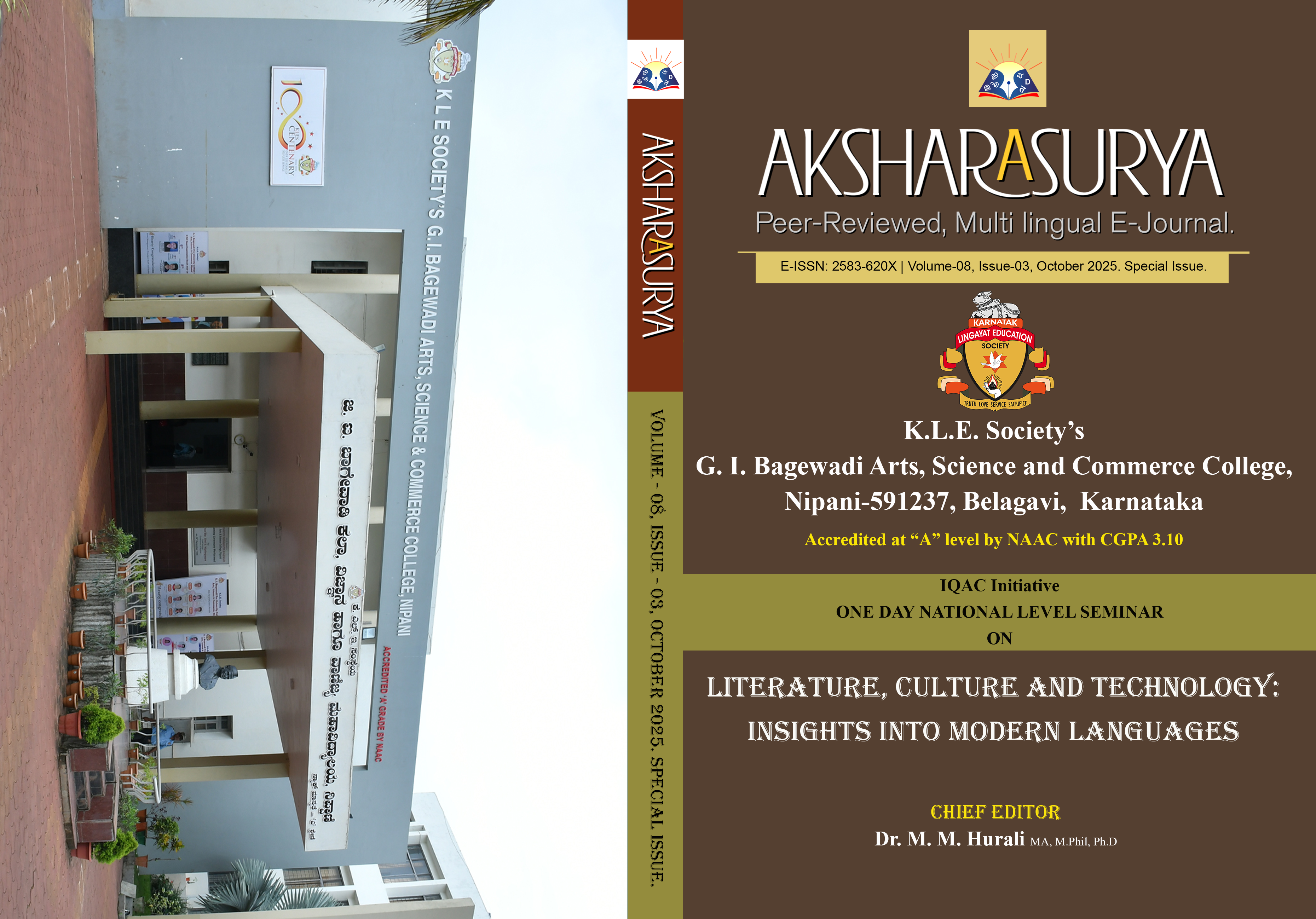
Main Article Content
Abstract
Artificial Intelligence (AI) has become one of the most transformative forces in the 21st century, influencing multiple spheres including literature, culture, and technology. Its integration with modern language studies has not only reshaped how literature is produced, analyzed, and preserved, but has also broadened cultural narratives and redefined the way societies interact with knowledge. In literature, AI assists in text generation, translation, plagiarism detection, and literary analysis, offering new methodologies for students and scholars. In cultural contexts, AI fosters inclusivity by preserving endangered languages, digitizing manuscripts, and enabling cross-cultural dialogue through real-time translation. In technology, AI enhances human–computer interaction, content creation, and critical discourse, making it a vital tool for modern academic learning. For degree students, understanding the applications of AI in language-related domains is crucial, as it provides both critical insights and practical tools for research, creativity, and professional growth. This paper explores the intersections of AI with literature, culture, and technology while providing an academic lens into modern language use. Through charts, tables, and critical examples, it highlights AI’s role in shaping the intellectual landscape and provides degree students with a framework to critically engage with AI-driven advancements in the humanities and beyond.
Article Details
Section

This work is licensed under a Creative Commons Attribution-NonCommercial-ShareAlike 4.0 International License.
How to Cite
References
Bender, E. M., & Friedman, B. (2018). Data Statements for Natural Language Processing. Transactions of the ACL, 6, 587–604.
Floridi, L., & Chiriatti, M. (2020). GPT-3: Its Nature, Scope, Limits, and Consequences. Minds and Machines, 30, 681–694.
Liu, Y., & Zhang, H. (2021). AI in Cultural Heritage: Applications and Challenges. Journal of Cultural Informatics, 15(2), 45–63.
Marcus, G., & Davis, E. (2019). Rebooting AI: Building Artificial Intelligence We Can Trust. Pantheon Books.
Vinodhini, G., & Chandrasekaran, R. M. (2012). Sentiment Analysis and Opinion Mining. International Journal of Advanced Research in Computer Science, 2(6), 282–292.