
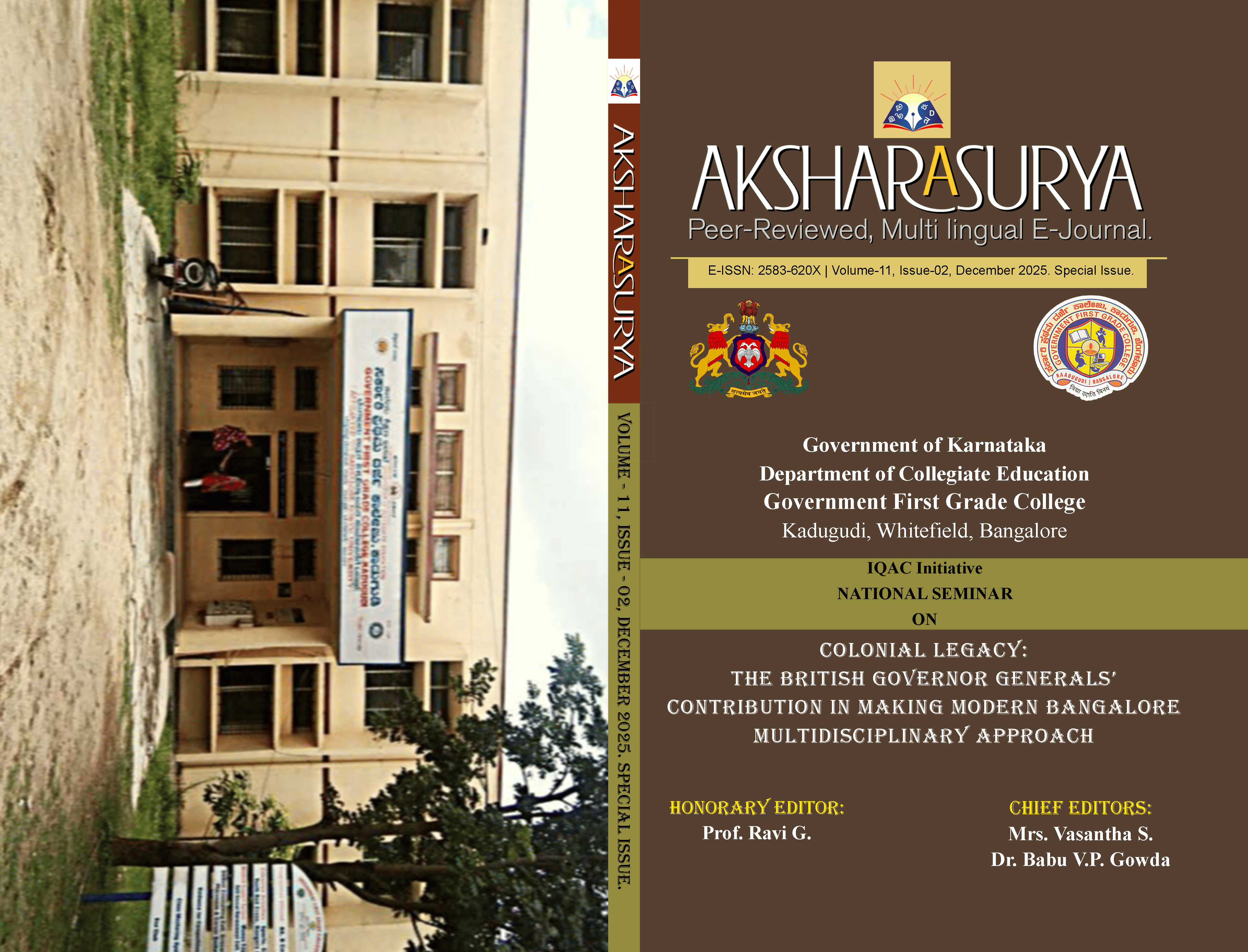
Published: 2025-12-23
Table of Contents
Research Articles
Impact on Colonial Bangalore: Political Movements, Protests and Nationalism– A Study
01 to 07
This article examines the impact of political movements, protests, and nationalism on colonial Bangalore (then the British cantonment-town) from the mid-19th century to India's independence. It traces the trajectory from early resistance (sepoys' attempted mutiny, agrarian unrest) to the mature nationalist struggles (Non-Cooperation, Quit India, local strikes at mills). The study argues that this mobilization-driven by students, laborers, and the urban middle class-significantly affected the city's structure. These movements led to the disruption of the colonial economy, fostered new social networks and political agency, and politicized urban spaces (like Banappa Park), ultimately challenging the cantonment-native city divide and shaping Bangalore’s post-colonial civic identity and culture.
The Dual Urbanism: The Socioeconomic and Demographic Changes Brought About by The Construction and Expansion of The British Cantonment (C. 1800–1947) in the Bangalore Hinterland
08 to 15
This study investigates the colonial urbanization of Bangalore, emphasizing the role of British colonial rulers in altering the city's layout, infrastructure, and sociopolitical environment during the late 19th and early 20th centuries. Before British intervention, Bangalore was a minor regional hub governed by South Indian dynasties. The establishment of the Bangalore Cantonment in 1809 marked a pivotal shift, leading to the construction of roads, drainage systems, telegraph lines, and military installations primarily for colonial purposes. This development resulted in a division between the local "Pete" area and British-controlled Bangalore, fostering a "dual city" characterised by racial hierarchies, socio-spatial segregation, and uneven growth. Utilizing archival materials and historical data, the article argues that the colonial approach to urbanization has left a lasting legacy of spatial and infrastructural inequalities in modern Bengaluru. It also explores the influence of colonial planning on the city's evolution post-independence into a major administrative and technological hub, contributing to a nuanced understanding of urban modernity and postcolonial identity in Indian cities.
Colonial Modernity and Language Hierarchies: The Rise of English and The Decline of Vernacular Voices: With Special Reference to Kannada
16 to 22
This paper explores how British colonial modernity reconfigured linguistic hierarchies in South India, particularly in Bengaluru, by elevating English as the language of power, modernity, and social mobility while relegating Kannada to the margins of intellectual and administrative life. Through postcolonial frameworks drawn from Fanon, Ngũgĩ wa Thiong’o, Gramsci, Bourdieu, and Spivak, the study examines how colonial education policies and missionary interventions institutionalized English as a symbol of enlightenment and cultural superiority. Bengaluru, as a hybrid city divided between princely Mysore and the British cantonment, became a site where linguistic hegemony translated directly into class distinction.
The essay further analyses the responses of Kannada intellectuals and reformers, including B. M. Srikantaiah, D. V. Gundappa, Kuvempu, Ti. Nam. Sri., K. Shivaram Karanth, and Aluru Venkata Rao, who resisted linguistic subordination through literature, translation, and education. Their efforts transformed Kannada into a medium of modern expression and cultural self-assertion, culminating in movements for linguistic unification and regional identity.
While postcolonial Bengaluru continues to project itself as a global metropolis, the colonial hierarchy of English over Kannada persists in education, employment, and prestige. The paper argues that genuine decolonization requires not the rejection of English but the revalorization of Kannada as an equal language of intellect, science, and creativity. By tracing the historical continuity of linguistic inequality, the study redefines modernity as a plural and multilingual experience rooted in the cultural consciousness of Karnataka.
Modern Bangalore and The Enduring Colonial Legacy: Historical Transformations, Urban Planning, Socio-Economic Structures, and The Continuity of Colonial Institutions in Post-Independence City Development
23 to 27
This paper explores the historical evolution of Bangalore from a colonial cantonment town to a modern global metropolis, tracing the enduring legacy of British colonial rule in the city’s spatial organization, socio-economic structures, and institutional frameworks. Colonialism not only reshaped Bangalore’s geography but also embedded administrative and economic patterns that continue to influence its post-independence development trajectory. The paper examines the dichotomy between the ‘native’ and ‘European’ sectors of the city, the role of colonial governance in shaping urban planning, and the transformation of Bangalore’s economy under British rule. It further analyses how these colonial imprints persist in the city’s contemporary urban development policies, governance structures, and social stratifications.
Colonial Legacy: The British Governor Generals’ Contribution to Making Modern Bangalore
28 to 32
The colonial encounter between Britain and India transformed not only the political landscape but also the urban and social geography of many Indian cities. Bangalore, today known as Bengaluru-the Silicon Valley of India-owes much of its modern urban form and infrastructure to the British colonial administration. This paper explores the significant contributions made by British Governor Generals and Resident officers in shaping the city’s civic, military, and administrative framework. The study analyses how policies under British rule established the city’s dual character-one indigenous and the other colonial-and how this duality continues to influence Bangalore’s contemporary identity. Using historical records, municipal archives, and secondary research, this paper highlights the role of colonial governance in building modern infrastructure, administrative systems, and socio-economic foundations that set the trajectory for Bangalore’s later development.
The Role of British Governor Generals, Residents, and Commissioners in the Administration of Bangalore
33 to 38
The British conquest of Mysore in 1799 marked the beginning of a new political and administrative order in Bangalore. Over the next century, the city came under three distinct but interrelated authorities: the Governor Generals of India, who directed overall colonial policy; the Residents, who supervised the Mysore court; and the Commissioners, who directly administered the state during the period of Commissioner’s Rule (1831–1881). This research article examines their respective roles in reshaping Bangalore’s governance, economy, and urban identity. While the Governor Generals provided strategic direction, the Residents functioned as political supervisors ensuring Mysore’s compliance, and the Commissioners carried out administrative reforms and infrastructural development from Bangalore. The study highlights how these interventions consolidated colonial power, created a dual city structure of Cantonment and Pettah, and inadvertently laid the foundations of Bangalore’s modernity.
Colonial Roots to National Growth: Tracing the Legacy of Indian Entrepreneurship A Study
39 to 46
This paper examines the evolution of Indian entrepreneurship during the colonial period and its enduring influence on modern industrial growth. Drawing from historical-economic analysis, it explores how British economic structures-though designed to serve imperial interests-created the infrastructure, institutions, and financial systems that later supported indigenous enterprise. Despite systemic constraints, Indian entrepreneurs like the Tatas, Birla’s, and indigenous bankers-built industries and networks that laid the groundwork for national growth after independence. The study concludes that colonial legacies shaped India’s entrepreneurial culture and continue to influence its postcolonial economy.
The Colonial Roots of India’s Land Revenue Systems and Their Enduring Impact on the Agrarian Economy
47 to 52
This paper explores the intricate relationship between India’s agrarian economy and land revenue systems, tracing their evolution from pre-colonial times through British colonial rule and into the post-independence period. Land revenue policies imposed during British rule fundamentally transformed land ownership patterns, agrarian relations, and rural livelihoods, often prioritizing revenue extraction over cultivator welfare. The study analyzes the effects of the colonial land revenue systems-Zamindari, Ryotwari, and Mahalwari-on agricultural productivity, social stratification, and economic hardship. It also evaluates post-independence land reforms aimed at rectifying historical inequalities and promoting equitable land distribution. Despite reforms, persistent challenges such as land fragmentation, rural poverty, and institutional weaknesses remain, underscoring the enduring legacy of colonial-era policies. The paper contributes to a deeper understanding of the historical and institutional factors shaping India’s agrarian structure and suggests policy directions for sustainable rural development and social justice.
The Ambivalent Legacy: The Role of British Governor-Generals in the Cultural and Temple Landscape of Colonial Bangalore (1800–1857)
53 to 58
The British colonial period (1800–1857) marked a transformative phase in the evolution of Bangalore’s cultural and religious landscape. As the administrative and military hub of the Mysore region, the city became a focal point for British experimentation in urban planning, architecture, and heritage policy. The Governor-Generals of the British East India Company played a crucial role not only in shaping the political and economic spheres of Bangalore but also in redefining its cultural and temple spaces. Their interventions-ranging from temple restorations and spatial reorganizations to cultural appropriations-reflected both admiration and ambivalence toward native traditions. This paper explores how the British Governor-Generals’ policies and attitudes toward temples, culture, and urban design contributed to the emergence of a hybrid colonial-modern identity in Bangalore. The study draws upon archival records, government reports, and scholarly interpretations to reveal the ambivalent legacy of colonial engagement with Bangalore’s sacred geography.
The Colonial Roots of Modern Bangalore: A Study of British Influence on Commerce
59 to 64
Modern Bangalore, now known as Bengaluru, stands as India’s leading commercial and technological hub. However, its transformation from a small cantonment town to a vibrant economic center was deeply rooted in its colonial past. The British influence on Bangalore’s commercial structure, urban planning, and institutional development fundamentally reshaped its socio-economic landscape. This paper explores the evolution of commerce in Bangalore under British rule, focusing on how colonial policies, infrastructural expansion, and trade networks laid the foundation for the city’s modern economy. Drawing upon historical archives, government records, and existing scholarship, the study examines how the British cantonment became the nucleus of urban and economic development. The paper concludes that colonial-era economic reforms, though exploitative in intent, inadvertently laid the groundwork for Bangalore’s later industrial and technological growth.
A Study on Colonial Legacy on Trade Systems and Business Structure
65 to 69
The legacy of colonialism continues to shape modern trade and business structures across the world. Colonial powers established systems that primarily benefited their own economies while deeply influencing the economic, social, and political landscapes of the colonized regions. This paper explores how colonialism shaped trade patterns, business practices, and institutional frameworks, with a focus on its long-term effects on post-colonial economies. By examining examples from Asia, Africa, and Latin America, the study highlights how colonial exploitation and economic dependency have persisted into contemporary global trade relations.
Cantonment to Silicon Valley: Cinematic Traces of Colonial Bangalore in Indian and British Films
70 to 76
The transformation of Bangalore from a native town (Pete) to a Cantonment and eventually to a cosmopolitan city is truly remarkable. At each stage of this evolution, the city has assumed new forms, identities, and energies across economic, political, social, and cultural spheres. This dynamic progression is vividly captured in cinema, which provides visual documentation of Bangalore’s dramatic development. As a powerful medium of mass communication, cinema conveys messages to audiences in compelling ways. Film content often reflects social practices and their impact on people, showcasing diverse facets of society that offer valuable insights into colonial residues and postcolonial reforms. Both disparities and delusions are highlighted through the lenses of colonial and postcolonial perspectives.
Public Health Reforms: Vaccination, Sanitation, and Hospital
77 to 86
Public health always been central to Indian society, reflecting the ancient belief that prevention is superior to cure. Historical evidence highlights hygiene, safe water supply, and environmental health as vital and enduring longevity. Public health services, measures sanitation, vaccination, and vector control, are essential components of national development in the developed world and East Asia. Such efforts raised labour productivity, life expectancies, and rapid economic growth and poverty reduction even before modern medical technologies emerged. In India, public funds have focused largely on medical services, public health services and regulations have been neglected. This lacks systematic planning, hindering delivery of effective public health services.
A Study on the Patterns and Dynamics of Labour Migration in Karnataka
87 to 94
Migration plays a pivotal role in shaping India’s economic and demographic structure by supplying a continuous flow of labour to rapidly urbanizing and industrializing regions. It mitigates regional imbalances in the availability of skilled and unskilled workers, thereby supporting key sectors such as construction, manufacturing, and services. Census data reveal a steady increase in internal migration, rising from 29. 1% in 1971 to 37% in 2011, underscoring its growing significance in the national economy. Internal migration in India occurs in various forms-intra-district, inter-district, and inter-state-with rural-to-urban movement being the most dominant pattern, largely driven by employment opportunities. Karnataka, one of India’s more industrially advanced states, has emerged as a major destination for labour migrants, particularly in cities like Bengaluru, Mysore, and Mangalore, which offer abundant employment in construction, manufacturing, and the service sectors. However, the state continues to face substantial regional disparities; northern districts such as those in Kalyana Karnataka remain economically underdeveloped, prompting significant out-migration toward southern and metropolitan areas. This study highlights the economic drivers, spatial patterns, and regional inequalities influencing labour migration in Karnataka, emphasizing the need for balanced regional development, infrastructure expansion, and employment generation in lagging districts to achieve inclusive growth.
Caste Class Continuum in Bangalore: A Colonial Legacy
95 to 100
Colonial legacy is almost visible in all walks of life in all the imperialised social structures across the globe with no exception to India, which has had a long history of over three centuries of foreign rule. The geographical and socio-economic structure of Indian society has ever since witnessed dramatic changes. A society which weighed heavily in terms of its culture and tradition saw sweeping pragmatic changes brought forth through external sources. Fortunately or unfortunately internal factors also played a major role in accelerating this change.
The impact of which is experienced even to this day. One such impact was seen in the system of social stratification. The so-called ‘Caste ridden Indian society was liberalised through the colonial legacy’. Which means to say that India was existing without a proper social structure; the European imperialists were great enough to assume the role of a global saviour and were here to emancipate and ensure egalitarian power to all the citizens. Having done this they administered a new system of stratification namely class into the Indian social structure. This as a colonial legacy is carried on to this day. The striking feature of introduction of this system was the concept of caste class continuum. A colonial form of social differentiation thus emerged. Even more evident was the nature of changes that took place in the nature and forms of mobility of different castes.
The concepts of Sanskritisation and dominant caste as mentioned by Prof. M N Srinivas is seen as a consequence of such influential forces. The concepts of universalisation and Parochialisation too can be seen as examples for changing the nature of Indian Society.
The process of change has been influencing society not only as a whole but also in parts.
This article is concerned in bringing to light the factors that contributed to changes in one of its parts, that is Bangalore and how it got into the process of caste class continuum.
Contribution of British Governor-Generals to the Development of Archives and Architecture in Bangalore
101 to 105
This research paper explores the major contributions of British Governor-Generals in the development of archives and architecture in Bangalore during the colonial period. It traces the administrative and infrastructural initiatives taken by colonial authorities to systematize record-keeping, establish archival institutions, and design public buildings that reflected European architectural influences blended with Indian traditions. The study is based on historical sources, archival records, and secondary literature. It concludes that while British administrative reforms brought modernization and urban development, they also reinforced social hierarchies and left a complex legacy.
Cost Containment Strategy in Advantage Health Care Solution: A Case Study
106 to 119
This study examines the cost containment strategies implemented by Advantage Healthcare Solutions within its Revenue Cycle Management (RCM) services. It employs a descriptive and analytical research design to investigate the range of services provided and evaluate the effectiveness of various cost-containment measures. Data collection methods include literature reviews, structured interviews with Advantage stakeholders, surveys of client healthcare providers, and analysis of internal documents. Key findings reveal that Advantage employs a range of strategies to enhance operational efficiency and reduce financial waste. These strategies include automation of claims processing, accurate coding, denial management, and optimized accounts receivable management. Additionally, Advantage leverages advanced reporting tools, compliance training, and flexible staffing to further reduce costs. The study highlights how these strategies collectively contribute to improved financial performance and operational efficiency, allowing healthcare providers to focus more on patient care. The findings suggest that Advantage’s comprehensive approach to RCM and cost containment effectively supports healthcare providers in managing their revenue cycles more efficiently.
Colonial Legacy: The British Governor-Generals’ Contribution in Making Modern Bangalore
120 to 125
This paper examines the enduring legacy of British colonial rule in shaping modern Bengaluru, with a particular focus on the contributions of the Governor-Generals. Through a detailed analysis of urban planning, infrastructural development, administrative reforms, and architectural innovations, the study highlights how colonial policies transformed Bengaluru from a modest regional town into a prominent administrative and military hub. The paper also explores the cultural and social impacts of British interventions, including the establishment of educational institutions, civic amenities, and military cantonments. By investigating archival records, historical accounts, and contemporary urban studies, the research demonstrates that while colonial governance facilitated modernization, it also imposed structural hierarchies and spatial divisions that continue to influence the city’s development. Understanding this colonial legacy provides valuable insights into Bengaluru’s contemporary urban landscape and its historical evolution.
Urban Planning and Spatial Transformation
126 to 132
Urban planning and spatial transformation is a future-oriented activity, which links “scientific and technical knowledge to actions in the public domain”. Planning as a general activity is the making of an orderly sequence of actions that will lead to the achievement of a stated goal or goals. Urban planning is just a sub-class of a general activity called planning; it is concerned with managing and controlling a particular system, the urban system. The field, in particular, focuses on the use of space, shaping the geographical layout of a city, zoning specific areas for development and deciding on the location of major public facilities like utilities and transportation corridors. The fields of urban planning involve the planning, design, operation, and management of infrastructure and resources. It incorporates a collection of spatial and non- spatial data regarding transportation, household, public services and life quality, population and activities for people. The human environment is concerned with change; therefore planning concepts must be dynamic, not static to cope with this transformation. The concept of an information society has been described by many scientists and futurologists the information society depending on five main criteria; these are: technological; economy; occupational; spatial; cultural. The technological criterion refers to the development of information and communication technology, and its effects on social development. The economy criterion refers to the development of new products that affect industrial structures. The occupational criterion refers to the development of new types of work places and occupational restructuring. The spatial criterion refers to the development of different types of networks and their effects on the organization of time and space. The cultural criterion refers to the rapid increase in information in social circulation.
Changing Gender Roles and Expectations in Modern Society: A Case Study in Mysore City in Karnataka
133 to 146
India’s gender roles have evolved due to social, economic, and cultural changes. Greater access to education and employment empowers women, enhances decision-making, challenges traditional norms, and promotes equality. These shifts enable women’s active participation in the workforce and society, fostering broader acceptance of diverse roles and advancing a more inclusive society. This study examines the evolving gender roles and expectations of women in modern society, with a focus on Mysore, Karnataka. It explores how education and employment opportunities contribute to the transformation of traditional gender norms, enabling women to participate more actively in economic, social, and familial spheres. A sample of 60 women from Mysore was surveyed using a structured questionnaire, and data were analyzed using Chi-Square tests to assess the impact of education and employment on changing gender roles. The findings reveal that higher educational attainment and increased participation in the workforce significantly enhance women’s autonomy, decision-making power, and societal influence, challenging conventional norms. The study underscores the importance of promoting gender-sensitive policies and interventions to support women’s empowerment and foster equitable participation in all areas of life.
The 3-I Engine: Driving India's Journey to $5 Trillion Economy with Inclusion of Skill Development
147 to 154
India's ambition to become a $5 trillion economy necessitates a transformative approach that not only focuses on economic growth but also ensures inclusive development. Central to this vision is the "3-I Engine"—a strategic framework encompassing Infrastructure, Innovation, and Inclusion. This paper explores how these three pillars, when synergized with robust skill development initiatives, can propel India towards its economic aspirations.
Infrastructure forms the backbone of economic expansion, facilitating connectivity, enhancing productivity, and attracting investments. Recent initiatives, such as the establishment of the Centre for Invention, Innovation, Incubation, and Training (CIIIT) in Ramtek, Maharashtra, exemplify efforts to bolster infrastructure and provide advanced training in emerging technologies to rural youth.
Innovation drives competitiveness and productivity. The government's emphasis on sectors like digital economy, fintech, and renewable energy underscores the importance of fostering innovation. These sectors not only contribute to economic growth but also create avenues for skill enhancement and employment.
Inclusion ensures that the benefits of economic growth are equitably distributed. With over 90% of India's workforce employed informally, there is a pressing need to upskill this segment to enhance productivity and job security.
Integrating skill development into the 3-I framework is imperative. Targeted training programs, aligned with industry needs, can bridge the skill gap, fostering a workforce adept at navigating the challenges of a rapidly evolving economy.
This paper delves into the interplay between infrastructure development, innovation, and inclusive growth, proposing a cohesive strategy to achieve a $5 trillion economy. By aligning policy initiatives with the 3-I Engine, India can pave the way for sustainable and inclusive economic prosperity.
Colonial Legacy and Economic Change in Bangalore: Trade, Taxation, and Industrial Development During the British Period
155 to 160
This paper explores the economic transformation of Bangalore during the British colonial period, emphasizing trade networks, taxation systems, and industrial development. The British economic policies in the Mysore region—especially after the fall of Tipu Sultan in 1799—brought significant structural changes to local commerce and industries. While colonial administration introduced new fiscal systems, railway infrastructure, and administrative reforms, it simultaneously disrupted indigenous trade, handicrafts, and agrarian relations. This study critically examines how these policies shaped Bangalore’s transition from a pre-colonial agrarian economy into a colonial commercial and industrial hub, leaving behind a legacy that influenced its post-independence economic growth.