
Colonial Modernity and Language Hierarchies: The Rise of English and The Decline of Vernacular Voices: With Special Reference to Kannada
Article Sidebar
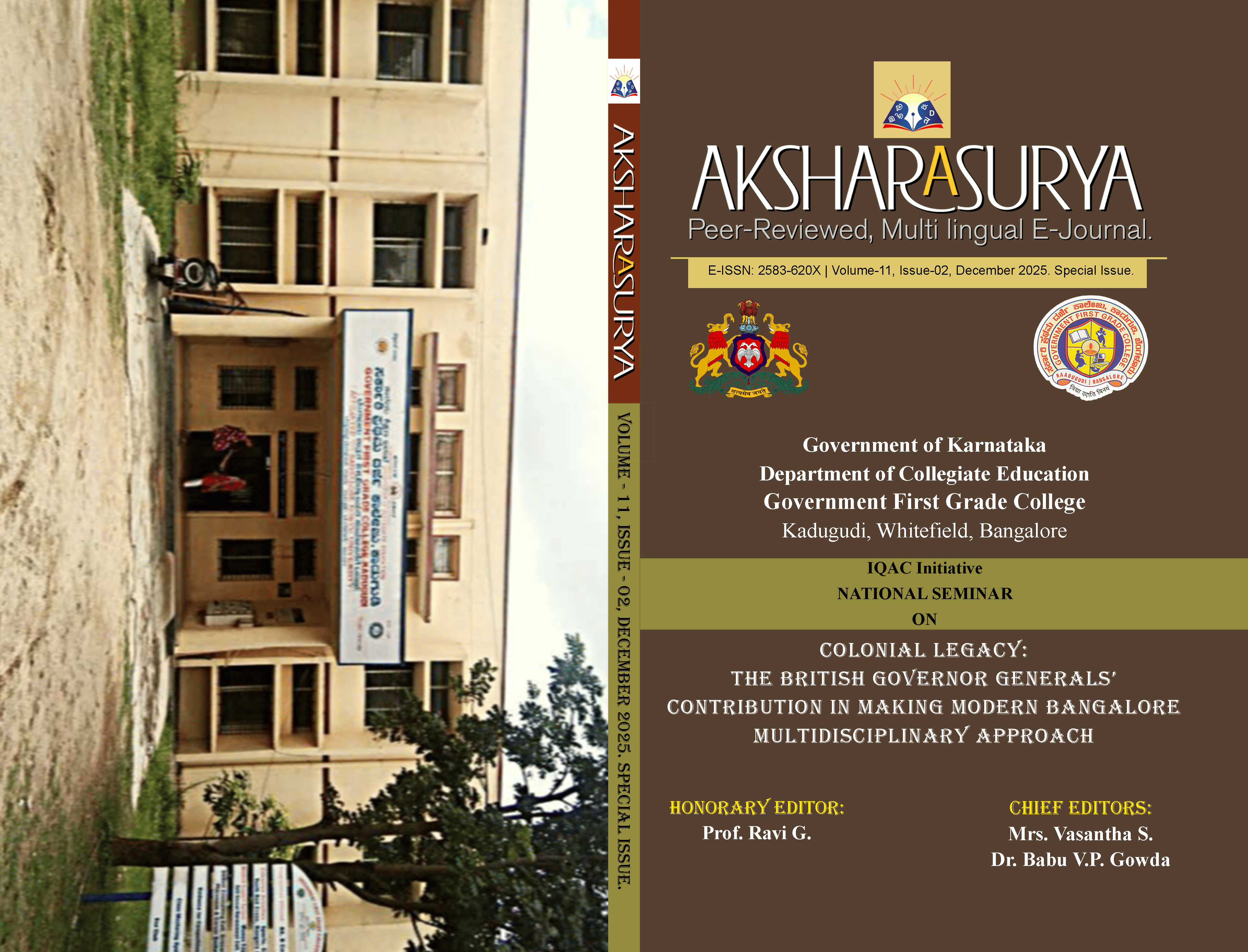
Main Article Content
Abstract
This paper explores how British colonial modernity reconfigured linguistic hierarchies in South India, particularly in Bengaluru, by elevating English as the language of power, modernity, and social mobility while relegating Kannada to the margins of intellectual and administrative life. Through postcolonial frameworks drawn from Fanon, Ngũgĩ wa Thiong’o, Gramsci, Bourdieu, and Spivak, the study examines how colonial education policies and missionary interventions institutionalized English as a symbol of enlightenment and cultural superiority. Bengaluru, as a hybrid city divided between princely Mysore and the British cantonment, became a site where linguistic hegemony translated directly into class distinction.
The essay further analyses the responses of Kannada intellectuals and reformers, including B. M. Srikantaiah, D. V. Gundappa, Kuvempu, Ti. Nam. Sri., K. Shivaram Karanth, and Aluru Venkata Rao, who resisted linguistic subordination through literature, translation, and education. Their efforts transformed Kannada into a medium of modern expression and cultural self-assertion, culminating in movements for linguistic unification and regional identity.
While postcolonial Bengaluru continues to project itself as a global metropolis, the colonial hierarchy of English over Kannada persists in education, employment, and prestige. The paper argues that genuine decolonization requires not the rejection of English but the revalorization of Kannada as an equal language of intellect, science, and creativity. By tracing the historical continuity of linguistic inequality, the study redefines modernity as a plural and multilingual experience rooted in the cultural consciousness of Karnataka.
Article Details
Section

This work is licensed under a Creative Commons Attribution-NonCommercial-ShareAlike 4.0 International License.
How to Cite
References
Bourdieu, Pierre. Language and Symbolic Power. Edited by John B. Thompson, translated by Gino Raymond and Matthew Adamson, Harvard University Press, 1991.
Chakrabarty, Dipesh. Provincializing Europe: Postcolonial Thought and Historical Difference. Princeton University Press, 2000.
Fanon, Frantz. Black Skin, White Masks. Translated by Charles Lam Markmann, Grove Press, 1967.
Gramsci, Antonio. Selections from the Prison Notebooks. International Publishers, 1971.
Kittel, Ferdinand. A Kannada-English Dictionary. Basel Mission Press, 1894.
Kuvempu. Ramayana Darshanam. Udaya Press, 1949.
Macaulay, Thomas Babington. "Minute on Indian Education. " Selections from Educational Records, Part I (1781–1839), edited by H. Sharp, Government Press, 1920.
Ngũgĩ wa Thiong’o. Decolonising the Mind: The Politics of Language in African Literature. James Currey, 1986.
Nair, Janaki. The Promise of the Metropolis: Bengaluru’s Twentieth Century. Oxford University Press, 2005.
Visvesvaraya, M. Memoirs of My Working Life. Bangalore Press, 1951.
Gundappa, D. V. Mankutimmana Kagga. Kannada Sahitya Parishat, 1943.
Spivak, Gayatri Chakravorty. "Can the Subaltern Speak?" Marxism and the Interpretation of Culture, edited by Cary Nelson and Lawrence Grossberg, University of Illinois Press, 1988.
Raghavan, B. Colonial Modernity and Cultural Transformation in South India. Routledge, 2019.
Kavitha, C. N. "Language, Identity and Power: The Case of Kannada in the Shadow of English. " Indian Journal of Language and Society, vol. 12, no. 2, 2018, pp. 55–72.