
Modern Bangalore and The Enduring Colonial Legacy: Historical Transformations, Urban Planning, Socio-Economic Structures, and The Continuity of Colonial Institutions in Post-Independence City Development
Article Sidebar
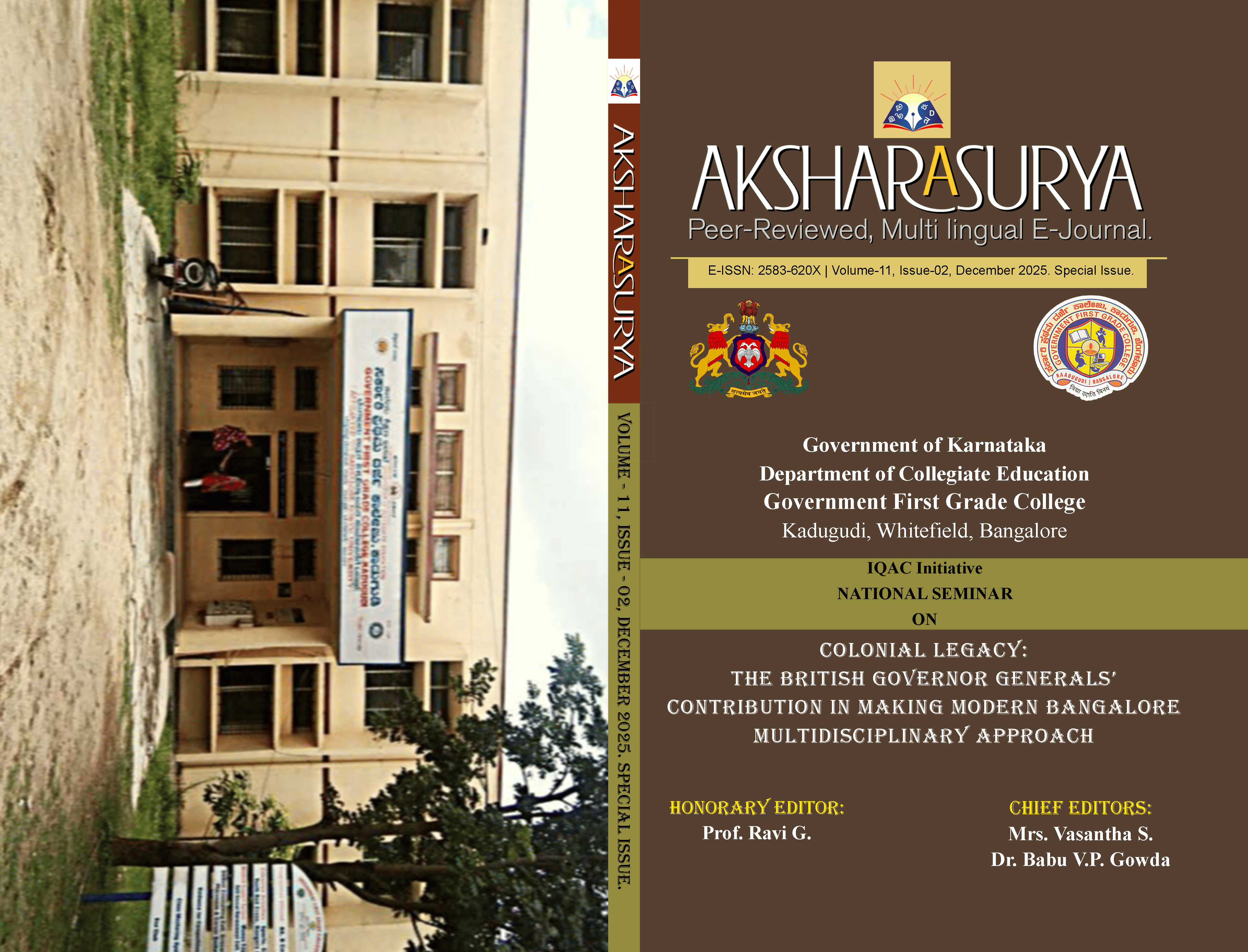
Main Article Content
Abstract
This paper explores the historical evolution of Bangalore from a colonial cantonment town to a modern global metropolis, tracing the enduring legacy of British colonial rule in the city’s spatial organization, socio-economic structures, and institutional frameworks. Colonialism not only reshaped Bangalore’s geography but also embedded administrative and economic patterns that continue to influence its post-independence development trajectory. The paper examines the dichotomy between the ‘native’ and ‘European’ sectors of the city, the role of colonial governance in shaping urban planning, and the transformation of Bangalore’s economy under British rule. It further analyses how these colonial imprints persist in the city’s contemporary urban development policies, governance structures, and social stratifications.
Article Details
Section

This work is licensed under a Creative Commons Attribution-NonCommercial-ShareAlike 4.0 International License.
How to Cite
References
Nair, Janaki. The Promise of the Metropolis: Bangalore’s Twentieth Century. Oxford University Press, 2005.
Heitzman, James. Network City: Planning the Information Society in Bangalore. Oxford University Press, 2004.
Srinivas, Smriti. Landscapes of Urban Memory: The Sacred and the Civic in India’s High-Tech City. Orient Blackswan, 2004.
Bawa, Vasant. Bangalore: The Story of a City. East West Books, 2001.
Rice, B. L. Mysore: A Gazetteer Compiled for the Government of Mysore. Asian Educational Services, 1897.
Ninan, T. The Turn of the Tortoise: The Challenge and Promise of India’s Future. Penguin, 2015.
Official Reports of Bangalore Municipal Corporation, 1949–2000.
Economic and Political Weekly Archives, Urban Studies Section.