
Colonial Legacy and Economic Change in Bangalore: Trade, Taxation, and Industrial Development During the British Period
Article Sidebar
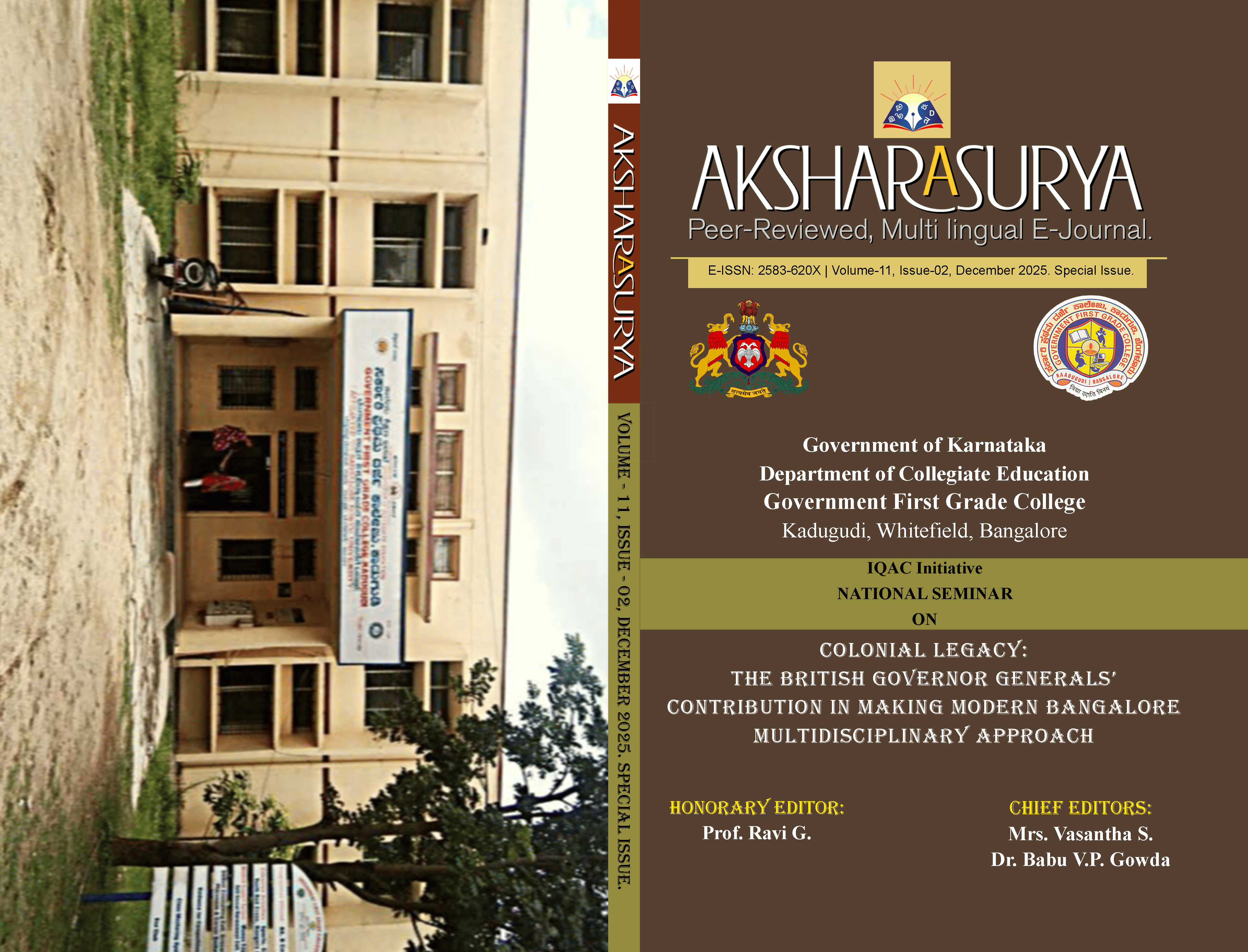
Main Article Content
Abstract
This paper explores the economic transformation of Bangalore during the British colonial period, emphasizing trade networks, taxation systems, and industrial development. The British economic policies in the Mysore region—especially after the fall of Tipu Sultan in 1799—brought significant structural changes to local commerce and industries. While colonial administration introduced new fiscal systems, railway infrastructure, and administrative reforms, it simultaneously disrupted indigenous trade, handicrafts, and agrarian relations. This study critically examines how these policies shaped Bangalore’s transition from a pre-colonial agrarian economy into a colonial commercial and industrial hub, leaving behind a legacy that influenced its post-independence economic growth.
Article Details
Section

This work is licensed under a Creative Commons Attribution-NonCommercial-ShareAlike 4.0 International License.
How to Cite
References
Bayly, C.A. Indian Society and the Making of the British Empire. Cambridge University Press, 1988.
Maheshwari, S.R. Economic History of Mysore. Bangalore University Press, 1995.
Thorner, Daniel. The Shaping of Modern India: Economic Policies during Colonial Rule. Penguin, 1993.
Raj, N. Visvesvaraya and Industrialization of Mysore. Orient Blackswan, 1976.
Habib, Irfan. Colonial Economy in India 1757–1947. Tulika Books, 2012.
Nair, Janaki. The Promise of the Metropolis: Bangalore’s Twentieth Century. Oxford University Press, 2005.