
The Colonial Roots of Modern Bangalore: A Study of British Influence on Commerce
Article Sidebar
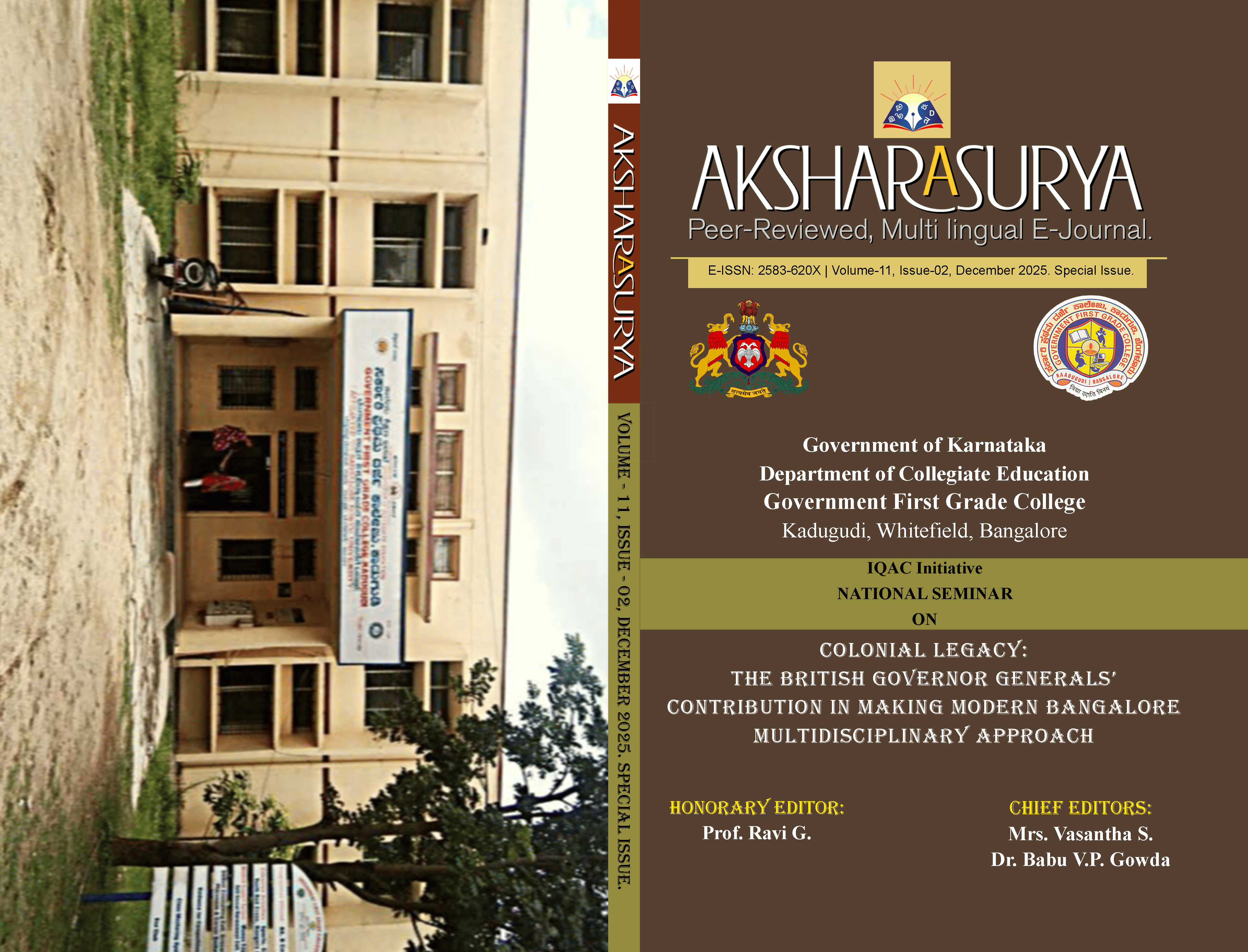
Main Article Content
Abstract
Modern Bangalore, now known as Bengaluru, stands as India’s leading commercial and technological hub. However, its transformation from a small cantonment town to a vibrant economic center was deeply rooted in its colonial past. The British influence on Bangalore’s commercial structure, urban planning, and institutional development fundamentally reshaped its socio-economic landscape. This paper explores the evolution of commerce in Bangalore under British rule, focusing on how colonial policies, infrastructural expansion, and trade networks laid the foundation for the city’s modern economy. Drawing upon historical archives, government records, and existing scholarship, the study examines how the British cantonment became the nucleus of urban and economic development. The paper concludes that colonial-era economic reforms, though exploitative in intent, inadvertently laid the groundwork for Bangalore’s later industrial and technological growth.
Article Details
Section

This work is licensed under a Creative Commons Attribution-NonCommercial-ShareAlike 4.0 International License.
How to Cite
References
Bayly, C. A. (1988). Indian Society and the Making of the British Empire. Cambridge University Press.
Chandrasekhar, S. (1983). Economic Development in Mysore State (1800–1947). Government Press.
Nair, J. (2005). The Promise of the Metropolis: Bangalore’s Twentieth Century. Oxford University Press.
Nagendra, H. (2016). Nature in the City: Bengaluru in the Past, Present and Future. Oxford University Press.
Rice, B. L. (1897). Mysore: A Gazetteer Compiled for Government. Mysore Government Press.
Washbrook, D. A. (1976). The Emergence of Provincial Politics: The Madras Presidency 1870–1920. Cambridge University Press.
Arnold, D. (1994). The Colonial City and the Making of Modern India. Oxford University Press.
Bangalore Municipal Archives (1910–1935). Reports of the Cantonment Board and Municipality of Bangalore.