
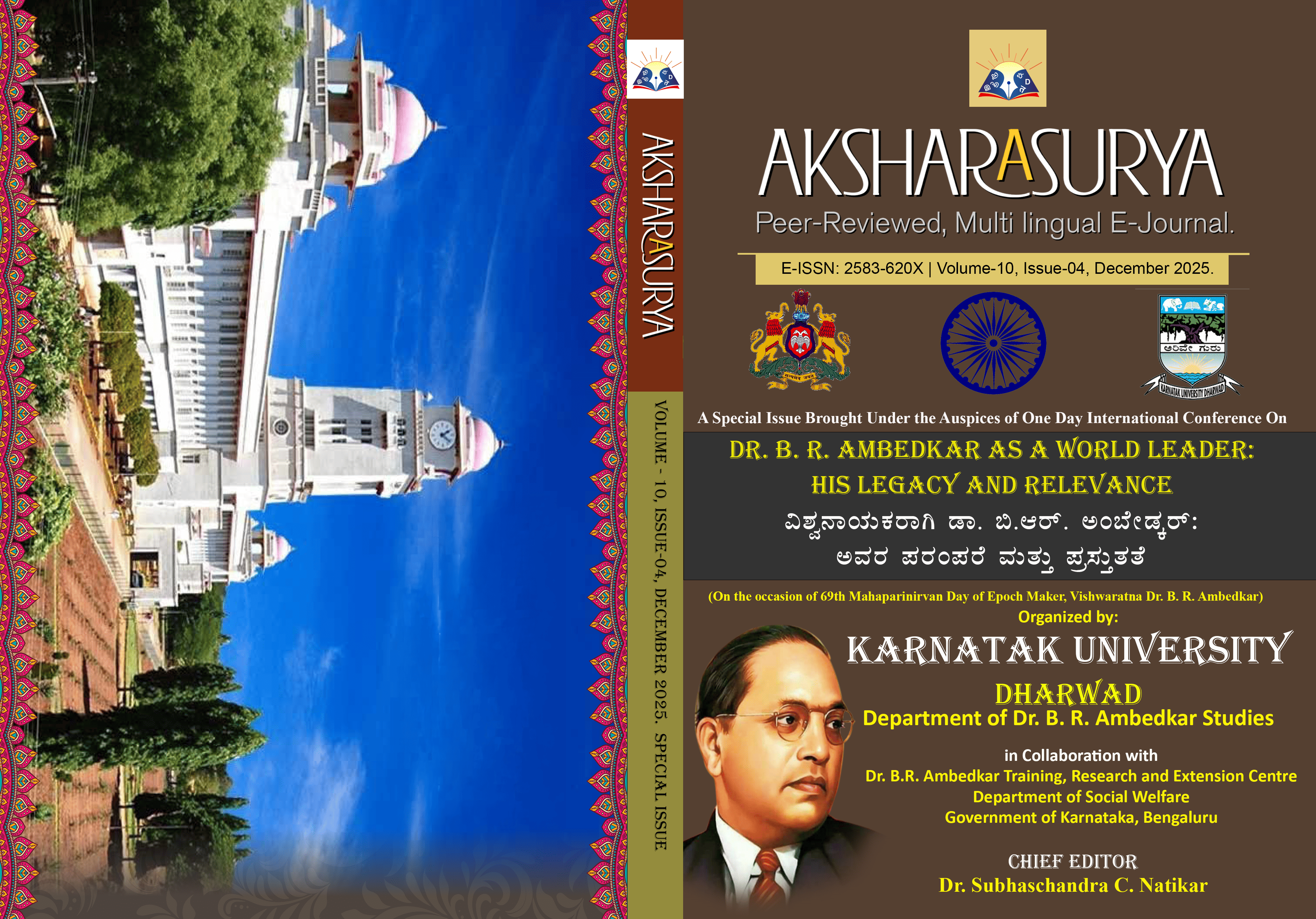
Published: 2025-12-15
Table of Contents
Research Articles
Dr. B.R. Ambedkar: Fountain of knowledge and Humanism
01 to 05
This article highlights Dr. B.R. Ambedkar, affectionately known as Babasaheb, as a towering figure of knowledge and humanism, and the Chief Architect of the Indian Constitution. Despite facing extreme caste-based discrimination as a child from the Mahar community, he transformed these adversities into strength. He equipped himself with education, earning over 34 degrees, and dedicated his life to championing the downtrodden and establishing an egalitarian society. Ambedkar spearheaded historical protest movements (e.g., Mahad Satyagraha) and legislative reforms like the Hindu Code Bill, advocating for equality, justice, and dignity for all, particularly for the marginalized and women. His immense intellectual and social contributions, which led to him being posthumously awarded the Bharat Ratna in 1990, cemented his enduring legacy as a global icon and crusader for human rights.
Reshaping the Discourse on Women's Empowerment: Through Perspective of Dr. B. R. Ambedkar
06 to 13
Dr. B. R. Ambedkar redefined the framework of women's empowerment in India by grounding it in the principles of liberty, equality, and justice. Dissimilar mainstream feminist discourses of his time, Ambedkar's approach was intersectional recognizing that caste, class, and gender together shaped women's oppression, particularly for Dalit and marginalized women. His efforts in constitutional drafting, labor rights, education reform, and social activism uniquely positioned him as a pioneer of inclusive feminism in India. His legislative reforms, educational advocacy, and insistence on women's political and economic participation marked a radical shift in Indian feminism. This paper delves into how Ambedkar laid the foundation for inclusive feminist discourse in India, highlighting its continuing relevance in addressing the challenges faced by marginalized women today. And its explores that, Dr. B. R. Ambedkar's transformative feminist philosophy that redefined the path of women's empowerment in India.
Dalit Feminism: A Weapon Against the Two-Edged Sword of Caste and Patriarchy: Dr. Ambedkar's Enduring Legacy
14 to 28
This article explores the foundational role of Dalit feminism as a radical, intersectional response to the two-edged sword of caste and patriarchy, grounded in the enduring legacy of Dr B. R. Ambedkar. Tracing both historical context and contemporary manifestations, it examines how Dalit women's oppression is structured by a fusion of caste, gender, and class-based hierarchies. It engages deeply with Ambedkar's feminist praxis—his advocacy for women's education, his challenge to caste-coded embodiment during the Mahad Satyagraha, his critique of Brahmanical patriarchy in The Rise and Fall of Hindu Women, and his transformative vision for self-liberation through Buddhism.
The article then shifts focus to present-day Dalit women's activism, showcasing their leadership in anti-caste and feminist movements, both through grassroots organising and global advocacy platforms. It argues that Dalit feminism is not just a theoretical framework, but a living, breathing resistance led by women who continue to challenge systemic violence while reimagining justice itself. In doing so, the article contributes to a growing body of work that centres Dalit women not as marginal subjects, but as central architects of India's most vital social transformations.
Women's Liberation for Social Justice through the Perspective of Dr. B. R. Ambedkar
29 to 38
The people are aware of constant efforts to improve women's status in Indian society. These are a few of Dr. B.R. Ambedkar's lesser-known sayings, concepts, ideas, and writings about the empowerment of women. Celebrating Women's Day without honoring the efforts of Mahatma Jotiba Phule, Dr. Ambedkar, and Savitribai Phule is dishonorable and hypocritical. Dr. B. R. Ambedkar launched two periodicals, Mooknayak and Bahiskrit Bharat, both of which focused mostly on issues related to women's empowerment. Dr. Ambedkar has always been concerned with women's empowerments. In a letter written to his father's friend while he was still in New York, the young Dr. Ambedkar expressed his belief that progress would be accelerated and better times would soon come if education for both genders was promoted. On 18 July 1927, Dr Ambedkar spoke to a crowd of more than 3,000 women from lower socio-economic classes, “I measure the progress of community by the degree of progress which women had achieved.” Empowerment is the process of increasing one's own or a community's spiritual, political, social, or economic power. Women's empowerment and autonomy, along with advances to their political, social, economic, and health status, are not only a very important aim in and of themselves, but they are also necessary for the accomplishment of sustainable human progress. Dr. Babasaheb Ambedkar's achievements as the chairman of the Constitution Drafting Committee have shaped India's socio-political environment and left a lasting impact on the social fabric of the country long after independence. India most likely would have been a very different, unfair, and unjust place without him. He put a lot of effort into building a constitutional democracy that has a political system that is considerate to the poor, regardless of whether their circumstances are the product of current social relations or historical legacies. In addition, he worked to provide India new social and moral underpinnings. Dr. Ambedkar had the highest educational credentials of any Indian at the time and was widely acknowledged for his learning and erudition. Dr. B.R. Ambedkar is widely acknowledged as the father of the Indian Constitution. But reading several volumes about his life and work and his ideas about India's future will show that, beyond being a serious scholar, he was also a formidable debater, an effective teacher, a capable lawyer, a devoted writer, a renowned educationalist, a social rebel, and a multifaceted genius. He was an ardent supporter of human rights, an accomplished statesman, a liberal liberator, a strong proponent of constitutionalism, a fearless defender of the downtrodden masses, and a first-rate administrator.
Dr. B.R. Ambedkar's Views on Population, Birth Control and Reproductive Rights
39 to 48
Dr. Ambedkar's visionary stance on women's rights—including what we today understand as reproductive rights—is equally significant but often underexplored. Though the contemporary framework of “Reproductive Rights” was not articulated during Ambedkar's lifetime, his work consistently emphasized the centrality of bodily autonomy, gender equality, and social reform as preconditions for genuine liberation. Reproductive Rights can be traced through his writings, speeches, and especially his legislative efforts. Poverty is the cause of overpopulation in our country, unfortunately, today also, it is highly impossible to uproot poverty without the aid of birth-control. As a champion of female health and birth control measures, Ambedkar enthusiastically asserted it is, therefore, established that there is no go without recourse to modern contraceptives. As an economist, our expectations increase on how Dr Ambedkar visualized the role of population control policy in the development of the country further maintaining the economic balance of the state. The aim of the paper is to throw light on Ambedkar's views on reproductive rights, though expressed in the language of his time, align closely with modern principles of reproductive justice. His insistence on equality, autonomy, and dignity for all, especially for women at the intersection of caste and gender oppression, makes his thought highly relevant to ongoing debates about reproductive freedom in India. As we revisit his legacy, it becomes clear that Ambedkar not only envisioned political freedom but also a deeply personal, social freedom—one that included the right of every woman to control her own body and destiny.
Dr. B. R. Ambedkar and the Empowerment of Backward Classes
49 to 52
This article explores the monumental contributions of Dr. Bhimrao Ramji Ambedkar, the chief architect of the Indian Constitution and a pivotal figure in the empowerment of India's backward classes. Born an 'untouchable,' Ambedkar overcame severe discrimination to achieve global academic distinction. His life's work was dedicated to eradicating the rigid caste system and fighting for social, political, and economic equality for Dalits. Key contributions include incorporating Constitutional safeguards (Articles 15, 17, 46, and reservations), launching influential social movements like the Mahad Satyagraha, and the historic conversion to Buddhism. His legacy fundamentally shaped modern, progressive India, laying the groundwork for ongoing social justice efforts.
The Contributions of Dr. B.R. Ambedkar to Women Empowerment in India
53 to 59
Dr. B.R Ambedkar, popularly known as Babasaheb Ambedkar was one of the prime architects of Indian constitution. He worked all his life for the upliftment of the Dalits and bring social justice in the society. Even though he was criticized hard and was called a challenge to Hinduism, his work for eradication of social evils like caste system was remarkable. This paper throws light on his contribution towards women's emancipation, gender equality, electoral rights and compulsory education for all segments of the society, creating awareness about various unjust practices like child marriages and Devdasi system. It basically intends to discuss his contribution towards the upliftment and empowerment of downtrodden women in the Indian society.
Contributions of Dr. B.R.Ambedkar on Women Entrepreneurship
60 to 68
In the Indian man-dominated society, women faced terrific problems since vedic period due to superstitions and misguided rituals. The women have been victimised through different ways, like-child marriage, sati pratha, parda pratha, restriction to widow remarriage, widow's exploitation, devadasi system etc. So, incidentally taking birth as women had been treated as a curse for the women. That system insipid the women and brought inferiority complex which proved a big hurdle in their social, economic and personal development. During British rule in India and after independence Dr. B.R. Ambedkar fought for the rights of women and made such provisions in constitution of India so that women must be treated equally in the society. The provision of equality to women made for all streams whether it is education, employment, social and economic rights. It is only due to Dr. Ambedkar that today women feel self-confident and self-dependent. The implementation of many articles of constitution and laws brought self-confidence, individuality, self-respect and overall empowerment for women. The empowered women have proved themselves better than men in all fields be it education, entrepreneurship, medical, engineering and defence etc. The old ill trusted traditions disappeared to a large extent gradually from the society only due to the hard efforts put by Dr. Ambedkar. However, due to absence of strong judicial and administrative system and ignorance of laws women become victimized by various social evils such as child bearing, family care roles, deep rooted cultural norms etc. and become target of discrimination, exploitation and domestic violence. Women Empowerment is the vital instrument to expand women's ability to have resources and to make strategic life choices. This present paper attempts to examine the status of women in India and their empowerment through Dr. Ambedkar in India. It tries to highlight the issues and challenges related to women in Indian society and eradication of such impediments though Ambedkarite approach. Through this paper it is tried to verify the relevance of Dr. Ambedkar approach for upliftment of economic, social and political status of women.
Dalit Emancipation for Social Justice through Dr. B.R. Ambedkar's Vision
69 to 75
Dr. B.R. Ambedkar, also known as Dr. Babasaheb Bhimrao Ramji Ambedkar, was a multifaceted figure revered as a messiah of the Dalit community. He embodied roles as an intellectual, revolutionary, philosopher, patriot, scholar, writer, and the principal architect of the Constitution of India. Throughout his life, he fiercely opposed untouchability and the caste system, drawing from his own experiences as an untouchable and extending his mission to include other marginalized classes. Ambedkar advocated for the emancipation of Dalits and marginalized groups through a three-pronged approach centered on education, agitation, and organization. His vision for social justice was deeply intertwined with notions of a virtuous society, rationality, and a scientific worldview. Ambedkar espoused the principles of liberty, equality, and fraternity for all human beings, envisioning a social system founded on harmonious relations among individuals across all spheres of life. Consequently, Ambedkarite socialism holds significant relevance for Indian society, offering a pathway towards achieving social justice, eradicating untouchability, and realizing true equality and democracy.
Ambedkarite Perspectives on Land, Water, and Irrigation Policies in Karnataka's Agrarian Regions
76 to 83
This paper looks at the land, water, and irrigation policies within the agrarian areas of Karnataka regarding the concept of social justice, redistribution of resources, and the role of the state as put forward by Dr. B. R. Ambedkar. It is concerned with the ways the contemporary land reforms, irrigation programs, and state water policy answer the question of caste inequality, ownership, and access by the Scheduled Castes and other marginalized rural population. The analysis, relying on the descriptive approach that is founded on secondary sources, such as policy reports, commission papers, and scholarly literature, emphasizes that there are structural inequalities in land tenure, lack of equal access to irrigation sources (canal and groundwater), and that the Dalit populations are largely disinterested in institutions of water governance. It maintains that the principles of equal distribution of resources, legal protection, and democratic management of common resources of the work of Ambedkar offer a serious look into the agrarian policy regime in Karnataka to substantively equalize and dignify the historically oppressed communities.
Relevance of Economics Thoughts of Dr. B.R.Ambedkar in India
84 to 90
Dr. B. R. Ambedakar was well educated, trained and more importantly expert of international repute and fame of economics with very concrete contribution in the number of branches and areas of economics He has very radically and substantially contribute here the field of specialisation in economics such as farming economics, monetary economics, manufacturing and labour economics, development economics, economics of irrigate and natural resources, economics of social exclusion and discrimination, women empowerment and gender studies, energy, poverty, inequality and public economics and policy. B.R. Ambedkar on public finance reveals some very important conclusion with mention to fiscal operations of Indian economy. The fiscal operation of the administration in India is not in the view of Dr. B.R. Ambedkar. Taxation in India is not for economic unfairness and social justice. India is excessively depending upon indirect taxes than direct taxes for revenue mobilisation. The cost in India is social development, but not economic development. But in social development also, education and health did not get necessary and desirable attention. The role of Indian government in economic Development in natural development of agriculture and industry in particular is need than what Dr. Ambedkar was expecting.
Economic Empowerment and Social Justice: Insights from Dr. B.R. Ambedkar's Thoughts
91 to 96
Dr. B.R. Ambedkar's economic and social thought presents a transformative framework for addressing inequality and promoting inclusive growth in India. His philosophy integrates social justice, equal opportunity, and the elimination of caste-based economic discrimination as foundational principles for building a resilient and equitable society. Ambedkar emphasized state-led industrialization, land reforms, labor rights, and affirmative action as central strategies to uplift marginalized communities, especially Dalits, Advises, and women. He advocated for universal education, gender equality, and welfare policies to dismantle structural injustices embedded in Indian society. By bridging economic democracy with social justice, Ambedkar's insights remain profoundly relevant to contemporary policy-making and governance, offering crucial lessons for promoting fiscal equity and empowering vulnerable populations.
Dr. Ambedkar's Perspectives of Social Justice: The Pathway to Global Peace
97 to 102
Dr. B.R. Ambedkar, one of the principal architects of the Indian Constitution, remains a global intellectual whose ideas on social justice, equality, and human dignity transcend time and geography. While he is often remembered for his struggle against caste-based discrimination in India, Ambedkar's vision was broader: he believed that lasting peace, within nations and across the world, could only arise from a foundation of social justice. This article examines Ambedkar's perspectives on social justice and analyses how his principles rooted in democracy, liberty, equality, and fraternity offer pathways to true global peace. The article argues that Ambedkar's philosophy provides not only a framework for addressing internal social inequalities but also a universal ethical model for harmonious global coexistence.
Dr. B. R. Ambedkar Role in Shaping the Indian Electoral System
103 to 108
This article explores Dr. B. R. Ambedkar's foundational and transformative role in shaping the Indian electoral system. As Chairman of the Drafting Committee, Ambedkar viewed the ballot box as a vital instrument for social revolution and addressing systemic caste injustices. His profound commitment to social equality and political democracy led to the constitutional adoption of key features, including Universal Adult Franchise (Article 326) and the establishment of an Independent Election Commission (Article 324) to ensure fairness and integrity. Furthermore, he secured Reserved Seats for Scheduled Castes and Scheduled Tribes (Articles 330–334) to guarantee fair representation for marginalized communities, overcoming the opposition to separate electorates via the Poona Pact. Ambedkar's vision ensured that India's democracy was fundamentally inclusive and dedicated to justice.
Equality Beyond Borders: Dr B. R. Ambedkar's Socio-Political Philosophy and Its Impact on Gogu Shyamala's Writings
109 to 114
Dr B. R. Ambedkar is one of the prominent social reformers of the 20th century who fought for social justice, democracy, and equality for Dalits in India. He is the strong founder of anti-caste and Dalit movements in India. He is widely regarded as a radical thinker and is best known for his philosophy, thoughts, and ideology. He has proposed equality, liberty and social justice. Ambedkar stood for the equality of Dalits in society, politics, economics, and education. His ideology, philosophy, and thoughts influenced so many writers and speakers like Gogu Shyamala, Annabhau Sathe, Baburao Bagul, Daya Pawar, Namdeo Dasal, Arjun Dangle, Sharankumar Limbale, Omprakash Valmiki, Bama, P. Shivakami, Meena Kandasamy, Mahasweta Devi and several other writers. Gogu Shyamala is an ardent follower of Ambedkar and his philosophy. She has written about Ambedkar's thought and ideology in her works. Gogu Shyamala is a Dalit activist and writer in Telugu; written several stories, poems, biographies, and fictions. Her writing reflects simple Dalit narratives. This paper deals with Gogu Shyamala's Ambedkarite concept of Dalits' equality in socio-political, economic and educational. This paper illustrates Gogu Shyamala's literary works like Father May Be an Elephant and Mother Only a Small Basket But…, Takaki Wins Again, Raw Wound these works are the better understanding of Ambedkarite ideology in her writing. The Indian Constitution said that in Article 14, all citizens are equal before the law and are entitled to equal protection, and everyone is subject to the same laws in similar circumstances.
The Buddha and Dr.Ambedkar: Voices for Global Humanism
115 to 122
The mastermind behind the elephantine Indian Constitution took on this own and out of conscientious necessity a humanistic view at the time of shaping the constitutional cocoon which was the outcome of the culmination of his education, realization issued out of bitter reality. His very own wounded feelings and religious preference Dr. B.R.Ambedkar did not hold back his views and time and again, gave vent to them in this numerous letters speeches, pamplets, and books. Throughout his potent life, Dr.Ambedkar studied Budissum and followed instructions with a view to reflecting them in his own life and in the lives of the people around him. No wonder, this votary of egalitarianism embraced Buddhism in his ripe old age and wrote the glittering book. The Buddha and His Dhamma, which got published posthumously. The present article choose to pick out some pearls out of the book, which are, even today, dazzling enough to radiate relevant glow.
Ambedkar In the Digital Age: Caste, Gender and Democracy
123 to 130
The paper attempts to comprehend the complexities of caste, gender, and democracy by analyzingdifferent aspects of Ambedkar's writings and other related texts. It also aims to uncover the similarities anddisparities between digital and physical realities. It has been discovered that, like offline environments, onlineoutlets reflect oppressive and abusive practices against women and marginalized caste groups, and are therefore,with few exceptions, clearly representations of the same real-world phenomena.
Revisiting Ambedkar's Democratic Philosophy: Foundational Perspectives on Tribal Development in India
131 to 136
Dr. B.R. Ambedkar's democratic philosophy, rooted in social democracy, constitutional morality, and human dignity, offers critical perspectives for addressing tribal marginalization in India. Despite constitutional protections and affirmative action policies, tribal communities continue to experience systemic exclusion, economic deprivation, and cultural erosion. This paper examines Ambedkar's foundational principles—education as liberation, women's rights, political participation, and dismantling hierarchical structures—to develop a transformative framework for tribal empowerment beyond paternalistic welfare approaches. By integrating Ambedkarite philosophy with participatory development models, policymakers can address structural causes of marginalization while respecting cultural autonomy and self-determination.
Dr. Babasaheb Ambedkar and Human Right
137 to 142
The present paper focuses on the basic issues which are barriers to the egalitarian democracy of Indiansocial system: Brahmanism and equivalent to the caste and class systems respectively. The paper adopts a novelperspective that is quite unknown to the west which perceives basic human rights as natural rights. In fact, thestate is a social construction and human rights are the legal output. The paper proposes an alternative remedy tohuman rights issues in Indian context that is Ambedkar's thought which can be better qualified as Ambedkarism; asocial medicine for caste-ridden sick Indian social order. In the end, in order to adopt human rights as a part oflife to establish just social order, a series of strategies compatible with Indian situations are proposed; as used byDr Ambedkar himself.