
Reshaping the Discourse on Women's Empowerment: Through Perspective of Dr. B. R. Ambedkar
Article Sidebar
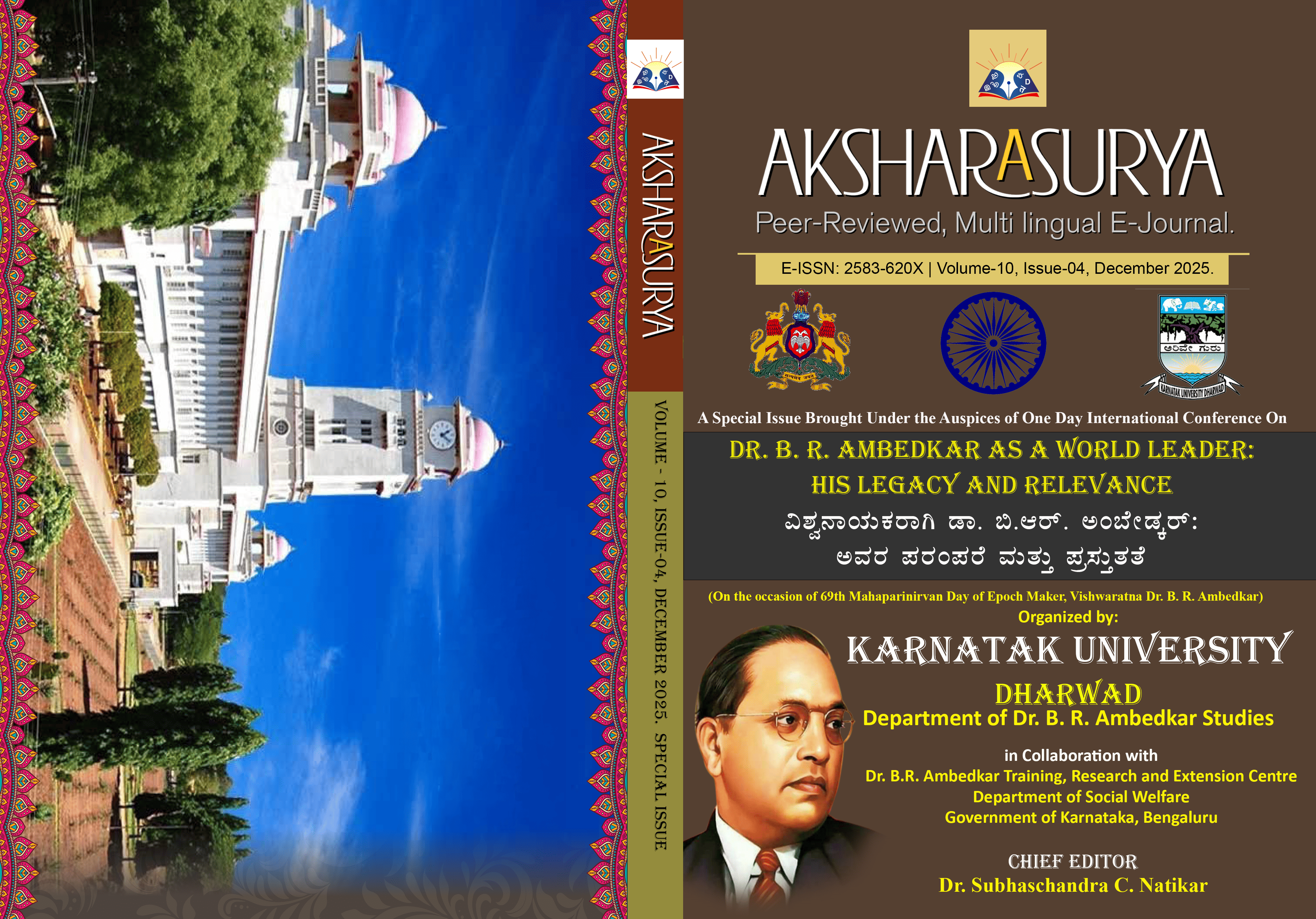
Main Article Content
Abstract
Dr. B. R. Ambedkar redefined the framework of women's empowerment in India by grounding it in the principles of liberty, equality, and justice. Dissimilar mainstream feminist discourses of his time, Ambedkar's approach was intersectional recognizing that caste, class, and gender together shaped women's oppression, particularly for Dalit and marginalized women. His efforts in constitutional drafting, labor rights, education reform, and social activism uniquely positioned him as a pioneer of inclusive feminism in India. His legislative reforms, educational advocacy, and insistence on women's political and economic participation marked a radical shift in Indian feminism. This paper delves into how Ambedkar laid the foundation for inclusive feminist discourse in India, highlighting its continuing relevance in addressing the challenges faced by marginalized women today. And its explores that, Dr. B. R. Ambedkar's transformative feminist philosophy that redefined the path of women's empowerment in India.
Article Details
Section

This work is licensed under a Creative Commons Attribution-NonCommercial-ShareAlike 4.0 International License.
How to Cite
References
Ambedkar, B. R. (1957). The Buddha and His Dhamma. Bombay: Siddharth College Publications.
Ambedkar, B.R. (1945). What Congress and Gandhi Have Done to the Untouchables.
Ambedkar, B.R. (1957). The Buddha and His Dhamma.
Government of India. (1950). The Constitution of India
Guru, Gopal. (1995). Dalit Women Talk Differently: A Critique of “Difference” and Towards a Dalit Feminist Standpoint Position. Economic and Political Weekly.
Kumar, Raj. (2006). Dalit Personal Narratives.
Kumar, Raj. (2016). Ambedkar and Social Justice: A Study in Social Philosophy. New Delhi: Rawat Publications.
Moon, Vasant (Ed.). (1991). Dr. Babasaheb Ambedkar: Writings and Speeches (Vols. 1–17). Government of Maharashtra.
Omvedt, Gail. (1994). Dalits and the Democratic Revolution.
Omvedt, Gail. (2004). Ambedkar: Towards an Enlightened India. New Delhi: Penguin..
Paik, Shailaja. (2014). Dalit Women's Education in Modern India.
Paik, Shailaja. (2014). Dalit Women's Education in Modern India: Double Discrimination. New York: Routledge.
Rege, Sharmila. (2006). Writing Caste/Writing Gender.
Rege, Sharmila. (2006). Writing Caste/Writing Gender: Narrating Dalit Women's Testimonios. New Delhi: Zubaan.
Teltumbde, Anand. (2005). Ambedkar in and for the Post-Ambedkar Dalit Movement. Pune: Sugawa Prakashan.
Zelliot, Eleanor. (2005). Ambedkar's World: The Making of Babasaheb and the Dalit Movement. New Delhi: Navayana.