
Dr. B. R. Ambedkar’s Feminist Vision in Women’s Empowerment and Its Contemporary Relevance
Article Sidebar
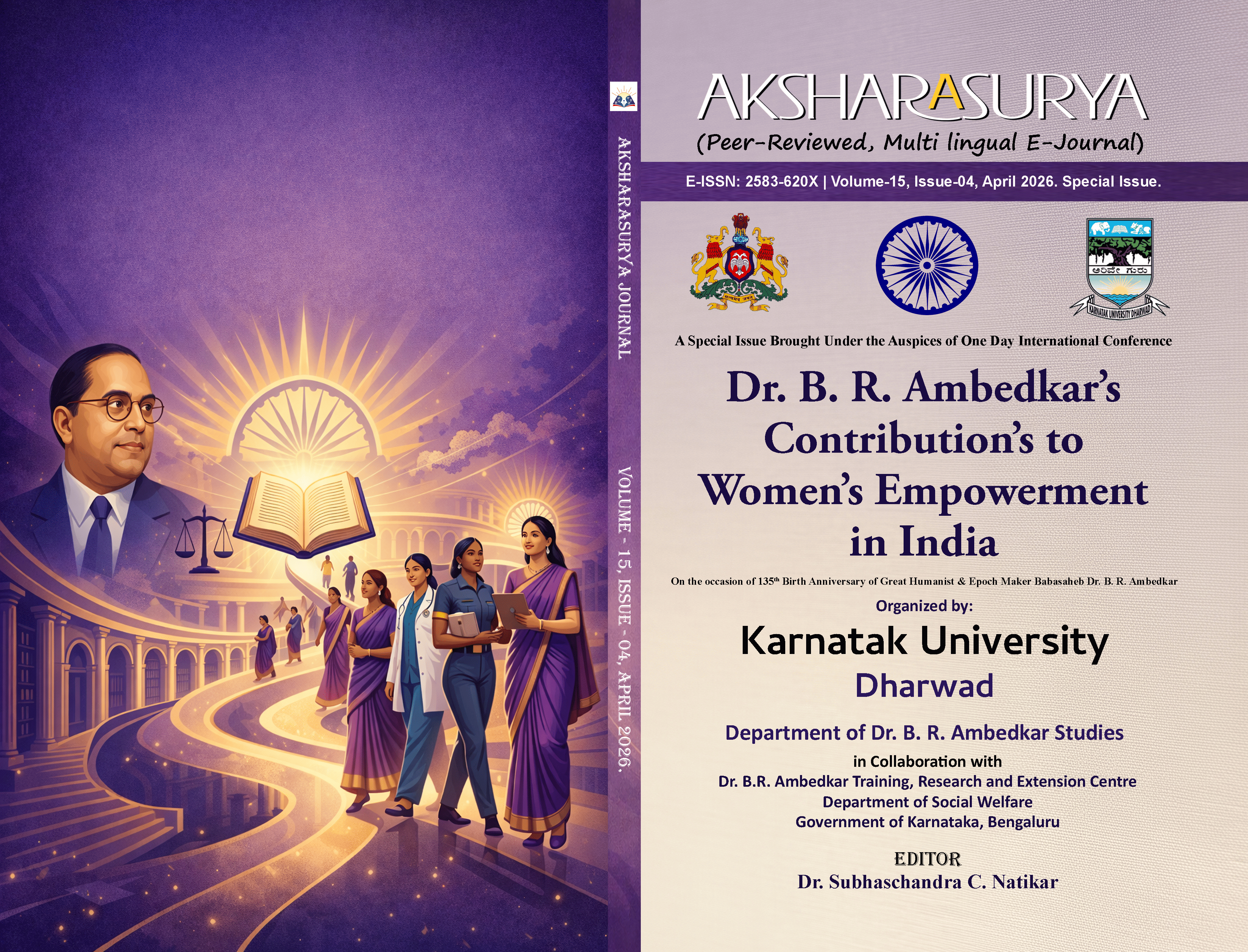
Main Article Content
Abstract
Women’s empowerment in India is deeply shaped by the interplay of caste, class and gender hierarchies. B. R. Ambedkar articulated a transformative vision of social justice that placed women’s emancipation at the center of societal progress. This paper offers a detailed and critical exploration of Ambedkar’s feminist thought, focusing on his analysis of patriarchy, his advocacy for legal reforms and his emphasis on education and economic independence. Moving beyond descriptive narratives the study situates his ideas within contemporary debates on gender equality and intersectionality. It argues that Ambedkar’s approach provides a comprehensive framework for addressing structural inequalities and continues to hold significant relevance in shaping policies, social work practices and feminist discourse in modern India.
Article Details
Section

This work is licensed under a Creative Commons Attribution-NonCommercial-ShareAlike 4.0 International License.
How to Cite
References
Dr. B. R. Ambedkar. Annihilation of Caste. 1936.
Dr. B. R. Ambedkar. States and Minorities. 1947.
Dr. B. R. Ambedkar. The Hindu Code Bill. 1948.
Gopal Guru. “Dalit Women Talk Differently: A Critique of ‘Difference’ and ‘Towards a Dalit Feminist Standpoint.’” Economic and Political Weekly, vol. 30, no. 41/42, 1995, pp. 2548–2550.
Gail Omvedt. Ambedkar: Towards an Enlightened India. Penguin, 2004.
Sharmila Rege. Against the Madness of Manu: B. R. Ambedkar’s Writings on Brahmanical Patriarchy. Navayana, 2013.
Susie Tharu, and Tejaswini Niranjana. “Problems for a Contemporary Theory of Gender.” Social Scientist, vol. 27, no. 1/2, 1999, pp. 93–117.