
Dr. B.R. Ambedkar's Views on Population, Birth Control and Reproductive Rights
Article Sidebar
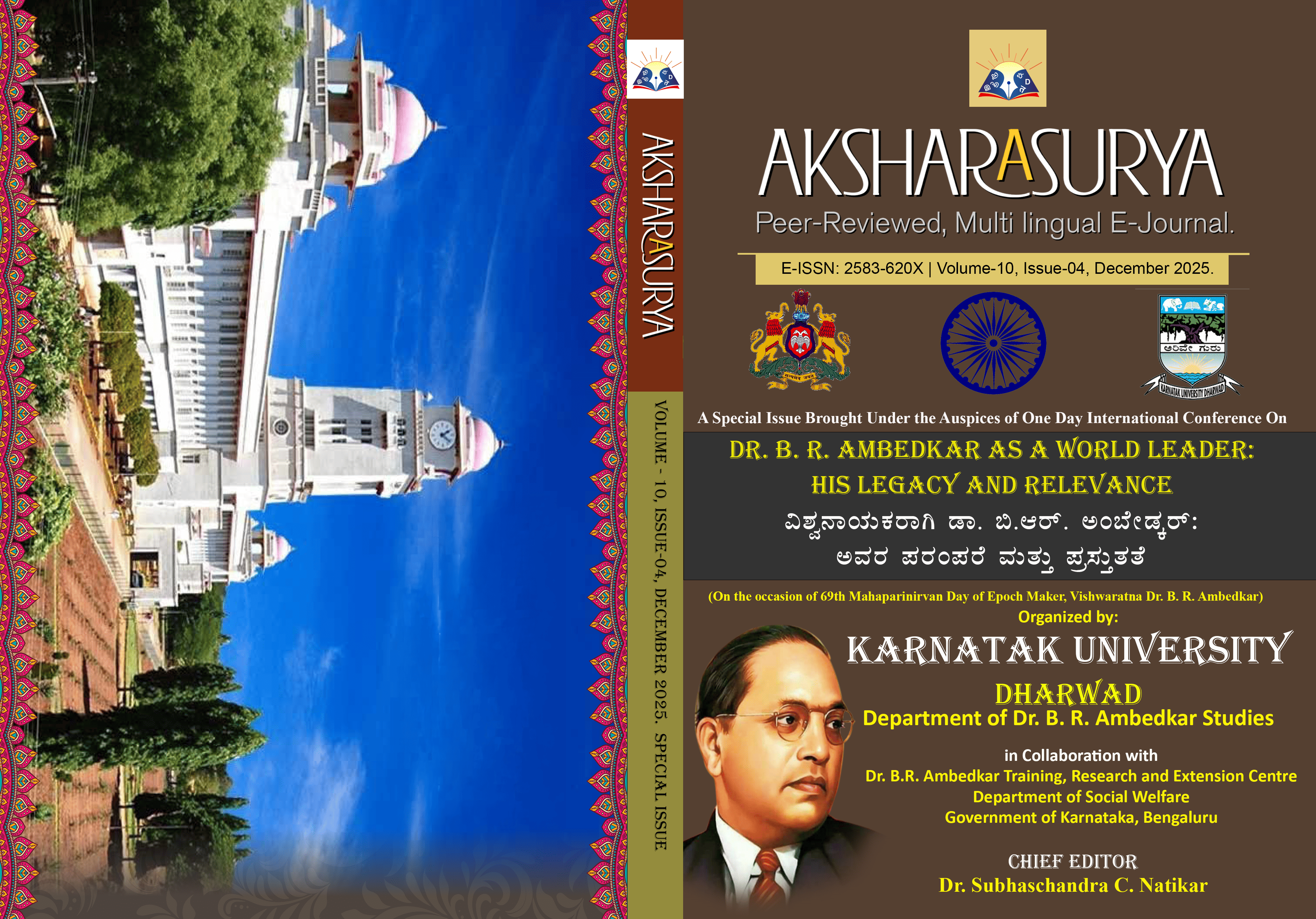
Main Article Content
Abstract
Dr. Ambedkar's visionary stance on women's rights—including what we today understand as reproductive rights—is equally significant but often underexplored. Though the contemporary framework of “Reproductive Rights” was not articulated during Ambedkar's lifetime, his work consistently emphasized the centrality of bodily autonomy, gender equality, and social reform as preconditions for genuine liberation. Reproductive Rights can be traced through his writings, speeches, and especially his legislative efforts. Poverty is the cause of overpopulation in our country, unfortunately, today also, it is highly impossible to uproot poverty without the aid of birth-control. As a champion of female health and birth control measures, Ambedkar enthusiastically asserted it is, therefore, established that there is no go without recourse to modern contraceptives. As an economist, our expectations increase on how Dr Ambedkar visualized the role of population control policy in the development of the country further maintaining the economic balance of the state. The aim of the paper is to throw light on Ambedkar's views on reproductive rights, though expressed in the language of his time, align closely with modern principles of reproductive justice. His insistence on equality, autonomy, and dignity for all, especially for women at the intersection of caste and gender oppression, makes his thought highly relevant to ongoing debates about reproductive freedom in India. As we revisit his legacy, it becomes clear that Ambedkar not only envisioned political freedom but also a deeply personal, social freedom—one that included the right of every woman to control her own body and destiny.
Article Details
Section

This work is licensed under a Creative Commons Attribution-NonCommercial-ShareAlike 4.0 International License.
How to Cite
References
Government of India, National Plan of Action for Children, Ministry of Women and Child Development, 2016, p-20.
www.censusindia.gov.in
Dr Babsaheb Ambedkar Writings and Speeches, Vol. II, p-264.
Ibid
Narendra Kumar and Sukhadeo Thorat, B.R. Ambedkar Perspective on Social Exclusion and Inclusive Policies, (New Delhi: Oxford University Press, 2008); S. Thorat, S and N. Kumar, B.R. Ambedkar: Perspectives on Social Exclusion and Inclusive Policies, (New Delhi: Oxford University Press, New Delhi, 2008); E. Zelliot, From Untouchable to Dalits: Essays on Ambedkar Movements, ( New Delhi: Manohar Publications, 2005); A. Rao, The Caste Question: Dalits and Politics of Modern India, (London: University of California Press, 2009); C. Jaferrlot, Dr. Ambedkar and Untouchablity: Analysing and Fighting Caste, Oxford University Press (New Delhi: OUP, 2004), Ishan Khan, Ambedkar's relation with Jatavas (Landless Labourers) of Agra, Research Journal of Humanities and Social Sciences, 2018; 9(4): 799-802
Dr. Rajendra D. Jeur, Relevance Of Dr. B. R. Ambedkar's Thoughts On Family Planning, Research Journali's Jornal of Sociology, Jan. 2014. Last accessed- 11 December 2016. Available from- www.ijcrt.org/papers/IJCRT1133046.pdf
Dr. Suresh Bhadarge, Dr. B. R. Ambedkar approach towards Family Planning, International Journal of Creative Research Thoughts, 5(1), March 2017, Last accessed 10 December 2017. Available from- Last accessed: http://www.researchjournali.com /view.php?id=336.
Dr. Babsaheb Ambedkar Writings and Speeches, Vol. II, p-268.
Dr. Babsaheb Ambedkar Writings and Speeches, Vol. II, pp-267-68.
Dr. Babsaheb Ambedkar Writings and Speeches, Vol. II, p-264.
Maneesha Lal, “The ignorance of women is the house of illness”: Gender, nationalism, and health reform in colonial North India, pp-14-40 in Mary P. Sutphen and Bridie Andrews (ed.), Medicine and Colonial Identity, (London: Routledge, 2003).
Dr. Babsaheb Ambedkar,Writings and Speeches, Vol. II, pp 272-73
Dr. Babsaheb Ambedkar Writings and Speeches, Vol. II, pp-272-73.
Dr. Babsaheb Ambedkar Writings and Speeches, Vol. II, p-265.
Dr. Babsaheb Ambedkar Writings and Speeches, Vol. II, p-267.
Dr. Babsaheb Ambedkar Writings and Speeches, Vol. II, p-274.
Dr. Babsaheb Ambedkar Writings and Speeches, Vol. II, p-275.