
Women's Liberation for Social Justice through the Perspective of Dr. B. R. Ambedkar
Article Sidebar
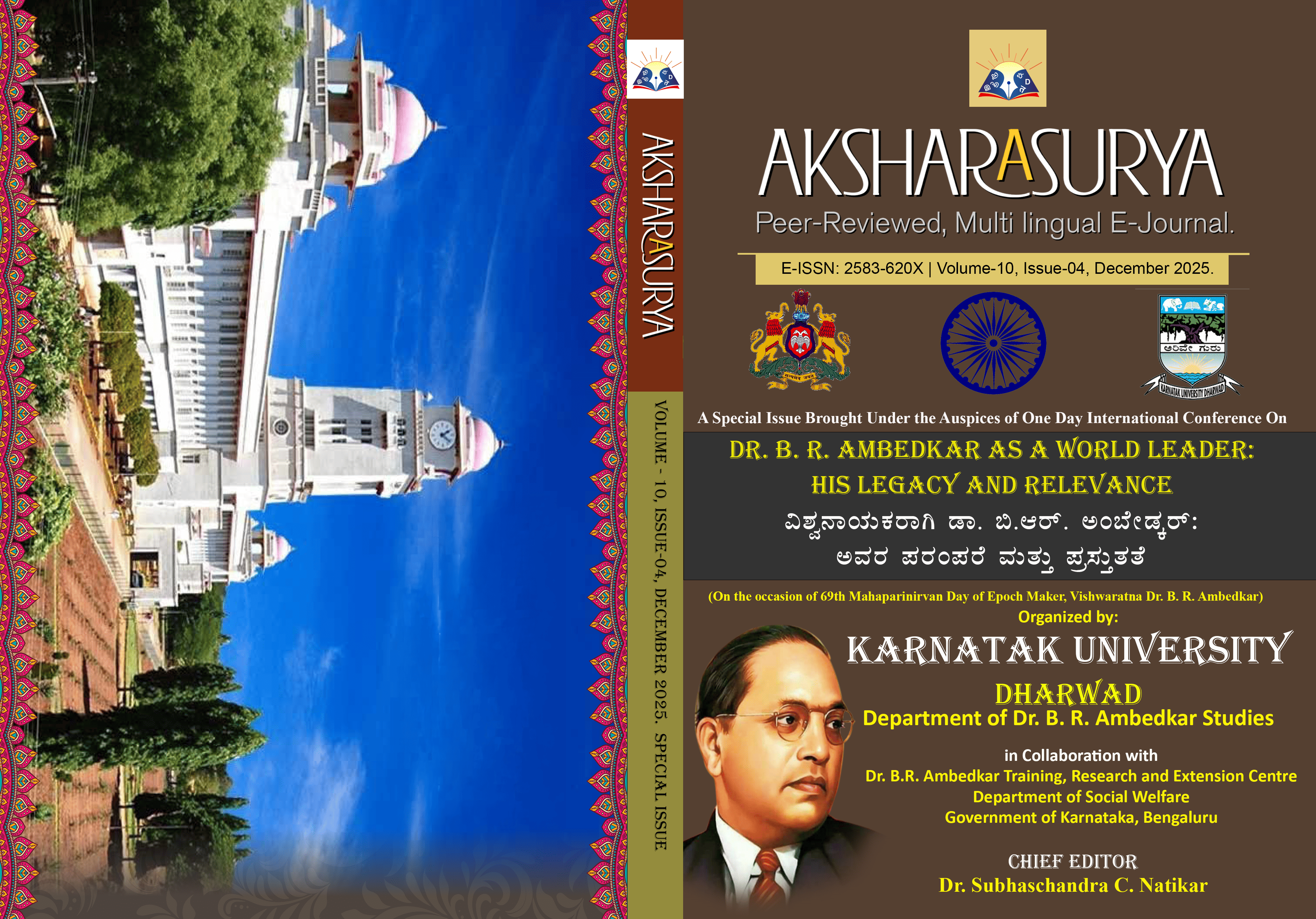
Main Article Content
Abstract
The people are aware of constant efforts to improve women's status in Indian society. These are a few of Dr. B.R. Ambedkar's lesser-known sayings, concepts, ideas, and writings about the empowerment of women. Celebrating Women's Day without honoring the efforts of Mahatma Jotiba Phule, Dr. Ambedkar, and Savitribai Phule is dishonorable and hypocritical. Dr. B. R. Ambedkar launched two periodicals, Mooknayak and Bahiskrit Bharat, both of which focused mostly on issues related to women's empowerment. Dr. Ambedkar has always been concerned with women's empowerments. In a letter written to his father's friend while he was still in New York, the young Dr. Ambedkar expressed his belief that progress would be accelerated and better times would soon come if education for both genders was promoted. On 18 July 1927, Dr Ambedkar spoke to a crowd of more than 3,000 women from lower socio-economic classes, “I measure the progress of community by the degree of progress which women had achieved.” Empowerment is the process of increasing one's own or a community's spiritual, political, social, or economic power. Women's empowerment and autonomy, along with advances to their political, social, economic, and health status, are not only a very important aim in and of themselves, but they are also necessary for the accomplishment of sustainable human progress. Dr. Babasaheb Ambedkar's achievements as the chairman of the Constitution Drafting Committee have shaped India's socio-political environment and left a lasting impact on the social fabric of the country long after independence. India most likely would have been a very different, unfair, and unjust place without him. He put a lot of effort into building a constitutional democracy that has a political system that is considerate to the poor, regardless of whether their circumstances are the product of current social relations or historical legacies. In addition, he worked to provide India new social and moral underpinnings. Dr. Ambedkar had the highest educational credentials of any Indian at the time and was widely acknowledged for his learning and erudition. Dr. B.R. Ambedkar is widely acknowledged as the father of the Indian Constitution. But reading several volumes about his life and work and his ideas about India's future will show that, beyond being a serious scholar, he was also a formidable debater, an effective teacher, a capable lawyer, a devoted writer, a renowned educationalist, a social rebel, and a multifaceted genius. He was an ardent supporter of human rights, an accomplished statesman, a liberal liberator, a strong proponent of constitutionalism, a fearless defender of the downtrodden masses, and a first-rate administrator.
Article Details
Section

This work is licensed under a Creative Commons Attribution-NonCommercial-ShareAlike 4.0 International License.
How to Cite
References
Government of Maharashtra (2008) Ambedkar, B. R. Writings and Speeches. Vol. 3. Mumbai:, Education Department,.
Bakshi, S. (2017, April 4). Ambedkar on women. Retrieved from http://www.dailyexcelsior.com/ambedkar-on-women/
Barnwal, K. B. (2014). Dr. B. R. Ambedkar's quest for gender equality its relevance in contemporary feminist discourse. International Interdisciplinary Research Journal, IV(11), 393–400.
Das, S. (2015). Ambedkar and women rights: An analysis. International Research Journal of Interdisciplinary and Multidisciplinary Studies, I(I), 191–195.
Katulkar, R. (2008, August 31). Dr. Ambedkar on women liberation. Retrieved from http://www.countercurrents.org/Katulkar3108
Kumar, B. (2016). Liberating Indian women from slavery: An analysis of Dr. Ambedkar's contribution for uplifting Indian women's rights. International Journal of English Language, Literature and Humanities, IV(I), 212–219.
Sawant, C. (2015, April 14). Women should understand Dr. Ambedkar's teachings. The Free Press Journal. Retrieved from http://www.freepressjournal.in/mumbai/women -should-understand-dr-ambedkarsteachings/565508
Singariya, M. R. (2014). Dr. B. R. Ambedkar and women empowerment in India. Quest Journals, Journal of Research in Humanities and Social Science, 2(1), 1–4.
Tiwari, R., Meshram, S. H. (n.d.). Dr. Ambedkar's contribution to women development.Academia.Retrievedfrom http://www.academia.edu/11998296/ Dr._Ambedkar_s_contribution _to_women_development1
Gunjal V.R (2012), Dr. Babasaheb Ambedkar and Women Empowerment, Social Work, Vol. XI (1), pp 84-85.
Vaisali Dhanvijay, (2012) “Dr. Babasaheb Ambedkar's efforts for women empowerment and present status of women in society, Electronic International Interdisciplinary Research Journal (EIIRJ), {Bi-Monthly}, Volume-I, Issue II.
Ambedkar, B.R (1987), “Women and Counter Revolution” Riddles of Hindu Women” in Dr. Babasaheb Ambedkar.
Gore, M S. (1994) The Social Context of an Ideology: Ambedkar's Political and Social Thought. New Delhi: Sage Publications, pp.l5-18.
S. R. Manjula, (2017) Emancipation of Women: Dr. B. R. Ambedkar's Perspectives, Journal of Advances and Scholarly Researches in Allied Education [JASRAE] Volume: 14 /Issue: 1, Pages: 1 - 6 (6) DOI: 10.29070/JASRAE