
Revisiting Ambedkar's Democratic Philosophy: Foundational Perspectives on Tribal Development in India
Article Sidebar
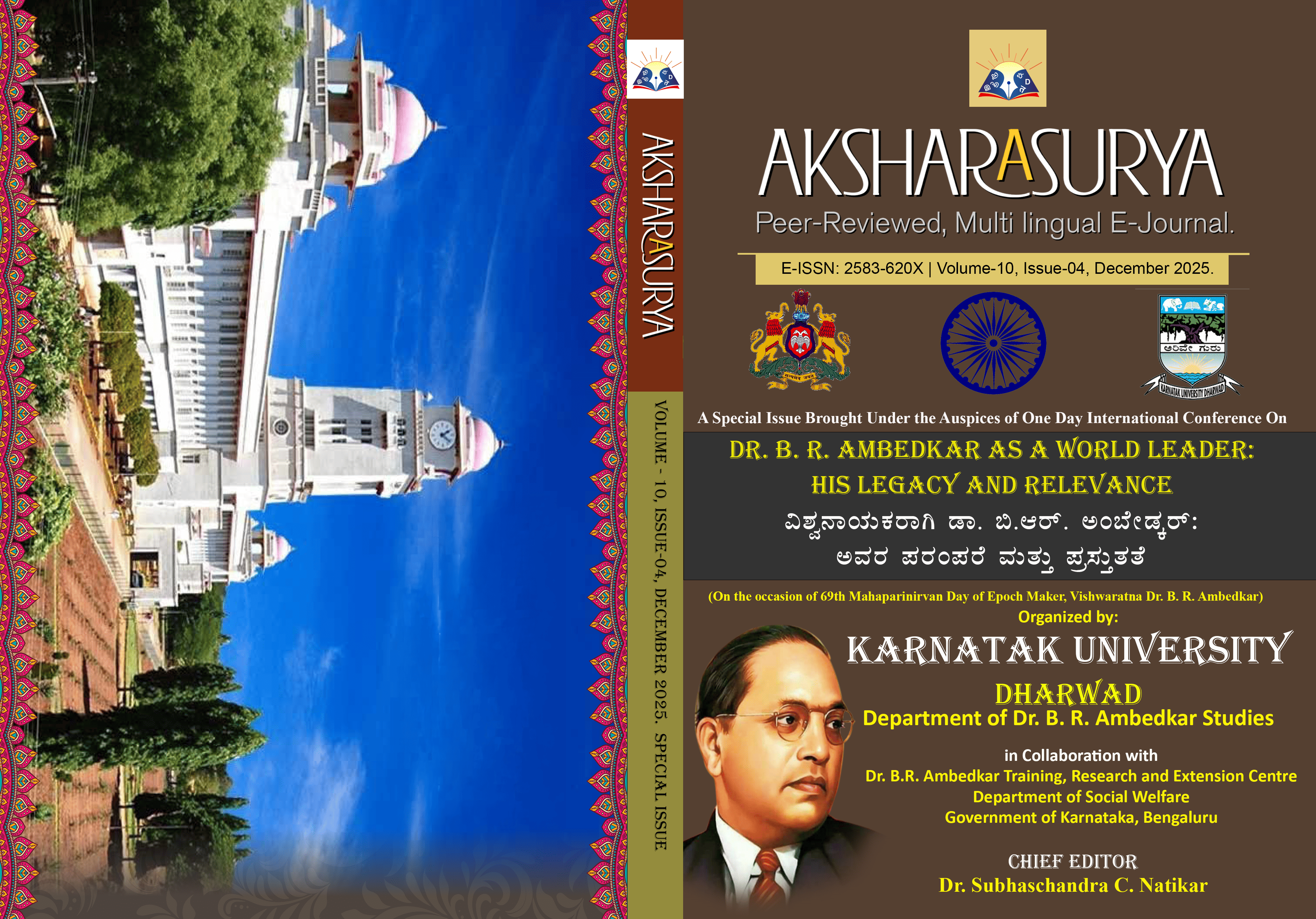
Main Article Content
Abstract
Dr. B.R. Ambedkar's democratic philosophy, rooted in social democracy, constitutional morality, and human dignity, offers critical perspectives for addressing tribal marginalization in India. Despite constitutional protections and affirmative action policies, tribal communities continue to experience systemic exclusion, economic deprivation, and cultural erosion. This paper examines Ambedkar's foundational principles—education as liberation, women's rights, political participation, and dismantling hierarchical structures—to develop a transformative framework for tribal empowerment beyond paternalistic welfare approaches. By integrating Ambedkarite philosophy with participatory development models, policymakers can address structural causes of marginalization while respecting cultural autonomy and self-determination.
Article Details
Section

This work is licensed under a Creative Commons Attribution-NonCommercial-ShareAlike 4.0 International License.
How to Cite
References
Ambedkar, Bhimrao Ramji. Annihilation of Caste. Thacker & Co., 1936.
"Draft Constitution – Speech." Constituent Assembly Debates, 25 Nov. 1949.
"To the Educated Scheduled Castes." Dr. Babasaheb Ambedkar: Writings and Speeches, edited by Vasant Moon, vol. 17, Government of Maharashtra, 1942.
Baviskar, Amita. In the Belly of the River: Tribal Conflicts over Development in the Narmada Valley. Oxford UP, 2005.
Census of India. Scheduled Tribes in India. Office of the Registrar General, 2011.
Deshpande, Satish. "Tribal Education in India: The Predicament and the Context." Indian Journal of Social Development, vol. 13, no. 1, 2013, pp. 87-104.
Guru, Gopal. "Ambedkar and the Future of Indian Democracy." Economic and Political Weekly, vol. 51, no. 15, 2016, pp. 45-52.
Jaffrelot, Christophe. Dr. Ambedkar and Untouchability: Analysing and Fighting Caste. Permanent Black, 2005.
Jayal, Niraja Gopal. Citizenship and Its Discontents: An Indian History. Harvard UP, 2013.
Ministry of Tribal Affairs. Annual Report 2017-18. Government of India, 2018.
Padel, Felix, and Samarendra Das. Out of This Earth: East India Adivasis and the Aluminium Cartel. Orient BlackSwan, 2010.
Rodrigues, Valerian. "Ambedkar's Political Philosophy." The Cracked Mirror: An Indian Debate on Experience and Theory, edited by Gopal Guru and Sundar Sarukkai, Oxford UP, 2017, pp. 134-57.
Sarin, Madhu. "Undoing Historical Injustice: Reclaiming Citizenship Rights and Democratic Governance for India's Forest Dwellers." Natural Resources Forum, vol. 38, no. 3, 2014, pp. 175-84.
Shah, Ghanshyam, et al. Untouchability in Rural India. Sage Publications, 2017.
Sundar, Nandini. The Burning Forest: India's War in Bastar. Juggernaut Books, 2016.
World Bank. Poverty and Social Exclusion in India. World Bank Publications, 2011.
Xaxa, Virginius. State, Society, and Tribes: Issues in Post-Colonial India. Pearson Longman, 2008.