
Dr. Babasaheb Ambedkar and Human Right
Article Sidebar
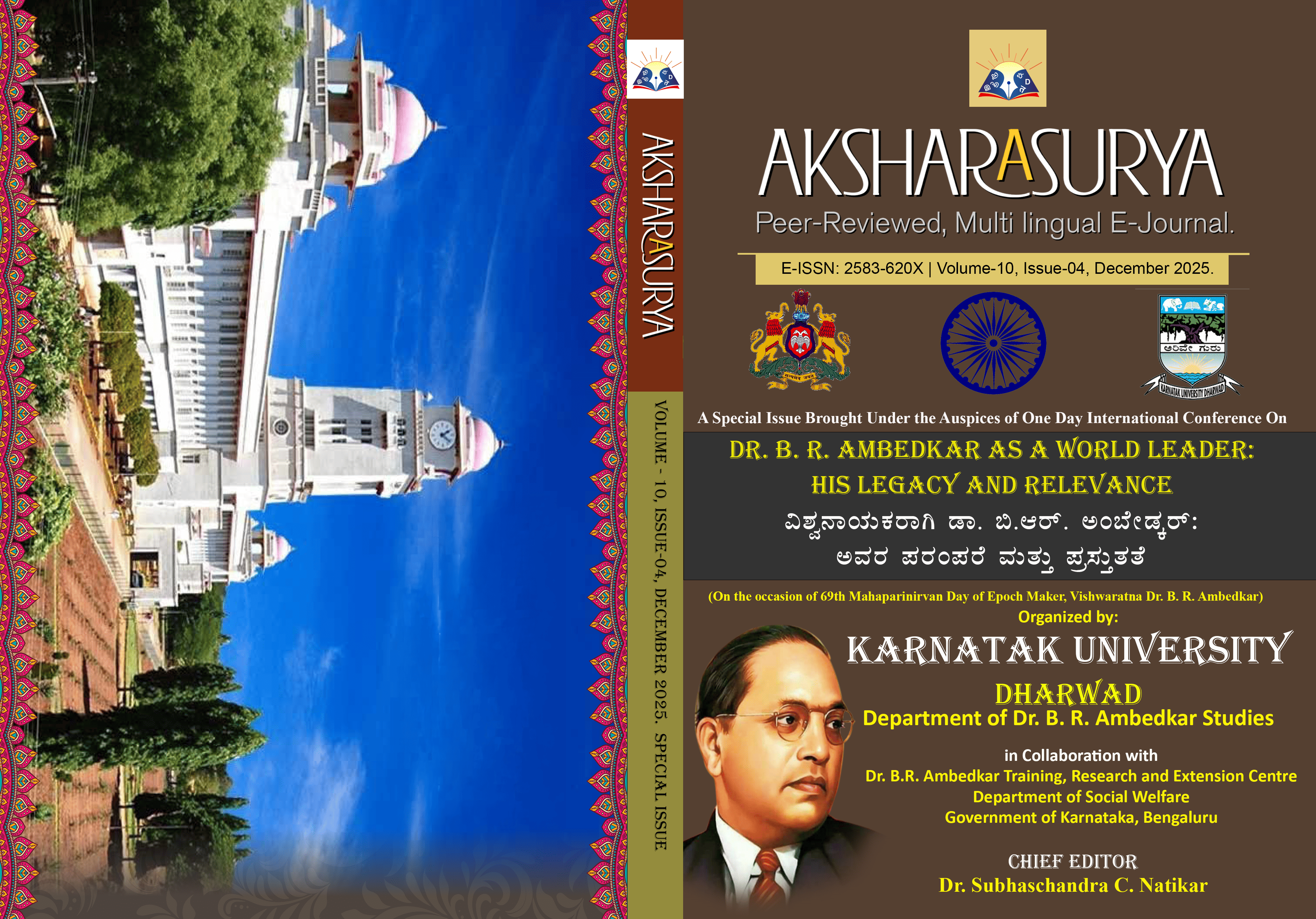
Main Article Content
Abstract
The present paper focuses on the basic issues which are barriers to the egalitarian democracy of Indiansocial system: Brahmanism and equivalent to the caste and class systems respectively. The paper adopts a novelperspective that is quite unknown to the west which perceives basic human rights as natural rights. In fact, thestate is a social construction and human rights are the legal output. The paper proposes an alternative remedy tohuman rights issues in Indian context that is Ambedkar's thought which can be better qualified as Ambedkarism; asocial medicine for caste-ridden sick Indian social order. In the end, in order to adopt human rights as a part oflife to establish just social order, a series of strategies compatible with Indian situations are proposed; as used byDr Ambedkar himself.
Article Details
Section

This work is licensed under a Creative Commons Attribution-NonCommercial-ShareAlike 4.0 International License.
How to Cite
References
Ambedkar, (1990). Philosophy of Hinduism. In V. Moon, Dr Babasaheb Ambedkar Writings and SpeechesVol.3 (p. 379). Mumbai: Government of Maharashtra.
Ambedkar, (2014). Untouchables or the Children of India's Ghetto. In V. Moon, Dr Babasaheb AmbedkarWritngs and Speeches (pp. 66, 5). New Delhi: Dr Ambedkar Foundation.
Charanjit Singh, M. N. (2008). Concept of Human Rights and the Indian Constitution. In B. Sehgal,Human Rights in India Problems and Perspectives (pp. 288-296). New Delhi: Deep and Deep PublicationsPvt Ltd.
Cornescu, A. V. (2009). The Generations of Human Rights. Days of Law: The Conference Proceedings 1(p. 11). Brno: Masaryk University.
Centre, I. H. (2018). Concept of Human Rights. Retrieved October 13, 2018, from Icelandic HumanRights Centre: http://www.humanrights.is/en/human-rights-education-project/human-rightsconceptsideas-and-fora/part-i-the-concept-of-human-rights
Keer, D. (2016). Dr. Babasaheb Ambedkar. Mumbai: Popular Prakashan.
Kishore, M. A. (2005). B. R. Ambedkar: His Approach Towards Human Rights. In A. Shabbir, Ambedkaron Law, Constitution and Social Justice (pp. 234-236). Jaipur: Rawat Publication.
MoL J, M. o. (2018, July 31). Document Files. Retrieved October 14, 2018, from Legislative Department:http://www.legislative.gov.in/sites/default/files/COI-updated-as-31072018.pdf
Rao, A. V. (2006). Bharata Ratna Dr. B. R. Ambedkar: A Champion of Human Rights with SpecialReference to Scheduled Castes and Scheduled Tribes. Indian Political Science Association 901-906.
Zelliot, E. (2012). Ambedkar's World the Making of the Babasaheb and Dalit Movement. New Delhi:Navayana.
Zelliot, E. (1996). From Untouchable to Dalit Essay on the Ambedkar Movement. New Delhi: ManoharPublishers.