
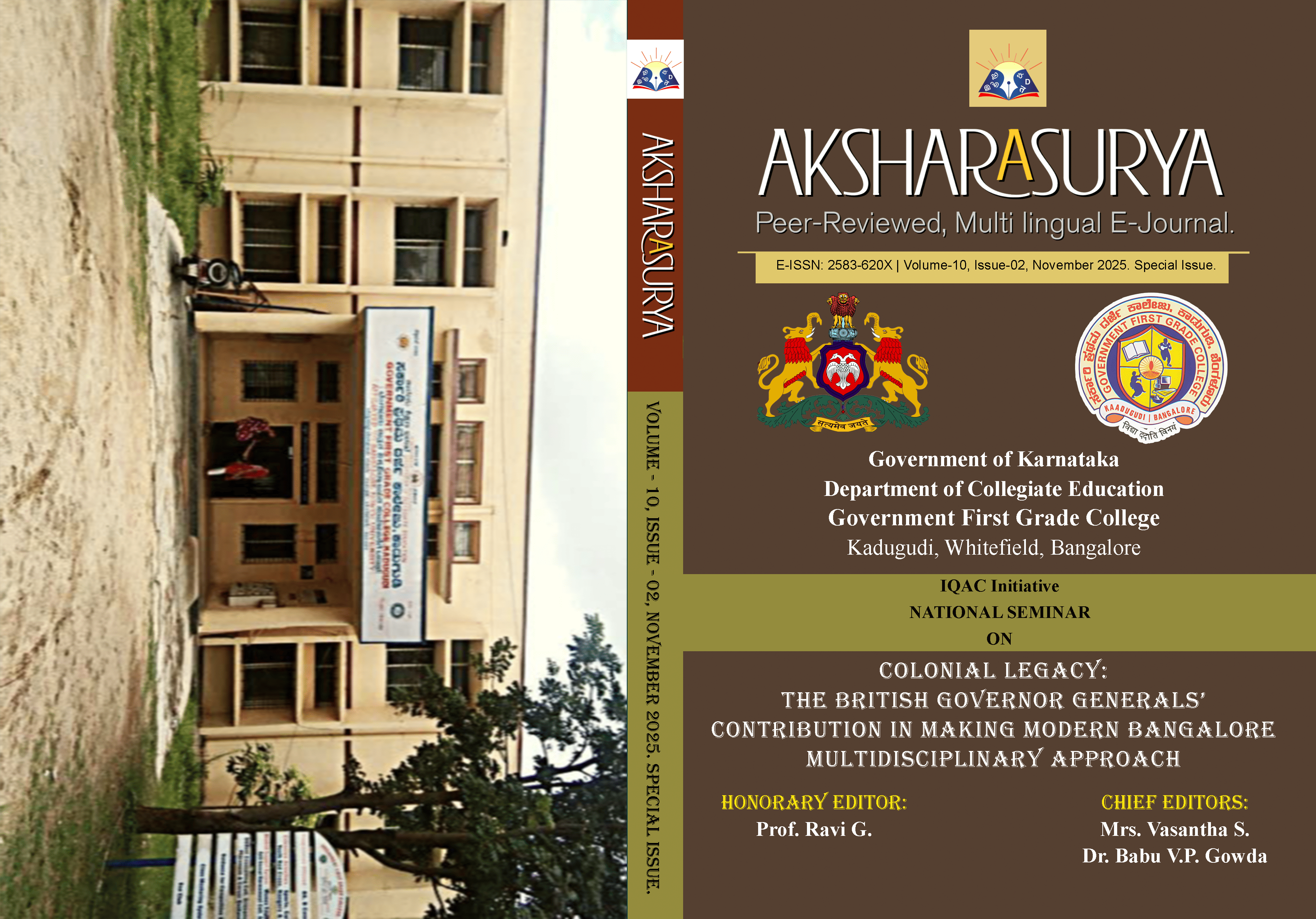
Published: 2025-11-23
Table of Contents
Research Articles
From Cantonment to Commercial Hub: Colonial Policies and Trade in Bangalore
01 to 06
This paper analyzes how colonial-era policies transformed Bangalore from a military cantonment into a commercial hub between ca. 1800 and 1920. The cantonment initially served as a concentrated demand node, but sustained commercialization was driven by targeted infrastructural investments. Specific policies—urban planning, rail transport development, and municipal/land regulations—reoriented pre-existing trade patterns, facilitated commercial aggregation, and enabled the emergence of hybrid merchant networks. The study concludes that while these institutional and spatial choices were foundational to Bangalore's economic prominence, they also embedded the socio-spatial inequalities visible in its modern urban form.
Administrative and Governance Reforms During the British Governor Generals’
07 to 13
The British colonial period in India witnessed significant transformations in administrative and governance structures, particularly under various Governor Generals who served as the highest authority of the British East India Company and later the British Crown. This paper explores the key reforms initiated by notable Governor Generals such as Warren Hastings, Lord Cornwallis, Lord Wellesley, Lord William Bentinck, and Lord Dalhousie, among others. These reforms encompassed areas such as civil administration, judiciary, police, revenue systems, and education, laying the groundwork for a centralized bureaucratic state. The introduction of the Permanent Settlement, codification of laws, professionalization of the Indian Civil Service, and various social reforms not only reshaped governance in colonial India but also had long-term impacts on the post-independence administrative framework. The study critically examines the motives behind these reforms, evaluating whether they were intended for efficient governance or to consolidate colonial control. Ultimately, the reforms reflected a blend of utilitarian ideals and imperial interests, marking a turning point in India’s colonial history.The British colonial period in India witnessed significant transformations in administrative and governance structures, particularly under various Governor Generals who served as the highest authority of the British East India Company and later the British Crown. This paper explores the key reforms initiated by notable Governor Generals such as Warren Hastings, Lord Cornwallis, Lord Wellesley, Lord William Bentinck, and Lord Dalhousie, among others. These reforms encompassed areas such as civil administration, judiciary, police, revenue systems, and education, laying the groundwork for a centralized bureaucratic state. The introduction of the Permanent Settlement, codification of laws, professionalization of the Indian Civil Service, and various social reforms not only reshaped governance in colonial India but also had long-term impacts on the post-independence administrative framework. The study critically examines the motives behind these reforms, evaluating whether they were intended for efficient governance or to consolidate colonial control. Ultimately, the reforms reflected a blend of utilitarian ideals and imperial interests, marking a turning point in India’s colonial history.
Governor-General Directives and Local Bureaucracy: Implementation and Resistance in Bangalore
14 to 23
This study examines the Governor-General directives and the local bureaucracy in Bangalore during British colonial rule, highlighting both implementation strategies and forms of resistance. Following the defeat of Tipu Sultan in 1799, Bangalore emerged as a strategic administrative and military hub, with the British establishing the Cantonment alongside the native town. Governor-General directives aimed at standardizing revenue collection, municipal administration, public health, infrastructure, and law enforcement were central to consolidating imperial control. These orders were transmitted through the hierarchical administrative chain from Calcutta to the Madras Government, the Mysore Commissioner, and finally to local officers, including European officials and Indian subordinates. Implementation involved the establishment of municipal boards, public works departments, and policing structures, often blending technical rationality with bureaucratic discretion. However, the directives’ execution was uneven due to resource constraints, local socio-political dynamics, and the hybrid nature of governance within a princely state. Resistance emerged in multiple forms: bureaucratic hesitation, selective enforcement, civic protests, and social opposition to public health and taxation measures. Notably, measures during plague outbreaks in the late nineteenth century provoked significant local opposition, revealing tensions between colonial authority and indigenous norms.
The study demonstrates that Bangalore’s bureaucracy functioned as both an executor and mediator of colonial power, negotiating between the Governor-General’s objectives and local realities. The interplay of directives, implementation, and resistance not only shaped the administrative landscape of the city but also fostered civic consciousness and practices of negotiation that influenced subsequent reforms. Understanding this dynamic provides insight into the mechanisms of colonial governance, the limitations of central authority, and the emergence of hybrid administrative practices in South India.
Cantonment And Cluster: How The British Military Presence Shaped Early Industrial Concentrations in Bangalore (1806–1900)
24 to 33
The establishment of the British cantonment in Bangalore in 1806 marked a turning point in the city’s economic and industrial development. The cantonment, strategically located on the eastern periphery of the native pete, created a concentrated demand for goods and services, effectively acting as a catalyst for early industrial clustering. Industries such as leatherworking, carpentry, metalworking, and textile production emerged in proximity to the military installation, responding to both the scale and standardization of military procurement. The spatial segregation between the cantonment and the pete facilitated the formation of distinct industrial zones, where labor specialization, technological adoption, and market-oriented production were more pronounced than in traditional artisanal neighbourhoods.
Infrastructure development under British administration-roads, water supply, sanitation, and communication networks-further reinforced the concentration of workshops and related enterprises. These measures not only supported the logistical needs of the military but also reduced transaction costs for producers, encouraging agglomeration economies. The influx of migrant labor, structured along caste and community lines, shaped the social organization of the clusters, while women and children contributed to auxiliary production in cottage industries. Military demand fostered the adoption of standardized techniques, mechanized tools, and managerial practices, facilitating technological and institutional transfer to local artisans. Over time, the clusters evolved into resilient industrial ecosystems, linking Bangalore to regional and imperial supply networks. This study examines the interplay between colonial governance, military procurement, infrastructure, labor mobility, and technological diffusion to understand how the British cantonment influenced early industrial concentrations in Bangalore. It highlights the long-term impact of institutional and economic interventions on the city’s industrial landscape, offering insights into the processes of urban-industrial formation under colonial rule.
Social Stratification and Class Formations Under Colonial Rule
34 to 41
Social stratification means in the domain of sociology and how the concept had appeared sporadically in the writings of the philosophers, social as well as political thinkers through different periods of history. This paper is also introduces you about social inequality and natural inequality and helps you to draw the differences between them along with major dimensions of social stratification. Further we explain what hierarchy is and how it is intimately tagged with caste and class. Furthermore this unit describes how social stratification by nature relates to the unequal distribution of power, privilege and prestige in the society Social stratification generally refers to the socially ordered hierarchical positions of men in the human society. It is manmade. Right from antiquity to the present or in other words right from the dawn of human civilization i.e., starting from the simplest societies to the present day complex modern societies stratification is an inevitable phenomenon, and interestingly it is continuing through the ages. No human society is unstratified and hence it can be said that there is no society known to the mankind at different phases of history that does not make some distinction between individuals by ranking them in higher and lower positions in the society or societies where they live.
The Role of Governor(S) - Legal Perspective, With Special Reference to Bengaluru’s Administration
42 to 50
The institution of the Governor plays a key role in India’s constitutional and administrative system, connecting the Union and the States. While the Governor serves as the nominal head of the State, the position comes with important constitutional duties that help maintain federal balance and uphold democratic governance. This article looks at the Governor’s role from a legal and constitutional viewpoint, focusing on the details of gubernatorial powers under Articles 153 to 162 of the Indian Constitution.
By closely examining judicial cases like S.R. Bommai v. Union of India, Shamsher Singh v. State of Punjab, and Nabam Rebia v. Deputy Speaker, the study shows how the judiciary has gradually clarified and limited the discretionary powers of Governors to protect democratic principles. The article also delves into the practical effects of these powers on Bengaluru’s administration, since the city is the center of Karnataka’s executive and legislative activities.
In Bengaluru, the Governor’s influence reaches legislative oversight, approval of bills related to urban governance, and serving as the Chancellor of major universities. The article discusses how these powers affect policy decisions, administrative continuity, and educational governance in the capital. However, it also critically assesses issues of political misuse, central interference, and constitutional conflicts that have sometimes arisen in the use of gubernatorial authority.
Ultimately, the article argues that the Governor’s office should operate with constitutional neutrality, accountability, and transparency, making sure that its actions support rather than weaken state autonomy. It concludes that while the Governor remains a symbol of unity and constitutional integrity, the changing dynamics of governance in urban areas like Bengaluru require a careful and restrained use of gubernatorial power.
A study on the conditions of inter caste marriages in the social system of the colonial period in India
51 to 57
This study looks at the legislation, reformist movements, and common social norms that surrounded inter caste marriages in colonial India during the late 18th and mid-20th centuries. This study examines how British legal policies permitted and prohibited caste-based marriages by drawing on missionary archives, social and religious reform literature, colonial legal papers, and secondary history. The Special Marriage Act of 1872 and other civil marriage rules are given special emphasis since they increased community authority in many locations while also establishing official processes for partnerships outside of traditional Hindu or Muslim personal laws. It draws attention to the dichotomy of colonial conflict, new possibilities for personal preference, urbanization, Western education, reformist activism, missionary influence, and robust societal structures that safeguarded caste-based marriages. Caste groups, village panchayats, and family councils enforced prohibitions that ranged from violence and financial fines to religious exclusion. Wide variations are revealed by regional case studies, which examine elements that offer comparatively higher accessibility in contrast to urban and rural.
Bangalore: A Colonial Dream, A Postcolonial Memory
58 to 64
The Indian city of Bangalore, now known as the “Silicon Valley of India,” has long-standing colonial foundations that defined the modern identity of the city. This paper delves into the representation of Bangalore in Anglo-Indian literature, examining the role of British administrators and Governor Generals in the transformation of the city during the British Raj. Anglo-Indian literature from the 19th to the mid-20th centuries frequently depicted Bangalore as a microcosmic site of British-Indian hybridity-a location where British control over the colonies coexisted with Indian adaptation. The research uses literary as well as historical material such as G. D’Cruz’s Midnight’s Orphans (2006), Charlton-Stevens’ Decolonising Anglo-Indians (2012), Ikegami's Princely India Re-Imagined (2013), et al., to interpret the role of the urban planning, architectural growth, educational growth, as well as cultural contact sites during the British Raj. The role played by individuals such as Lord Cornwallis as well as Lord Wellesley in establishing the groundwork of the army as well as administrative infrastructures-such as the cantonment-in the development of the transformation of the city of Bangalore is highlighted as determinant to the modern transformation of the city. This way, Anglo-Indian literature not only maintains a nostalgic account of the hybrid city but also discloses the contradictions between the idea of colonial improvement and cultural disaffiliation. The study ultimately positions Bangalore as a literary as well as historical emblem that symbolizes the long-lasting British colonial legacy within the larger context of Anglo-Indian identity as well as postcolonial urban development.
A Study: Colonial Legacy on Banking, Finance and Taxation
65 to 72
This paper examines the long-lasting effects of colonial rule on banking, finance, and taxation systems in colonized territories. By exploring the institutional designs, fiscal objectives, and financial infrastructures introduced or reshaped during colonial administrations, it argues that the colonial legacy created structural patterns that have continued to shape post-colonial economic development. The analysis highlights three interlinked dimensions: the creation of extractive fiscal systems, the formation and orientation of banking institutions, and the imposition of legal-financial frameworks that privileged metropolitan capital flows. Case evidence is drawn largely from British colonial India and comparative observations from other European colonies to illustrate mechanisms through which colonial policies became persistent features of modern financial systems. The paper concludes by reflecting on policy implications for contemporary reforms aimed at reorienting financial systems toward inclusive development.
Colonial Legacy and the Evolution of Modern Banking Institutions in India: A Historical and Analytical Perspective
73 to 78
The foundation of India’s modern banking system was laid during British colonial rule. Introduced primarily to facilitate imperial trade, revenue collection, and financial control, colonial banking institutions neglected indigenous financial needs and shaped an unequal financial structure that continued even after independence. This paper explores how the British colonial administration institutionalized Western banking models in India, how these systems marginalized native banking, and how post-independence reforms attempted to “decolonize” the financial system. Using statistical data from the Reserve Bank of India, historical archives, and scholarly sources, the paper highlights the structural continuities and policy responses that define India’s banking evolution.
Impact of Colonial Governance on Modern Civic Administration in Bangalore: Legacy, Renewal, and Reconfiguration
79 to 84
In this paper, the continuity between the colonial process of civic governance and the development of the modern model of municipal administration in Bangalore is studied, considering the recent structural changes in the city. The British rule piloted in municipal institutions, infrastructure, and administrative structures that formed a base on which independent India established its civic order. These colonial precedents, too, however, were marked by strict hierarchies and spatial inequalities. The state government superseded the Bruhat Bengaluru Mahanagara Palike (BBMP) with the Greater Bengaluru Authority (GBA). It split the city into five corporations in 2025 to decentralize and modernize administration. Examining the innovations of colonial times, post-independence legacies and the rationale of contemporary rearrangements, the paper maintains that Bangalore is reworking its colonial legacies - retaining its administrative assets and coping with new urban demands. The new composition reflects the burden of the past and the possibility of institutional regeneration.
Industrial Development in Karnataka: Policy Evolution, Sectoral Challenges, and Future Prospects
85 to 93
Karnataka has consistently ranked among India’s most industrially advanced states, known for its innovation, investment inflows, and diversified industrial base. In recent years, the state government has introduced a series of refined industrial policies, the latest being the Industrial Policy 2025–30. This policy aims to tackle previous bottlenecks, promote growth across both emerging and traditional sectors, ensure balanced regional development, and integrate sustainability into industrial planning. This paper examines the Industrial Development in Karnataka: Policy Evolution, Sectoral Challenges, and Future Prospects It further explores the key challenges facing the sector, particularly in terms of infrastructure gaps and ease of doing business. The analysis draws primarily on secondary data, complemented by insights from field observations to provide a grounded understanding of the state’s industrial landscape.
Colonial Trade Policies and The Production of Economic Inequality In Bangalore Between 1800 And 1947
94 to 103
This paper critically examines the colonial trade policies implemented in Bangalore between 1800 and 1947 and their long-term consequences in shaping patterns of economic inequality. The study explores how British economic interests, revenue systems, and trade frameworks systematically restructured Bangalore’s local economy to serve imperial objectives rather than indigenous development. Colonial authorities introduced export-oriented trade mechanisms, prioritising commodities beneficial to the British market while neglecting local consumption and production needs. This redirection of economic activity disrupted traditional trade networks, marginalised native artisans and weavers, and eroded the foundations of indigenous industries that once sustained the regional economy. Drawing on archival materials, including administrative reports, revenue records, and census data, the paper situates Bangalore’s economic transformation within the broader imperial framework of exploitation and dependency. The study argues that British policies such as differential land revenue systems, monopolisation of trade routes, and selective infrastructural investments particularly in railways, cantonments, and commercial zones were instrumental in producing spatial and social inequalities. The historical processes laid the groundwork for enduring disparities in wealth distribution, occupational mobility, and urban infrastructure in postcolonial Bangalore. By revisiting the city’s colonial economic past, this paper contributes to broader debates on the political economy of empire and its persistent legacies in shaping urban inequality in South Asia.
Life Insurance in Karnataka: A Colonial Legacy
104 to 109
In the history of mankind the concept of “Risk” is not new. To live a better life man has to face more challenges and take risks. Since the birth of civilizations humans have tried to manage different kinds of risks like loss of men and material, health problem, assets etc,. Human’s search for security has led to different ideas and concepts since the ancient times but this was given importance on a large scale only in the modern times. This mostly developed in the western world. With the advent of East India Company, it introduced a number of changes in the political, administrative, economic aspects of the country. Some of it were also taken up by the local princely states which were indirectly under the control of the British. One such state was the Princely state of Mysore. Mysore was under the indirect rule of the British hence any reforms introduced by the British was brought into effect in Princely Mysore state also. By the second half of 1800s many private insurance companies were established in different parts of the country. It was the Dewan of Mysore K Sheshadri Iyer introduced insurance in Mysore for the security of Government officials in 1891.Since then insurance as an industry has been growing both in public and private sectors in Karnataka and in India. The Mysore state life insurance which began in colonial period continues to thrive in Karnataka after independence as a major public sector undertaking providing compulsory insurance for the government employees in the name of Karnataka Government Insurance Department. The concept of modern insurance as a way of risk management and a tool for security of men and material in the state of Karnataka is a form of colonial legacy.
Land Revenue and Agrarian Economy
110 to 114
Land revenue policies play a crucial role in shaping agrarian economies, influencing farmers' livelihoods, and determining agricultural productivity. This paper provides a critical review of the relationship between land revenue policies and agrarian economics, highlighting the challenges and opportunities in promoting sustainable agricultural practices and rural development. By examining existing literature and case studies, this review aims to contribute to a deeper understanding of the complex interactions between land revenue systems, agricultural productivity, and rural economies, ultimately informing policy decisions that support sustainable agricultural development and equitable economic growth.
Private Sector Insurance Companies and Their Marketing Strategies to Increase the Life Insurance Density and Penetration in India
115 to 121
Life insurance density and penetration in India remain lower compared to global standards, despite rapid economic growth and rising disposable incomes. The entry of private sector insurance companies’ post-liberalization has transformed the insurance landscape, introducing innovative products, technology-driven distribution, and aggressive marketing strategies. This paper examines the role of private insurance companies in enhancing life insurance density (premium per capita) and penetration (premium as a percentage of GDP). It reviews key marketing strategies-including bancassurance, digital platforms, customer education campaigns, and micro-insurance-and evaluates their effectiveness in improving outreach. Findings highlight that while private insurers have succeeded in urban markets through innovation and technology, rural penetration remains a challenge due to low awareness and affordability issues. Policy support, financial literacy, and hybrid distribution models are recommended for deepening insurance penetration.
A study of Consumer Awareness for Green Marketing
122 to 130
In current business scenario environmental issues plays an important role in business. In most of the countries government is concerned about the environmental problems. In today’s business environmentally sustainable development has become a key issue. Thus Green marketing is one of the strategies a firm can adopt to achieve this. Green Marketing refers to the process of selling products and /or services based on their environmental benefits. Such a product or service should be eco-friendly in itself or produced in an eco-friendly way. In today’s environmentally conscious world the word “Green” has become a buzz word. Green causes are increasingly popular with public making green marketing good for public relations and sales. Green Marketing has been defined by AMA as “The study of the positive and negative aspects of marketing activities on pollution, energy depletion and non-energy resource depletion”. However one of the basic assumptions of green marketing is that potential consumers would be willing to pay more for a “green” product. The present paper makes an attempt to analyse the awareness and willingness of the consumer to buy green products.
Factors Contributing the Transformation in Animal Husbandry in India: With Special Reference to Mysuru District in Karnataka
131 to 143
India, the world’s largest milk producer and second-largest producer of fruits and vegetables, has been progressively strengthening its agricultural and animal husbandry sectors to meet both domestic and global demands. The animal husbandry sector has undergone a notable transformation in recent decades, driven by increased production of milk, eggs, and meat, adoption of modern technologies, and supportive government initiatives. Modernizing the sector is crucial to overcoming challenges such as low productivity, poor animal health, and limited market access, which have traditionally constrained rural livelihoods. This study focuses on examining the status and trends in animal husbandry in India and analyzing the key factors contributing to its transformation. Primary data were collected from 60 livestock farmers in Mysore district through structured questionnaires and interviews.
Correlation Between Selected Physical Fitness Components and Psychomotor Abilities Among University-Level Football Players
144 to 154
This study investigated the correlation between selected physical fitness components and psychomotor abilities among university-level football players. A total of 60 male intercollegiate football players (30 from public and 30 from private universities), aged 18–28 years, were assessed using field-based tests. Physical fitness was evaluated through measures of speed (50-yard dash), explosive strength (standing broad jump), flexibility (sit and reach), and endurance (800-meter run), while psychomotor abilities were assessed via reaction time (audio-visual timer) and coordination (plate tapping test).
Descriptive analysis revealed that public university players exhibited superior performance in speed (6.35 sec), explosive strength (2.35 cm), flexibility (31.03 cm), and endurance (2.73 min), while private university players demonstrated better reaction time (0.22 sec). Correlational analysis showed no significant relationships between physical fitness and psychomotor abilities within public university players. However, a significant positive correlation was found between flexibility and coordination among private university players (r = 0.417, p < 0.05). When data from both groups were combined, significant negative correlations emerged between overall physical fitness and psychomotor abilities (r = -0.618, p < 0.01), particularly between endurance and reaction time (r = -0.587, p < 0.01). These findings suggest that higher levels of physical fitness are associated with improved psychomotor performance.
Fiscal Dependency of Karnataka
155 to 161
Revenue adequacy refers to the availability of a sufficient level of revenue to finance essential public services. The objective of this study is to examine the changing trends in the composition of total revenue receipts of Karnataka. Covering the period from 2011–12 to 2023–24, the analysis focuses on Karnataka’s fiscal autonomy and its dependency on various components of transfers. To examine compositional shifts and growth patterns in the total revenue receipts comprising own tax revenue, non-tax revenue, share in central taxes and grants, it employs descriptive statistics, Coefficient of Variation, Annual Average Growth Rate, and Compound Annual Growth Rate. It is evident from the analysis of CAGR and AAGR that, growth of total revenue receipts displayed a steady long-term expansion, with an AAGR of 6.42% and a CAGR of 6.15%. Within this, own source revenue has recorded an AAGR of 5.82% and a CAGR of 5.66%, reflecting stable but moderate growth, largely driven by SGST, excise, and stamp duty. In contrast, intergovernmental transfers grew more rapidly, with an AAGR of 8.18% and a CAGR of 7.36%, indicating increasing reliance on central transfers. Among the two major components of transfers, the share in central taxes an AAGR of 8.25% but a lower CAGR of 5.68%, due to volatility during the early years of GST implementation and disruptions caused by COVID-19. Grants from the Centre exhibited the highest growth, with an AAGR of 11.16% and a CAGR of 9.28%, though their unstable and conditional nature makes them an unreliable revenue source. Overall, own source revenue has remained as most stable source of revenue. However, Karnataka’s recent revenue growth has been driven largely by central transfers and grants, highlighting structural dependence despite a strong internal revenue base. The evidence suggests that, despite stronger fiscal self-reliance, Karnataka continues to relay on intergovernmental transfers to sustain revenue growth.
Bidri Art And the Harmony of Cultures: An Indo-Islamic Synthesis
162 to 165
Bidri Art, though of Persian origin, is a unique Indo-Islamic synthesis and purely an Indian innovation, flourishing under the Bahamani and Baridi dynasties, particularly in Bidar. Its history traces back to the 15th century when Sultan Allauddin-II patronized Bidri workers from Bijapur, including the first Indian artisan, Shivanna. The art form, named 'Bidriware' by the Sultan, involves casting an alloy (primarily zinc and copper) followed by intricate silver and gold inlay work. The specialized blackening process, utilizing a mixture of local fort clay, is distinctive. Bidriware represents a harmonious blend of Hindu and Muslim craftsmanship, with artisans contributing diverse motifs—from Hindu figures to Persian flowers and geometric patterns. Though once widespread, the craft is now facing extinction and requires urgent support.
Fiscal Dynamics and Revenue Efficiency in South Indian States
166 to 172
The study examines the fiscal performance and revenue efficiency of five South Indian states such as, Andhra Pradesh, Karnataka, Kerala, Tamil Nadu, and Telangana for the period 2011-12 to 2022-23, employing revenue performance index formula provided by Morris and Alpine (1982). Using index analysis as a primary tool, it evaluates the efficiency of mobilizing own revenue sources within the broader federal framework.
The analysis indicates that own-tax revenue collection in the South Indian states remained consistently progressive, while Own Non-Tax Revenue improved in the post 2016, despite significant inter-state variations. Among the five states, Telangana recorded the highest score in own source revenue across both sub-periods, followed by Kerala and Karnataka. Telangana consistently emerged as the frontrunner in own-tax revenue efficiency during 2016-23, reflecting its effectiveness in mobilizing tax revenue from internal sources. In terms of non-tax revenue, Telangana also demonstrated consistent growth from 2015 onwards, ranking second after Kerala. Meanwhile, Kerala has remained in lead in mobilizing non-tax revenue from 2016 to 2023. In contrast, Andhra Pradesh dominated both tax and non-tax revenue performance until 2014 but witnessed a sharp decline post-bifurcation, highlighting the adverse fiscal consequences of state reorganization. Karnataka exhibited a notable turnaround in own source revenue performance, performing well in own-tax revenue collection between 2014 and 2015, though with limited non-tax revenue in the first half of the period. However, it showed a marked improvement in non-tax revenue during 2020 to 2023, indicating renewed policy focus. In the meanwhile, Tamil Nadu and Kerala, despite recording notable improvements between 2014-19, struggled to sustain growth momentum in subsequent years. Overall, the findings reveal significant variations in fiscal strategies and outcomes across the five states, reflecting diverse structural and administrative approaches to revenue mobilization within the federal system.
An Economic Analysis of Impact of Land Use on Productivity of Arecanut in Karnataka: With Special Reference to Shivamogga District
173 to 183
Arecanut cultivation plays a pivotal role in the agrarian economy of Shivamogga district, Karnataka, contributing over 70 percent of the district’s agricultural income and providing substantial rural employment. The district’s favourable agro-climatic conditions, fertile soils, and efficient land-use practices have positioned it as a major hub of arecanut production in India. This study aims to analyze the impact of land use patterns on the productivity of arecanut in Shivamogga district. The findings highlight that efficient land management and optimal fertilizer application are critical to improving arecanut productivity in Shivamogga. The study underscores the importance of adopting sustainable land use practices and scientific resource management to ensure long-term growth and economic stability in the arecanut sector.
Managerial Efficiency: A Catalyst for Industry and Entrepreneurship
184 to 188
Managerial efficiency has become a decisive factor in the growth and sustainability of both industries and entrepreneurial ventures. It encompasses the ability of managers to optimize resources, streamline processes, foster innovation, and make strategic decisions under uncertainty. This article explores managerial efficiency in the context of industry and entrepreneurship, supported by both conceptual review and statistical evidence. The study uses synthetic firm-level data (n = 60) to examine the relationship between managerial efficiency, productivity, and return on investment (ROI). Results indicate that managerial efficiency significantly enhances productivity and ROI, with notable differences between start-ups and established industries. The findings highlight managerial efficiency as a critical determinant of competitiveness, innovation, and sustainable economic growth.
Land Revenue Administration and Agricultural Development: Policy Implications for Rural Growth
189 to 197
Land revenue administration has historically served as a cornerstone of agrarian economies, shaping patterns of production, taxation, and overall rural prosperity. This study explores the intricate relationship between land revenue systems and agricultural development, emphasizing their long-term policy implications for sustainable rural growth. Drawing upon historical accounts, government reports, and secondary data, the paper traces the evolution of land revenue administration from colonial settlements to post-independence reforms. It investigates how differing fiscal policies, tenure systems, and administrative mechanisms have influenced the economic conditions of farmers and the efficiency of agricultural production.
The analysis identifies several persistent challenges that continue to impede progress, including inequitable taxation structures, bureaucratic inefficiencies, and the slow adoption of technology in record management. It further examines how outdated administrative practices have hindered equitable access to land rights and agricultural credit. In response, the study advocates for the modernization of land revenue administration through rationalized fiscal policies, enhanced transparency, and the integration of digital land management systems. By linking revenue reform with broader rural development strategies, the paper underscores the need for a more inclusive, technology-driven, and farmer-centric approach to governance. Such an approach, it argues, can foster agricultural productivity, strengthen rural livelihoods, and ensure the equitable distribution of economic benefits. Ultimately, the research concludes that modernizing land revenue administration with principles of fairness, efficiency, and integration can transform it into a vital instrument for sustainable agricultural advancement and rural prosperity.
Colonial Economic Policies and Trade in Bangalore under the British Governor Generals’ Rule
198 to 202
This paper examines the economic transformation of Bangalore under British colonial rule, focusing on the period spanning the nineteenth and early twentieth centuries. It analyzes how the policies enacted by the Governor-General and implemented through the Madras Presidency reshaped agrarian structures, trade flows, artisanal production, and urban economy. Using archival sources such as Madras Presidency annual reports, Mysore Gazetteers, and railway records, along with secondary scholarship on deindustrialization, urbanism, and economic history, the paper argues that colonial administrative interventions created a dual legacy: modernization of infrastructure and integration into global markets, accompanied by the decline of indigenous industries and the deepening of agrarian and artisanal vulnerabilities. The paper also examines the role of the Bangalore cantonment in shaping demand structures, indigenous banking in facilitating trade, and comparative perspectives with other urban centers in British India. By combining macroeconomic analysis with micro-level case studies, the research highlights the spatial, social, and economic consequences of colonial policies, providing insights into the long-term patterns that shaped Bangalore’s postcolonial development.
Colonial Trade and Industrial Legacy: The British Governor Generals’ Role in Shaping Entrepreneurial Bangalore
203 to 208
Bangalore’s rise as an entrepreneurial and technology hub is rooted in its transformation during British colonial rule under successive Governor Generals from 1799 onwards. The establishment of the Cantonment in 1809, the expansion of railways and textile industries, and foundational education reforms catalyzed rapid migration, dual-city urban growth, and significant industrial and export development-illustrated by institutions such as Binny Mills (established 1884). Population and workforce data, together with recent peer-reviewed publications (Beleyur, 2025; Iyer & Weir, 2024), confirm how colonial policies produced both economic progress and persistent inequalities. Reforms by leaders like Mark Cubbon established educational, legal, and governance institutions that enabled Bangalore’s modern information technology (IT) sector to flourish. Today’s startup ecosystem, encompassing over 11,000 firms and over one million technology workers, remains concentrated in former colonial industrial and transport corridors. This multidisciplinary empirical study integrates historical data, visuals, and scholarship to analyze Bangalore’s continuing colonial legacy and its influence on present-day economic dynamics.
The British Colonial Legacy: Trade and Business in Bangalore (1800–1947)
209 to 213
This article explores how, during the early 19th and mid-20th centuries, British colonial government changed trade and business in Bangalore (then part of Mysore State) through administrative reforms, infrastructure development, and legal and tax systems. It examines the ways in which colonial policies influenced regional trade networks, land and labor relations, merchant classes, and urban marketplaces. The study, which draws on secondary and archival sources, contends that although colonial rule brought modernizing institutions (banking, railroads, and municipal regulations) that promoted integration and growth, these same institutions also strengthened access disparities and ingrained extractive dependency patterns. Bangalore's economic geography is still shaped by the effects of colonial land control, trade regulation, and infrastructure design.
Globalization its Impact on Delayed Marriage, Fertility and Women Empowerment in India a Sociological Study
214 to 222
This sociological study investigates the repercussions of globalization on marriage, fertility, and women's empowerment in India, relying on a thorough analysis of existing secondary data. Employing a mixed-methods approach, the research synthesizes insights from scholarly articles, reports, and statistical data to examine the multifaceted effects of globalization on these interconnected facets of societal life. The study explores shifting marriage patterns and fertility rates in the context of economic Globalization, while also scrutinizing the nuanced impact on women's empowerment, encompassing access to education, participation in the workforce, and evolving gender roles. this research aims to offer a comprehensive understanding of the sociological transformations occurring in India, contributing valuable insights to the broader discourse on the consequences of globalization on marriage, fertility, and women's empowerment.
Policy Integration and Urban Growth: Skill India Mission’s Impact on Employment and Economic Activity in Bengaluru
223 to 232
The Skill India Mission, launched by the Government of India in 2015, aims to transform the Indian workforce by equipping individuals with the skills necessary to meet the demands of the modern economy. With a focus on vocational training and industry-relevant skills, the mission seeks to bridge the gap between education and employment, thereby addressing the challenges of unemployment and underemployment in the country. Bengaluru, known as the Silicon Valley of India, presents a unique context for the implementation of this mission due to its dynamic and diverse economy. The rapid pace of technological advancement and the constant evolution of industry demands require a workforce that is not only highly skilled but also adaptable. Despite the efforts under the Skill India Mission, there are concerns about the effectiveness of the training programs in meeting these demands, particularly in a city like Bengaluru where the need for specialized skills is paramount.