
Governor-General Directives and Local Bureaucracy: Implementation and Resistance in Bangalore
Article Sidebar
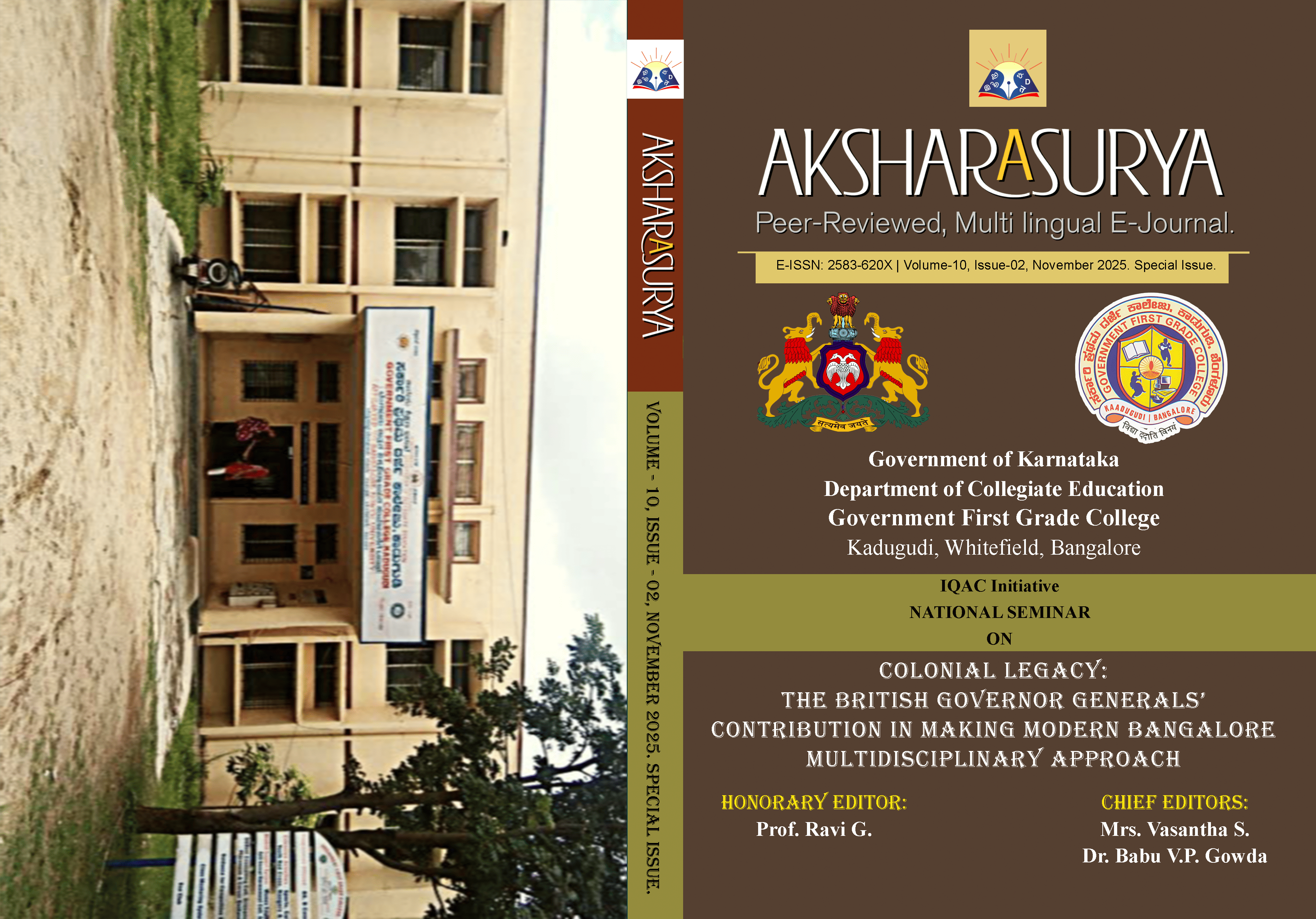
Main Article Content
Abstract
This study examines the Governor-General directives and the local bureaucracy in Bangalore during British colonial rule, highlighting both implementation strategies and forms of resistance. Following the defeat of Tipu Sultan in 1799, Bangalore emerged as a strategic administrative and military hub, with the British establishing the Cantonment alongside the native town. Governor-General directives aimed at standardizing revenue collection, municipal administration, public health, infrastructure, and law enforcement were central to consolidating imperial control. These orders were transmitted through the hierarchical administrative chain from Calcutta to the Madras Government, the Mysore Commissioner, and finally to local officers, including European officials and Indian subordinates. Implementation involved the establishment of municipal boards, public works departments, and policing structures, often blending technical rationality with bureaucratic discretion. However, the directives’ execution was uneven due to resource constraints, local socio-political dynamics, and the hybrid nature of governance within a princely state. Resistance emerged in multiple forms: bureaucratic hesitation, selective enforcement, civic protests, and social opposition to public health and taxation measures. Notably, measures during plague outbreaks in the late nineteenth century provoked significant local opposition, revealing tensions between colonial authority and indigenous norms.
The study demonstrates that Bangalore’s bureaucracy functioned as both an executor and mediator of colonial power, negotiating between the Governor-General’s objectives and local realities. The interplay of directives, implementation, and resistance not only shaped the administrative landscape of the city but also fostered civic consciousness and practices of negotiation that influenced subsequent reforms. Understanding this dynamic provides insight into the mechanisms of colonial governance, the limitations of central authority, and the emergence of hybrid administrative practices in South India.
Article Details
Section

This work is licensed under a Creative Commons Attribution-NonCommercial-ShareAlike 4.0 International License.
How to Cite
References
Bhat, R. B. (2007). Bangalore: The story of a city. Westland Publications.
Chakrabarti, D. K. (2012). Colonial governance in South India: Bureaucracy and urban reforms. Oxford University Press.
Maddison, A. (2001). The British administrative system in India. Routledge.
Rice, B. L. (1900). Mysore: A gazetteer compiled for government. Government Press.
Subramanian, L. (2010). Urban planning and public health in colonial Bangalore. Indian Historical Review, 37(2), 45–68.