
Cantonment And Cluster: How The British Military Presence Shaped Early Industrial Concentrations in Bangalore (1806–1900)
Article Sidebar
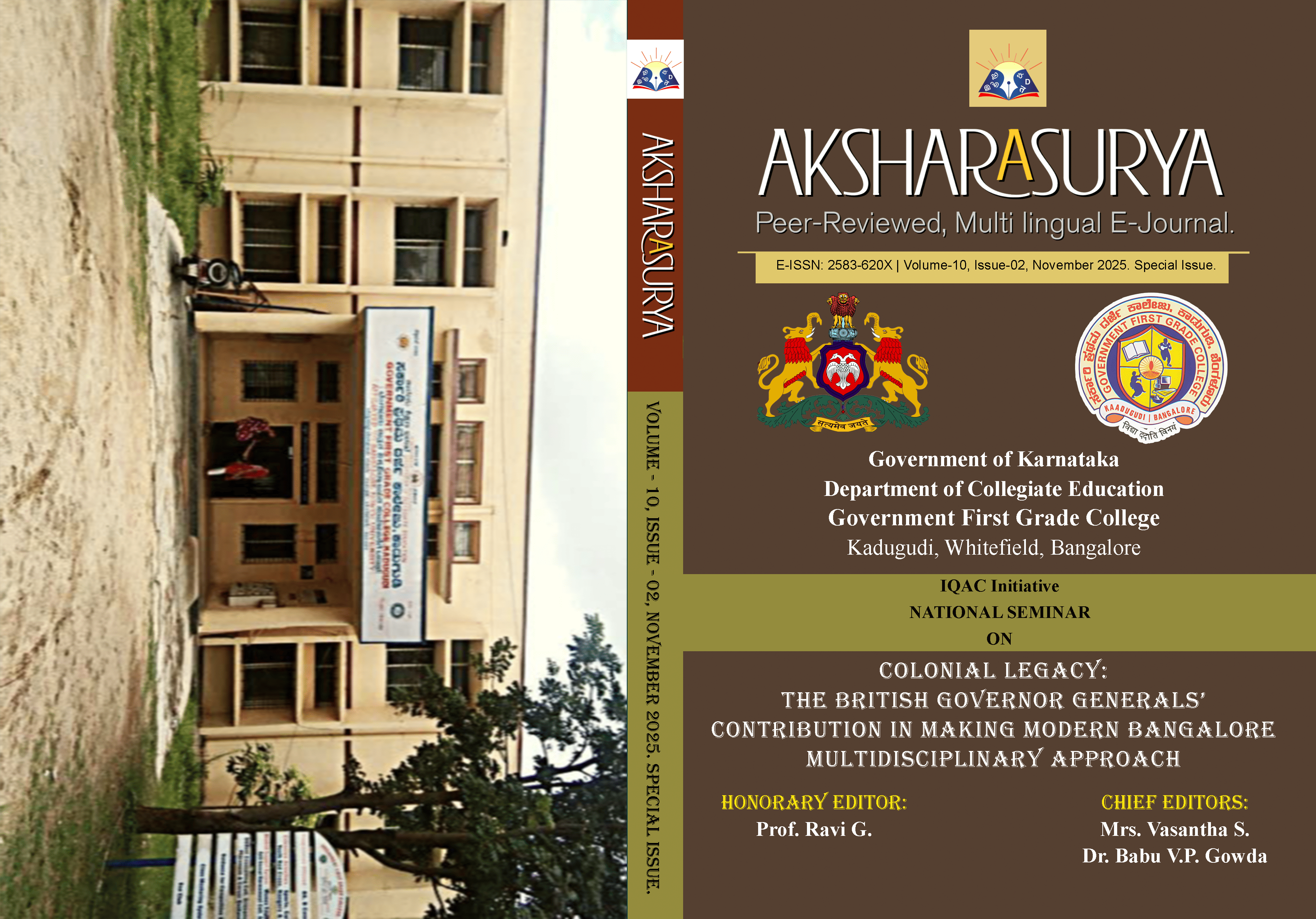
Main Article Content
Abstract
The establishment of the British cantonment in Bangalore in 1806 marked a turning point in the city’s economic and industrial development. The cantonment, strategically located on the eastern periphery of the native pete, created a concentrated demand for goods and services, effectively acting as a catalyst for early industrial clustering. Industries such as leatherworking, carpentry, metalworking, and textile production emerged in proximity to the military installation, responding to both the scale and standardization of military procurement. The spatial segregation between the cantonment and the pete facilitated the formation of distinct industrial zones, where labor specialization, technological adoption, and market-oriented production were more pronounced than in traditional artisanal neighbourhoods.
Infrastructure development under British administration-roads, water supply, sanitation, and communication networks-further reinforced the concentration of workshops and related enterprises. These measures not only supported the logistical needs of the military but also reduced transaction costs for producers, encouraging agglomeration economies. The influx of migrant labor, structured along caste and community lines, shaped the social organization of the clusters, while women and children contributed to auxiliary production in cottage industries. Military demand fostered the adoption of standardized techniques, mechanized tools, and managerial practices, facilitating technological and institutional transfer to local artisans. Over time, the clusters evolved into resilient industrial ecosystems, linking Bangalore to regional and imperial supply networks. This study examines the interplay between colonial governance, military procurement, infrastructure, labor mobility, and technological diffusion to understand how the British cantonment influenced early industrial concentrations in Bangalore. It highlights the long-term impact of institutional and economic interventions on the city’s industrial landscape, offering insights into the processes of urban-industrial formation under colonial rule.
Article Details
Section

This work is licensed under a Creative Commons Attribution-NonCommercial-ShareAlike 4.0 International License.
How to Cite
References
Madras Presidency. (1865). Annual administrative report of the Madras Presidency. Government Press.
Bangalore District Gazetteer. (1886). Gazetteer of the Bangalore District. Government Press.
Mysore Gazetteer. (1897). Mysore: Gazetteer, volume II. Government Press.
Reddy, K. R. (2010). Colonial urbanism and industrial development in South India. New Delhi: Oxford University Press.
Subrahmanyam, S. (1990). History of South India under British rule. Cambridge: Cambridge University Press.