
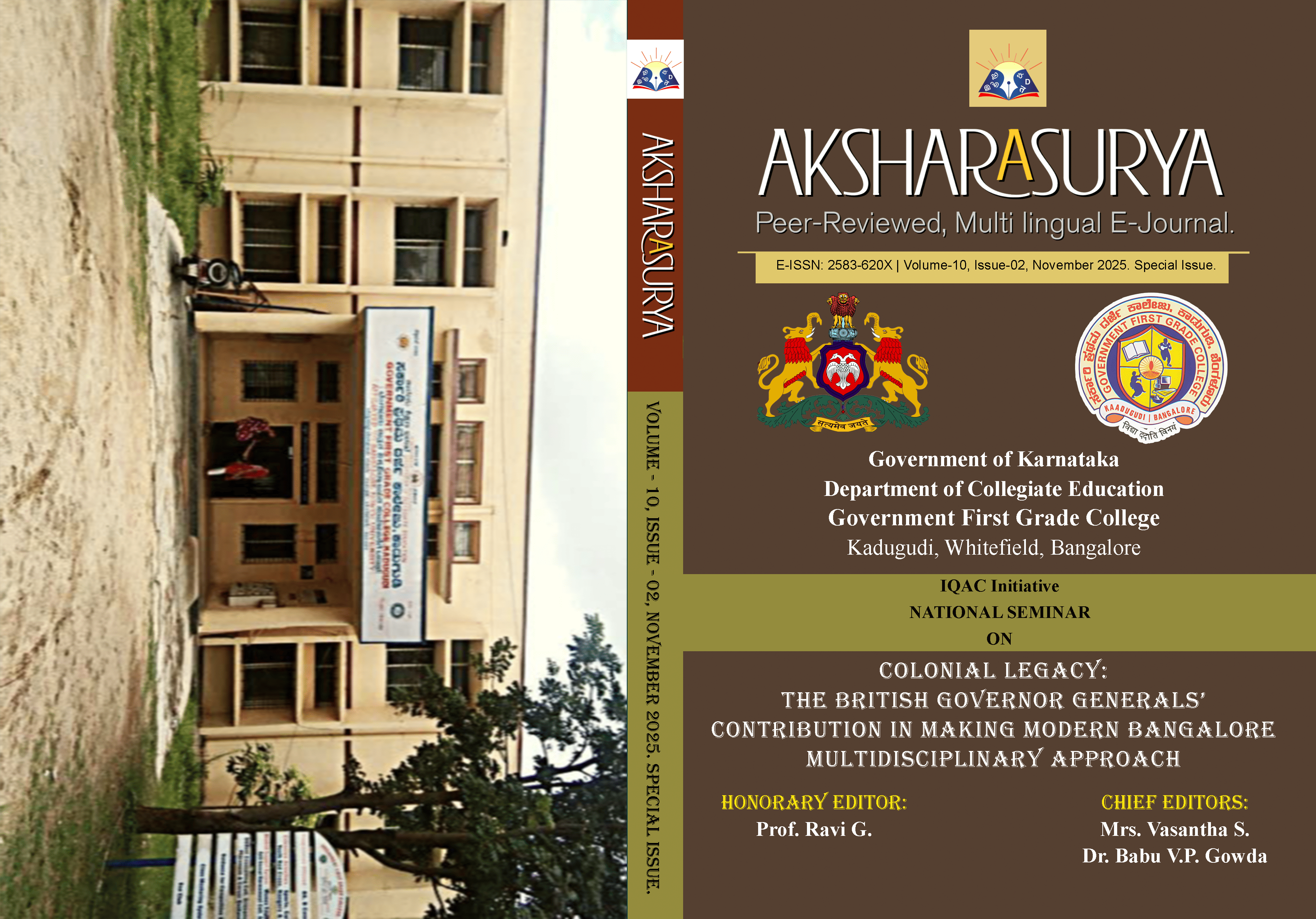
Colonial Trade Policies and The Production of Economic Inequality In Bangalore Between 1800 And 1947
Article Sidebar
Main Article Content
Abstract
This paper critically examines the colonial trade policies implemented in Bangalore between 1800 and 1947 and their long-term consequences in shaping patterns of economic inequality. The study explores how British economic interests, revenue systems, and trade frameworks systematically restructured Bangalore’s local economy to serve imperial objectives rather than indigenous development. Colonial authorities introduced export-oriented trade mechanisms, prioritising commodities beneficial to the British market while neglecting local consumption and production needs. This redirection of economic activity disrupted traditional trade networks, marginalised native artisans and weavers, and eroded the foundations of indigenous industries that once sustained the regional economy. Drawing on archival materials, including administrative reports, revenue records, and census data, the paper situates Bangalore’s economic transformation within the broader imperial framework of exploitation and dependency. The study argues that British policies such as differential land revenue systems, monopolisation of trade routes, and selective infrastructural investments particularly in railways, cantonments, and commercial zones were instrumental in producing spatial and social inequalities. The historical processes laid the groundwork for enduring disparities in wealth distribution, occupational mobility, and urban infrastructure in postcolonial Bangalore. By revisiting the city’s colonial economic past, this paper contributes to broader debates on the political economy of empire and its persistent legacies in shaping urban inequality in South Asia.
Article Details
Section

This work is licensed under a Creative Commons Attribution-NonCommercial-ShareAlike 4.0 International License.
How to Cite
References
Imperial Gazetteer of India, Vol. IV: The Indian Empire – Administrative. Oxford: Clarendon Press, 1909.
Mysore State Administrative Reports (Annual Volumes), Government of Mysore, 1860–1947.
Madras Presidency Revenue and Settlement Records, British Library – India Office Collections.
Bangalore Cantonment Municipal Reports, Government of India Archives, 1870–1947.
Census of India, Various Volumes (1871–1941), Government of India Press, Calcutta.
Correspondence and Reports of the British Resident at Mysore, India Office Records, London.
Mysore Gazette, Government of Mysore Publications, Bangalore (Selected Years: 1880–1945).
Dutt, R. C. The Economic History of India Under Early British Rule. London: Kegan Paul, 1902.
Naoroji, Dadabhai. Poverty and Un-British Rule in India. London: Swan Sonnenschein, 1901.
Chandra, Bipan. The Rise and Growth of Economic Nationalism in India: Economic Policies of Indian National Leadership, 1880–1905. New Delhi: People’s Publishing House, 1966.
Chaudhuri, K. N. The Trading World of Asia and the English East India Company, 1660–1760. Cambridge: Cambridge University Press, 1978.
Bayly, C. A. Indian Society and the Making of the British Empire. Cambridge: Cambridge University Press, 1988.
Washbrook, David. The Emergence of Provincial Politics: The Madras Presidency, 1870–1920. Cambridge: Cambridge University Press, 1976.