
Bangalore: A Colonial Dream, A Postcolonial Memory
Article Sidebar
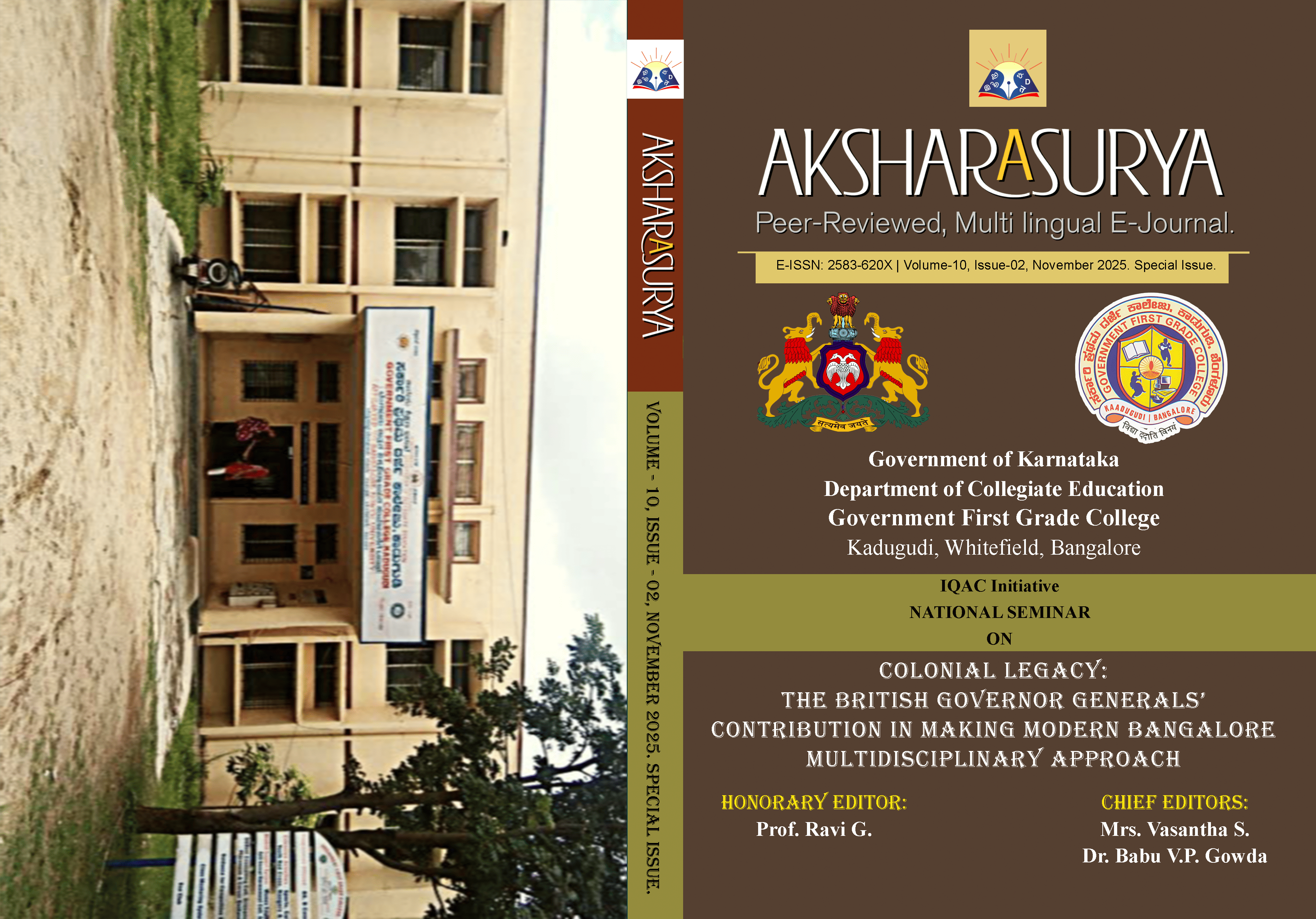
Main Article Content
Abstract
The Indian city of Bangalore, now known as the “Silicon Valley of India,” has long-standing colonial foundations that defined the modern identity of the city. This paper delves into the representation of Bangalore in Anglo-Indian literature, examining the role of British administrators and Governor Generals in the transformation of the city during the British Raj. Anglo-Indian literature from the 19th to the mid-20th centuries frequently depicted Bangalore as a microcosmic site of British-Indian hybridity-a location where British control over the colonies coexisted with Indian adaptation. The research uses literary as well as historical material such as G. D’Cruz’s Midnight’s Orphans (2006), Charlton-Stevens’ Decolonising Anglo-Indians (2012), Ikegami's Princely India Re-Imagined (2013), et al., to interpret the role of the urban planning, architectural growth, educational growth, as well as cultural contact sites during the British Raj. The role played by individuals such as Lord Cornwallis as well as Lord Wellesley in establishing the groundwork of the army as well as administrative infrastructures-such as the cantonment-in the development of the transformation of the city of Bangalore is highlighted as determinant to the modern transformation of the city. This way, Anglo-Indian literature not only maintains a nostalgic account of the hybrid city but also discloses the contradictions between the idea of colonial improvement and cultural disaffiliation. The study ultimately positions Bangalore as a literary as well as historical emblem that symbolizes the long-lasting British colonial legacy within the larger context of Anglo-Indian identity as well as postcolonial urban development.
Article Details
Section

This work is licensed under a Creative Commons Attribution-NonCommercial-ShareAlike 4.0 International License.
How to Cite
References
Charlton-Stevens, U. (2012). Decolonising Anglo-Indians: Strategies for a Mixed-Race Community in Late Colonial India. Oxford University Press.
D’Cruz, G. (2006). Midnight’s Orphans: Anglo-Indians in Post/Colonial Literature. Peter Lang.
Ikegami, A. (2013). Princely India Re-Imagined: A Historical Anthropology of Mysore from 1799 to the Present. Routledge
Montebello, S. (2024). The Representation and Self-Representation of Anglo-Indians in Literature from 1885 to the Present Day. Open University.
Boshier, C. A. (2022). Forgotten Voices of the British Empire. Bloomsbury Academic.
Rajagopalachari, M. (2019). Diversity in Indian Literatures in English: Recent Reflections. Academia Press.
Dharwad Ker, V. (2003). The Historical Formation of Indian-English Literature. University of California Press.