
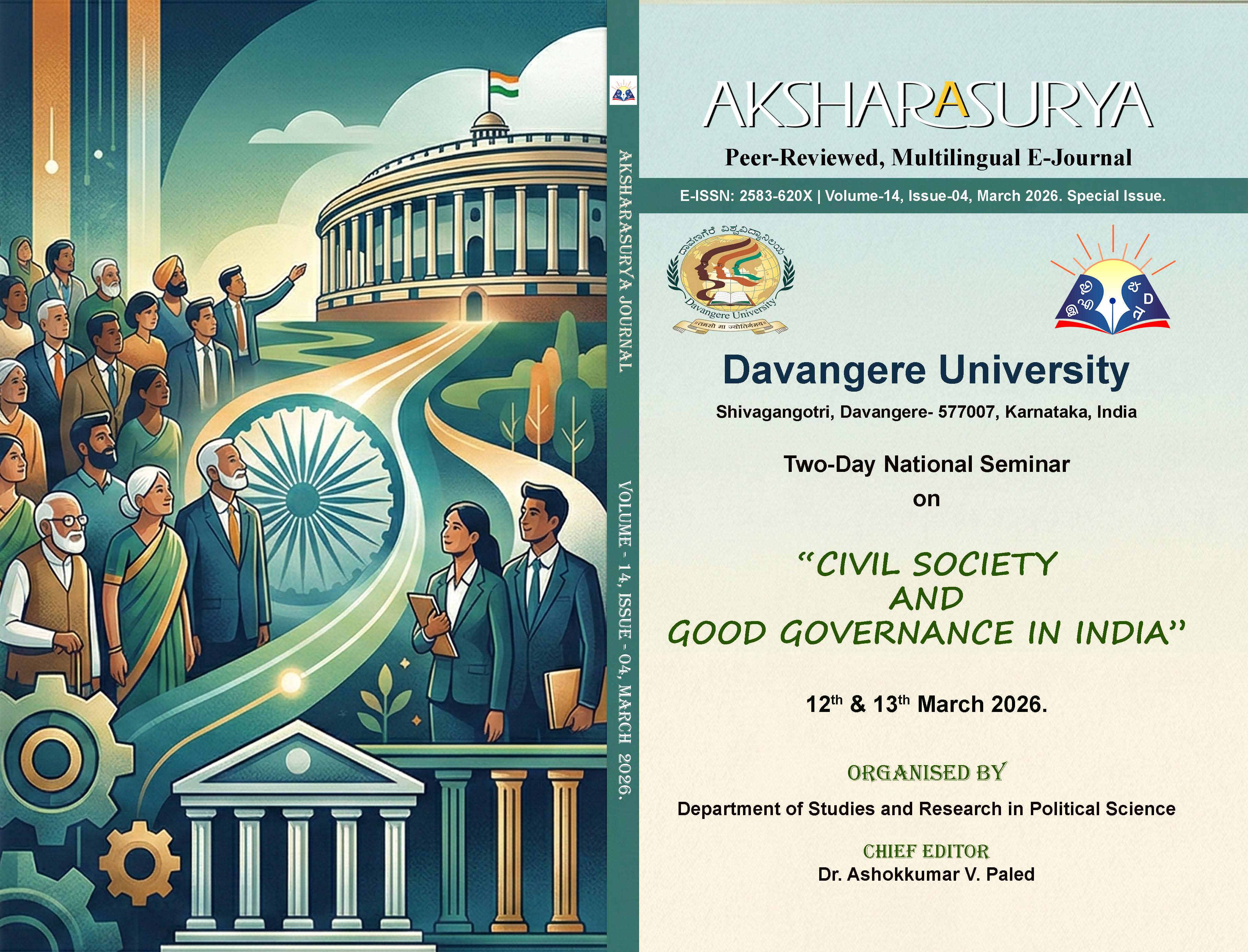
Published: 2026-03-25
Table of Contents
Research Articles
Civil Society Initiatives For Sustainability
01 to 09
Civil society serves as the vital ‘third sector’ bridging the gap
between the state and its citizens. Encompassing NGOs, trade unions,
and voluntary groups, it plays a crucial role in fostering democratic
values, advocating for the public good, and ensuring government
accountability. By facilitating political socialization, welfare activities,
and conflict resolution, these organizations actively strengthen
governance. However, modern civil society faces significant contemporary challenges, including the complex impacts of globalization, internal conflicting interests, and increasing politicization. Navigating these hurdles requires shifting towards a globalized approach to promote equity, justice, and nonviolent participation for marginalized communities worldwide.
Civil Society as Democracy’s Vanguard: Fortifying Institutions in Contemporary India
10 to 14
In contemporary India, civil society emerges as democracy’s vanguard, fortifying institutions through advocacy, oversight, and mobilization. This article traces its evolution from independence-era movements to modern campaigns like the Right to Information Act and anti-corruption protests, highlighting roles in citizen engagement, accountability, and rights protection. Case studies of the Mazdoor Kisan Shakti Sangathan, India Against Corruption, and Narmada Bachao Andolan illustrate transformative impacts amid challenges such as funding curbs under the FCRA and political pressures. Despite headwinds, civil society’s innovative adaptations via digital tools and coalitions promise resilient governance. The analysis calls for policy reforms to empower these actors, ensuring India’s democracy evolves inclusively in a polarized era.
Nepotism Politics and the Quality of Democracy in Karnataka: A Critical Examination of Representation and Accountability
15 to 25
Nepotism has become an increasingly visible feature of contemporary politics in Karnataka, raising fundamental concerns about the quality of democratic governance at the state level. This research paper critically examines the implications of nepotistic political practices for democratic representation and accountability in Karnataka. The study is based on secondary data collected from electoral statistics, party constitutions, legislative debates, media reports, and existing scholarly literature on Indian democracy and sub-national politics. It analyses how kinship-based political networks influence candidate selection, leadership recruitment, and the circulation of political power within major political parties.
The paper argues that the dominance of political families restricts political competition and undermines merit-based participation, thereby weakening the representational character of democracy. Nepotism tends to marginalize emerging leaders, women, youth, and socially disadvantaged groups who lack access to established political networks. Furthermore, the study highlights how entrenched family control over party organizations and elected institutions reduces political accountability, as loyalty to kinship structures often takes precedence over responsiveness to citizens, legislative scrutiny, and ethical governance. This erosion of accountability adversely affects public trust in democratic institutions and processes.
The study concludes by emphasizing the need for strengthening internal party democracy, ensuring transparency in candidate selection, and introducing institutional safeguards to promote accountability. Such reforms are essential for enhancing democratic quality and sustaining representative governance in Karnataka.
Community Role in Waste Management
26 to 33
Rapid urbanization, population growth, and changing consumption patterns have significantly increased the quantity and complexity of solid-waste generation in India. While government policies and institutional mechanisms provide a structural framework for waste management, their effectiveness depends largely on active and sustained community participation. Communities play a central role in waste generation, segregation, recycling, monitoring, and creating awareness. This paper presents an in-depth analysis of the role of communities in waste management in India, supported by government initiatives, policy frameworks, and a detailed case study of Mysuru city. This study highlights best practices, challenges, socioeconomic dimensions, and future opportunities for strengthening community-driven waste management systems. The findings emphasize that sustainable waste management can only be achieved through participatory, decentralized, and inclusive approaches.
Indian Public Administration in the Era of Digital Governance: Challenges, Artificial Intelligence Integration, and Pathways Toward a Corruption-Free State
34 to 43
The digital transformation of public administration has emerged as a critical governance reform strategy in India, driven by initiatives such as Digital India, e-Governance frameworks, and data-driven public service delivery models. While digital governance promises enhanced transparency, administrative efficiency, and citizen-centric service delivery, it also introduces complex challenges related to infrastructural disparities, digital literacy gaps, cybersecurity risks, bureaucratic resistance, and evolving forms of digital corruption. This study critically examines the structural, technological, and institutional challenges confronting Indian public administration in its digital transition and evaluates the role of artificial intelligence (AI), blockchain, and data analytics in strengthening governance integrity. Using a doctrinal and policy analysis methodology, this paper proposes a multidimensional governance framework to build a resilient and corruption-free digital administrative ecosystem. The findings highlight that technological innovation alone is insufficient without institutional capacity building, regulatory reforms, and participatory governance mechanisms.
Significance of Youth Vote in Indian Electoral Politics: The ‘Yuva’ Factor
44 to 50
This Research paper examines the importance of the youth vote in Indian elections and the factors that contribute to youth voting. Post-2014, MY Factor (Mahila and youth) has had the numbers to decide the outcome of elections, both at the national and state levels. The data from the Election Commission of India proves this, as do the outcomes of different state elections. Young voters, who constitute more than 20 percent of the electorate and include 21.5 crore people aged 18-29 in the 2024 Lok Sabha elections, are an essential group that will determine who wins elections. Their rising population, which includes 18.4 million new voters, has turned unenthusiastic tendencies since 2014 into resolute engagement, including the Election Commission’s involvement, such as Turning 18, and severe engagement by parties in employment, education, and national development.
Nari Shakti Vandana Adhiniyam: A Revolutionary Step Towards Women’s Empowerment
51 to 55
Women’s Empowerment is a key measure of democratic progress and social development. In India, despite constitutional guarantees of equality, women’s representation in legislative bodies has remained limited for decades. The enactment of the Nari Shakti Vandana Adhiniyam marks a significant milestone aimed at strengthening women’s political participation and ensuring inclusive governance. This paper analyses the historical evolution of women’s political representation in India, the major provisions of the Act, and its broader implications for social, economic, and political empowerment. The paper argues that political reservation for women is not merely a legal reform but an evolutionary transformation that can reshape democratic institutions by integrating gender perspectives in policy-making. The study also discusses possible challenges in implementation, including socio-cultural barriers, institutional preparedness, and the need for capacity-building. The paper concludes that the Act has the potential to deepen democracy, promote gender justice, and inspire future generations of women leaders, thereby contributing to sustainable national development.
A Study on the Emerging Challenges for Civil Society in India
56 to 65
The Indian third sector – as the non-profit sector is sometimes called, is one of the largest and certainly the most diverse in the world. There are civil society organizations in virtually every area of human endeavour, including community bee-keeping!
As for size, a sample survey of the sector showed that there are about 1.2 million organizations in India, which engage more than 6 million people. And this number is growing steadily as new non-profits get registered every other day. Civil society remains the vehicle of choice for social change. And in fact, we can safely say that civil society organizations have been very effective on many fronts in India. Not only have they filled social services delivery gaps left by the government, they have succeeded in generating awareness, driving new legislation, uncovering scams and malafide intentions and in fact, done everything that the civil sector – as the conscience and the ombudsman of the nation’s agenda is supposed to do.
Role of urban governance in waste management with special reference to Bangalore city: Issues and functional challenges
66 to 71
This paper examines the role of urban governance in waste management with special reference to Bangalore city. Urban governance of solid waste in Bangalore is managed by the Bruhat Bangalore Mahanagara Palike (BBMP). But it is struggling to manage 5000 tonnes of daily waste through centralized landfills and decentralised participatory approaches. The BBMP supervises waste management in Bangalore aiming to move from a linear Collect & Dump Model to a Circular Sustainable System. The majority of this five thousand tonnes of waste is unprocessed and landfills have almost come to a saturation point creating environmental issues. The BBMP Urban Waste Management Policies are now focusing on decentralized waste management, composting and active involvement of NGOs. The Karnataka State Government Urban Solid Waste Management Policy promotes 3Rs Reduce, Reuse & Recycle by encouraging Waste to Energy projects in partnership with private NGOs and Business Firms. But there are several functional challenges including poor segregation rates with only 30%, limited processing capacity and inadequate infrastructure. Civic Activism groups, activists and residents play a major role in waste management by partnering with the BBMP promoting sustainability and advocating stronger waste management policies.
Agricultural Migration: Exploring the Socio-economic Realities of Migrated Women Sugarcane Workers
72 to 82
The agriculture sector in India provides employment opportunities to approximately 52% of the population, making it the largest employment generator in the country. In the second quarter of 2024, agriculture contributed ₹5,320.92 billion to India’s Gross Domestic Product (GDP). Additionally, the sector accounted for about USD 48.9 billion in exports by 2024, reflecting an 8% decline compared to 2023.
Often referred to as the backbone of India, agriculture plays a vital role in the nation’s economic development. However, the sector faces numerous challenges, including environmental uncertainties, loss of arable land, insufficient irrigation and storage facilities, inadequate minimum support prices for crops, and slow adoption of advanced technologies. Despite various government initiatives and programs aimed at revitalizing agriculture, the desired level of growth remains elusive.
These challenges often lead to migration within the agricultural workforce. This study focuses on the issues faced by women who migrated from Tamil Nadu and parts of Bellary in Karnataka to Ganadalu village in Mandya district for employment in sugarcane cultivation. The research findings are presented in detailed tables to provide insights into their experiences and challenges.
Digital Activism and Youth Political Mobilization: A Case Study of the Nepal Gen Z Protests (2025)
83 to 90
The Nepal Gen Z Protests of 2025 represent a critical turning point in the evolution of youth political engagement in contemporary Nepal. Emerging from digitally connected networks rather than traditional political party structures, the movement reflected deep generational dissatisfaction with corruption, unemployment, and perceived restrictions on digital freedoms. This study examines the protests as a case study of digital activism within an emerging democracy, analysing how social media platforms functioned as mechanisms of mobilization, coordination, and political expression. Drawing upon public sphere theory and network society theory, the paper argues that Generation Z in Nepal transformed digital platforms into alternative spaces of political participation, effectively challenging conventional hierarchies of power. While the protests demonstrated the capacity of decentralized digital networks to generate rapid collective action, they also revealed structural limitations related to sustainability, leadership, and institutional reform. By situating the Nepal Gen Z protests within broader theoretical debates on democracy and digital communication, this study contributes to an understanding of how youth-led digital movements are reshaping political landscapes in South Asia. The findings suggest that digital activism can amplify marginalized voices and alter public discourse, but its long-term democratic impact depends upon the responsiveness of formal political institutions and the ability of youth movements to transition from symbolic protest to sustained civic engagement.
Civil Society Participation and Good Governance: A Conceptual Study of Waste Management Behaviour under Swachh Bharat Mission
91 to 98
Good governance is possible when the active involvement of citizens involved. In India, waste management has become a major concern due to population growth, urbanisation, and changing lifestyles. To address this issue, the Government of India launched the Swachh Bharat Mission in 2014 to promote cleanliness and proper waste management. However, the success of this mission depends not only on government efforts but also on the behaviour and participation of civil society. This conceptual study focuses on understanding how citizen behaviour, such as waste segregation, avoiding littering, and participating in cleanliness activities, contributes to good governance. The study is based on information collected from research articles, government reports, and other secondary sources. The study finds that when citizens are aware, responsible, and actively involved, waste management systems function more effectively. Civil society helps in improving accountability, transparency, and overall governance outcomes. The study concludes that government policies alone cannot achieve the desired results unless they are supported by positive behavioural changes among citizens. Therefore, civil society participation plays an important role in achieving the objectives of the Swachh Bharat Mission and ensuring good governance in waste management.
The Impact of E-Governance on Mass Media and Digital Activism
99 to 108
E-governance has reshaped the relationship between the state, mass media, and citizens by integrating digital technologies into public administration and service delivery. Through online portals, open data systems, digital identity frameworks, and social media engagement, governments now communicate in faster and more direct ways. This shift has altered how news is produced, distributed, and consumed. Journalists increasingly rely on official digital databases, real-time updates, and publicly accessible records to investigate policies and evaluate institutional performance. As a result, reporting has become more data-driven and interactive.
The rise of e-governance has also strengthened digital activism. Citizens and civil society groups can access policy documents, budget data, and grievance platforms without traditional bureaucratic barriers. Online petitions, participatory forums, and public consultation portals encourage civic engagement beyond physical spaces. Social media platforms such as Facebook and Twitter amplify these engagements, enabling activists to mobilize support and influence public debate. Mass media often bridges online activism and wider audiences by reporting on digital campaigns and policy responses.
At the same time, the expansion of digital governance raises questions about regulation, surveillance, and digital divides. Unequal access to technology may limit participation, while data collection practices can affect privacy and freedom of expression. The impact of e-governance on media and activism therefore depends on transparency, digital literacy, and institutional safeguards. When supported by open data and accountability mechanisms, e-governance can deepen democratic participation. When constrained by restrictive policies, it may narrow the space for independent journalism and civic action. E-governance represents both an opportunity and a challenge for contemporary media systems and digitally mediated activism.
Democratic Institutions and Electoral Reforms in India
109 to 116
Democratic governance relies on strong institutions and effective decision-making processes that guide public policy and political competition. In recent years, scholars have warned of democratic backsliding-an erosion of democratic norms, institutional independence, and accountability. This trend has affected both developed and developing nations, but its consequences are particularly significant in large and diverse societies. India, widely regarded as the world’s largest democracy, has historically demonstrated institutional resilience through regular elections, judicial oversight, and regulatory mechanisms. Institutions such as the legislature, judiciary, and election authorities have played a crucial role in maintaining representative governance. However, emerging challenges-including rising campaign costs, polarization, misinformation, institutional pressures, and declining public trust-pose risks to democratic stability.
This study explores how institutional autonomy, transparency, regulatory oversight, and ethical political conduct shape electoral credibility and governance outcomes. It argues that democratic strength depends not only on constitutional design but also on the integrity of decision-making processes. The article concludes that democracy is a continuous process requiring vigilance, reform, and citizen engagement. By reinforcing institutional independence and improving governance practices, India can sustain democratic resilience and adapt effectively to evolving socio-political challenges.
Digital Participation And Citizen Engagement
117 to 121
Digital participation has transformed the relationship between governments and citizens by enabling interactive, transparent, and inclusive governance processes. The rapid growth of internet penetration, mobile technologies, and social media platforms has provided new opportunities for citizen engagement in public decision-making. Digital tools such as e-governance portals, online petitions, social media campaigns, and participatory budgeting platforms enhance democratic participation and accountability. However, challenges such as the digital divide, misinformation, data privacy concerns, and unequal access to technology continue to hinder effective digital engagement.
This paper examines the concept of digital participation, its significance in strengthening democratic governance, key digital platforms used for citizen engagement, and the challenges faced in implementation. The study also highlights best practices from national and global contexts and proposes strategic recommendations for improving digital inclusion and civic participation. The findings suggest that digital participation, when supported by policy frameworks, digital literacy, and transparent governance mechanisms, can significantly enhance citizen empowerment and democratic sustainability.
Raja Rammohun Roy: From Idolatrous to Civil Society
122 to 129
Roy perceived the contemporary Indian society as corrupted, shocking, barbarous and uncivilized. It became corrupted due to the inculcation of idolatry, deviating from the worshiping of one ‘Supreme Being.’ This diversion was the root of all social evils in the Indian society such as widow burning, caste system, polytheism, idolatry and other superstitions. According to Roy, the Indian priests, as in the west, played an important role in corrupting the Indian society. They introduced idolatrous practices for their own benefit and selfishness. The research question which this article deals with is whether the Indian society was really corrupted or if it was the repercussion of the import of the western model? This article delves into the latter part of the research question. Roy adopted the same model of ‘corruptness and restoration’ of the west. Roy intended to purify Indian society by introducing the ‘real scripture of the Hindus’, i.e. Vedas and established various organizations including Atmiya Sabha and Brahma Samaj to inculcate the ‘doctrines’ of the ‘real Hinduism’.
Bridging Citizens and State: The Pivotal Role of Civil Societies in Indian Democracy
130 to 134
Civil society acts as a crucial bridge in Indian democracy, linking citizens to state institutions through mobilization, oversight, and policy influence. This article examines its pivotal roles in enhancing participation, enforcing transparency, and advancing rights, drawing on cases like the Right to Information (RTI) campaign, Narmada Bachao Andolan, and Kerala’s Gram Sabhas. Despite challenges such as Foreign Contribution Regulation Act (FCRA) restrictions and political pressures, civil society sustains democratic vitality amid inequality and polarization. Findings highlight the need for enabling policies to strengthen this bridge, ensuring inclusive governance for India’s 1.4 billion citizens. The analysis underscores civil society’s indispensable function in preventing institutional erosion and promoting participatory democracy.
The Electoral System @2047: Vision for India’s Democratic Future
135 to 144
India’s democratic foundation is anchored in its electoral system-a powerful mechanism that channels the will of its people into governance. As the nation approaches its centenary of independence in 2047, a reimagination of the electoral framework becomes imperative to ensure inclusivity, digital transparency, and participatory governance. This paper examines the evolution, current challenges, and future prospects of India’s electoral system within the context of the Vision India@2047 blueprint. Through analytical methods, policy reviews, and comparative insights, it proposes reforms that blend technology and ethics to strengthen democracy by 2047.
Civil Society as an overseer in Digital Governance
145 to 155
Digital technology is increasingly transforming governance, reconfiguring how the state delivers services, governs society and engages with citizens. The rise of the digital public infrastructure and platform-based governance in India has maximised efficiency, access, but also raised concerns around surveillance, accountability, privacy and exclusion. As such, policy making becomes more and more based on data-driven and automatic setup. Democratic oversight is under increasing strain. This article investigates the oversight role of civil society in India’s digital policy architecture. It considers how civil society organisations, the media and civilian networked practices mediating through litigation, policy advocacy, research and public participation in order to understand digital power. The paper assesses the impact of these interventions on rights protection, transparency and policy making, as it diagnoses institutional, political and resource obstacles that dull their effectiveness. It argues that the requirement of accountability in e-governance is not only technical regulation but constant ongoing independent and participatory rule of civil society based on democracy and social justice.
Impact of Social Media Campaigns on Electoral Behaviour in Karnataka
156 to 161
The rapid expansion of digital communication has significantly transformed electoral politics in India. In Karnataka, social media platforms such as Facebook, WhatsApp, Instagram, and X (Twitter) have emerged as powerful tools for political mobilization, opinion formation, and voter engagement. This paper examines the impact of social media campaigns on electoral behaviour in Karnataka, particularly in recent Assembly and Parliamentary elections. It analyzes how political parties utilize digital strategies, targeted messaging, and digital activism to influence voter perception, youth participation, and electoral outcomes. The study adopts a qualitative methodology supported by secondary data sources. The findings indicate that social media campaigns have reshaped campaign strategies, enhanced political awareness, but also contributed to misinformation and polarization. The findings reveal that social media has become a powerful tool for agenda-setting, political branding, and voter persuasion in Karnataka elections. However, issues of fake news, polarization, and digital divide remain critical challenges. The study concludes with policy recommendations and strategic solutions for strengthening democratic accountability in the digital age.
ವಿದ್ಯುನ್ಮಾನ ಆಡಳಿತದಲ್ಲಿ ನಾಗರಿಕ ಸಮಾಜದ ಹೊಣೆಗಾರಿಕೆ
162 to 169
ವಿದ್ಯುನ್ಮಾನ ಆಡಳಿತವು ಸಾರ್ವಜನಿಕ ಸೇವೆಗಳ ವಿತರಣೆಯಲ್ಲಿ ಪಾರದರ್ಶಕತೆ, ಕ್ಷಿಪ್ರತೆ ಮತ್ತು ಕಾರ್ಯದಕ್ಷತೆಯನ್ನು ಹೆಚ್ಚಿಸುವ ಮಹತ್ವದ ಸಾಧನವಾಗಿದೆ. ವಿದ್ಯುನ್ಮಾನ ಆಡಳಿತದ ಮೂಲಕ ಆಡಳಿತದಲ್ಲಾದ ಬೆಳವಣಿಗೆಯ ಜೊತೆಗೆ ಮಾಹಿತಿ ಸೋರಿಕೆ, ದುರ್ಬಳಕೆ ಮತ್ತು ತಂತ್ರಜ್ಞಾನದ ಮೇಲಿನ ಅವಲಂಬನೆಯು ಮಾನವ ಸಂಪನ್ಮೂಲ ಕೌಶಲ್ಯವನ್ನು ಕಡಿಮೆ ಮಾಡುವ ಸಾಧ್ಯತೆಯೂ ವಿದ್ಯುನ್ಮಾನ ಆಡಳಿತಕ್ಕಿದೆ, ಆದುದರಿಂದ ವಿದ್ಯುನ್ಮಾನ ಆಡಳಿತದ ನೀತಿಗಳು ಪ್ರಜಾಸತ್ತಾತ್ಮಕ ಮೌಲ್ಯಗಳಿಗೆ ಅನುಗುಣವಾಗಿರಲು ನಾಗರಿಕ ಸಮಾಜದ ಜಾಗೃತಿಯಿಂದ ಕೂಡಿದ ಜವಾಬ್ದಾರಿಯು ಪ್ರಮುಖವಾಗಿದೆ. ವಿದ್ಯುನ್ಮಾನ ಆಡಳಿತದ ಉತ್ತೇಜನಕ್ಕೆ ಸರಕಾರ ಮತ್ತು ಪ್ರಜೆಗಳ ಸಹಕಾರ, ಜವಾಬ್ದಾರಿತ್ವ, ಉಪಯೋಗಿಸುವಿಕೆ ಮತ್ತು ವಿಮರ್ಶೆಯ ಅಗತ್ಯವನ್ನು ವಿವರಿಸುವುದರ ಜೊತೆಗೆ, ಈ ಲೇಖನವು ವಿದ್ಯುನ್ಮಾನ ಆಡಳಿತ ಮತ್ತು ನಾಗರಿಕ ಸಮಾಜದ ಹೊಣೆಗಾರಿಕೆ ಪಾತ್ರವನ್ನು ವಿಶ್ಲೇಷಿಸುತ್ತದೆ. ವಿದ್ಯುನ್ಮಾನ ಆಡಳಿತದ ಸೇವೆಗಳು ಲಕ್ಷಾಂತರ ಜನರಿಗೆ ನಿರ್ವಹಣಾ ಸುಲಭತೆ ಉಂಟು ಮಾಡಿದರೂ, ಅದರೊಂದಿಗೆ ಹಲವು ಆರ್ಥಿಕ, ಸಾಮಾಜಿಕ ಮತ್ತು ನೀತಿತಾತ್ತ್ವಿಕ ಸವಾಲುಗಳೂ ಹುಟ್ಟಿಕೊಂಡಿವೆ. ವಿದ್ಯುನ್ಮಾನ ಆಡಳಿತಾಧಿಕಾರದ ದುರುಪಯೋಗದಿಂದ ನಾಗರಿಕ ಹಕ್ಕುಗಳಿಗೆ ಉಂಟಾಗಬಹುದಾದ ಅಪಾಯಗಳನ್ನು ತಡೆಗಟ್ಟಲು ನಾಗರಿಕ ಸಮಾಜವು ಹೇಗೆ ಪಾರದರ್ಶಕತೆ, ಜವಾಬ್ದಾರಿ ಮತ್ತು ಸಮಾನ ಹಕ್ಕುಗಳನ್ನು ಕಾಯ್ದಿರಿಸಲು ಹೊಣೆಗಾರಿಕೆಯಿಂದ ಕೆಲಸ ಮಾಡುತ್ತದೆ ಎಂಬುದನ್ನು ಈ ಪ್ರಬಂಧವು ವಿವರಿಸುತ್ತದೆ.
ಡಿಜಿಟಲ್ ಮಾಧ್ಯಮ ಮತ್ತು ರಾಜಕೀಯ ಪ್ರಜ್ಞೆಯ ಹೊಸ ಆಯಾಮಗಳು: ಒಂದು ಅಧ್ಯಯನ
170 to 181
ಪ್ರಸ್ತುತ ಜಾಗತಿಕ ರಾಜಕೀಯ ಸನ್ನಿವೇಶದಲ್ಲಿ ಡಿಜಿಟಲ್ ಮಾಧ್ಯಮಗಳು ನಿರ್ಣಾಯಕ ಪಾತ್ರ ವಹಿಸುತ್ತಿವೆ. ಮಾಹಿತಿ ತಂತ್ರಜ್ಞಾನದ ಕ್ರಾಂತಿಯು ಪ್ರಜಾಪ್ರಭುತ್ವದ ಪ್ರಕ್ರಿಯೆಗಳನ್ನು ಮತ್ತು ಸಾರ್ವಜನಿಕರ ಆಲೋಚನಾ ಕ್ರಮವನ್ನು ಆಮೂಲಾಗ್ರವಾಗಿ ಬದಲಾಯಿಸಿದೆ. ಈ ಸಂಶೋಧನಾ ಲೇಖನವು ಡಿಜಿಟಲ್ ಮಾಧ್ಯಮ ಮತ್ತು ರಾಜಕೀಯ ಪ್ರಜ್ಞೆಯ ನಡುವಿನ ಸಂಕೀರ್ಣ ಸಂಬಂಧವನ್ನು ಮತ್ತು ಅದರಿಂದ ಸೃಷ್ಟಿಯಾದ ಹೊಸ ಆಯಾಮಗಳನ್ನು ವಿಶ್ಲೇಷಿಸುತ್ತದೆ. ಸಾಂಪ್ರದಾಯಿಕ ಮಾಧ್ಯಮಗಳಿಗೆ ಹೋಲಿಸಿದರೆ, ಸಾಮಾಜಿಕ ಜಾಲತಾಣಗಳು ನಾಗರಿಕರಿಗೆ ದ್ವಿಮುಖ ಸಂವಹನ ನಡೆಸಲು ಮತ್ತು ತಮ್ಮ ಅಭಿಪ್ರಾಯಗಳನ್ನು ಮುಕ್ತವಾಗಿ ವ್ಯಕ್ತಪಡಿಸಲು ವೇದಿಕೆಯನ್ನು ಒದಗಿಸಿವೆ. ವಿಶೇಷವಾಗಿ ಯುವಜನತೆಯಲ್ಲಿ ರಾಜಕೀಯ ಆಸಕ್ತಿ ಮೂಡಿಸುವಲ್ಲಿ, ಚರ್ಚೆಗಳನ್ನು ಹುಟ್ಟುಹಾಕುವಲ್ಲಿ ಮತ್ತು ಅವರನ್ನು ಪ್ರಜಾಪ್ರಭುತ್ವದ ಪ್ರಕ್ರಿಯೆಗಳಲ್ಲಿ ಸಕ್ರಿಯವಾಗಿ ತೊಡಗಿಸುವಲ್ಲಿ ನವಮಾಧ್ಯಮಗಳ ಪ್ರಭಾವವನ್ನು ಈ ಅಧ್ಯಯನ ಗುರುತಿಸುತ್ತದೆ. ಅಂತರ್ಜಾಲ ಆಧಾರಿತ ವೇದಿಕೆಗಳು ಮಾಹಿತಿಯ ಪ್ರಸರಣ ವೇಗವನ್ನು ಹೆಚ್ಚಿಸಿವೆ. ಆದಾಗ್ಯೂ, ಸುಳ್ಳು ಸುದ್ದಿಗಳ ಹರಡುವಿಕೆ, ದ್ವೇಷ ಭಾಷಣ ಮತ್ತು ಜನಮತದ ತಿರುಚುವಿಕೆಯಂತಹ ಗಂಭೀರ ಸವಾಲುಗಳು ಪ್ರಜಾಪ್ರಭುತ್ವದ ಮೌಲ್ಯಗಳಿಗೆ ಹೇಗೆ ಅಪಾಯಕಾರಿಯಾಗಿ ಪರಿಣಮಿಸಿವೆ ಎಂಬುದನ್ನು ಸಹ ಇಲ್ಲಿ ವಿಮರ್ಶಾತ್ಮಕವಾಗಿ ಚರ್ಚಿಸಲಾಗಿದೆ. ರಾಜಕೀಯ ಪಕ್ಷಗಳು ತಮ್ಮ ಪ್ರಚಾರ ತಂತ್ರಗಳಿಗೆ ಮತ್ತು ಸಾರ್ವಜನಿಕ ಸಂಪರ್ಕಕ್ಕೆ ಡಿಜಿಟಲ್ ತಂತ್ರಜ್ಞಾನವನ್ನು ಬಳಸಿಕೊಳ್ಳುವ ರೀತಿ ಹಾಗೂ ಅದು ಮತದಾರರ ವರ್ತನೆಯ ಮೇಲೆ ಬೀರುವ ಪರಿಣಾಮಗಳನ್ನು ಈ ಲೇಖನವು ಪರಿಶೀಲಿಸುತ್ತದೆ. ಅಂತಿಮವಾಗಿ, ಆರೋಗ್ಯಕರ ಸಮಾಜ ನಿರ್ಮಾಣಕ್ಕೆ ಮತ್ತು ಪ್ರಜಾಪ್ರಭುತ್ವದ ಬಲವರ್ಧನೆಗೆ ಡಿಜಿಟಲ್ ಸಾಕ್ಷರತೆ ಹಾಗೂ ವಿಮರ್ಶಾತ್ಮಕ ರಾಜಕೀಯ ಪ್ರಜ್ಞೆಯ ಅಗತ್ಯವನ್ನು ಈ ಅಧ್ಯಯನ ಪ್ರತಿಪಾದಿಸುತ್ತದೆ.
ರಾಜಕೀಯ ಸಂಸ್ಕೃತಿ ಮತ್ತು ನಾಗರಿಕರು ರಾಜಕೀಯ ಭಾಗವಹಿಸುವಿಕೆಯಲ್ಲಿನ ಬದಲಾವಣೆಗಳು
182 to 193
ರಾಜಕೀಯ ಸಂಸ್ಕೃತಿ ಮತ್ತು ರಾಜಕೀಯ ಭಾಗವಹಿಸುವಿಕೆಯು ಪ್ರಜಾಪ್ರಭುತ್ವ ವ್ಯವಸ್ಥೆಯ ಯಶಸ್ಸಿನ ಪ್ರಮುಖ ಆಧಾರಸ್ತಂಭಗಳಾಗಿವೆ. ಪ್ರಜೆಗಳ ಮೌಲ್ಯಗಳು, ನಂಬಿಕೆಗಳು ಹಾಗೂ ನಿಲುವುಗಳು ವ್ಯವಸ್ಥೆಯ ಕಾರ್ಯವೈಖರಿಯನ್ನು ನಿರ್ಧರಿಸುತ್ತವೆ. ಗ್ಯಾಬ್ರಿಯಲ್ ಆಲ್ಮಂಡ್ ಮತ್ತು ಲೂಸಿಯನ್ ಪೈ ಅವರಂತಹ ಚಿಂತಕರು ವಿಶ್ಲೇಷಿಸಿರುವಂತೆ, ಸಂಕುಚಿತ, ವಿಷಯ, ಸಹಭಾಗಿ ಹಾಗೂ ನಾಗರಿಕ ಸಂಸ್ಕೃತಿಗಳು ಜನರ ರಾಜಕೀಯ ಪ್ರಜ್ಞೆಯನ್ನು ಬಿಂಬಿಸುತ್ತವೆ. ಇತಿಹಾಸ, ಭೌಗೋಳಿಕತೆ ಹಾಗೂ ಸಾಮಾಜಿಕ-ಆರ್ಥಿಕ ಅಂಶಗಳು ಈ ಸಂಸ್ಕೃತಿಯನ್ನು ರೂಪಿಸುತ್ತವೆ. ಪ್ರಜಾಪ್ರಭುತ್ವದಲ್ಲಿ ನಾಗರಿಕರ ಸಕ್ರಿಯ ಪಾಲ್ಗೊಳ್ಳುವಿಕೆಯು ಕೇವಲ ಆಡಳಿತಗಾರರ ಆಯ್ಕೆಗೆ ಸೀಮಿತವಾಗಿರದೆ, ಸಾರ್ವಜನಿಕ ನೀತಿ ನಿರೂಪಣೆ, ಸರ್ಕಾರವನ್ನು ಜವಾಬ್ದಾರಿಯುತವಾಗಿಸುವಿಕೆ ಮತ್ತು ವ್ಯವಸ್ಥೆಯ ಸ್ಥಿರತೆಯನ್ನು ಕಾಯ್ದುಕೊಳ್ಳುವಲ್ಲಿ ನಿರ್ಣಾಯಕ ಪಾತ್ರ ವಹಿಸುತ್ತದೆ. ಜಾಗೃತ ನಾಗರಿಕ ಸಂಸ್ಕೃತಿಯಿಂದ ಮಾತ್ರ ಅರ್ಥಪೂರ್ಣ ರಾಜಕೀಯ ಭಾಗವಹಿಸುವಿಕೆ ಮತ್ತು ಸುಭದ್ರ ಪ್ರಜಾಪ್ರಭುತ್ವ ಸಾಧ್ಯ ಎಂಬುದನ್ನು ಇಲ್ಲಿ ಸಮಗ್ರವಾಗಿ ವಿಶ್ಲೇಷಿಸಲಾಗಿದೆ.
ಕರ್ನಾಟಕದಲ್ಲಿ ನಿರಾಶ್ರಿತ ಮಕ್ಕಳ ಸಬಲೀಕರಣ: ಒಂದು ರಾಜ್ಯಶಾಸ್ತ್ರೀಯ ಅಧ್ಯಯನ
194 to 203
ಈ ಸಂಶೋಧನಾ ಪ್ರಬಂಧವು ಕರ್ನಾಟಕದ ನಿರಾಶ್ರಿತ ಮಕ್ಕಳ ಸಬಲೀಕರಣವನ್ನು ರಾಜ್ಯಶಾಸ್ತ್ರೀಯ ದೃಷ್ಟಿಕೋನದಿಂದ ವಿಶ್ಲೇಷಿಸಲಾಗಿದೆ. ನಿರಾಶ್ರಿತ ಮಕ್ಕಳು ಸಾಮಾಜಿಕ ಮತ್ತು ಆರ್ಥಿಕ ಅಸಮಾನತೆಗಳ ಪರಿಣಾಮವಾಗಿ ಅಂಚಿನಲ್ಲಿರುವ ಸಮೂಹವಾಗಿದೆ. ಭಾರತದಲ್ಲಿ ಜುವೆನೈಲ್ ಜಸ್ಟಿಸ್ (ಬಾಲ ನ್ಯಾಯ) ಕಾಯಿದೆ, ಶಿಕ್ಷಣದ ಹಕ್ಕು ಕಾಯಿದೆ ಮತ್ತು ವಿವಿಧ ಪುನರ್ವಸತಿ ಯೋಜನೆಗಳು ಅಸ್ತಿತ್ವದಲ್ಲಿದ್ದರೂ, ಅವುಗಳ ಜಾರಿಗೆ ಇರುವ ಸವಾಲುಗಳು ನಿರಾಶ್ರಿತ ಮಕ್ಕಳ ಜೀವನ ಮಟ್ಟದಲ್ಲಿ ಪರ್ಯಾಯ ಬದಲಾವಣೆ ತರುವಲ್ಲಿ ವಿಫಲವಾಗಿವೆ. ಈ ಅಧ್ಯಯನವು ಕಲ್ಯಾಣ ರಾಜ್ಯ ಸಿದ್ಧಾಂತ, ಹಕ್ಕು-ಆಧಾರಿತ ದೃಷ್ಟಿಕೋನ ಮತ್ತು ಸಾಮರ್ಥ್ಯ ಸಿದ್ಧಾಂತಗಳನ್ನು ಸಿದ್ಧಾಂತಾತ್ಮಕ ಆಧಾರವಾಗಿ ಬಳಸಿಕೊಂಡು, ಕರ್ನಾಟಕದಲ್ಲಿ ನೀತಿ ನಿರೂಪಣೆ ಮತ್ತು ಜಾರಿಗೆ ಇರುವ ಅಂತರವನ್ನು ಪರಿಶೀಲಿಸುತ್ತದೆ. ವಿಶೇಷವಾಗಿ ಕರ್ನಾಟಕದಲ್ಲಿ ಶಿಕ್ಷಣ, ಮಾನಸಿಕ ಆರೋಗ್ಯ ಮತ್ತು ಸ್ಥಳೀಯ ಆಡಳಿತದ ಪಾತ್ರವನ್ನು ವಿಶ್ಲೇಷಿಸಲಾಗಿದೆ. ಅಧ್ಯಯನವು ತಿಳಿಸುವಂತೆ ಸಬಲೀಕರಣ ಕೇವಲ ಆಶ್ರಯ ಒದಗಿಸುವುದರಿಂದ ಸಾಧ್ಯವಿಲ್ಲ, ಅದು ಸಮಗ್ರ ಹಕ್ಕು-ಆಧಾರಿತ, ಸಮನ್ವಯಿತ ಮತ್ತು ಒಳಗೊಂಡ ಆಡಳಿತ ವ್ಯವಸ್ಥೆಯನ್ನು ಅಗತ್ಯಪಡಿಸುತ್ತದೆ. ಈ ಪ್ರಬಂಧವು ನಿರಾಶ್ರಿತ ಮಕ್ಕಳ ಪ್ರಶ್ನೆಯನ್ನು ಸಾಮಾಜಿಕ ಕಲ್ಯಾಣದ ವಿಷಯವಷ್ಟೇ ಅಲ್ಲ, ಪ್ರಜಾಸತ್ತಾತ್ಮಕ ಆಡಳಿತದ ಗುಣಮಟ್ಟದ ಸೂಚಕವಾಗಿ ಪರಿಗಣಿಸುತ್ತದೆ.
ಯುವಜನರ ಭಾಗವಹಿಸುವಿಕೆ ಮತ್ತು ಪ್ರಜಾಪ್ರಭುತ್ವದ ತೊಡಗಿಸಿಕೊಳ್ಳುವಿಕೆ
204 to 213
ಪ್ರಜಾಪ್ರಭುತ್ವ ಎಂಬ ಪರಿಕಲ್ಪನೆಯು ಬಹುರೂಪಿಯಾಗಿದ್ದು, ಹಲವಾರು ಮೂಲಾಂಶಗಳನ್ನು ಒಳಗೊಳ್ಳುವ ಸಂಯುಕ್ತ ಪರಿಕಲ್ಪನೆಯಾಗಿದೆ. ಪ್ರಜಾಪ್ರಭುತ್ವ ವ್ಯವಸ್ಥೆಯ ಸ್ಥಿರತೆ, ಯಶಸ್ಸು ಮತ್ತು ಭವಿಷ್ಯವು ಯುವಜನರ ಸಕ್ರಿಯ ಹಾಗೂ ಅರ್ಥಪೂರ್ಣ ಭಾಗವಹಿಸುವಿಕೆಯ ಮೇಲೆ ಪ್ರಮುಖವಾಗಿ ಅವಲಂಬಿತವಾಗಿದೆ. ಯುವಜನರು ಸಮಾಜದ ಅತ್ಯಂತ ನಿರ್ಣಾಯಕ, ಬಲಶಾಲಿ ಮತ್ತು ಬದಲಾವಣೆ ತರುವ ವರ್ಗವಾಗಿದ್ದು, ರಾಜಕೀಯ, ಸಾಮಾಜಿಕ ಹಾಗೂ ನಾಗರಿಕ ಕ್ಷೇತ್ರಗಳಲ್ಲಿ ಮಹತ್ವದ ಪಾತ್ರ ವಹಿಸಬಲ್ಲವರಾಗಿದ್ದಾರೆ. ಆದರೆ ಇತ್ತೀಚಿನ ವರ್ಷಗಳಲ್ಲಿ ಯುವಜನರಲ್ಲಿ ರಾಜಕೀಯ ನಿರಾಸಕ್ತಿ, ಪ್ರಜಾಪ್ರಭುತ್ವದ ಸಂಸ್ಥೆಗಳ ಮೇಲಿನ ಅವಿಶ್ವಾಸ ಮತ್ತು ಸಾಂಪ್ರದಾಯಿಕ ರಾಜಕೀಯ ಪ್ರಕ್ರಿಯೆಗಳಿಂದ ದೂರವಿರುವ ಪ್ರವೃತ್ತಿ ಹೆಚ್ಚುತ್ತಿರುವುದು ಗಮನಕ್ಕೆ ಬರುತ್ತಿದೆ. ಈ ಸಂಶೋಧನಾ ಲೇಖನವು ಯುವಜನರ ಭಾಗವಹಿಸುವಿಕೆಯ ಅರ್ಥ, ಪ್ರಜಾಪ್ರಭುತ್ವದ ತೊಡಗಿಸಿಕೊಳ್ಳುವಿಕೆಯ ಸ್ವರೂಪ, ಯುವಜನರ ಪಾತ್ರ, ಭಾರತದ ಪ್ರಜಾಪ್ರಭುತ್ವದಲ್ಲಿ ಯುವಜನರು ಸಕ್ರಿಯವಾಗಿ ಭಾಗವಹಿಸಿರುವ ಕೇಸ್ ಸ್ಟಡಿಗಳ ಅವಲೋಕನ, ಯುವಜನತೆಯ ಪರಿಣಾಮಕಾರಿ ಪಾಲ್ಗೊಳ್ಳುವಿಕೆಗೆ ಎದುರಾಗುವ ಸವಾಲುಗಳು, ಸಾಮಾಜಿಕ ಮಾಧ್ಯಮ ಮತ್ತು ಶಿಕ್ಷಣದ ಪಾತ್ರ ಹಾಗೂ ಪ್ರಜಾಪ್ರಭುತ್ವವನ್ನು ಬಲಪಡಿಸುವಲ್ಲಿ ಯುವಜನರ ಭಾಗವಹಿಸುವಿಕೆಯ ಮಹತ್ವವನ್ನು ಸಮಗ್ರವಾಗಿ ವಿಶ್ಲೇಷಿಸುತ್ತದೆ.