
Influence of Social Media on Language
Article Sidebar
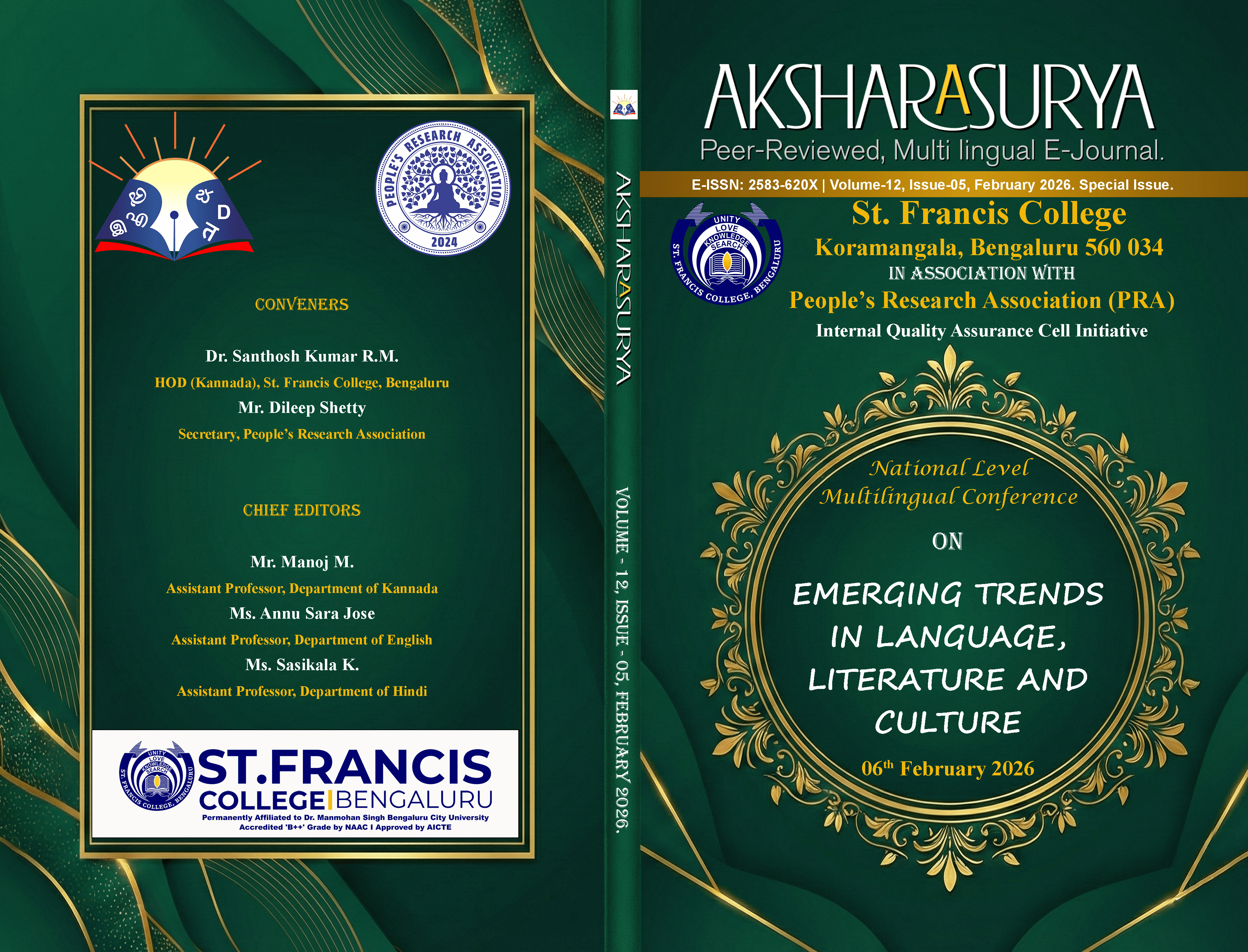
Main Article Content
Abstract
In recent years before the advent of the media, traditional observation of grammar, sentence structure, spelling etc. were highly acknowledged and adhered to, especially when it comes to written conversations. During this time, people were measured by their mode of creative writings, composure etc. There was no welcoming of errors that lead to misunderstanding of what one was meant to say. However, with the introduction of media communication in the 20th century, the world of language has witnessed a lot of transformation and changes. Some of those changes include the carving of words, particularly shortcuts, abbreviations and acronyms, emojis, etc. that represent and suit the space (media) through which they are used. During this time people no longer follow the diction that defines what was earlier known as the formal way of communication. Users find it however more suitable to use, because of the impacts it has (easy understanding) in the course of the conversation. Social media platforms such as Facebook, Instagram, Twitter (X), and WhatsApp encourage this rapid and interactive informal communication, leading to noticeable changes in vocabulary, grammar, and writing styles. Owing to this fact, this paper examines the influence of social media on language, with reference to the informal English language used in digital communication. The study employs a descriptive qualitative approach and is particularly based on secondary sources like books, journal articles, and scholarly discussions on language and digital media. It focuses primarily on the key linguistic features commonly found in social media communication, which includes abbreviations, slangs, emojis, informal writing styles, and also, code-mixing. This finding indicates that social media is not a tool that creates division in linguistics, particularly on its strict observance of rules, but as a tool that welcomes creativity, efficiency, and emotional expression in communication while contributing to increasing informalization of language. At the same time, particular concerns are drawn regarding the reduced attention to standard grammar, spelling and formal writing conventions. This paper affirms that social media has in no way threatened English language but functions as a dynamic space where language adapts certain changes that enhance communication among people of different backgrounds. Therefore, understanding these changes does not only help us to understand media communication language alone, but leading us to recognize how language continues to evolve in the digital era. By the end of the study submission, it would suffice to welcome media language rather than gazing at it from the optical point of view as a tool that inflicts injuries to the ever-cherished mode of formal conversation. This is highly important because it enables users to communicate effectively with every group of learners.
Article Details
Section

This work is licensed under a Creative Commons Attribution-NonCommercial-ShareAlike 4.0 International License.
How to Cite
References
Androutsopoulos, J. (2014). Language change and digital media. Language in Society.
Baron, N. S. (2008). Always on: Language in an online and mobile world. Oxford University Press.
Crystal, D. (2006). Language and the Internet. Routledge.
Crystal, D. (2011). Language and the Internet. Cambridge University Press.
Danesi, M. (2017). The semiotics of emoji: The rise of visual language in the age of the Internet. Bloomsbury.
Herring, S. C. (2013). Discourse in Web 2.0: Familiar, reconfigured, and emergent. Pragmatics & Cognition.
McCulloch, G. (2019). Because Internet: Understanding the new rules of language. Riverhead Books.
Tagliamonte, S. A. (2016). Variation in digital language. Journal of Sociolinguistics.
Thurlow, C., Lengel, L., & Tomic, A. (2004). Computer mediated communication: Social interaction and the Internet. Sage Publications.