
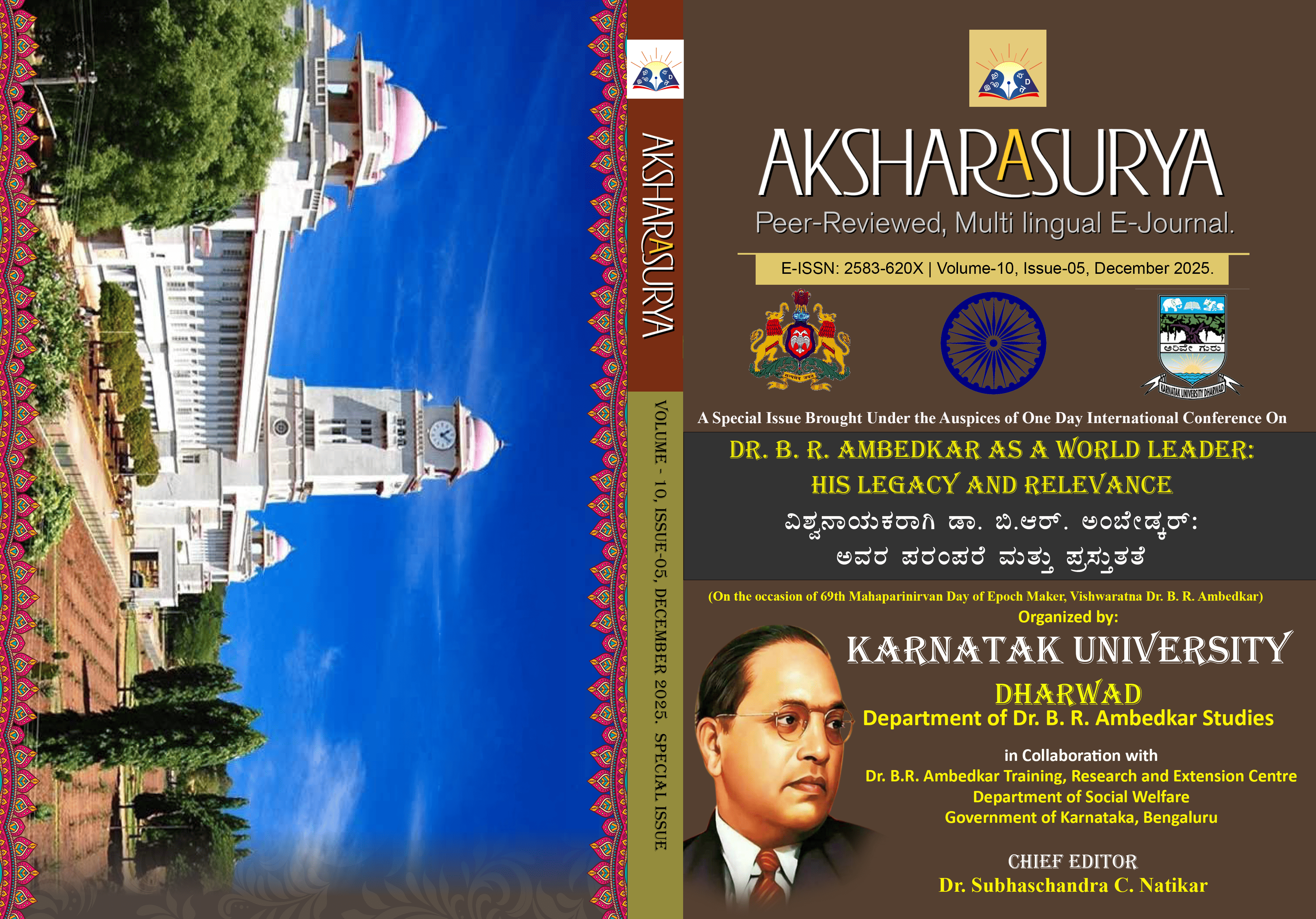
Published: 2025-12-15
Table of Contents
Research Articles
Ambedkar's Philosophical Foundations of Human Rights: The Concept of Equality, Liberty, and Fraternity
01 to 08
Dr. B. R. Ambedkar's philosophical approach to human rights is grounded in the interrelated principles of equality, liberty, and fraternity, which he regarded as essential pillars of a just and democratic society. Drawing inspiration from Enlightenment thought, constitutionalism, and Buddhist ethics, Ambedkar redefined these concepts within the Indian socio-cultural context marked by caste-based discrimination and social hierarchy. He viewed equality as the eradication of all forms of social and economic oppression; liberty as the freedom of thought, expression, and choice necessary for individual self-realization; and fraternity as the moral and emotional bond that ensures social harmony and collective responsibility. Ambedkar emphasized that the sustainability of democracy depends on the balanced coexistence of these values, as none can function effectively in isolation. His vision forms a comprehensive philosophical foundation for modern human rights discourse and continues to offer a transformative framework for addressing contemporary issues of inequality, injustice, and exclusion. This abstract highlightsAmbedkar's enduring relevance as a global thinker whose ideas contribute significantly to the on-going pursuit of human dignity and social justice.
Revisiting Ambedkar's Fiscal Federalism: Implications for Fiscal Consolidation in Post-GST India
09 to 16
Dr. B. R. Ambedkar's fiscal vision laid the groundwork for India's federal financial architecture by playing a major role in crafting constitutional provisions governing taxation, intergovernmental transfers, and state financial safeguards. In the current setting of India's most extensive indirect tax reform, the Goods and Services Tax (GST), revisiting Ambedkar's principles is critical for assessing the consequences for both fiscal consolidation and cooperative federalism. This study critically investigates post-GST revenue performance, tax buoyancy patterns, and emerging intergovernmental fiscal relations, specifically determining whether GST has strengthened or harmed fiscal autonomy and sustainability among Indian states. This article uses a mixed-method research methodology that includes secondary data from the Reserve Bank of India, Comptroller and Auditor General reports, and state budget records, as well as qualitative insights from constitutional analysis, to identify various emerging concerns. These include ongoing salary reliance, inherent structural injustices, administrative inefficiencies, and growing regional budgetary disparities. The findings strongly imply that reiterating Ambedkar's philosophy of balanced fiscal federalism—based on equity, accountability, and strong institutional mechanisms—is critical to accomplishing long-term budgetary consolidation in the post-GST period. As a result, the study makes specific policy recommendations to improve revenue mobilization capability, revise the Finance Commission's transfer formula, and strengthen cooperative federalism in order to achieve shared prosperity and long-term financial stability.
Ambedkar on Poverty and Inequality: Policy Directions for the 21st Century
17 to 26
Dr. B. R. Ambedkar remains one of the most influential thinkers on social justice, economic inequality, and structural poverty in India. While his writings are often discussed within political or social contexts, his economic insights particularly his analysis of caste-based exploitation, labour markets, and institutional exclusion offer timeless frameworks for contemporary policy discourse. This paper revisits Ambedkar's contributions to the debate on poverty and inequality and situates them within 21st-century developmental challenges. Using secondary literature, historical economic reasoning, and a qualitative analytical method, the paper evaluates Ambedkar's perspectives on structural deprivation and proposes policy directions aligned with the modern socio-economic landscape. The analysis highlights that Ambedkar's approach was essentially institutional, rights-based, and redistributive, advocating for state intervention, affirmative action, educational expansion, labour protections, and social democracy. The paper concludes by presenting actionable policy directions rooted in Ambedkarite principles for addressing contemporary poverty and inequality.
From Nationalism to Cosmopolitanism: The Evolving Interplay Between Ideology and Identity
27 to 39
The discussion of nationalism and cosmopolitanism has shifted over time in tune with major trends taking place in the world today. This paper aims to discuss whether it is possible and under what circumstances two such ideologies which appear as antithetical on the surface – can be compatible during the process of globalization. The focus of nationalism are people united with the help of cultural and territorial bonds, which create a familiar and unified unity among them. On the other hand, cosmopolitanism supports a global citizenship that is in contrast to claiming local references with advocacy for liberalism, multiculturalism and world citizenship. This failure of the nation state to solve global problems like the global economic crisis, climate change and war has resulted in renewed focus on cosmopolitan values. This shift is defined by inclined population migration and widespread popularity of innovative technology and social media platforms that enable cross-cultural interaction and necessitate the development of new cultures that can be referred to as transnational. But, when globalization has made nationalism the key issue of today's politics, it shows that local patriotism does conflict as well as interfere with the global obligation of today's political regulations. In this article the author submits that a historical approach is needed in analysing the relationship between nationalism and cosmopolitanism, as the two may be complementary in an increasingly globalized world. Our position in this case is that such identities can be combined or a middle-level identity can be developed, where an individual can be patriotic but still uphold cosmopolitan values. At the same time, it can also be seen at the level of identity construction and as a result, impacts politico-discursive formations and features of global politics in contemporary globalised contexts. As such, this study hopes to advance existing literature in the exploration of identity processes in response to globalization threats by analysing the historical backdrop and current studies.
The Political Economy of Poverty and Vulnerability in India: Navigating the Road to Social Justice and Strengthened Democracy
40 to 50
India being one of the largest democracies in the world is a resurrected story of the interaction between modern economic progression and the constant suffering and instability. This paper analyses how poverty and vulnerability are intertwined with the politics and economy of India's social realities. It is important to bear in mind that poverty and vulnerability are not just an economic characteristic; they are more equally outcomes of historical, structural, and governance factors that affect distribution of resource endowment. The study revisits colonialism up to post-independence policies to show how socio-economic inequality was fostered and sustained over several years. Today, it is economic liberalisation, caste and gender discrimination, high unemployment, and limited accessibility to fundamentals that add to vulnerabilities. This situation is combined with the high prevalence of the informal sector activity and the lack of sufficient social protection that increases economic vulnerability in African countries. However, several governmental poverty rebalancing processes such as the PDS and MGREGA remain closely imperfect due to policy gaps in the implementation process. The paper also discusses the application to context on social justice to show that the initiatives aim to provide justice, equality, and voice to the oppressed groups. It also emphasizes democratic consolidation which means institutionalization of the democratic policy, enhancing democratic governance and nurturing social democracy to tackle the issue of socio-economic cleavages. This paper's policy advocacy agenda includes a multitude of social rights protection, decentralisation, development of education and healthcare system, and promotion of civil society activism. The problem of poverty and vulnerability in India cannot be solved with a single European social policy - the state needs to combine social justice, relevant to India, with an emphasis on the democratic nature of the country's development, creating the preconditions for building a stable society.
B.R. Ambedkar's Vision of Land Reform: State Socialism, Collective Farming, and the Pursuit of Dalit Emancipation
51 to 69
This research article delves into Dr. B.R. Ambedkar's radical and comprehensive vision for land reform in India, positing it as an indispensable tool for achieving Dalit emancipation. Ambedkar critically analyzed the Indian agrarian structure, identifying inequitable land ownership and exploitative practices as fundamental pillars upholding the caste system and perpetuating the socio-economic subjugation of Dalits. 1 Rejecting incremental changes, he advocated for a structural overhaul rooted in 'State Socialism'. Central to his blueprint was the nationalization of land and key industries, coupled with the mandatory implementation of collective farming under state management. This model aimed to dismantle the economic dominance of upper castes, eradicate landlessness and insecure tenancy among Dalits, and ensure equitable distribution of agricultural resources and profits. By transforming the relations of production in the countryside, Ambedkar believed the state could guarantee economic security, undermine caste-based hierarchies, and provide the material foundation necessary for the social, political, and human liberation of the oppressed castes. This paper examines the theoretical underpinnings of his proposals, particularly as outlined in States and Minorities, analyzing their connection to broader socialist thought and their specific focus on annihilating caste through economic restructuring. The enduring relevance and challenges of Ambedkar's vision for contemporary land politics and social justice movements are also explored.
Ambedkar's Role in Educating the Marginalized
70 to 74
For the Dalit community, Dr Ambedkar was a hero towering over all others and a social activist, but for the world at large, Ambedkar was an alert and alive thinker. Ambedkar's writings played an important role in turning him into an international figure. Ambedkar believed that education is a movement. If it does not fulfil its objectives, it is useless. True education cradles humanity, generates sources of livelihood, imparts wisdom and imbues us with egalitarianism. Even before Independence, he was recognized as a jurist of rare intellect. He raised some pertinent questions about education in Indian society while speaking in the Bombay Legislative Council on 12 March 1927. He was deeply concerned that India was lagging behind in education.
Ambedkar's Idea of Equality: A Universal Necessity Beyond Borders and Generations
75 to 79
This Article tries to throw some bright light on Dr.B.R.Ambedkar's thoughts or views on “Equality” from different angles. The thoughts of Ambedkar's on the concept called, “Equality” is beyond the borders like; Time, Region, Areas, Nations, Concepts, Generations, Centuries etc. This border free or limit free or time free ideas of Ambedkar on “Equality” speaks about the relevance of his Ideas or Thoughts for all time and can be considered as universal necessity.
“Equality” is nothing but going according to the Nature without making any discrimination on the grounds of Caste, Creed, Gender, Socio-politico-Economic status, Cultural practices, Traditions, Norms, Ideas, Practices etc. It is a principle of treating all fairly. “Equality” is just like treating all equally in front of the Nature. “Equality” is like inclusion of all fit and eligible people with equal opportunities in all activities of the Public, Society or the System. The concept called “Equality” speaks about Human Dignity, Social Justice and Legal Rights etc.
The idea of “Equality” is depended upon the concept called, “Inclusivity” as per Ambedkar's views with different dimensions like;
Social Equality, Political Equality, Economic Equality, Legal Equality, Gender Equality, Educational Equality, Global Equality, Cultural Equality, Constitutional Equality etc and these different dimensions of Equality must be co-existed with the values called Justice, Laws, Ethics and Rights etc.
This Article also speaks about how Ambedkar's views on “Equality” is co-connected with Annihilation of Caste Discrimination, Women Empowerment, Eradication of Gender discrimination etc. Relevance of his thoughts in contemporary India and also beyond Centuries or Generations or Nations etc.
Dr. B. R. Ambedkar and the Hindu Code Bill: A Constitutional Breakthrough for Women's Empowerment in India
80 to 87
This study examines Dr. B. R. Ambedkar's pioneering role in advancing women's rights through the Hindu Code Bill, one of the most ambitious gender-equality reforms of early independent India. Anchored in feminist and constitutional philosophy, Ambedkar's legislative project sought to dismantle entrenched patriarchal structures by granting Hindu women equal rights in marriage, divorce, property, inheritance, guardianship, and adoption. Although the Bill faced significant socio-political resistance and was only partially enacted following Ambedkar's resignation, its core principles were eventually realized through the Hindu Marriage Act (1955), Hindu Succession Act (1956), Hindu Minority and Guardianship Act (1956), and Hindu Adoptions and Maintenance Act (1956). Using historical, legal, and socio-economic analysis, this paper evaluates the transformative impact of these reforms on women's lives. Empirical indicators—from literacy and higher education to property ownership and political participation—demonstrate sustained improvements aligned with Ambedkar's vision of social democracy. The study identifies persistent challenges in achieving substantive gender equality and proposes policy measures grounded in Ambedkar's feminist jurisprudence. Overall, the paper reaffirms the constitutional significance and contemporary relevance of Ambedkar's Hindu Code Bill as a foundational milestone in India's pursuit of gender justice.
Identity, Assertion and Legacy of Socio-Political Movements of Ambedkar
88 to 99
This article examines the identity, assertion, and legacy of Dr. B.R. Ambedkar's socio-political movements. It highlights the perceived failure of post-Ambedkar Dalit movements to meet the community's expectations and address their enduring issues of caste oppression and discrimination, despite constitutional safeguards. The text positions Ambedkar as an iconoclast and scholar, detailing his relentless struggle for the identity, rights, and political representation of the Untouchables (Dalits), tracing this from pre-Ambedkar activism to his pivotal role in the Communal Award and the drafting of the Constitution. Key moments like the Mahad Satyagraha and the burning of Manusmriti are discussed as acts of self-assertion. The enduring legacy of Ambedkar's emphasis on education and the symbolic power of his statues as icons of liberation are explored.
Dr. B. R. Ambedkar’s Contribution to Women Empowerment
100 to 104
This Paper Focuses on Dr. B. R. Ambedkar Views on Women Empowerment, he was a fighter for the dignity of women and depressed people. Being a pioneer of Social Justice, he always functioned for the empowerment and betterment of women’s life. According To Babasaheb Ambedkar Everybody Should Be Treated Equally Irrespective of Caste, Creed, Gender and Religion. That’s Why He Started Working for The Liberation of Women and Their Rights. This Paper focus on The Thoughts of Dr. B.R. Ambedkar towards women, he strongly believed that women empowerment can be achieved by welfare of women, the activities of empowering women worldwide should follow the vision of Dr. B.R. Ambedkar.
ಕಾರ್ಮಿಕರ ಸುಧಾರಣೆಗೆ ಡಾ. ಬಿ ಆರ್ ಅಂಬೇಡ್ಕರ್ ಅವರ ಕೊಡುಗೆಗಳು
105 to 108
ಆಧುನಿಕ ಭಾರತದ ವಾಸ್ತುಶಿಲ್ಪಿ ಡಾ. ಬಿ. ಆರ್. ಅಂಬೇಡ್ಕರ್ ಅವರು ಭಾರತೀಯ ಕಾರ್ಮಿಕರ ಹಕ್ಕುಗಳು ಮತ್ತು ಕಲ್ಯಾಣಕ್ಕೆ ನೀಡಿದ ಮಹತ್ವದ ಕೊಡುಗೆಗಳನ್ನು ಈ ಲೇಖನವು ವಿಶ್ಲೇಷಿಸುತ್ತದೆ. ಅಂಬೇಡ್ಕರ್ ಅವರು ಕಾರ್ಮಿಕರ ಸುಧಾರಣೆಗೆ ಕಾನೂನು ಮತ್ತು ರಾಜಕೀಯ ಮಟ್ಟದಲ್ಲಿ ಹೋರಾಡಿದರು, ಆಗಸ್ಟ್ 1936 ರಲ್ಲಿ ಇಂಡಿಪೆಂಡೆಂಟ್ ಲೇಬರ್ ಪಾರ್ಟಿ (ILP) ಅನ್ನು ಸ್ಥಾಪಿಸಿದರು. ಅವರ ಕೊಡುಗೆಗಳು ಕಾರ್ಮಿಕರ ಹಕ್ಕುಗಳ ಕಾಯ್ದೆಗಳಿಗೆ ಸುಧಾರಣೆ ತಂದವು, ಇದರಲ್ಲಿ ಉತ್ತಮ ವೇತನ, ಕೆಲಸದ ಸಮಯದ ನಿಗದಿ, ಮತ್ತು ಸುರಕ್ಷತಾ ಮಾನದಂಡಗಳು ಸೇರಿವೆ. ಅವರು ಶಿಕ್ಷಣದ ಮೂಲಕ ಕಾರ್ಮಿಕರ ಸಬಲೀಕರಣ, ಸಾಮಾಜಿಕ ಭದ್ರತೆ ಮತ್ತು ಸಮಾನತೆಗಾಗಿ ಒತ್ತು ನೀಡಿದರು. ಅಂಬೇಡ್ಕರ್ ಅವರ ದೃಷ್ಟಿಕೋನವು ಶ್ರಮಿಕ ವರ್ಗದವರಿಗೆ ಘನತೆ ಮತ್ತು ನ್ಯಾಯವನ್ನು ಒದಗಿಸುವ ಗುರಿಯನ್ನು ಹೊಂದಿತ್ತು, ಇದು ಇಂದಿಗೂ ಸಾಮಾಜಿಕ ನ್ಯಾಯಕ್ಕೆ ಸ್ಫೂರ್ತಿಯಾಗಿದೆ.
ಅಲಕ್ಷಿತ ಸಮೂಹದಲ್ಲಿ ಒಂದಾದ ಮಹಿಳಾ ಸಮೂಹಕ್ಕೆ ಅಂಬೇಡ್ಕರ್ರವರ ಕೊಡುಗೆ
109 to 114
ಪ್ರಸ್ತುತ ಲೇಖನವು ಅಲಕ್ಷಿತ ಸಮೂಹಗಳಲ್ಲಿ ಒಂದಾದ ಮಹಿಳೆಯರ ಹಕ್ಕುಗಳು ಮತ್ತು ಸಬಲೀಕರಣಕ್ಕಾಗಿ ಡಾ. ಬಿ.ಆರ್. ಅಂಬೇಡ್ಕರ್ರವರ ಅಪಾರ ಕೊಡುಗೆಗಳನ್ನು ಪರಿಶೋಧಿಸುತ್ತದೆ. ಅಂಬೇಡ್ಕರ್ರವರು ಜಾತಿ ಮತ್ತು ಲಿಂಗ ಆಧಾರಿತ ಸಾಮಾಜಿಕ ಶ್ರೇಣೀಕರಣದ ವಿರುದ್ಧ ಹೋರಾಡಿದರು, ಶಿಕ್ಷಣ ಮತ್ತು ಸಮಾನತೆಯನ್ನು ಮಹಿಳಾ ವಿಮೋಚನೆಗೆ ನಿರ್ಣಾಯಕ ಸಾಧನಗಳೆಂದು ಪ್ರತಿಪಾದಿಸಿದರು. ಸ್ವತಂತ್ರ ಭಾರತದ ಮೊದಲ ಕಾನೂನು ಸಚಿವರಾಗಿ, ಅವರು ಮದುವೆ, ವಿಚ್ಛೇದನ, ಆಸ್ತಿ ಮತ್ತು ದತ್ತು ಹಕ್ಕುಗಳನ್ನು ಒಳಗೊಂಡಂತೆ ಮಹಿಳೆಯರಿಗೆ ಕಾನೂನು ರಕ್ಷಣೆ ಮತ್ತು ಸಮಾನತೆಯನ್ನು ಒದಗಿಸುವ ಗುರಿಯನ್ನು ಹೊಂದಿದ್ದ ಕ್ರಾಂತಿಕಾರಿ 'ಹಿಂದೂ ಸಂಹಿತೆ ಮಸೂದೆ'ಯನ್ನು ಪರಿಚಯಿಸಿದರು. ಅವರ ಪ್ರಯತ್ನಗಳು 1955 ಮತ್ತು 1956 ರ ಪ್ರಮುಖ ಶಾಸನಗಳಿಗೆ ಕಾರಣವಾಯಿತು. ಅಂಬೇಡ್ಕರ್ರವರ ದೃಷ್ಟಿಕೋನವು ಪ್ರಗತಿಪರ, ಸಮಾನತಾ ಸಮಾಜವನ್ನು ನಿರ್ಮಿಸುವಲ್ಲಿ ಮಹಿಳೆಯರ ಸ್ಥಾನಮಾನವನ್ನು ಹೆಚ್ಚಿಸುವ ಮಹತ್ವವನ್ನು ಒತ್ತಿಹೇಳುತ್ತದೆ.
ಡಾ. ಬಾಬಾಸಾಹೇಬ ಅಂಬೇಡ್ಕರ್ ಮತ್ತು ಬೌದ್ಧ ಧರ್ಮ
115 to 119
ಡಾ. ಬಿ. ಆರ್. ಅಂಬೇಡ್ಕರ್ ಅವರು 20ನೇ ಶತಮಾನದ ಪ್ರಮುಖ ಯುಗಪ್ರವರ್ತಕರಾಗಿದ್ದು, ಭಾರತೀಯ ಸಮಾಜದ ಧಾರ್ಮಿಕ ಅಸಮಾನತೆ, ಜಾತಿ ವ್ಯವಸ್ಥೆ ಮತ್ತು ಅಸ್ಪೃಶ್ಯತೆಯ ವಿರುದ್ಧ ತೀವ್ರ ಹೋರಾಟ ನಡೆಸಿದರು. ವೈದಿಕ ಧರ್ಮವು ಪ್ರತಿಪಾದಿಸಿದ ಶ್ರೇಣಿಕೃತ ವರ್ಣ ವ್ಯವಸ್ಥೆ ಮತ್ತು ಅಮಾನವೀಯ ಪದ್ಧತಿಗಳನ್ನು ಅವರು ಖಂಡಿಸಿದರು. ಹಿಂದೂ ಧರ್ಮದಲ್ಲಿ ಸಮಾನತೆ ಅಸಾಧ್ಯವೆಂದು ಅರಿತ ಡಾ. ಅಂಬೇಡ್ಕರ್ ಅವರು 1935ರಲ್ಲಿ ಯವಲಾ ಮತಾಂತರ ಘೋಷಣೆ ಮಾಡಿದರು. ಸುಮಾರು ಇಪ್ಪತ್ತು ವರ್ಷಗಳ ಅಧ್ಯಯನದ ನಂತರ, ಬೌದ್ಧ ಧರ್ಮದಲ್ಲಿರುವ ಸ್ವಾತಂತ್ರ್ಯ, ಸಹೋದರತ್ವ, ವೈಚಾರಿಕ ಪ್ರಜ್ಞೆ ಮತ್ತು ಸಮಾನತೆಯ ಪರಿಕಲ್ಪನೆಗೆ ಆಕರ್ಷಿತರಾದರು. ಅಂತಿಮವಾಗಿ, ಅಕ್ಟೋಬರ್ 14, 1956ರಂದು ನಾಗಪುರದಲ್ಲಿ ಐದು ಲಕ್ಷ ಅನುಯಾಯಿಗಳೊಂದಿಗೆ ಬೌದ್ಧ ಧಮ್ಮವನ್ನು ಸ್ವೀಕರಿಸಿ, 22 ಪ್ರತಿಜ್ಞೆಗಳನ್ನು ಬೋಧಿಸಿದರು. ಈ ಧರ್ಮಾಂತರವು ಭಾರತದಲ್ಲಿ ಧಾರ್ಮಿಕ ಕ್ರಾಂತಿಯನ್ನು ಉಂಟುಮಾಡಿತು ಮತ್ತು ಪ್ರಬುದ್ಧ ಭಾರತ ನಿರ್ಮಾಣಕ್ಕೆ ಕರೆ ನೀಡಿತು.
ಡಾ. ಬಿ. ಆರ್. ಅಂಬೇಡ್ಕರ್: ಮಾನವತಾವಾದಿ
120 to 122
ಭಾರತದ ಸಂವಿಧಾನ ಶಿಲ್ಪಿ, ಡಾ. ಬಿ. ಆರ್. ಅಂಬೇಡ್ಕರ್ ಅವರ ಮಾನವತಾವಾದಿ ಜೀವನ ಮತ್ತು ಕೊಡುಗೆಯನ್ನು ಈ ಲೇಖನವು ವಿಶ್ಲೇಷಿಸುತ್ತದೆ. ಏಪ್ರಿಲ್ 14, 1891 ರಂದು ಜನಿಸಿದ ಅಂಬೇಡ್ಕರ್ ಅವರು ತಮ್ಮ ಜೀವನದುದ್ದಕ್ಕೂ ಅಸ್ಪೃಶ್ಯತೆ, ಶೋಷಣೆ ಮತ್ತು ಅನ್ಯಾಯದ ವಿರುದ್ಧ ಹೋರಾಡಿದರು. ಕಬೀರದಾಸರ ತತ್ವಶಾಸ್ತ್ರದಿಂದ ಪ್ರಭಾವಿತರಾಗಿ, ಅವರು ಸ್ವಾತಂತ್ರ್ಯ, ಸಮಾನತೆ ಮತ್ತು ಭ್ರಾತೃತ್ವದಂತಹ ಮಾನವೀಯ ಮೌಲ್ಯಗಳನ್ನು ಪ್ರತಿಪಾದಿಸಿದರು. ವಿದೇಶಗಳಲ್ಲಿ ಉನ್ನತ ಪದವಿಗಳನ್ನು ಪಡೆದ ಅವರು, ದಮನಿತ ಜನಾಂಗಕ್ಕೆ ಗೌರವ ತರಲು ಶ್ರಮಿಸಿದರು. ಸುಮಾರು 61 ದೇಶಗಳನ್ನು ಸುತ್ತಾಡಿ, 2 ವರ್ಷ 11 ತಿಂಗಳು 18 ದಿನಗಳಲ್ಲಿ ಭಾರತಕ್ಕೆ ಬೃಹತ್ ಸಂವಿಧಾನವನ್ನು ರಚಿಸಿದರು. ಹಿಂದೂ ಧರ್ಮದ ಶೋಷಣೆಯಿಂದ ಬೇಸತ್ತು, ಅಕ್ಟೋಬರ್ 14, 1956 ರಂದು ಬೌದ್ಧ ಧರ್ಮವನ್ನು ಸ್ವೀಕರಿಸಿದರು. ಅವರ ಹೋರಾಟವು ದಲಿತರ ವಿಮೋಚನೆ ಮತ್ತು ಸಾಮಾಜಿಕ ನ್ಯಾಯಕ್ಕೆ ಮೀಸಲಾಗಿತ್ತು.
ದೇವದಾಸಿ ಪದ್ಧತಿ ನಿರ್ಮೂಲನೆಯಲ್ಲಿ ಅಂಬೇಡ್ಕರ್ ಅವರ ಪಾತ್ರ
123 to 129
ಪ್ರಸ್ತುತ ಲೇಖನವು ದೇವದಾಸಿ ಪದ್ಧತಿಯ ಐತಿಹಾಸಿಕ ಮತ್ತು ಸಾಮಾಜಿಕ ಮೂಲಗಳನ್ನು ವಿಶ್ಲೇಷಿಸುತ್ತದೆ, ಪ್ರಾಚೀನ ಗ್ರಂಥಗಳಲ್ಲಿನ ವಿವಿಧ ಪ್ರಕಾರಗಳ ದೇವದಾಸಿಯರ ಉಲ್ಲೇಖದೊಂದಿಗೆ ಆರಂಭಿಸುತ್ತದೆ. ಇದು ಓಕಳಿ ಹಬ್ಬಕ್ಕೂ ದೇವದಾಸಿ ಪದ್ಧತಿಗೂ ಇರುವ ನೈಜ ಸಂಬಂಧವನ್ನು, ವಿಶೇಷವಾಗಿ ದಲಿತ ಮಹಿಳೆಯರ ಮೇಲಿನ ಲೈಂಗಿಕ ದಬ್ಬಾಳಿಕೆಯ ರೂಪವನ್ನು, 'ಅರಗಿಣಿ' ಚಲನಚಿತ್ರದ ಉದಾಹರಣೆಯೊಂದಿಗೆ ಹೊರಗೆಡಹುತ್ತದೆ. ಅಂಬೇಡ್ಕರ್ ಅವರು ಈ ಪದ್ಧತಿಯನ್ನು ಹಿಂದೂ ಧರ್ಮದ ಪಿತೃಪ್ರಧಾನ ಮತ್ತು ತಾರತಮ್ಯದ ಸ್ವರೂಪದ ಅಭಿವ್ಯಕ್ತಿ, ಮತ್ತು ಮಹಿಳೆಯರನ್ನು ವೇಶ್ಯಾವೃತ್ತಿಗೆ ತಳ್ಳುವ ಗುಲಾಮಗಿರಿಯ ರೂಪ ಎಂದು ತೀವ್ರವಾಗಿ ಟೀಕಿಸಿದ್ದಾರೆ. ಸಮಾನತೆ ಮತ್ತು ಸ್ವಾತಂತ್ರ್ಯದ ಅವರ ದೃಷ್ಟಿಕೋನವು ಈ ಪದ್ಧತಿಯನ್ನು ರದ್ದುಗೊಳಿಸಲು ನಡೆದ ಚಳುವಳಿಗೆ ಮಹತ್ವದ ಪ್ರಭಾವ ಬೀರಿದೆ. ಅಂತಿಮವಾಗಿ, ಮದ್ರಾಸ್ (1947) ಮತ್ತು ಕರ್ನಾಟಕ (1982) ಸೇರಿದಂತೆ ವಿವಿಧ ರಾಜ್ಯ ಕಾಯಿದೆಗಳ ಮೂಲಕ ಈ ಪದ್ಧತಿಯ ನಿರ್ಮೂಲನೆಗೆ ಕಾನೂನು ಕ್ರಮಗಳನ್ನು ವಿವರಿಸುತ್ತದೆ.
ಡಾ. ಬಿ.ಆರ್. ಅಂಬೇಡ್ಕರ್ ಮತ್ತು ಸಾಮಾಜಿಕ ಸಮಾನತೆ
130 to 133
ಪ್ರಸ್ತುತ ಲೇಖನವು ಡಾ. ಬಿ.ಆರ್. ಅಂಬೇಡ್ಕರ್ ಅವರ ಸಾಮಾಜಿಕ ಸಮಾನತೆ ಮತ್ತು ನ್ಯಾಯದ ಸಿದ್ಧಾಂತಗಳ ಮಹತ್ವವನ್ನು ವಿಶ್ಲೇಷಿಸುತ್ತದೆ. ಅಸಮಾನತೆ, ಶೋಷಣೆ ಮತ್ತು ಜಾತಿ ವ್ಯವಸ್ಥೆಯ ವಿರುದ್ಧ ಅಂಬೇಡ್ಕರ್ರವರು ಮಾಡಿದ ಹೋರಾಟ, ಅವರ ವಿಚಾರಗಳು ಮತ್ತು ಸಂವಿಧಾನದ ಮೂಲಕ ಅವರು ತಂದ ಬದಲಾವಣೆಗಳ ಮೇಲೆ ಬೆಳಕು ಚೆಲ್ಲುತ್ತದೆ. ಶಿಕ್ಷಣದಿಂದ ಮಾತ್ರ ಸಾಮಾಜಿಕ ನ್ಯಾಯ ಸಾಧ್ಯ ಎಂದು ಪ್ರತಿಪಾದಿಸಿದ ಅಂಬೇಡ್ಕರ್, ದಲಿತರು ಮತ್ತು ಮಹಿಳೆಯರ ಉನ್ನತಿಗಾಗಿ ಶ್ರಮಿಸಿದರು. ಸಮಾನತೆ, ಭ್ರಾತೃತ್ವ, ಮತ್ತು ಮಾನವ ಹಕ್ಕುಗಳನ್ನು ಪ್ರತಿಪಾದಿಸುವ ಅವರ ದೃಷ್ಟಿಕೋನವು ಇಂದಿಗೂ ಪ್ರಸ್ತುತವಾಗಿದೆ. ಭಾರತೀಯ ಸಂವಿಧಾನದ ಮೂಲಕ ಸಾಮಾಜಿಕ, ಆರ್ಥಿಕ ಮತ್ತು ರಾಜಕೀಯ ನ್ಯಾಯವನ್ನು ತರುವ ಅವರ ಪ್ರಯತ್ನವು ದೇಶದಲ್ಲಿ ಶಾಂತಿ ಮತ್ತು ಸಮಗ್ರ ಅಭಿವೃದ್ಧಿಗೆ ಕಾರಣವಾಗಿದೆ.
ವಿಶ್ವಜ್ಞಾನದ ಸಂಕೇತವಾಗಿ ಡಾ. ಬಿ.ಆರ್. ಅಂಬೇಡ್ಕರ್ವರನ್ನು ತಿಳಿಯುವುದರ ಅವಶ್ಯಕತೆ: ಒಂದು ವಿಶ್ಲೇಷಣಾತ್ಮಕ ಅಧ್ಯಯನ
134 to 141
ಡಾ. ಭೀಮರಾವ್ ರಾಮ್ಜಿ ಅಂಬೇಡ್ಕರ್ವರು ಭಾರತೀಯ ಸಂವಿಧಾನದ ರೂಪಕರ್ತರಾಗಿ ಮಾತ್ರವಲ್ಲದೆ, ವಿಶ್ವಜ್ಞಾನದ ಒಂದು ಅನನ್ಯ ಸಂಕೇತವಾಗಿ ನಿಲ್ಲುತ್ತಾರೆ. ಈ ಸಂಶೋಧನಾ ಲೇಖನವು ಅಂಬೇಡ್ಕರ್ ಅವರ ಜೀವನಚರಿತ್ರೆ, ಶೈಕ್ಷಣಿಕ ತತ್ವಜ್ಞಾನ, ಸಾಮಾಜಿಕ ನ್ಯಾಯದ ಹೋರಾಟ, ಆರ್ಥಿಕ ಸಿದ್ಧಾಂತಗಳು, ರಾಜಕೀಯ ದೃಷ್ಟಿಕೋನಗಳು, ಧಾರ್ಮಿಕ ಸುಧಾರಣೆಗಳು ಮತ್ತು ಆಧುನಿಕ ನೀತಿಗಳ ಮೇಲಿನ ಪ್ರಭಾವಗಳನ್ನು ಆಳವಾಗಿ ವಿಶ್ಲೇಷಿಸುತ್ತದೆ. ಇಂದಿನ ಸಮಾಜದಲ್ಲಿ ಅವರ ಕೊಡುಗೆಗಳನ್ನು ತಿಳಿಯದಿರುವುದು ಸಾಮಾಜಿಕ ಅಸಮಾನತೆಗಳನ್ನು ಮುಂದುವರೆಸುವುದು, ಶೈಕ್ಷಣಿಕ ಸಮಾನತೆಯನ್ನು ತಡೆಯುವುದು, ಆರ್ಥಿಕ ಅಂತರಗಳನ್ನು ವಿಸ್ತರಿಸುವುದು ಮತ್ತು ಪ್ರಜಾಪ್ರಭುತ್ವದ ಮೂಲತತ್ವಗಳನ್ನು ದುರ್ಬಲಗೊಳಿಸುವುದರೊಂದಿಗೆ ಸಂಬಂಧ ಹೊಂದಿದೆ ಎಂದು ಈ ಲೇಖನವು ವಾದಿಸುತ್ತದೆ. 2025ರಲ್ಲಿ ಭಾರತದಲ್ಲಿ ಜಾತಿ ಆಧಾರಿತ ಹಿಂಸೆಗಳು ಜನವರಿ - ಜೂನ್ನಲ್ಲಿ ಮಾತ್ರ 113 ಘಟನೆಗಳನ್ನು ಸಿಜೆಪಿ ದಾಖಲಿಸಿದ್ದು, ರಾಷ್ಟ್ರೀಯ ಅಪರಾಧ ದಾಖಲೆ ಬ್ಯೂರೋ (ಎನ್ಸಿಆರ್ಬಿ) ವರದಿಯ ಪ್ರಕಾರ ಒಟ್ಟು ಅತ್ಯಾಚಾರಗಳ ಸಂಖ್ಯೆಯು ಹೆಚ್ಚಾಗುತ್ತಿದೆ, ಇದರಲ್ಲಿ ಯುವಕರಲ್ಲಿ ಅಂಬೇಡ್ಕರ್ ಅವರ ಚಿಂತನೆಗಳ ಬಗ್ಗೆ ಅಜ್ಞಾನವು ಪ್ರಮುಖ ಕಾರಣವಾಗಿದೆ. ವಿಶ್ವಬ್ಯಾಂಕ್ನ 2025ರ ವರದಿಯ ಪ್ರಕಾರ, ಭಾರತದ ಜಿನಿಸೂಚ್ಯಂಕ 25.5 ಆಗಿದ್ದು, ಆರ್ಥಿಕ ಸಮಾನತೆಯಲ್ಲಿ ನಾಲ್ಕನೇ ಸ್ಥಾನ ಪಡೆದಿದ್ದರೂ, ಆತಂಕದ ಬಡತನ 2.3%ಕ್ಕೆ ಕಡಿಮೆಯಾಗಿದ್ದರೂ, ಇದು ಬಳಕೆ ಆಧಾರಿತವಾಗಿದ್ದು ಆರ್ಥಿಕ ಅಸಮಾನತೆಯನ್ನು ಸಂಪೂರ್ಣವಾಗಿ ಪ್ರತಿಬಿಂಬಿಸುವುದಿಲ್ಲ. ಐತಿಹಾಸಿಕ ದಾಖಲೆಗಳು, ಮೂಲ ಗ್ರಂಥಗಳು, ಸಮಕಾಲೀನ ಅಧ್ಯಯನಗಳು ಮತ್ತು 2025ರ ಸಮೀಕ್ಷೆಗಳನ್ನು ಆಧರಿಸಿ, ಈ ಲೇಖನವು ಅಂಬೇಡ್ಕರ್ ಅವರ ಜ್ಞಾನವನ್ನು ತಿಳಿಯುವುದರ ಮೂಲಕ ವಿಮರ್ಶಾತ್ಮಕ ಚಿಂತನೆ, ಸಾಮಾಜಿಕ ಸಾಮರಸ್ಯ, ಜಾಗತೀಕರಣದ ಸಂದರ್ಭದಲ್ಲಿ ಸಮಾನತೆಯನ್ನು ಬೆಳೆಸುವ ಅಗತ್ಯತೆಯನ್ನು ಒತ್ತಿಹೇಳುತ್ತದೆ. ಇದು ಆಧುನಿಕ ಬೌದ್ಧ ಚಳವಳಿಗಳು, ಮಹಿಳಾ ಸಬಲೀಕರಣ, ಸಮಗ್ರ ನೀತಿಗಳು (ಉದಾ. ಎನ್ಈಪಿ 2020) ಮತ್ತು ಆರ್ಥಿಕ ನೀತಿಗಳ ಮೇಲಿನ ಅವರ ಪ್ರಭಾವವನ್ನು ಸಹ ವಿವರಿಸುತ್ತದೆ. ಕೀವರ್ಡ್ಗಳು: ಅಂಬೇಡ್ಕರ್, ವಿಶ್ವಜ್ಞಾನ, ಶಿಕ್ಷಣ, ಸಾಮಾಜಿಕ ನ್ಯಾಯ, ಜಾತಿನಿರ್ಮೂಲನ, ಸಂವಿಧಾನಶಾಸ್ತ್ರ, ಆರ್ಥಿಕ ಜ್ಞಾನ.
ಪರಿಶಿಷ್ಟ ಜಾತಿ ಮತ್ತು ಪರಿಶಿಷ್ಟ ಪಂಗಡಗಳ (ದೌರ್ಜನ್ಯ ತಡೆ) ಕಾಯಿದೆ, 1989: ಒಂದು ವಿಮರ್ಶಾತ್ಮಕ ರಾಜಕೀಯ ಮತ್ತು ಕಾನೂನಾತ್ಮಕ ಅಧ್ಯಯನ
142 to 146
ಭಾರತೀಯ ಸಾಮಾಜಿಕ ಸನ್ನಿವೇಶದಲ್ಲಿ ಶತಮಾನಗಳಿಂದ ಬೇರೂರಿರುವ ಜಾತಿತಾರತಮ್ಯ ಮತ್ತು ಅಸ್ಪೃಶ್ಯತೆಯು ಪ್ರಜಾಪ್ರಭುತ್ವದ ಮೌಲ್ಯಗಳಿಗೆ ಮತ್ತು ಸಮಾನತೆಯ ತತ್ವಕ್ಕೆ ದೊಡ್ಡ ಸವಾಲಾಗಿದೆ. ಸಂವಿಧಾನದ ಮೂಲಕ ಅಸ್ಪೃಶ್ಯತೆಯನ್ನು ನಿಷೇಧಿಸಿದ್ದರೂ, ಸ್ವಾತಂತ್ರ್ಯದ ನಂತರದ ದಶಕಗಳಲ್ಲಿ ದಲಿತರು ಮತ್ತು ಆದಿವಾಸಿಗಳ ಮೇಲಿನ ದೌರ್ಜನ್ಯಗಳು ಹೊಸ ರೂಪಗಳನ್ನು ಪಡೆದುಕೊಂಡವು. ಈ ಹಿನ್ನೆಲೆಯಲ್ಲಿ, ಪರಿಶಿಷ್ಟ ಜಾತಿ ಮತ್ತು ಪರಿಶಿಷ್ಟ ಪಂಗಡಗಳ (ದೌರ್ಜನ್ಯ ತಡೆ) ಕಾಯಿದೆ, 1989 ಒಂದು ಕ್ರಾಂತಿಕಾರಿ ಮತ್ತು ನಿರ್ಣಾಯಕ ಶಾಸನವಾಗಿ ಹೊರಹೊಮ್ಮಿದೆ. ಈ ಸಂಶೋಧನಾ ಲೇಖನವು ಸದರಿ ಕಾಯಿದೆಯ ಐತಿಹಾಸಿಕ ಹಿನ್ನೆಲೆ, ಪ್ರಮುಖ ಉದ್ದೇಶಗಳು ಮತ್ತು ಅದರ ಅನುಷ್ಠಾನದ ಸ್ವರೂಪವನ್ನು ಆಳವಾಗಿ ವಿಶ್ಲೇಷಿಸುತ್ತದೆ. ಪ್ರಸ್ತುತ ಅಧ್ಯಯನವು ಸುಪ್ರೀಂಕೋರ್ಟ್ ತೀರ್ಪುಗಳು ಮತ್ತು ತದ ನಂತರದ ರಾಜಕೀಯ ಬೆಳವಣಿಗೆಗಳನ್ನು ಒಳಗೊಂಡಂತೆ, ಸಾಮಾಜಿಕ ನ್ಯಾಯದ ಸ್ಥಾಪನೆಯಲ್ಲಿ ಈ ಕಾಯಿದೆಯ ಪ್ರಸ್ತುತತೆಯನ್ನು ಚರ್ಚಿಸುತ್ತದೆ. ಅಂತಿಮವಾಗಿ, ಕಾನೂನು ಎಷ್ಟೇ ಪ್ರಬಲವಾಗಿದ್ದರೂ, ಪ್ರಬಲ ರಾಜಕೀಯ ಇಚ್ಛಾಶಕ್ತಿ, ಆಡಳಿತ ಯಂತ್ರದ ಬದ್ಧತೆ ಮತ್ತು ಜಾಗೃತ ನಾಗರಿಕ ಸಮಾಜದ ಸಹಭಾಗಿತ್ವವು ದೌರ್ಜನ್ಯ ಮುಕ್ತ ಸಮಾಜದ ನಿರ್ಮಾಣಕ್ಕೆ ಅತ್ಯಗತ್ಯ ಎಂಬುದನ್ನು ಈ ಲೇಖನವು ಪ್ರತಿಪಾದಿಸುತ್ತದೆ.