
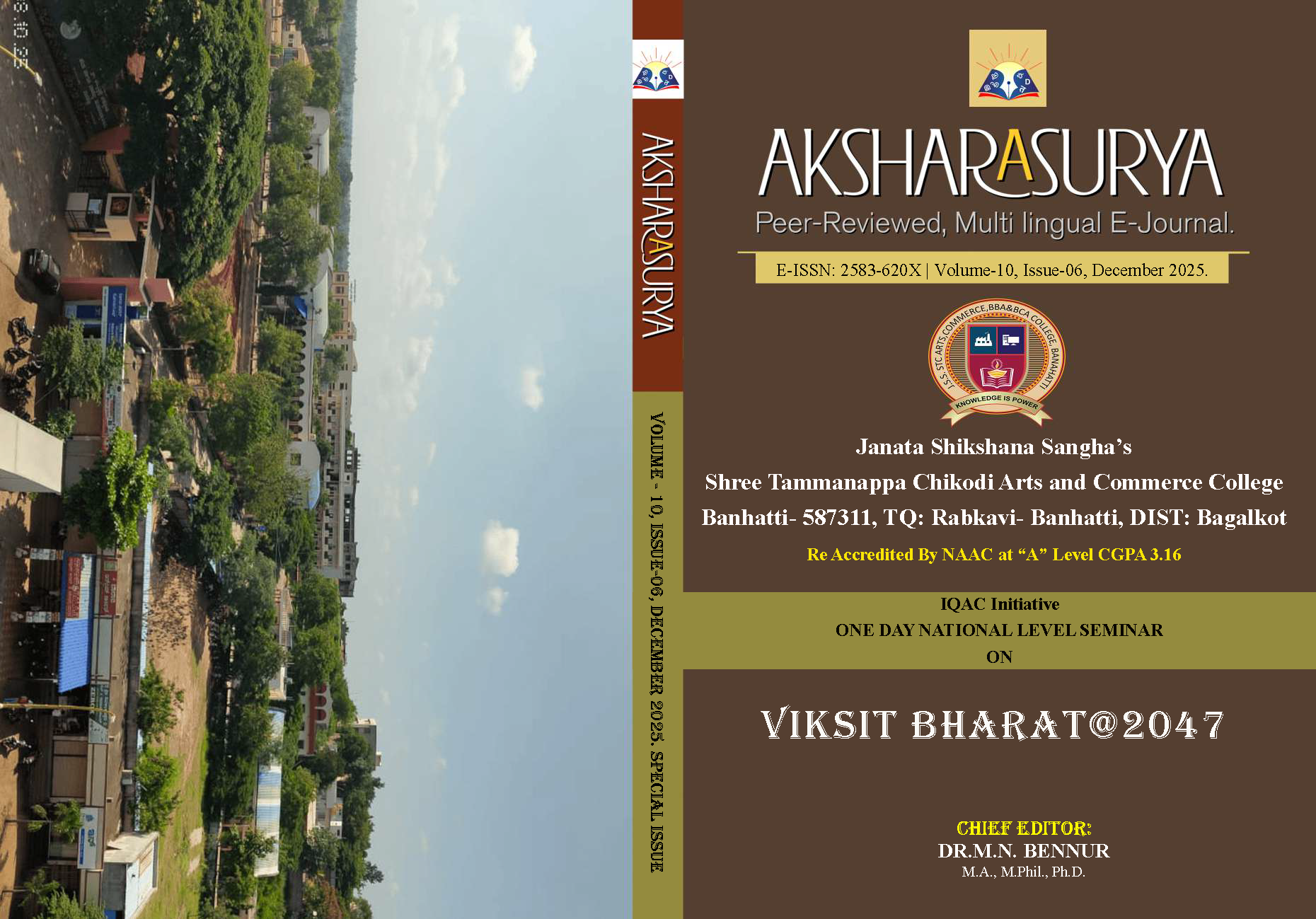
Published: 2025-12-15
Table of Contents
Research Articles
ವಸಹಾತುಶಾಹಿ ಕಾಲದ ಶಿಕ್ಷಣದ ಸಂತ: ಶ್ರೀ ತ್ಯಾಗಜೀವಿ ತಮ್ಮಣ್ಣಪ್ಪ ಚಿಕ್ಕೋಡಿ
01 to 09
ಶ್ರೀ ತಮ್ಮಣ್ಣಪ್ಪ ಚಿಕ್ಕೋಡಿಯವರು ಉತ್ತಮ ಶಿಕ್ಷಣಚಿಂತಕರು ಮತ್ತು ಸಂಕಲ್ಪಬದ್ಧ ಸಾಮಾಜಿಕ ಕ್ರಾಂತಿಕಾರರು. 1929ರಲ್ಲಿ ಅವರು ಜನತಾ ಶಿಕ್ಷಣ ಸಂಘವನ್ನು ಸ್ಥಾಪಿಸಿ, ಬನಹಟ್ಟಿಯಲ್ಲಿ ಒಂದು ಆಂಗ್ಲೋ-ವೆರ್ನಾಕುಲರ್ ಶಾಲೆಯನ್ನು ಆರಂಭಿಸುವ ಮೂಲಕ ಶಿಕ್ಷಣ ಕ್ಷೇತ್ರದಲ್ಲಿ ಮಹತ್ವದ ಬೆಳವಣಿಗೆಗೆ ನಾಂದಿ ಹಾಡಿದರು. ಹಿಂದುಳಿದ ಮತ್ತು ಒಗ್ಗಟ್ಟಿಲ್ಲದ ಸಮುದಾಯಗಳಿಗೆ ಶಿಕ್ಷಣದ ಮೂಲಕ ಸಬಲೀಕರಣ ನೀಡುವುದು ಅವರ ಜೀವನಧರ್ಮವಾಗಿತ್ತು. ಅವರ ದೃಷ್ಟಿ ಮತ್ತು ದಾನಶೀಲತೆಯಿಂದ ಜಮಖಂಡಿ, ಮುಧೋಳ, ರಾಯಬಾಗ್, ಅಥಣಿ ಮೊದಲಾದ ಪ್ರದೇಶಗಳ ಅನೇಕ ಯುವಕರು ದೂರದ ಮುಂಬೈಗೆ ತೆರಳಬೇಕಾದ ಅವಶ್ಯಕತೆ ಇಲ್ಲದೆ ತಮ್ಮ ಸ್ಥಳದಲ್ಲೇ ಕಾಲೇಜು ಶಿಕ್ಷಣ ಪಡೆಯುವ ಅವಕಾಶ ಪಡೆದುಕೊಂಡರು. ಸಾಮಾಜಿಕ, ಧಾರ್ಮಿಕ, ರಾಜಕೀಯ, ಶೈಕ್ಷಣಿಕ ಹಾಗೂ ಸಾಹಿತ್ಯ ಕ್ಷೇತ್ರಗಳಲ್ಲಿ ನಿಸ್ವಾರ್ಥ ಸೇವೆಯಿಂದ, ಶಿಕ್ಷಣವು ವರ್ಗಭೇದ ಮತ್ತು ಅಸಮಾನತೆಯನ್ನು ಮೀರಿ, ಸಮೃದ್ಧಿ ಮತ್ತು ಸಮಾನ ಅವಕಾಶಗಳ ಸುಂದರ ದಾರಿಯಾಗಿ ಬೆಳೆದುಬಂತು.
ವಿಕಸಿತ ಭಾರತದಲ್ಲಿ ಪಾರಂಪರಿಕ ಸ್ಮಾರಕಗಳ ಸಂರಕ್ಷಣೆ ಮತ್ತು ಸಂವರ್ಧನೆಯ ಮಹತ್ವ
10 to 17
ಭಾರತವು 2047 ರ ಹೊತ್ತಿಗೆ ತನ್ನ ಸ್ವಾತಂತ್ರ್ಯದ 100 ವರ್ಷಗಳನ್ನು ಪೂರ್ಣಗೊಳಿಸುತ್ತಿದ್ದು, ಸ್ವಾತಂತ್ರ್ಯದ ಶತಮಾನವನ್ನು ಆಚರಿಸಲು ಸಜ್ಜಾಗಿದೆ. ‘ವಿಕಸಿತ ಭಾರತ @2047’ ಎಂಬ ದೃಷ್ಟಿಯಡಿ, ಆರ್ಥಿಕ, ಸಾಂಸ್ಕೃತಿಕ ಮತ್ತು ಐತಿಹಾಸಿಕ ಕ್ಷೇತ್ರಗಳಲ್ಲಿ ಮಹತ್ವದ ಬೆಳವಣಿಗೆ ಸಾಧಿಸುವ ನಿಟ್ಟಿನಲ್ಲಿ ಹಲವಾರು ಯೋಜನೆಗಳನ್ನು ಸರ್ಕಾರ ರೂಪಿಸಿದೆ. ಈ ದೃಷ್ಟಿಯಲ್ಲಿ ಪ್ರಮುಖ ಅಂಶಗಳಲ್ಲಿ ಐತಿಹಾಸಿಕ ಸ್ಮಾರಕಗಳ ಸಂರಕ್ಷಣೆ ಮತ್ತು ಸಂವರ್ಧನೆ ಮುಖ್ಯವಾಗಿದೆ. ಸ್ಮಾರಕಗಳು ನಮ್ಮ ಸಂಸ್ಕೃತಿಯ ಸಾಕ್ಷಿ ಮತ್ತು ಭೂತಕಾಲದ ನೆನಪಿನ ಹಾದಿಗಳು. ಸ್ಮಾರಕಗಳು -ಪ್ರಾಚೀನ ದೇವಾಲಯಗಳು, ಕೋಟೆಗಳು, ಕಾಲಾನುಗತ ವಾಸ್ತುಶಿಲ್ಪದ ಉದಾಹರಣೆಗಳು, ವಸಾಹತುಶಾಹಿ ಕಾಲದ ಕಟ್ಟಡಗಳು -ಭಾರತೀಯ ಸಂಸ್ಕೃತಿ, ಶಿಲ್ಪಕಲಾ ಕೌಶಲ್ಯ ಮತ್ತು ಸಾಮಾಜಿಕ-ರಾಜಕೀಯ ಕಥಾನಕಗಳನ್ನು ಪ್ರತಿಬಿಂಬಿಸುತ್ತವೆ. ಈ ಸ್ಮಾರಕಗಳ ರಕ್ಷಣೆಯು ನಾಗರಿಕರಲ್ಲಿ ವೈಯಕ್ತಿಕ ಹಾಗೂ ರಾಷ್ಟ್ರೀಯ ಗುರುತನ್ನು, ಪರಂಪರಾ ಜ್ಞಾನವನ್ನು ಮತ್ತು ಹೆಮ್ಮೆಯನ್ನು ಹೆಚ್ಚಿಸುತ್ತದೆ. ಈ ಲೇಖನದಲ್ಲಿ, ಭಾರತದಲ್ಲಿ ಸ್ಮಾರಕಗಳ ಸಂರಕ್ಷಣೆ, ಅವುಗಳ ಮಹತ್ವ ಮತ್ತು 2047 ರವರೆಗೆ ಸಂವರ್ಧನೆಗೆ ರೂಪಿಸಲಾಗುತ್ತಿರುವ ಯೋಜನೆಗಳ ಕುರಿತು ಚರ್ಚಿಸಲಾಗುತ್ತದೆ. ಈ ಅಧ್ಯಯನವು ಸ್ಮಾರಕ ಸಂರಕ್ಷಣೆಗೆ ಸಂಬಂಧಿಸಿದ ನೀತಿ, ತಂತ್ರಗಳು ಮತ್ತು ಸವಾಲುಗಳನ್ನು ವಿಶ್ಲೇಷಿಸುತ್ತದೆ. ಇದರ ಮೂಲಗಳು ಯುನೆಸ್ಕೋ ಮಾರ್ಗಸೂಚಿಗಳು, ಭಾರತೀಯ ಪುರಾತತ್ವ ಸಮೀಕ್ಷೆ (ASI), ಸಂಸ್ಕೃತಿ ಸಚಿವಾಲಯ (MoC) ಮತ್ತು ರಾಷ್ಟ್ರೀಯ ಸಾಂಸ್ಕೃತಿಕ ಚೌಕಟ್ಟಿನ (NCF-2047) ದತ್ತಾಂಶಗಳನ್ನು ಒಳಗೊಂಡಿವೆ.
ಬ್ರಿಟಿಷರ ಕಾಲದ ಬಿಜಾಪುರ ಜಿಲ್ಲೆಯ ಶಿಕ್ಷಣ ವ್ಯವಸ್ಥೆ
18 to 25
19 ನೇ ಶತಮಾನದ ಪ್ರಾರಂಭದಲ್ಲಿ ಮುಂಬೈ ಕರ್ನಾಟಕ ಒಂದು ಸಂಕೀರ್ಣ ವ್ಯವಸ್ಥೆಯನ್ನು ಒಳಗೊಂಡ ಪ್ರಾಂತ್ಯವಾಗಿತ್ತು. ಮೂರನೆಯ ಆಂಗ್ಲೋ-ಮರಾಠ ಯುದ್ಧದಲ್ಲಿ ಎರಡನೇ ಬಾಜಿರಾಯನು ಸೋತು ಇಡೀ ದಕ್ಷಿಣ ಮರಾಠ ಪ್ರದೇಶವನ್ನು ಬ್ರಿಟಿಷರ ಆಡಳಿತಕ್ಕೆ ಒಳಪಡಿಸಿದನು. ಈ ದಕ್ಷಿಣ ಮರಾಠ ಪ್ರದೇಶವು ಬಿಜಾಪುರ, ಬೆಳಗಾವಿ, ಮತ್ತು ಧಾರವಾಡ ಪ್ರಾಂತ್ಯಗಳನ್ನು ಒಳಗೊಂಡ ಪ್ರದೇಶವಾಗಿತ್ತು. ಇದರ ಸಂಪೂರ್ಣ ಆಡಳಿತ ಬ್ರಿಟಿಷರ ಆಳ್ವಿಕೆಗೆ ಒಳಪಟ್ಟಿತ್ತು. ಆಡಳಿತಾತ್ಮಕ ಹಿತ ದೃಷ್ಟಿಯಿಂದ ಕ್ರಿ. ಶ. 1864 ರಲ್ಲಿ ಸೋಲಾಪುರ ಜಿಲ್ಲೆಗೆ ಸೇರಿದ ಭೀಮ, ಕೃಷ್ಣಾ ನದಿಯ ನಡುವಿನ ಪ್ರದೇಶಗಳಾದ ಇಂಡಿ, ದೇವರಹಿಪ್ಪರಗಿ, ಬಿಜಾಪುರ, ಮನಗೂಳಿ ಮತ್ತು ಮುದ್ದೇಬಿಹಾಳ ಈ ತಾಲೂಕುಗಳನ್ನು ಸೇರಿಸಿದರು. ಬಾಗಲಕೋಟೆ, ಬದಾಮಿ, ಹುನಗುಂದ ಈ ಮೂರು ತಾಲೂಕುಗಳನ್ನು ಕಲಾದಗಿ ಜಿಲ್ಲೆಯನ್ನಾಗಿ ಮಾಡಲಾಯಿತು. 1884 ರಲ್ಲಿ ಜಿಲ್ಲಾ ಕೇಂದ್ರವಾಗಿದ್ದ ಕಲಾದಗಿಯನ್ನು ವಿಜಾಪುರಕ್ಕೆ ವರ್ಗಾಯಿಸಿ ಬಿಜಾಪುರ ಜಿಲ್ಲೆಯನ್ನಾಗಿ ಮಾಡಿದರು.
ಐತಿಹಾಸಿಕ ಸ್ಮಾರಕಗಳ ಸಂರಕ್ಷಣೆ ಮತ್ತು ರಕ್ಷಣೆ @ 2047
26 to 35
ಯುದ್ಧವು ಯಾವಾಗಲೂ ನಾಗರಿಕ ಸಾವುನೋವುಗಳು ಮತ್ತು ನಾಗರಿಕ ಮೂಲಸೌಕರ್ಯ, ಸ್ಮಾರಕಗಳು, ಐತಿಹಾಸಿಕ ಕಟ್ಟಡಗಳ ಮತ್ತು ವಾಸ್ತುಶಿಲ್ಪಗಳ ನಾಶಕ್ಕೆ ಕಾರಣವಾಗುತ್ತದೆ. ಕಾನೂನು ಸ್ಥಿತಿ, ರಕ್ಷಣೆ ಮತ್ತು ಸಂರಕ್ಷಣೆಯ ನಿಯಂತ್ರಕ ಚೌಕಟ್ಟಿನಲ್ಲಿ ನ್ಯೂನತೆಗಳಿವೆ, ಜೊತೆಗೆ ಆಕ್ರಮಿತ ಪ್ರದೇಶಗಳಲ್ಲಿ ಉಲ್ಲಂಘನೆಗಳಿವೆ. ಐತಿಹಾಸಿಕ ಸ್ಮಾರಕಗಳ ಸ್ಥಿತಿಯನ್ನು ನಿರ್ಧರಿಸುವಲ್ಲಿ ವಿವಿಧ ದೇಶಗಳ ಚಟುವಟಿಕೆಗಳನ್ನು ಪರಿಶೀಲಿಸಲಾಗುತ್ತದೆ. ಸಾಂಸ್ಕೃತಿಕ ಪರಂಪರೆಯ ವಸ್ತುಗಳ ರಕ್ಷಣೆ ಮತ್ತು ಪುನಃಸ್ಥಾಪನೆ ನೀತಿಯ ಸಕಾರಾತ್ಮಕ ಮತ್ತು ನಕಾರಾತ್ಮಕ ಅಂಶಗಳನ್ನು ವಿವರಿಸಲಾಗಿದೆ ಮತ್ತು ಆಕ್ರಮಿತ ಪ್ರದೇಶಗಳಲ್ಲಿನ ಐತಿಹಾಸಿಕ ಸ್ಮಾರಕಗಳ ರಕ್ಷಣೆಯನ್ನು ಸುಧಾರಿಸಲು ಪ್ರಾಯೋಗಿಕ ಶಿಫಾರಸುಗಳನ್ನು ಮಾಡಲಾಗಿದೆ. ಐತಿಹಾಸಿಕ ಸ್ಮಾರಕಗಳು ಒಂದು ರಾಷ್ಟ್ರದ ಸಂಸ್ಕೃತಿ, ವಾಸ್ತುಶಿಲ್ಪ ಕೌಶಲ್ಯ ಹಾಗೂ ಇತಿಹಾಸದ ಬೆಳವಣಿಗೆಯ ಅಮೂಲ್ಯವಾದ ಸಾಕ್ಷಿಗಳಾಗಿವೆ. ಅವು ನಮ್ಮ ಪೂರ್ವಜರ ಜೀವನಶೈಲಿ, ಕೌಶಲ್ಯ ಮತ್ತು ಕಲಾತ್ಮಕತೆಯನ್ನು ತೋರಿಸುತ್ತವೆ. ಕಾಲಕ್ರಮೇಣ ಧೂಳಿನ ಮಾಲಿನ್ಯ, ಹವಾಮಾನ ಬದಲಾವಣೆ, ಶಿಲೀಂಧ್ರಗಳ ಬೆಳವಣಿಗೆ, ಹಾಗೂ ಮಾನವೀಯ ನಿರ್ಲಕ್ಷ್ಯ ಮುಂತಾದ ಅಂಶಗಳಿಂದ ಇವು ಕ್ರಮೇಣ ಹಾನಿಗೊಳಗಾಗುತ್ತವೆ. ಇಂತಹ ಪರಿಸ್ಥಿತಿಯಲ್ಲಿ ಸ್ಮಾರಕಗಳ ಸಂರಕ್ಷಣೆ ಮತ್ತು ಸಂಭರಣೆ ಅತ್ಯಂತ ಅವಶ್ಯಕವಾಗುತ್ತದೆ. ಸಂರಕ್ಷಣೆ ಎಂದರೆ ಸ್ಮಾರಕವನ್ನು ಅದರ ಮೂಲ ಸ್ವರೂಪದಲ್ಲೇ ಉಳಿಸುವ ಪ್ರಕ್ರಿಯೆ, ಸಂಭರಣೆ ಎಂದರೆ ವೈಜ್ಞಾನಿಕ ಹಾಗೂ ತಾಂತ್ರಿಕ ವಿಧಾನಗಳ ಮೂಲಕ ಅದರ ಸ್ಥಿರತೆ ಮತ್ತು ಅಸ್ತಿತ್ವವನ್ನು ಕಾಯ್ದುಕೊಳ್ಳುವುದು. ಈ ಲೇಖನದಲ್ಲಿ ಸ್ಮಾರಕ ಸಂರಕ್ಷಣೆಯ ಅಗತ್ಯತೆ, ಅದರಲ್ಲಿನ ಸವಾಲುಗಳು, ಹಾಗೂ ಸಾಂಪ್ರದಾಯಿಕ ಮತ್ತು ಆಧುನಿಕ ಸಂಭರಣಾ ವಿಧಾನಗಳನ್ನು ವಿಶ್ಲೇಷಿಸಲಾಗಿದೆ. ಜೊತೆಗೆ, ಯುನೆಸ್ಕೋ (UNESCO) ಹಾಗೂ ಭಾರತೀಯ ಪುರಾತತ್ವ ಇಲಾಖೆ (ASI) ಮುಂತಾದ ಸಂಸ್ಥೆಗಳ ಪಾತ್ರವನ್ನೂ ವಿಶದಪಡಿಸಲಾಗಿದೆ. ಈ ಲೇಖನವು ಅನುಷಂಗಿಕ ಅಥವಾ ದ್ವಿತೀಯ ಮೂಲವನ್ನು ಆಧರಿಸಿದ್ದು, ಭಾರತದಲ್ಲಿ ಕಂಡುಬರುವ ಸ್ಮಾರಕಗಳನ್ನು ವಿಜ್ಞಾನ, ತಂತ್ರಜ್ಞಾನ ಮತ್ತು ಸಾರ್ವಜನಿಕ ಸಹಭಾಗಿತ್ವದ ಸಮನ್ವಯದ ಮೂಲಕ ನಮ್ಮ ಸಾಂಸ್ಕೃತಿಕ ಪರಂಪರೆಯನ್ನು ಮುಂದಿನ ಪೀಳಿಗೆಗಳಿಗೆ ಸುರಕ್ಷಿತವಾಗಿ ಉಳಿಸುವುದು ಈ ಲೇಖನದ ಮುಖ್ಯ ಉದ್ದೇಶವಾಗಿದೆ.
Languages and Cultural Identity Among Muslim Community in 21st Century: A Case Studies of Kamalapur
36 to 46
India is a multi-ethnic, multi-religious and multi-linguistic country. ' The Muslims are the second largest minority in India. Islam is India’s second-largest religion, with 14. 2% of the country’s population, or approximately 172. 2 million people, identifying as adherents of Islam in a 2011 census. India also has the third-largest number of Muslim in the world. According to 2001 census the total population in kalaburagi(Gulbarga) city was 2, 19, 845 of which 51. 18 percent were males and 48. 81 percent were females. According to 2001 census the total literacy rate of Muslims in kalaburagi(Gulbarga) city was 30. 01 percent, among which 21. 95 percent were males and 07. 96 percent were female literacy. Kamalapur is the taluka of kalaburagi (Gulbarga) District. Kamalapur Local Language is Kannada. Kamalapur, According to 2011, Village Total population is 11071 and number of houses are 2081. Female Population is 48. 8%. Village literacy rate is 61. 8% and the Female Literacy rate is 26. 4%. This research project on “Languages and cultural identity among Muslim community”, A case study in kamalapur taluka kalaburagi District is conducted with the objectives to highlight the challenges faced Muslim community of its Languages and cultural identity An attention is also focused on Tensions within identity, and identity crisis, Religious identity. Role of Language in Shaping Cultural Identity.
Startups, Entrepreneurship, and Innovation: Driving India’s Development Journey Towards 2047
47 to 53
India’s vision to become a developed nation by 2047 rests on three interlinked pillars: startups, entrepreneurship, and innovation. These forces have not only reshaped the country’s economic landscape but also strengthened its social fabric by generating employment, fostering technological advancement, and promoting inclusive growth. Startups act as engines of disruption, bringing agility and novel solutions to complex challenges, while entrepreneurship transforms ideas into viable enterprises that create jobs and empower communities. Innovation, on the other hand, serves as the creative backbone that drives progress across sectors, from fintech and healthcare to agriculture and renewable energy. The synergy among these pillars is amplified by supportive government policies such as Startup India and the Atal Innovation Mission, a rapidly growing youth population, and widespread digital transformation through initiatives like Digital India. Collectively, these forces position India to achieve self-reliance, sustainable growth, and global competitiveness.
Education and Upward Mobility: A Sociological Analysis
54 to 66
Education plays a pivotal role in promoting upward social mobility by enabling individuals to acquire knowledge, skills, and credentials that enhance their socioeconomic status. This study, “Education and Upward Mobility: A Sociological Analysis, ” examines the relationship between educational attainment and social mobility within the Indian context. It aims to understand how education functions as both a tool of empowerment and a mechanism that may reproduce existing inequalities related to class, caste, and gender.
The study aims to examine the role of education in promoting upward social mobility in India by analyzing existing secondary data, including the Census of India (2011), NSSO reports, Ministry of Education statistics, and classical sociological works by scholars such as Durkheim, Marx, Bourdieu, Bowles and Gintis, and Sorokin. It seeks to understand how educational attainment influences individuals’ occupational status, income levels, and overall social position across different social groups. In addition, the study aims to assess the structural and institutional factors that limit the potential of education as a means of social mobility, including disparities related to caste, class, gender, and rural-urban divides. By drawing on these secondary sources, the research provides a comprehensive analysis of education’s dual role as both a vehicle for upward mobility and a reflection of existing social hierarchies in the Indian context.
Findings reveal that education significantly contributes to upward mobility by widening employment opportunities and improving income levels. However, unequal access to quality education and persistent socio-economic disparities limit its potential as a true equalizer. The study concludes that inclusive educational reforms, equitable resource distribution, and skill-based learning are essential to enhance education’s role in achieving upward mobility and social justice.
Transitioning to a Green Economy: India’s Journey Toward Net-Zero Emissions by 2070
67 to 78
India’s transition toward a green economy represents a pivotal step in balancing rapid economic growth with environmental sustainability. This research paper examines India’s strategies and progress in achieving its commitment to net-zero emissions by 2070. Drawing upon secondary data from government reports, international indices, and policy frameworks, the study explores the nation’s efforts in renewable energy expansion, low-carbon development, and sustainable economic transformation. Key initiatives such as the National Action Plan on Climate Change (NAPCC), the Green Hydrogen Mission, and the Production Linked Incentive (PLI) scheme highlight India’s integrated approach to decarbonization. The study also evaluates India’s current emission profile, sectoral contributions, and energy mix to identify the major drivers and challenges in its green transition. Despite notable progress, persistent issues-such as dependence on coal, financing gaps, air pollution, and slow technology adoption-pose barriers to achieving carbon neutrality. The findings underscore the need for coordinated efforts across policy, finance, technology, and social inclusion to ensure an equitable, resilient, and sustainable low-carbon future.
Vision 2047: The Future of Digital Economy, Startups, and Innovation
79 to 85
The digital economy is rapidly transforming the global landscape by integrating technology, entrepreneurship, and innovation across every sector. Startups have become the key drivers of this transformation, enabling new models of production, finance, and governance. By 2047, the digital economy is expected to evolve into a deeply interconnected system powered by artificial intelligence, blockchain, decentralized finance, and sustainable technologies. These advancements will reshape industries, empower small enterprises, and foster inclusive growth.
This paper explores how startups will act as engines of innovation, leveraging digital tools to solve complex social and economic challenges. It highlights emerging trends such as AI-driven decision-making, edge computing, green technologies, and decentralized governance models that will redefine the global business environment. At the same time, the paper acknowledges the challenges of data privacy, cybersecurity, skill development, and environmental sustainability.
Through policy analysis and strategic recommendations, the study emphasizes the importance of strong digital infrastructure, ethical data practices, and inclusive innovation ecosystems to ensure balanced growth. By 2047, success in the digital economy will depend not only on technological advancement but also on human creativity, collaboration, and sustainable practices.
Social Justice, Equality and Inclusion: The Road@2047
86 to 90
The abstracts related to "Social Justice, Equality, and Inclusion: The Road to 2047" generally explore how these principles are essential pillars for India's vision of becoming a developed nation (Viksit Bharat) by its centenary of independence in 2047. They highlight the need to address deep-rooted inequalities and ensure equitable opportunities for all citizens, especially marginalized and vulnerable groups.
Social Justice, Equality, and Inclusion: The Road to 2047" refers to the integration of these principles as foundational pillars of Viksit Bharat (Developed India) @2047, the Government of India's vision to become a developed nation by the 100th anniversary of its independence.
The core idea is that development must be inclusive and equitable to be complete and sustainable, ensuring prosperity for every section of society.
Women Pioneers in Shaping Indian Constitution
91 to 95
We have heard about women Scholars like Maitreyi and Gargi during later vedic period in ancient Indian history. In modern India many women leaders were active participators of freedom struggle like Captain Laxmi Sehgal, Kamaladevi Chattopadhyay, Nellie Sengupta, Sucheta Kriplani, Kasturba Gandhi, Annie Besant and many more. Unfortunately our history and our history books forgot to highlight the role of women constitution makers. The present Paper is an effort to bring out the contributions of women constituent assembly members like Ammu Swaminathan, Annie Mascarene, Begaum AizazRasul, Sarojini Naidu and many others who contributed for the making of Indian Constitution.
India's Vision @ 2047 for Sustainable Development
96 to 100
In the spirit of celebrating 100 years of India’s independence in 2047, the nation has articulated an ambitious vision known as Viksit Bharat@2047. This transformative roadmap seeks to position India among the world’s developed nations by embracing holistic progress-economic, social, environmental, technological, and institutional. The main objectives of this paper to know the vision and pillars of Viksit Bharat @ 2047 and to know the sustainable development for Viksit Bharat @ 2047. The present paper primarily based on secondary data sources. Secondary data have been collected from various sources like various reports, research journal, text books, websites ect.
Preservation and Conservation of Historical Monuments in India @2047: Challenges, Innovations and Vision for Sustainable Heritage Management
101 to 106
India’s vast historical and cultural heritage, embodied in its monuments, temples, forts, mosques, palaces, and archaeological sites, stands as a testament to millennia of human civilization. As the nation advances toward 2047 - marking 100 years of independence - the imperative to preserve and conserve these tangible symbols of identity has never been greater. This paper critically examines the status of heritage conservation in India, tracing existing challenges, institutional frameworks, technological advancements, and socio-economic implications. It highlights the gap between policy design and implementation, emphasizing the urgent need for sustainable conservation strategies that balance heritage integrity with modern development pressures. The research adopts a qualitative methodology, drawing from governmental reports, UNESCO documents, scholarly publications, and case studies of key Indian monuments such as the Taj Mahal, Hampi, Red Fort, and Ajanta-Ellora Caves. The findings underscore that heritage conservation must evolve beyond traditional restoration to encompass community participation, digital documentation, climate resilience, and public-private collaboration. Furthermore, the study argues for the integration of heritage management into India’s Vision 2047 framework, aligning with Sustainable Development Goals (SDG 11. 4) that advocate for the protection of cultural and natural heritage. The paper concludes that the preservation of monuments is not only a cultural necessity but a national duty that strengthens identity, tourism, and socio-economic development. It recommends a multi-layered approach involving education, legislation, technology, and inclusive governance to ensure that India’s historical monuments continue to inspire future generations.
Empowering Learners: The Dynamic Role of STC College Library & Information Center, Banhatti
107 to 115
The Library of STC Arts and Commerce College, Banahatti, serves as an academic hub that supports the teaching, learning, and research activities of the institution. Equipped with a rich collection of textbooks, reference books, journals, newspapers, and digital resources, the library aims to provide students and faculty with timely and relevant information. With user-friendly services such as circulation, reference assistance, e-resources, reading facilities, and reprography, the library fosters an environment that promotes academic excellence and lifelong learning. By integrating technology through OPAC, digital databases, and ICT-enabled services, the library continually evolves to meet the diverse information needs of its users. The STC College Library stands committed to nurturing knowledge, encouraging inquiry, and supporting the holistic development of students in the regions.
The Future of India’s Digital Economy: Scale, Drivers, and A Roadmap To 2030
116 to 121
India’s digital economy is no longer a futuristic slogan - it’s a measurable and growing share of the national output. Recent government and industry estimates place the digital economy at roughly 12% of GDP in the early-2020s with a trajectory to exceed 13% by 2024–25, driven by payments, cloud adoption, smartphone penetration, digital platforms and a booming start up ecosystem. This article explains the current scale with concrete numbers, explores the main growth drivers and structural challenges, and gives practical policy and business recommendations that would help India realize a far larger, more inclusive digital economy by 2030.
Indian Democracy, Federalism and Secularism@2047
122 to 126
As India approaches the centenary of its independence in 2047, the nation envisions a transformative journey towards becoming a developed, inclusive and participative democracy. Strengthening the constitutional pillars of democracy, federalism and secularism forms the core of this vision. India’s democratic evolution demands a shift from mere electoral representation to a participatory, transparent and digitally empowered governance model that expands citizen engagement and accountability. India’s secularism, rooted in the ethos of Sarva Dharma Sambhava, must evolve into a more inclusive and culturally rooted pluralism that guarantees equal citizenship, protects diversity, and promotes social harmony without discriminatory state intervention. Together, these three pillars provide the ethical and institutional foundation for Viksit Bharat @ 2047, reinforcing India’s aspiration to emerge as a socially just, economically progressive and culturally cohesive nation. The main objectives of present paper are to study the democracy, federalism and secularism @ 2047. The study based on secondary sources of data. Secondary data have been collected from various sources like Various Reports, Research journal, Text books, Websites ect.