
Social Justice, Equality and Inclusion: The Road@2047
Article Sidebar
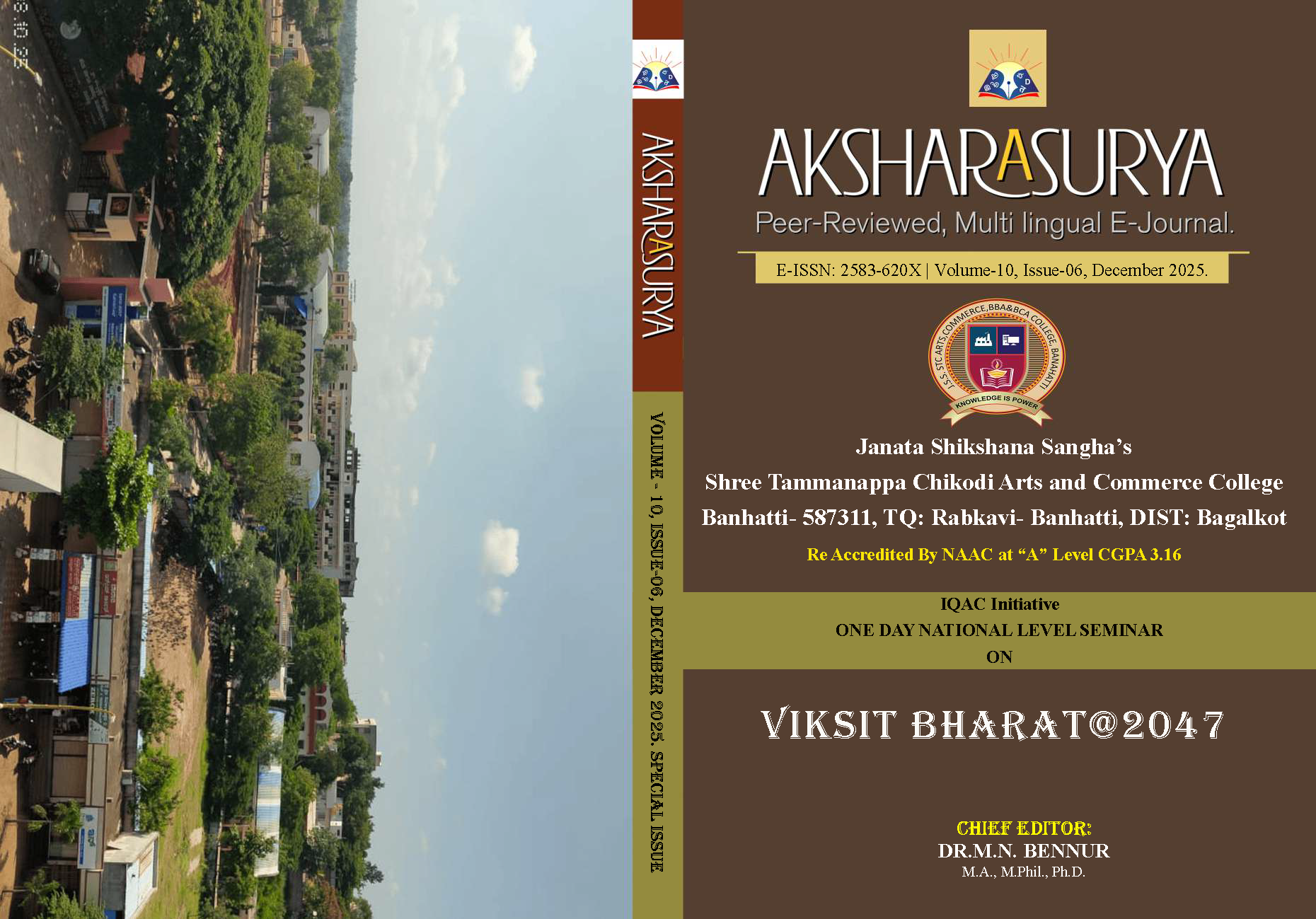
Main Article Content
Abstract
The abstracts related to "Social Justice, Equality, and Inclusion: The Road to 2047" generally explore how these principles are essential pillars for India's vision of becoming a developed nation (Viksit Bharat) by its centenary of independence in 2047. They highlight the need to address deep-rooted inequalities and ensure equitable opportunities for all citizens, especially marginalized and vulnerable groups.
Social Justice, Equality, and Inclusion: The Road to 2047" refers to the integration of these principles as foundational pillars of Viksit Bharat (Developed India) @2047, the Government of India's vision to become a developed nation by the 100th anniversary of its independence.
The core idea is that development must be inclusive and equitable to be complete and sustainable, ensuring prosperity for every section of society.
Article Details
Section

This work is licensed under a Creative Commons Attribution-NonCommercial-ShareAlike 4.0 International License.
How to Cite
References
Becker, G. S., (1993), Human Capital A Theoretical and Empirical Analysis, with Special Reference to Education. Publisher University of Chicago Press.
Census of India., (2021), Literacy and Education Data. Government of India.
Nussbaum M., (2000), Women and Human Development: The Capabilities Approach. Publisher Cambridge University Press.
Sen, A., (1999), Development as Freedom. Oxford University Press.
UNESCO., (2022), Global Education Monitoring Report. Paris: Publisher UNESCO
UNICEF., (2021), Child Marriage: Global Estimates and Trends. New York: UNICEF.
World Health Organization., (2020), Women’s Health and Education Report. Geneva: WHO.
National Family Health Survey (NFHS-5)., (2021), Key Indicators for India. Ministry of Health and Family Welfare, Government of India.