
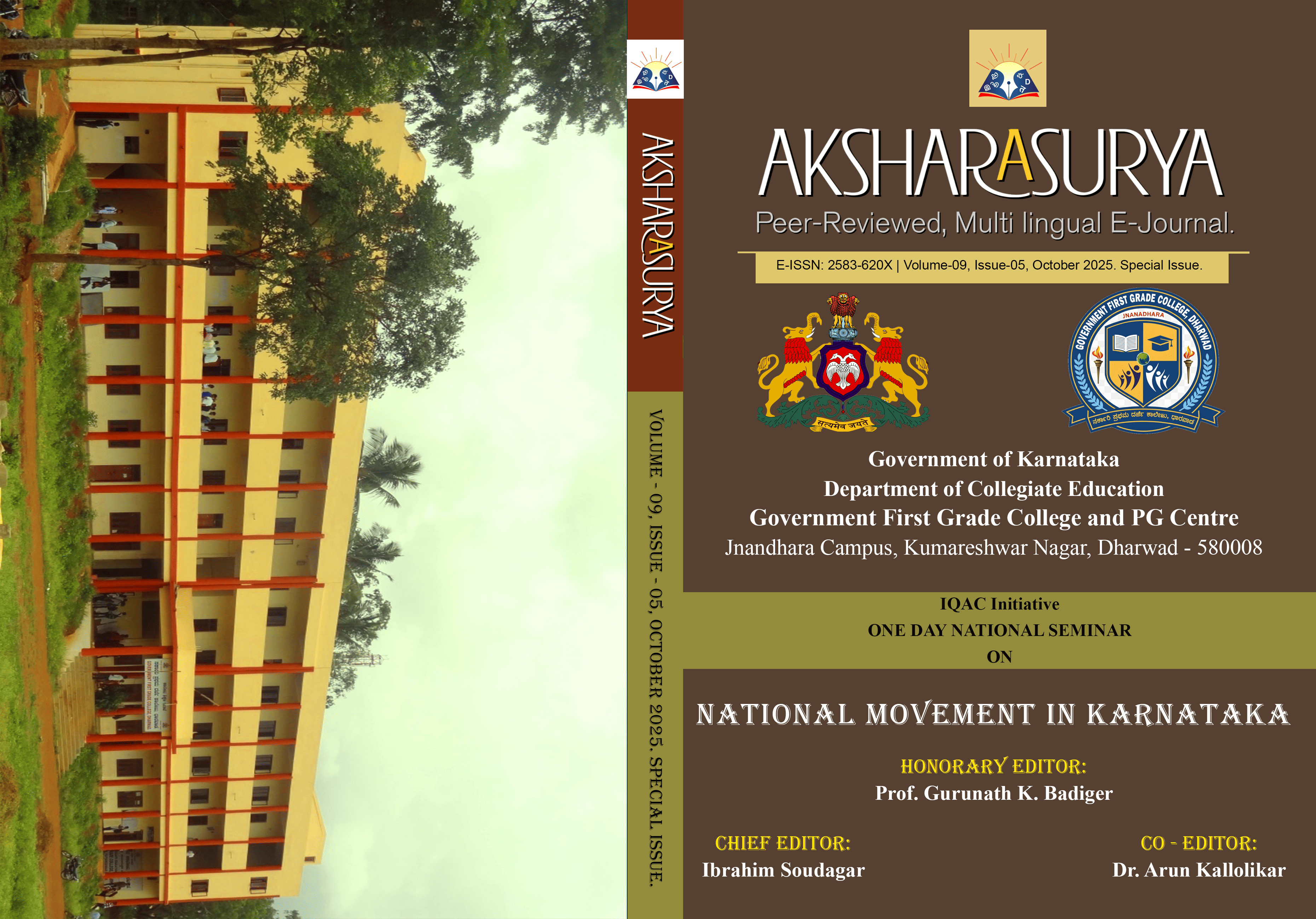
Published: 2025-10-30
Table of Contents
Research Articles
The Role of Peasant, Common Man, and Working Class in the National Movement during the Colonial Period: North Karnataka
01 to 08
The colonial period in North Karnataka witnessed a dynamic interplay between elite nationalist politics and grassroots social forces-peasants, commoners, and the working class-whose collective actions shaped the region’s contribution to India’s freedom struggle. Drawing from secondary literature, gazetteers, and colonial records, this paper examines how agrarian distress, indebtedness, and early industrial developments spurred localized mobilizations that later converged with national movements. Peasant resistance ranged from tax defaults to active participation in Non-Cooperation, Civil Disobedience, and Quit India campaigns. Artisans and small traders functioned as intermediaries linking urban and rural spheres, while the emerging working class in Belgaum, Hubli, and Dharwad adopted strike tactics connecting economic justice with anti-imperialist demands. Using a subaltern perspective, this study argues that North Karnataka’s nationalist trajectory cannot be understood without recognizing these non-elite actors whose collective defiance eroded colonial legitimacy and expanded the social base of India’s struggle for independence.
The Quit India Movement in Bombay Karnataka: Role of Undivided Dharwad District
09 to 14
The Quit India Movement was a Movement launched at the Bombay Session of the All India Committee by Mahatma Gandhi on 8th August 1942, during Second World War, demanding an end to British Rule in India. After Britain failed to secure Indian support for the British War effort with the Cripps Mission, M K Gandhi made a call to “Do or Die” in his Quit India Movement on 8th August 1942 at the Gowaliya Tank Maidan.(Ground) Viceroy Lithlithgow described the movement as “by the most serious rebellion since 1857” The Quit India Movement in Bombay Karnataka (Now Kitturu Karnataka) was marked by widespread protest, attacks on Government property like post offices and railway stations and the formation of a parallel government in Dharwad and Belagavi Districts. Initiated on in August the Movement was a direct result of the failure of the Cripps Mission and future the “Do or Die” decision given by Mahatma Gandhi in Bombay. The local response included the destruction of Government property, and despite harsh British suppression, the Movement showcased immense local commitment to achieving Independence.
The 1924 Belagavi Congress Session: Provincial Nationalism and the Making of Democratic Karnataka
15 to 22
The 1924 Belagavi Congress Session was a landmark of provincial nationalism during the Quit India Movement, highlighting how local activism shaped India’s freedom struggle and post-independence governance. This study explores the session as a convergence of local leadership, women’s participation, grassroots organization, and cultural mobilization, making Belagavi a centre of political consciousness in northern Karnataka. Despite British repression, leaders and volunteers organized rallies, strikes, underground publications, and Swaraj Committees, which acted as proto-democratic village institutions. Women played a vital role in mobilizing communities, leading marches, and managing committees, broadening the movement’s reach. The session also promoted cultural nationalism through folk songs, street plays, and Swadeshi industries. By linking local grievances with national goals, the Belagavi session strengthened the Quit India Movement and laid foundations for democratic governance, influencing Panchayati Raj institutions, cooperative societies, and political culture in Karnataka. It demonstrates how provincial activism transformed India’s freedom struggle into a participatory, democratic process, bridging national vision with local action.
Role Of Deputy Channabasappa in The Development of Education in The Colonial Rule of Mumbai Karnataka
23 to 27
This article examines the pivotal role of Deputy Channabasappa in advancing education and the Kannada language during the Colonial Rule in the Mumbai-Karnataka region (Belagavi and Dharwad). Born in 1833, Channabasappa overcame financial hurdles to gain an education, including engineering, at Pune. His dedication to his mother tongue led him to a remarkable career in the education department. As the first principal of the upgraded Teachers’ Training College in Belagavi (1864) and later as Deputy Education Inspector, he tirelessly promoted Kannada. He mandated the use of Kannada in teaching and communication, established schools, developed textbooks, and passed circulars to strengthen the language’s status, ensuring the region remained distinctly Kannada-speaking despite strong Marathi influence. His efforts laid a strong foundation for the language’s growth and eventual administrative recognition.
The Historic 1924 Belgaum Congress Session: A Milestone in India’s Freedom Struggle
28 to 33
The Indian National Congress session held at Belagavi (then Belgaum) in December 1924 marked a milestone in India’s freedom struggle. It was the only session presided over by Mahatma Gandhi, giving it unique historical significance. At a time when internal divisions weakened the Congress, Gandhi’s leadership revived the spirit of unity, discipline, and purpose within the movement.
In his presidential address, Gandhi emphasized truth, non-violence, Hindu-Muslim harmony, eradication of untouchability, promotion of Khadi, and rural self-reliance as the cornerstones of Swaraj. The session reflected his belief that political freedom must be rooted in moral strength and social reform.
A key feature of the Belagavi Session was its inclusiveness. Representatives from the Khilafat Committee, the Muslim League, non-Brahmin groups, and other social organizations participated, reflecting the Congress’s national outlook. Amid rising communal tensions, Gandhi used the platform to promote reconciliation and unity, turning diversity into a source of strength.
The 1924 Belagavi Congress thus stands as a symbol of Gandhian vision-one of moral leadership, harmony, and constructive nationalism-leaving an enduring legacy in India’s struggle for independence.
Freedom Movement in Undivided Dharwad District: Role of Adiveppa Hasabi and Rajashekarappa Hoskeri
34 to 39
The question that often arises is: what exactly constitutes the freedom movement? What is the contribution of freedom fighters to the nation and the people? Among them, what was the role of women freedom fighters, and how did classical Kannada culture encourage people to participate in the movement? This article focuses on a detailed study of the freedom struggle in the undivided Dharwad district of Karnataka, highlighting the contributions of prominent leaders such as Adiveppa Hasabi and Rajashekarappa Hoskeri during the Quit India Movement of 1942. The study examines the differences in terms of place, person, and time among the participants of the freedom struggle, offering a local perspective on the national movement.
Grace in Resistance: Karnataka’s Female Classical Dancers and the Freedom Movement
40 to 46
This paper explores the overlooked yet influential role of Karnataka’s female classical dancers in India’s freedom struggle, focusing on two key figures K. Venkatalakshamma and Shanta Rao. It situates their artistic practice within the socio-political and cultural contexts of colonial Mysore, demonstrating how dance served as both a spiritual discipline and a subtle form of political expression. Drawing upon archival sources, biographies, oral histories, and performance theory, the study reveals how these women transformed ritual and court traditions condemned by colonial morality into acts of aesthetic resistance. Their performances carried nationalist themes through mythic allegory, devotional emotion, and artistic precision, allowing political ideas to resonate in veiled yet powerful forms. Through pedagogy and institutional engagement, they secured continuity for classical dance within modern education and post-independence cultural policy. The paper also interrogates gendered aspects of cultural nationalism, showing how women dancers negotiated respectability and agency through art. Ultimately, Karnataka’s female artists contributed to India’s cultural sovereignty, embodying a “grace in resistance” that merged artistic devotion with the moral imagination of freedom.
Iconography in Buddhist Traditions: A Study
47 to 52
The visual language of Buddhist traditions serves as a profound medium for transmitting religious philosophy, cultural values, and historical narratives across time and space. This study, Iconography in Buddhist Traditions, explores the evolution, symbolism, and regional adaptations of Buddhist imagery from early aniconic representations to the richly elaborated anthropomorphic forms. Drawing on archaeological evidence, sculptural analysis, and comparative stylistic studies, the research examines how Buddhist iconography both reflects and shapes doctrinal developments, sectarian identities, and cross-cultural interactions across South Asia and beyond. The work investigates key motifs—such as the Bodhi tree, Dharma wheel, footprints, and the various mudras of the Buddha—while situating them within their socio-political and ritual contexts. By integrating art-historical methodology with historical inquiry, this study underscores the enduring role of iconography in sustaining Buddhist devotional practices and in facilitating the transmission of the Dharma across diverse geographies. The findings highlight not only the aesthetic richness of Buddhist art but also its capacity to serve as a dynamic vessel of meaning, bridging the sacred and the tangible, the universal and the local.
A Forgotten Freedom fighter Hanumantha Rao Kaujalgi
53 to 60
India’s long struggle for independence was shaped by countless patriots-both famous and unsung-who dedicated their lives to the nation’s freedom. Among these lesser-known heroes was Hanumantha Rao Kaujalgi, a devoted leader from Karnataka inspired by Bal Gangadhar Tilak and Mahatma Gandhi. He actively participated in the Swadeshi, Non-Cooperation, and Salt Satyagrahaa movements, promoting khadi and serving the poor, especially the depressed classes and weavers of North Karnataka. His relief work during the Bijapur drought and his efforts to mobilize people against the princely states of Mudhol, Jamkhandi, and Ramdurg were remarkable. As founder of the Praja Paratinidhi Sabha and participant in the Gandhi Cap incident, Kaujalgi demonstrated courage, organization, and literary skill-earning admiration from Gandhiji himself. His life exemplified selfless service and the spirit of true patriotism.
Guddappa Harijan of Hanagal Taluk, Bombay Karnataka’s Silent Revolution of Harijanodhara
61 to 66
Gandhiji’s Harijanoddhara (upliftment of the untouchables) movement played a crucial role in India’s freedom struggle, as he believed that true independence was impossible without eradicating untouchability. Inspired by Gandhiji’s call, many reformers and freedom fighters in Karnataka, particularly in Haveri district, actively participated in this social revolution. Couples like Mrs. Nagamma Patil and Veeranagowda of Kachavi village, supported by leaders such as K.F. Patil, T.R. Nesvi, Hallikeri Guddeppa, Sanguru Kariappa, and Menasinal Thimmanagoudru, advanced the cause through institutions like Mahila Vidya Peetha, Hubballi. Local leaders including Nyamati Veerabhadrappa and Betageri Ramanna also led community initiatives to abolish caste discrimination. Significantly, Guddanagouda Neelanagouda Patil (Harijan) of Akkialuru village emerged as a symbol of Gandhian ideals, dedicating his life to the upliftment of his community. His lifelong struggle, continuing until his passing in 2018, exemplifies the spirit of Gandhiji’s Harijan movement in Karnataka’s freedom and social reform efforts.
Freedom Movement in Oral Narratives of North Karnataka: A Study of Canarese Ballads
67 to 72
India’s national movement was a long narrative of resistance before becoming a mass movement in the 20th century. Various forms of cultural expression played vital roles in awakening nationalist consciousness. Among these, the Lavani-a popular folk art form emerged as a powerful medium for spreading patriotic ideas and inspiring the common people. Particularly in North Karnataka, Lavani poets and singers used their art to glorify local heroes like Sangolli Rayanna and Halagali Bedas, linking folk traditions to the larger freedom movement. This paper examines the contribution of Kannada Lavani to India’s struggle for independence and its lasting cultural impact.
The 1924 Belgaum Session of Indian National Congress and Its Significance
73 to 78
The Belgaum Session of the Indian National Congress, held in December 1924, marks a turning point in the history of India’s freedom struggle. It was only session presided over by Mahatma Gandhi, reflecting a unique confluence between constitutional politics and mass civil disobedience. The Belgaum session came at a time when the congress was re-evaluating its methods after the suspension of the Non-Cooperation Movement and internal divisions between the Swarajists and No-changers. This session not only attempted to heal the ideological rift within the congress but also laid the groundwork for the future course of India’s national movement by emphasizing unity, constructive work, and self-reliance. This paper explains the background, proceedings, and outcome of the Belgaum session and its significance.
Martyrs of Dharwad, Gadag, and Haveri: Unsung Heroes of India’s Freedom Struggle
79 to 83
India’s struggle for independence was shaped not only by national leaders but also by countless local heroes whose sacrifices often remain unrecognized. The districts of Dharwad, Gadag, and Haveri in North Karnataka played a significant role in resisting British colonial rule through armed rebellions, non-violent protests, and revolutionary acts. From the 1857 Revolt to the Quit India Movement of 1942–43, these regions produced martyrs whose bravery galvanized public support and inspired successive generations. This article chronologically traces the contributions of these unsung heroes, highlighting key uprisings, pivotal incidents such as the Jakani Bhavi massacre, and the socio-political context that shaped their resistance. Drawing from historical records, gazetteers, and local oral histories, the paper seeks to preserve the memory of Karnataka’s grassroots freedom fighters, emphasizing the region’s indispensable role in India’s liberation.
Contributions of Karnataka Women to the Indian Independence Movement
84 to 92
This article, “Contributions of Karnataka Women to the Indian Independence Movement,” distinguishes between pre-Gandhian rulers like Kittur Chennamma and actual freedom fighters of the Gandhian era. It highlights the significant role of Karnataka women in the national movement from the 1920s onwards, particularly through participation in the Swadeshi Movement, Non-Cooperation, Civil Disobedience, and Quit India Movement. Prominent figures discussed include Kamaladevi Chattopadyaya, a key leader in the Civil Disobedience Movement and international advocate; Umabai Kundapur, organizer of ‘Hindustan Sevadal’s’ ladies wing and women’s education promoter; and Ballary Siddamma, the first woman arrested during the Shivapura Congress Session. These women, primarily from educated, upper middle-class backgrounds, propelled the nationalist and unification movements in Karnataka through various acts of Satyagraha, social reform, and public awareness campaigns, leaving a lasting, inspirational legacy.
Haji Usman Sait of Bengaluru: The Pivotal Role of Khilafat Stalwart in Karnataka’s Nationalist Awakening
93 to 97
This paper examines the critical yet understudied role of Haji Usman Sait, a prominent merchant and president of the Bengaluru Khilafat Committee, in catalysing the Non-Cooperation Movement in Karnataka. While mainstream narratives of the freedom struggle in the region often highlight Congress leaders, this study argues that Sait’s leadership was instrumental in the initial mass mobilization of the early 1920s. As a key financier, organizer, and bridge between communities, he transformed the Khilafat agitation into a powerful force for nationalist action. Drawing from contemporary newspapers and historical accounts, this study reconstructs Sait’s multifaceted contributions from organizing large-scale protests and funding movement activities to fostering Hindu-Muslim unity. It concludes that figures like Haji Usman Sait were grassroots architects of Gandhian mass movements in Karnataka, and their erasure from mainstream historiography reflects a significant gap in acknowledging the diverse coalitions that defined India’s struggle for freedom.
Selected Women Freedom Fighters of Karnataka during Gandhian Era
98 to 103
The history of freedom movement would be incomplete without saluting the contribution of women. The women in Karnataka played a unique & vital role in the freedom struggle during the Gandhian Era. Mahatma Gandhi led the freedom struggle from 1920 to 1947. His leadership attracted people from all walks of life. The women of Karnataka actively participating in movements like the Salt Satyagraha, No Tax Campaigns & Quit India Movement. The women of Karnataka state have contributed a lot in the freedom struggle. Some of the women participated of this era are Umabai Kundapur, Bellary Siddamma, T.Sunadamma, Kamaladevi Chattopadhya, Nagamma Patil, Krishnabai Panajikar Yashodara Dasappa Jayadevi Tai Ligade etc., Their courage resilience & unwavering commitment to freedom serve as a reminder of their sacrifices and shaping the Destiny of our beloved nation.
Newspapers and Nationalism: Media as a Tool of Mobilisation in the Mysore Princely State in the Anti-Colonial Struggles
104 to 112
The press played a pivotal role in shaping political consciousness and mobilising anti-colonial sentiment in colonial India. In the Mysore princely state, newspapers were not merely instruments of information but crucial platforms for civic education, public debate, and nationalist mobilisation. This study examines the contribution of newspapers to key movements, including the Non-Cooperation Movement, legal disruption campaigns such as the Shivapur Satyagraha, Vidurasvatha, and forestry protests, as well as the Quit India Movement, including the Isur tragedy and Mysore Chalo movement. Using a historical-analytical approach, the research draws on archival newspapers, government records, and secondary literature to analyse how print media connected local grievances to the broader national struggle, encouraged civic participation, and sustained underground political activism despite censorship and surveillance. Findings indicate that newspapers in Mysore effectively fostered public awareness, coordinated grassroots resistance, and amplified demands for responsible governance. The study highlights the press as both a mirror and mediator of anti-colonial activism, linking regional struggles with national movements. By examining the interplay between media, regional politics, and nationalist consciousness, this research provides a deeper understanding of the role of print culture in semi-autonomous princely states and highlights the enduring influence of newspapers in shaping the trajectory of India’s freedom struggle.
Unsung Heroes of Freedom: Contributions of Leaders, Women Fighters, and Local Organizations from North Karnataka
113 to 120
The Indian independence movement was a complex confluence of regional and national struggles, yet the contributions of North Karnataka remain underrepresented in mainstream historiography. This paper explores the region’s crucial role in shaping anti-colonial resistance through revolutionary leaders, women freedom fighters, and local organizations. Figures such as Sangolli Rayanna, Bhaskar Rao Bhave, Kittur Rani Chennamma, Rani Abbakka Chowta, Umabai Kundapur, and Bellary Siddamma exemplified multifaceted resistance-ranging from armed rebellion and peasant uprisings to educational reform and cultural assertion. Organizations like the Karnataka Vidyavardhaka Sangha, Seva Dal, and underground groups such as Hublikar Sanghatane nurtured political awareness, social reform, and nationalist solidarity. Through these interconnected struggles, North Karnataka demonstrated that the freedom movement was not a peripheral endeavour but an integral component of India’s nationalist awakening. Recognizing these regional contributions restores balance to historiography and emphasizes how local identities, gendered agency, and grassroots activism coalesced to challenge colonial domination.
Early National Awakening in Karnataka: The Role of Libraries and Economic Issues in Shaping Regional Nationalism
121 to 129
The early national awakening in Karnataka, spanning the late 19th and early 20th centuries, was a multidimensional process shaped by educational, economic, and cultural factors. This study examines how grassroots initiatives such as public libraries, literary societies, and cooperative movements fostered political consciousness and regional nationalism. Libraries emerged as pivotal centres for disseminating nationalist literature, promoting literacy, and facilitating critical discussions on colonial policies and social reform. Simultaneously, economic grievances-including agrarian distress, exploitative land revenue systems, indebtedness, and the decline of traditional industries-mobilized local populations toward collective action. By analysing historical records, library networks, economic protests, and cooperative societies, this research highlights the interconnectedness of education, economic awareness, and political activism. The findings demonstrate that Karnataka’s early national awakening was not limited to elite leadership but was a community-driven movement in which literacy, access to information, and economic empowerment played central roles. The study underscores the significance of local institutions and economic consciousness in shaping regional identity and contributing meaningfully to India’s broader struggle for independence.
Between Martyrdom and Mobilization: Women’s Participation in Karnataka’s Nationalist Movement
130 to 138
This paper examines the significant yet often underrepresented role of women in Karnataka’s nationalist movement between the late 19th and mid-20th centuries. It highlights how women participated not only as supporters but as active revolutionaries, mobilizers, and martyrs. Drawing on secondary data, government archives, and published reports, the study explores the contributions of prominent figures such as Kittur Rani Chennamma, Onake Obavva (symbolic inspiration), Kamaladevi Chattopadhyay, and grassroots women activists during Quit India and Civil Disobedience Movements. Women’s engagement took diverse forms-ranging from organizing protests, distributing underground literature, to leading satyagraha’s. Despite patriarchal constraints, their mobilization efforts contributed to shaping Karnataka’s socio-political consciousness. The study employs a historical-analytical method and qualitative content analysis of archival records and scholarly works. It identifies key mobilization networks, local organizations, and the impact of women’s activism on national politics. The paper also addresses the historiographical gap in documenting regional women’s contributions and argues for integrating their narratives into mainstream nationalist history.
Women’s Participation in Freedom Movement in Princely Mysore with Special Reference to Gandhian Ideologists
139 to 145
This article examines women’s participation in the freedom movement in Princely Mysore, with a special focus on the influence of Gandhian ideology. While the Mysore state, ruled by the Wodeyars, was considered “Modern Mysore” with administrative progress, it also faced suppression of aspirations for Responsible Government. The national movement, spearheaded by organizations like the Mysore State Congress (established 1938), drew significant involvement from women, many encouraged by their families.
Women like Subbamma Jois, Yashodhara Dasappa, Caveramma, and Chennamma were prominent. Their activities included Khadi production and promotion (e.g., at the Badnaval center), picketing liquor shops, and civil disobedience, leading to arrests and imprisonment. These actions demonstrated a strong nationalistic urge and a commitment to Gandhian principles of simplicity and self-sacrifice, ultimately contributing to the state’s merger with independent India.
Economic Voices from the Margins: Peasants and Working Classes in Historical Perspective
146 to 152
This study examines the economic experiences of peasants and workers under colonial and early post-colonial regimes, highlighting their often-marginalized role in shaping economic structures. Colonial policies prioritized surplus extraction and export-oriented production, impoverishing rural producers and creating exploitative labor systems that shaped enduring inequalities. Peasants faced cash-crop cultivation, heavy taxation, and forced labor, while industrial workers endured low wages and insecure conditions. Agrarian uprisings, including Indian satyagraha’s and African women’s protests, reflected collective resistance rooted in subsistence rights. Post-independence land reforms and industrial policies aimed at equity were unevenly implemented, leaving structural disparities. Drawing on economic history and development perspectives, the paper underscores how peasants and workers contributed labor, resistance, and transformation while remaining constrained by colonial legacies.
The Relationship between National Leaders and Karnataka during the Indian National Movement
153 to 158
This paper critically examines the reciprocal relationship between national leaders and the region of Karnataka during the Indian National Movement (1885–1947), emphasizing the interplay between national political ideologies and regional socio-political dynamics. Karnataka then territorially fragmented under various British presidencies and princely states most notably Mysore, emerged as an active participant in the broader anti-colonial struggle. National figures such as Mahatma Gandhi, Bal Gangadhar Tilak, Jawaharlal Nehru, and Sardar Vallabhbhai Patel catalyzed mass mobilization through visits, speeches, and ideological influence. Their engagement was not unidirectional; Karnataka contributed significantly through grassroots activism, regional leaders like Karnad Sadashiva Rao and Hardekar Manjappa, and strategic adaptation of national programs including Non-Cooperation, Civil Disobedience, and Quit India.
The study further interrogates how Gandhian ideals were localized in Karnataka, particularly through khadi promotion, Harijan welfare, and village-based self-reliance. It also explores the unique political context of princely Mysore, culminating in the “Mysore Chalo” movement demanding responsible governance. The eventual unification of Kannada-speaking regions in 1956 is analyzed as a postcolonial extension of nationalist aspirations. Ultimately, the essay argues that Karnataka’s engagement with national leaders was both collaborative and transformative, contributing to the shaping of modern Indian nationalism and regional identity formation within the federal structure of post-independence India.
Economic Foundations of Society: The Historical Role of Peasants, Common Man, and Working Classes
159 to 166
This study investigates the economic foundations of society by tracing the historical role of peasants, the common man, and the working classes in shaping economic and social transformation. From agrarian civilizations to the rise of industrial capitalism and post-colonial development, these groups have remained the driving force behind production, distribution, and social change. Their labor sustained empires and industries, while their collective struggles challenged exploitation and redefined justice within the economic order. Grounded in economic history, Marxian political economy, and development theory, the study reveals that although technological and institutional advances have transformed modes of production, the underlying dependence on labor and surplus extraction endures. It emphasizes that peasants and workers have been both the architects and the conscience of economic progress, embodying the continuous dialectic between exploitation and empowerment. Ultimately, the research underscores that any understanding of economic development must center on these marginalized yet indispensable actors whose resilience and agency have shaped the material foundations of human civilization.
Veerashaiva Concept and Folk Tradition in Basaveshwar’s Vachanas
167 to 173
Basavanna was a philosopher and a social reformer in 12th century Karnataka, the paper represents on folk tradition in Basavanna Vachanas, the paper explores the important vachanas which are related folk language and folk communication. Basavanna accepted that men and women of all castes and creeds as social equals and his encouragement of inter-case marriages infuriated the King and some of his hide-bound followers. The paper deliberate the laying down the path of spiritual advancement and social reconstruction based on free thinking. This unique institution has few parallels in the religious history of the world.