
Unsung Heroes of Freedom: Contributions of Leaders, Women Fighters, and Local Organizations from North Karnataka
Article Sidebar
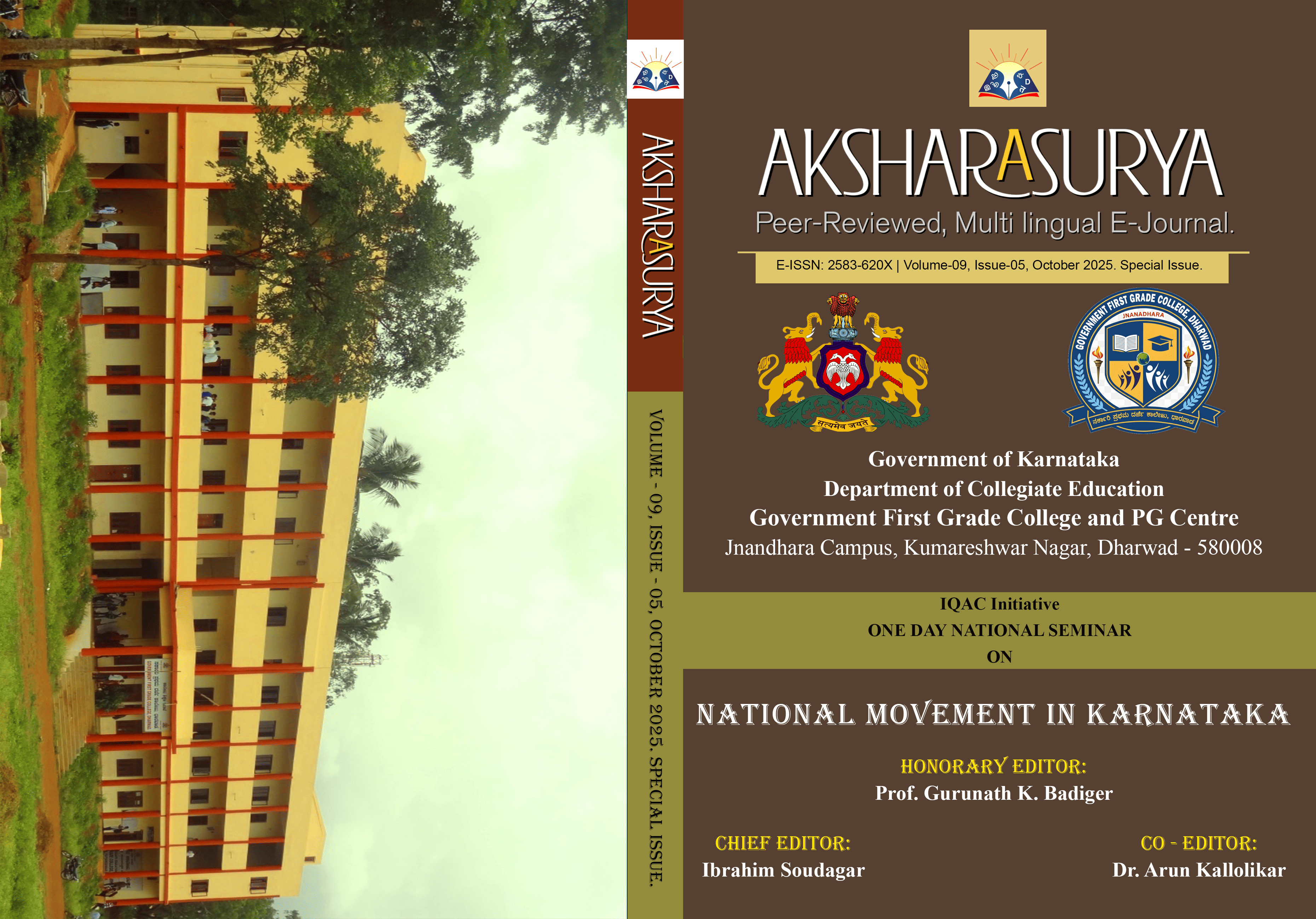
Main Article Content
Abstract
The Indian independence movement was a complex confluence of regional and national struggles, yet the contributions of North Karnataka remain underrepresented in mainstream historiography. This paper explores the region’s crucial role in shaping anti-colonial resistance through revolutionary leaders, women freedom fighters, and local organizations. Figures such as Sangolli Rayanna, Bhaskar Rao Bhave, Kittur Rani Chennamma, Rani Abbakka Chowta, Umabai Kundapur, and Bellary Siddamma exemplified multifaceted resistance-ranging from armed rebellion and peasant uprisings to educational reform and cultural assertion. Organizations like the Karnataka Vidyavardhaka Sangha, Seva Dal, and underground groups such as Hublikar Sanghatane nurtured political awareness, social reform, and nationalist solidarity. Through these interconnected struggles, North Karnataka demonstrated that the freedom movement was not a peripheral endeavour but an integral component of India’s nationalist awakening. Recognizing these regional contributions restores balance to historiography and emphasizes how local identities, gendered agency, and grassroots activism coalesced to challenge colonial domination.
Article Details
Section

This work is licensed under a Creative Commons Attribution-NonCommercial-ShareAlike 4.0 International License.
How to Cite
References
Bhat, R. (2009). Rani Abbakka Chowta: The Warrior Queen of Karnataka. Mangalore: Dakshina Publications.
Chandavar, S. (2010). Press and Nationalist Awakening in Karnataka. Dharwad: Vidyanidhi Publications.
Desai, V. (2017). Freedom Struggle in Karnataka: A Regional Study. Bengaluru: Sapna Book House.
Deshpande, A. (2006). Cultural Nationalism in Karnataka: A Historical Survey. Dharwad: Karnataka Historical Studies.
Deshpande, S. (2012). The Role of Karnataka in the Civil Disobedience Movement. Belagavi: Karnataka Historical Society.
Gopal, S. (1984). The Freedom Struggle in Karnataka. Delhi: People’s Publishing House.
Hiremath, R. (2007). The Halagali Rebellion: Resistance and Memory in Karnataka. Hubli: Kannada Sahitya Parishat.
Hiremath, R. (2009). Folk Traditions and Freedom Movement in Karnataka. Mysore: University of Mysore Press.
Joshi, V. (1988). Quit India Movement in Karnataka: A Study of Mass Participation. Hubballi: Navakarnataka Publications.
Kamath, S. U. (2001). A Concise History of Karnataka. Bangalore: Jupiter Books.
Kattimani, B. (1996). Freedom Movement in Karnataka. Dharwad: Karnataka University Press.
Kulkarni, G. (2002). Revolt and Resistance in Colonial Karnataka. Belagavi: Sahitya Prakashana.
Kulkarni, G. (2005). Educational Movements in Colonial Karnataka. Dharwad: Manohar Publishers.
Patil, P. (1998). Kittur Rani Chennamma and the Freedom Struggle in Karnataka. Belagavi: Karnataka Sahitya Academy.
Patil, S. (2014). Folk Memory and the Freedom Struggle in Karnataka. Mysore: University of Mysore Press.
Rao, A. V. (2015). Karnataka Gatha Vaibhava (Original work published 1928). Dharwad: Karnataka Vidyavardhaka Sangha.
Sharma, K. (1998). Peasant and Elite Resistance in Northern Karnataka. Delhi: Manohar Publications.
Shastri, M. (1990). Women and the Freedom Movement in Karnataka. Dharwad: Vidyanidhi Publications.
Srinivas, M. N. (2001). Social Change in Modern India. New Delhi: Orient Longman.
Ramaswamy, S. (2007). Political Mobilization and Cultural Identity in Karnataka. Bangalore: Indian Institute of Advanced Studies.