
Newspapers and Nationalism: Media as a Tool of Mobilisation in the Mysore Princely State in the Anti-Colonial Struggles
Article Sidebar
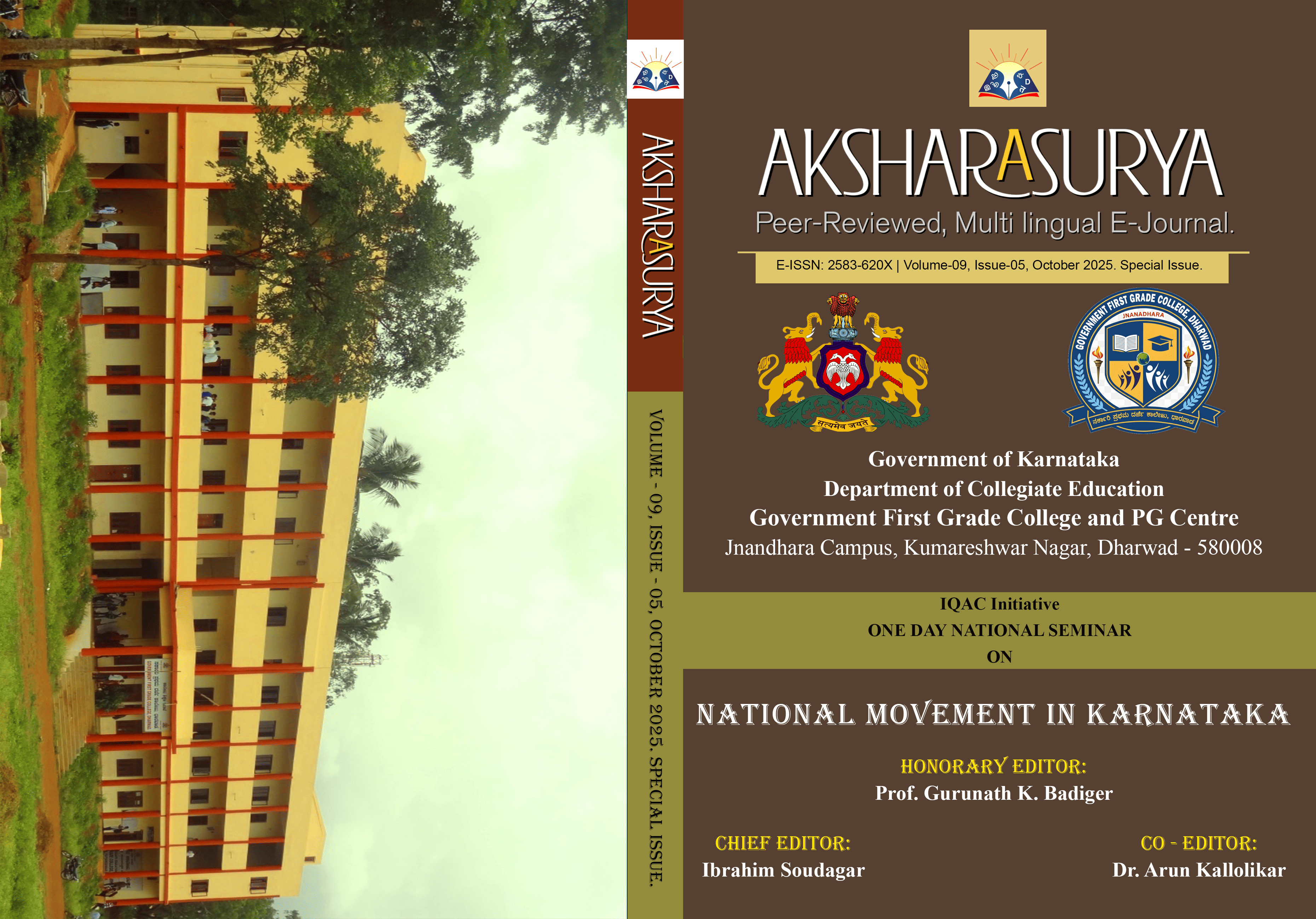
Main Article Content
Abstract
The press played a pivotal role in shaping political consciousness and mobilising anti-colonial sentiment in colonial India. In the Mysore princely state, newspapers were not merely instruments of information but crucial platforms for civic education, public debate, and nationalist mobilisation. This study examines the contribution of newspapers to key movements, including the Non-Cooperation Movement, legal disruption campaigns such as the Shivapur Satyagraha, Vidurasvatha, and forestry protests, as well as the Quit India Movement, including the Isur tragedy and Mysore Chalo movement. Using a historical-analytical approach, the research draws on archival newspapers, government records, and secondary literature to analyse how print media connected local grievances to the broader national struggle, encouraged civic participation, and sustained underground political activism despite censorship and surveillance. Findings indicate that newspapers in Mysore effectively fostered public awareness, coordinated grassroots resistance, and amplified demands for responsible governance. The study highlights the press as both a mirror and mediator of anti-colonial activism, linking regional struggles with national movements. By examining the interplay between media, regional politics, and nationalist consciousness, this research provides a deeper understanding of the role of print culture in semi-autonomous princely states and highlights the enduring influence of newspapers in shaping the trajectory of India’s freedom struggle.
Article Details
Section

This work is licensed under a Creative Commons Attribution-NonCommercial-ShareAlike 4.0 International License.
How to Cite
References
Bandyopadhyay, S. (2004). From Plassey to Partition: A History of Modern India. Orient BlackSwan.
Chandra, B. (2009). India’s struggle for independence. Penguin Books.
Chatterjee, P. (1993). The nation and its fragments: Colonial and postcolonial histories. Princeton University Press.
Chitnis, K. N. (1973). Mysore and the Indian national movement. Karnataka University Press.
Dirks, N. B. (2001). Castes of mind: Colonialism and the making of modern India. Princeton University Press.
Gordon, L. (1990). The history of the Indian nationalist press. Cambridge University Press.
Guha, R. (1983). Elementary aspects of peasant insurgency in colonial India. Oxford University Press.
Jeffrey, R. (1993). Politics, women, and well-being: How Kerala became a model. Oxford University Press.
Kulkarni, R. (2000). Peasant movements and regional politics in Mysore. Bangalore: Karnataka Historical Society.
Mahajan, S. (2004). Indian national movement and the role of regional newspapers. New Delhi: Sage Publications.
Menon, V. P. (1956). The story of the press in India. Bombay: Asia Publishing House.
Nair, J. (1995). Mysore in the colonial imagination: State, press, and society. Indian Institute of Historical Studies.
Panikkar, K. N. (1962). India and the British Empire: Press and politics. London: Oxford University Press.
Ramaswamy, S. (2007). Passions of the print: Nationalism and the vernacular press in colonial India. Oxford University Press.
Raychaudhuri, T. (1988). Nationalism and regional politics in princely states. Calcutta: Indian Historical Review.
Sarkar, S. (1983). Modern India: 1885–1947. Macmillan.
Srinivas, M. N. (1996). Caste, society, and politics in India. Delhi: Oxford University Press.
Chatterjee, P., & Guha, R. (1991). Print culture and nationalist movements in India. New Delhi: Oxford University Press.
Basu, S. (1985). Indian press and nationalism: The colonial period. Calcutta University Press.
Thorner, D. (1962). Land and labour in India. Asia Publishing House.
N. Chinnaswamy Sosale. (2010) Vasahaathu Kaalaghattada Mysore Samsthana, Prasaranga, Kannada University, Hampi.