
The GST on Fiscal Consolidation in India: An Ambedkar Perspective on Fiscal Federalism
Article Sidebar
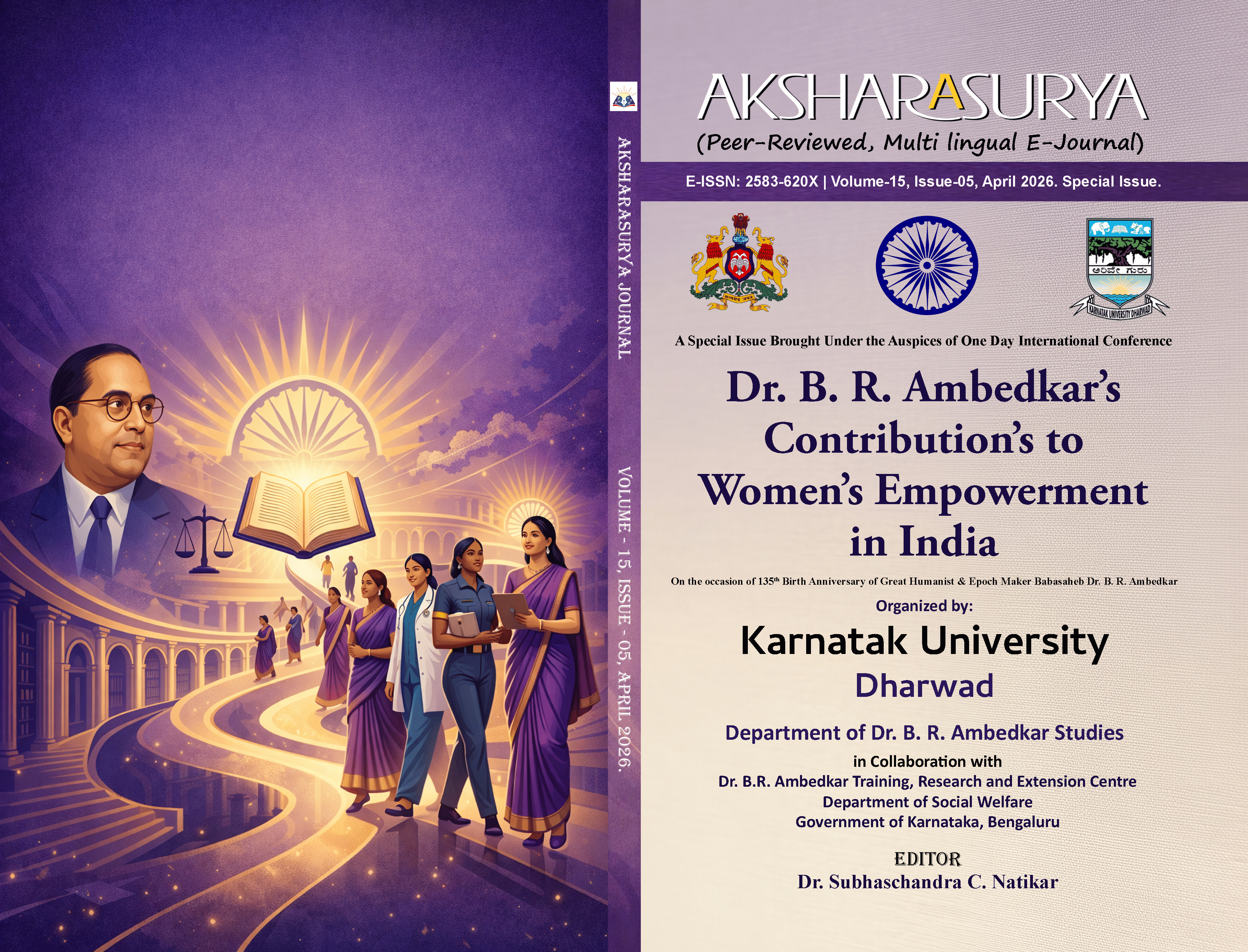
Main Article Content
Abstract
The Goods and Services Tax (GST), introduced in July 2017, aimed to create a unified market, improve compliance, and enhance revenue efficiency in India. This paper examines its impact on state-level fiscal consolidation-reduction of fiscal deficits and public debt-using an Ambedkarite framework emphasizing equity and state autonomy. Using panel data for 17 states (FY2013–FY2024) and a fixed-effects model, the study finds that GST improved tax buoyancy, with the indirect tax-to-GDP ratio rising from 5.4% to 6.2%. However, it is also associated with an increase in state fiscal deficits by about 0.35 percentage points of GSDP, particularly after the end of compensation in 2022, affecting less industrialized states more. From a B. R. Ambedkar perspective, GST enhances efficiency but weakens fiscal autonomy. The paper recommends permanent compensation, limited tax flexibility for states, and stronger equalization mechanisms to ensure balanced fiscal federalism.
Article Details
Section

This work is licensed under a Creative Commons Attribution-NonCommercial-ShareAlike 4.0 International License.
How to Cite
References
Ambedkar, B. R. (1923). The Problem of the Rupee: Its Origin and Its Solution. London: P.S. King & Son.
Ambedkar, B. R. (1947). States and Minorities: What are their rights and how to secure them? Bombay: Thacker & Co.
Chakraborty, L., Mukherjee, S., & Singh, R. (2023). GST and state fiscal autonomy: Evidence from panel data. Economic & Political Weekly, 58(12), 45–53.
Dodamani, T., & Bharadi, H. H. (2025). Revisiting Ambedkar’s fiscal federalism: Implications for fiscal consolidation in post-GST India. AKSHARASURYA, 10(05), 09–16.
Government of India. (2020). Report of the Fifteenth Finance Commission. New Delhi.
Gupta, A., & Nagarajan, L. (2021). Tax buoyancy under GST: A state-level analysis. Indian Journal of Public Finance, 37(2), 112–128.
Mukherjee, S. (2019). Goods and Services Tax in India: An assessment of the initial years. National Institute of Public Finance and Policy Working Paper No. 280.
Musgrave, R. A. (1959). The Theory of Public Finance. New York: McGraw-Hill.
Oates, W. E. (1972). Fiscal Federalism. New York: Harcourt Brace Jovanovich.
Rao, M. G., & Chakraborty, P. (2018). Goods and Services Tax in India: A progress report. Economic & Political Weekly, 53(12), 54–61.
Reserve Bank of India. (various issues). State Finances: A Study of Budgets. Mumbai: RBI.
Rodden, J. (2002). The dilemma of fiscal federalism: Hard and soft budget constraints around the world. American Political Science Review, 96(3), 496–510.
Saha, S., & Das, K. (2022). GST and fiscal consolidation: A state-level analysis. Journal of Asian Economics, 78, 101435.
Singh, N. (2024). Destination-based taxation and horizontal imbalances in India. India Policy Forum, 20, 85–122.
Thorat, S., & Kumar, R. (2023). Ambedkar’s economic thought and contemporary fiscal policy. Indian Journal of Social and Economic Policy, 15(1), 33–51.