
Dr. B.R. Ambedkar’s Contribution to Women’s Empowerment, Dalit Voices, and Social Transformation: A Study of Gogu Shyamala’s Narratives
Article Sidebar
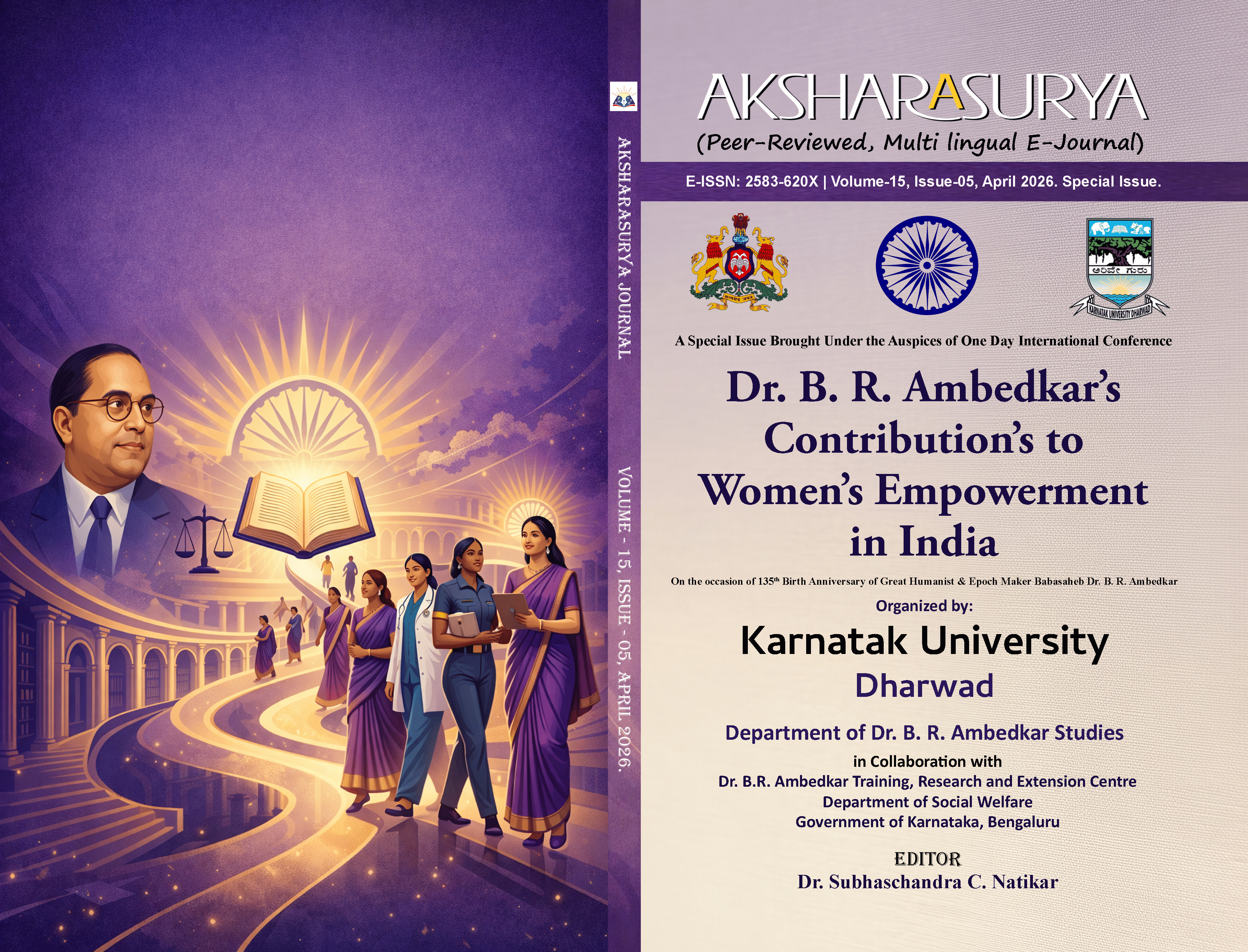
Main Article Content
Abstract
Indian English Literature has contributed immensely to enriching Global English language and literature. Literature is the mirror of society as it is the cause of social transformation. Dalit literature is one of the emerging literary genres in the Indian English literature. Dr. B. R. Ambedkar has immensely contributed to women’s empowerment. He has drafted the ‘Hindu Code Bill’ for the empowerment of women in traditional India. This paper delves into the intersection of social transformation and Dalit voices in Indian English literature through a centred analysis of Gogu Shyamala’s literary works. She is a prominent Dalit feminist writer, activist and orator. The paper aims to focus on marginalized communities’ experiences and challenges of the Madiga community, especially Madiga women in Telangana. Gogu Shyamala is using storytelling as a form of resistance and reclamation. This paper will focus on the selected works of Gogu Shyamala like ‘Raw Wound’, ‘Father May Be an Elephant Mother Only a Small Basket But…’ The paper tries to investigate how Gogu Shyamala subverts dominant literary paradigms and represents the socio-political imagination of Dalit identity in India. The paper examines how her use of language, oppression of Madiga women, problems of Jogini, regional dialects, and folk idioms resist the homogenising tendencies of mainstream literature and asserts a distinct Dalit literature. This paper mainly focuses on caste, class, and gender in the works of Gogu Shyamala to reveal how narratives of marginalisation become primary sources for resistance and transformation. This paper argues that her narratives not only enrich the corpus of Indian English literature but also contribute meaningfully to the broader discourse on social justice and transformation.
Article Details
Section

This work is licensed under a Creative Commons Attribution-NonCommercial-ShareAlike 4.0 International License.
How to Cite
References
Shyamala, Gogu. Father May Be an Elephant and Mother Only a Small Basket, But.... Translated by various, Navayana, 2012.
Limbale, Sharankumar. Towards an Aesthetic of Dalit Literature: History, Controversies and Considerations. Translated by Alok Mukherjee, Orient BlackSwan, 2004.
Rege, Sharmila. Writing Caste/Writing Gender: Narrating Dalit Women’s Testimonios. Zubaan, 2006.
Guru, Gopal. “Dalit Women Talk Differently.” Economic and Political Weekly, vol. 30, no. 41-42, 1995.
Omvedt, Gail. Dalits and the Democratic Revolution: Dr Ambedkar and the Dalit Movement in Colonial India. Sage, 1994.