
Revisiting Ambedkar’s States and Minorities (1947): A Textual Analysis of State Socialism, Land Nationalisation, and Collective Farming
Article Sidebar
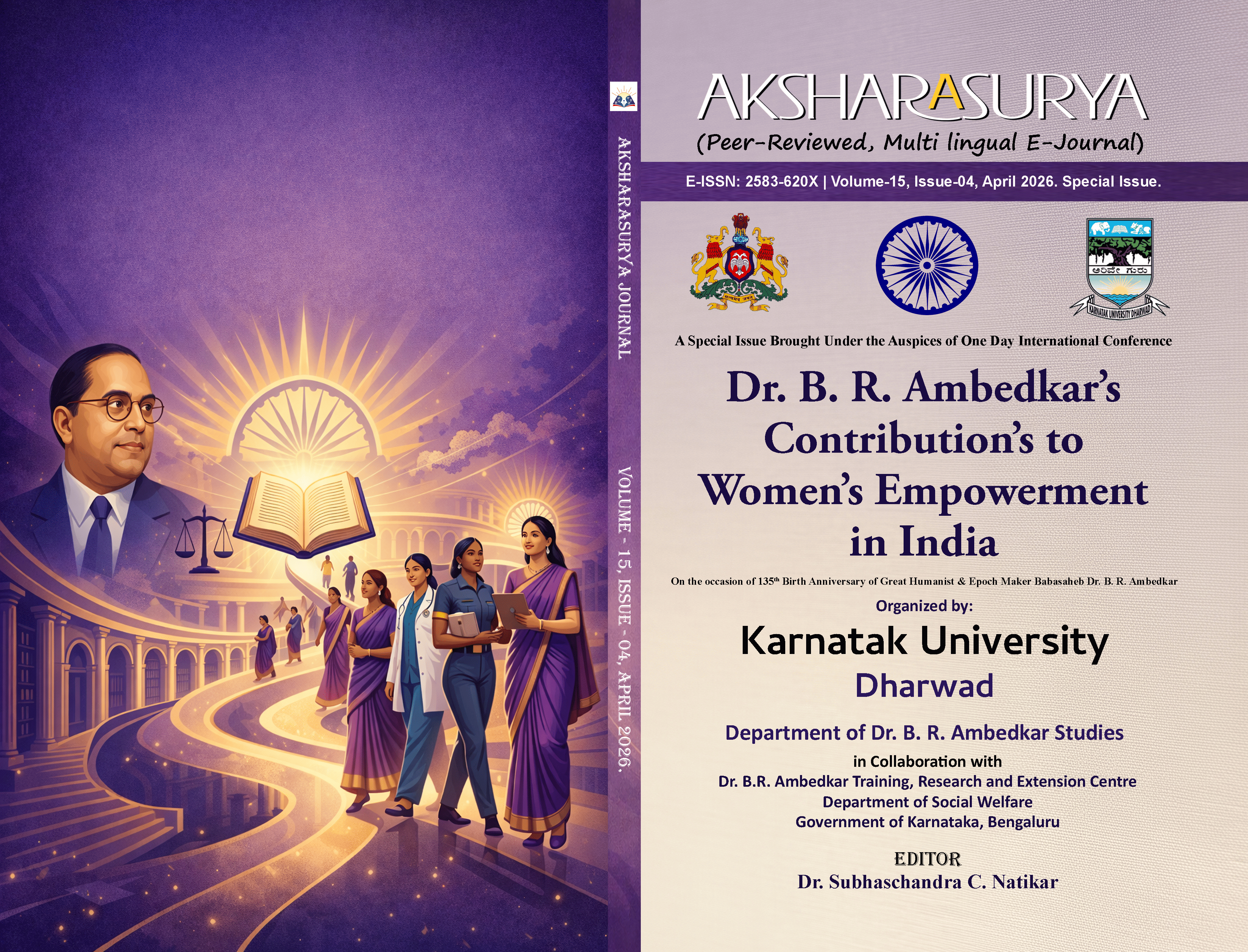
Main Article Content
Abstract
Though often quoted for defending minority rights, Dr. B.R. Ambedkar’s 1947 memo to India’s Constitution makers hides something sharper beneath. Submitted on March 15 to the Fundamental Rights sub-panel, States and Minorities sits oddly in history - famous yet half-read. Its boldest part, Article II, Section II, Clause 4, slips past most eyes. There, farms would belong to the state. Insurance too. Major industries either run by government or tightly watched. Little attention has gone to this trio. Yet it forms more than scattered ideas. Read closely, the document reveals a steady vision: land, labor, and production reshaped under public control. Not random fixes. A full blueprint drawn in legal tone. What looks like policy detail is actually an economic creed dressed as law. Looking closely at how ideas connect, the work follows Ambedkar’s way of tying landless lower-caste farmers, rural hardship, and systemic risk among Scheduled Castes to missing economic self-rule. Instead of copying Soviet-style farms, his idea for shared farming stood apart - built on ending landlord control, giving field workers joint rights through state oversight, reshaping crop production around mutual effort. Placed beside talks of that time about Nehru’s development plans or Gandhi’s moral ownership, his vision stands out, especially turning economic promises into enforceable legal rights. Overlooking such plans in today’s farm policies shows a closed-off thinking that needs reopening, now more than ever with rising farmer deaths, unstable renting, and Dalits without land. Returning to States and Minorities does two things: shifts view beyond seeing Ambedkar only as a social changer, brings forward a strong base for fresh approaches to India’s farming governance shaped by his thought.
Article Details
Section

This work is licensed under a Creative Commons Attribution-NonCommercial-ShareAlike 4.0 International License.
How to Cite
References
Ambedkar, B.R. (1918). Small Holdings in India and Their Remedies. Journal of the Indian Economic Society, Vol. 1, No. 1.
Ambedkar, B.R. (1923). The Problem of the Rupee: Its Origin and Its Solution. London: P.S. King & Son.
Ambedkar, B.R. (1925). The Evolution of Provincial Finance in British India. London: P.S. King & Son.
Ambedkar, B.R. (1947). States and Minorities: What Are Their Rights and How to Secure Them in the Constitution of Free India. Bombay: Thacker & Co.
Ambedkar, B.R. (1979–2020). Dr. Babasaheb Ambedkar: Writings and Speeches, Vols. 1–17. Mumbai: Government of Maharashtra, Education Department.
Constituent Assembly of India (1947). Reports of the Sub-Committee on Fundamental Rights. New Delhi: Constituent Assembly Secretariat.
Guru, G. (2011). The Cracked Mirror: An Indian Debate on Experience and Theory. New Delhi: Oxford University Press.
Jaffrelot, C. (2005). Dr. Ambedkar and Untouchability: Analysing and Fighting Caste. New Delhi: Permanent Black.
Nehru, J. (1946). The Discovery of India. Calcutta: Signet Press.
Omvedt, G. (1994). Dalits and the Democratic Revolution: Dr. Ambedkar and the Dalit Movement in Colonial India.
New Delhi: Sage Publications.
Rodrigues, V. (ed.) (2002). The Essential Writings of B.R. Ambedkar. New Delhi: Oxford University Press.
Teltumbde, A. (2016). Dalits: Past, Present and Future. London: Routledge.
Thorat, S. and Kumar, N. (eds.) (2008). In Search of Inclusive Policy: Addressing Graded Inequality. Jaipur: Rawat Publications.
Zelliot, E. (1992). From Untouchable to Dalit: Essays on the Ambedkar Movement. New Delhi: Manohar Publications.