
Civil Society and Good Governance Challenges
Article Sidebar
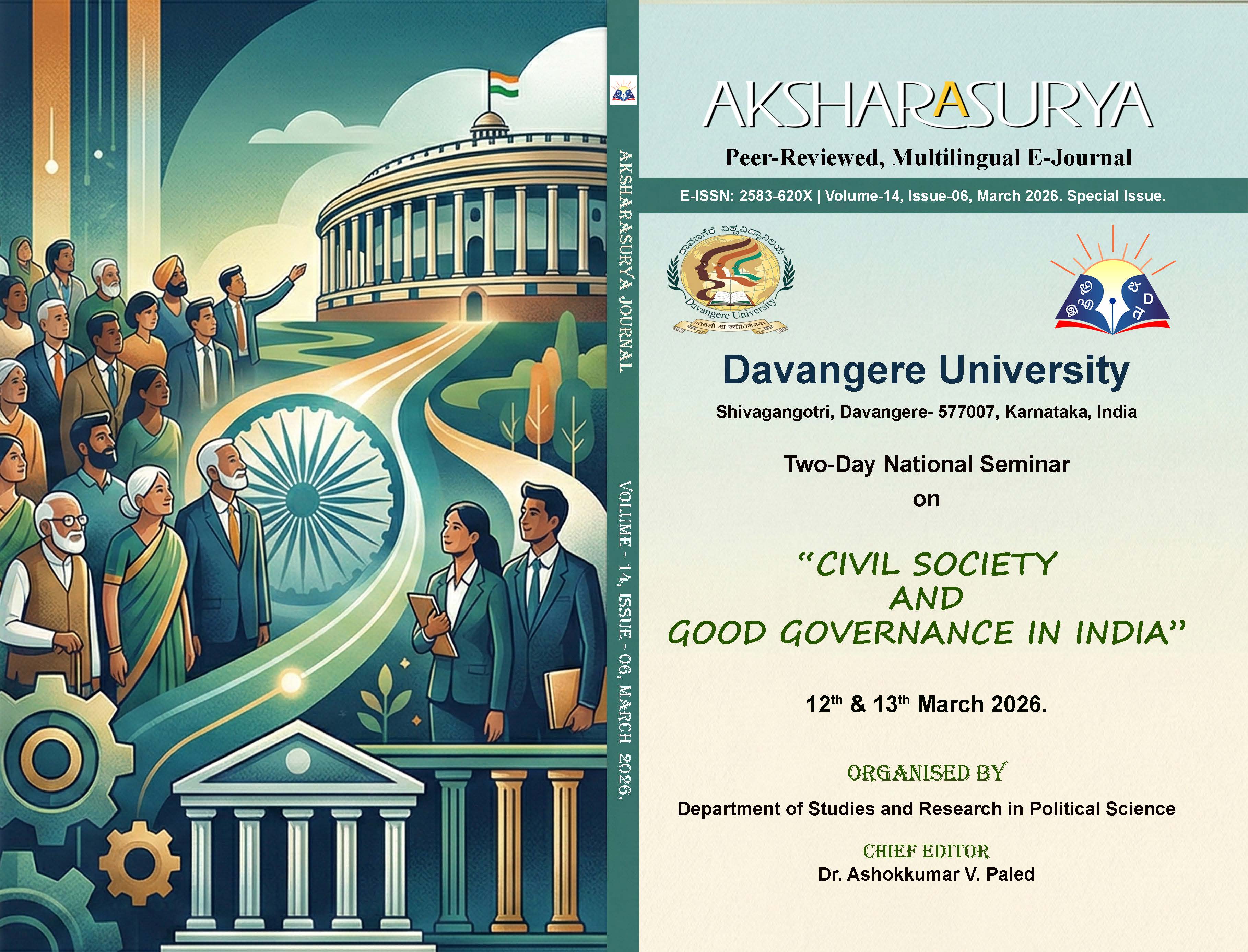
Main Article Content
Abstract
Civil society represents an autonomous sphere of social life that exists between the state and the economy, encompassing organizations like NGOs, trade unions, charities, and grassroots groups. It plays a vital role in societal development by enhancing the rule of law, promoting gender equality, protecting rights, and supporting good governance. Historically, philosophers like Plato, Aristotle, Locke, and Marx have shaped the concept of civil society, linking it to democracy, governance, and societal transformation. Civil society fosters democratic participation, provides a platform for public discourse, and acts as a safeguard against authoritarianism. It complements state structures by addressing human development challenges, empowering communities, and ensuring transparency and accountability in governance. Civil society also plays a critical role in political transformation, acting as a catalyst for change and a stabilizing force during transitions to democracy. It helps governments identify societal problems, reduces political alienation, and promotes institutional development. However, civil society can also destabilize states if it becomes polarized, radicalized, or overly demanding, potentially undermining democracy and governance. Group polarization within civil society can intensify societal divisions, reducing trust and solidarity. Civil society relies on the state for legal frameworks that ensure civil rights, equity, and protection for weaker groups. While civil society can challenge authoritarian regimes and democratic governments, its impact depends on the type of state, the phase of political transformation, and its ability to self-regulate. A balanced and reflexive civil society is crucial to prevent societal fragmentation, maintain equality, and foster inclusivity, trust, and cooperation.
Article Details
Section

This work is licensed under a Creative Commons Attribution-NonCommercial-ShareAlike 4.0 International License.
How to Cite
References
Report Title: CIVIL SOCIETY SUBMISSION TO THE APRM IN ZIMBABWE, Report Subtitle: 2020/2021, Report Author(s): South African Institute of International Affairs, Published by: South African Institute of International Affairs (2021).
Administration, Decentralisation and Good Governance Author(s): D. Bandyopadhyay Source: Economic and Political Weekly, Nov. 30, 1996, Vol. 31, No. 48 (Nov. 30, 1996), pp. 3109-3111+3113-3114 Published by: Economic and Political Weekly.
E-GOVERNANCE FOR GOOD GOVERNANCE Author(s): C.P. Barthwal Source: The Indian Journal of Political Science, July-December, 2003, Vol. 64, No. 3/4 (July-December, 2003), pp. 285-308 Published by: Indian Political Science Association.
CIVIL SOCIETY AND GOOD GOVERNANCE: EMERGING CHALLENGES Author(s): A.P. Singh Source: Journal of the Indian Law Institute, JANUARY-MARCH 2008, Vol. 50, No. 1 (JANUARY-MARCH 2008), pp. 81-93 Published by: Indian Law Institute.
Civil society in contemporary India. An analysis in the conceptual framework of Western social theory Author(s): ELISABETTA BASILE Source: Rivista di Studi Politici Internazionali, APRILE-GIUGNO 2017, NUOVA SERIE, Vol. 84, No. 2 (334) (APRILE-GIUGNO 2017), pp. 213-231 Published by: Maria Grazia Melchionni.
NGOs and Civil Society in India, Author(s): B. S. Baviskar, Source: Sociological Bulletin, Vol. 50, No. 1 (March 2001), pp. 3-15, Published by: Sage Publications, Ltd.
CORRUPTION & GOOD GOVERNANCE Author(s): Vishnu Bhagwan Source: The Indian Journal of Political Science, OCT. - DEC., 2007, Vol. 68, No. 4 (OCT. - DEC., 2007), pp. 727-738 Published by: Indian Political Science Association.
The State, Civil Society and Democracy: A Note Author(s): Satya Prakash Dash Source: The Indian Journal of Political Science, June 2001, Vol. 62, No. 2 (June 2001), pp. 241-252 Published by: Indian Political Science Association.
Civil Society, State and Democracy: Contextualising a Discourse, Author(s): D.N. Dhanagare, Source: Sociological Bulletin, Vol. 50, No. 2 (September 2001), pp. 167-191, Published by: Sage Publications, Ltd.
Report Part Title: Civil Society and Democratic Governance, Report Part Author(s): THELMA EKIYOR Report Title: THE PEACEBUILDING ROLE OF CIVIL SOCIETY IN SOUTHERN AFRICA Report Author(s): NORIA MASHUMBA and YALIWE CLARKE Centre for Conflict Resolution (2005).
What Makes Civil Society Civil? The State and Social Groups Author(s): Neil A. Englehart Source: Polity, July 2011, Vol. 43, No. 3 (July 2011), pp. 337-357 Published by: The University of Chicago Press on behalf of the Northeastern Political Science Association Stable.
Let’s Get Civil Society Straight: NGOs and Political Theory Author(s): Alan Whaites Source: Development in Practice, Aug., 1996, Vol. 6, No. 3 (Aug., 1996), pp. 240-244 Published by: Taylor & Francis, Ltd. on behalf of Oxfam GB.
The NGOs and the Grand Illusions of Development and Democracy Author(s): Lina Suleiman Source: Voluntas: International Journal of Voluntary and Nonprofit Organizations, March 2013, Vol. 24, No. 1 (March 2013), pp. 241-261 Published by: Springer Nature Stable URL: https://www.jstor.
Society vs State? Civil Society, Political Society and Non-Party Political Process in India Author(s): Sarah Joseph Source: Economic and Political Weekly, Jan. 26 - Feb. 1, 2002, Vol. 37, No. 4 (Jan. 26 - Feb. 1, 2002), pp. 299-305 Published by: Economic and Political Weekly.
Civil Society and its Discontents, Author(s): IRENEUSZ PAWEŁ KAROLEWSKI, Source: Polish Sociological Review, 2006, No. 154 (2006), pp. 167-185 Published by: Polskie Towarzystwo Socjologiczne (Polish Sociological Association).