
Digital Participation and Citizen Engagement in India: An Analytical Study of Democratic Involvement in the Digital Era
Article Sidebar
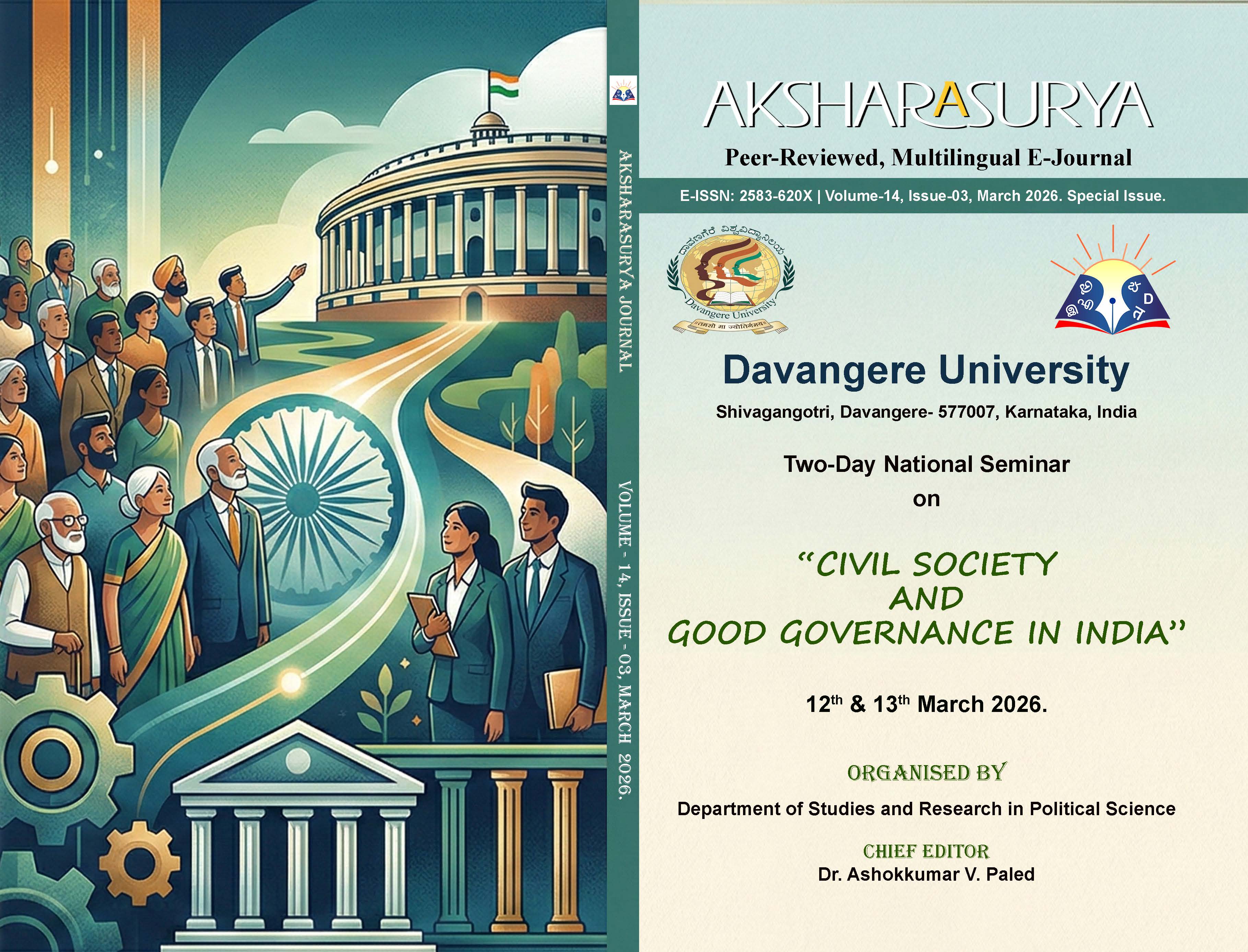
Main Article Content
Abstract
Digital participation has emerged as a significant dimension of citizen engagement in India, particularly with the expansion of digital governance initiatives and online civic platforms. While digital technologies have widened access to political information and participatory spaces, their contribution to substantive democratic engagement remains uneven. This article examines the nature, depth and quality of digital participation in India and reflects on what these patterns mean for democratic governance. Drawing on participatory and deliberative democratic theory, the study develops an analytical framework based on three dimensions: modes of participation, depth of engagement and institutional responsiveness. Methodologically, the article adopts a qualitative analytical design supported by secondary quantitative indicators drawn from government reports, policy documents and international governance indices. The analysis reveals that although digital platforms in India have significantly expanded informational access and symbolic participation, deeper and more influential forms of citizen engagement remain constrained by digital inequalities, institutional limitations and uneven feedback mechanisms. The article argues that digital participation should be evaluated not merely in terms of technological adoption or user numbers, but in relation to its capacity to influence decision-making and enhance democratic accountability. By offering an India-focused and theoretically grounded analysis, the study contributes to contemporary debates on digital democracy and provides concrete policy suggestions for strengthening citizen engagement in the digital age.
Article Details
Section

This work is licensed under a Creative Commons Attribution-NonCommercial-ShareAlike 4.0 International License.
How to Cite
References
Arnstein, S. R. (1969). A ladder of citizen participation. Journal of the American Institute of Planners, 35(4), 216–224.
Chadwick, A. (2013). The hybrid media system: Politics and power. Oxford University Press.
Fung, A. (2006). Varieties of participation in complex governance. Public Administration Review, 66(S1), 66–75.
Government of Karnataka. (2020). Karnataka digital governance and e-governance policy. Department of Information Technology, Biotechnology and Science & Technology, Government of Karnataka.
Government of India. (2023). Digital India programme: Annual report. Ministry of Electronics and Information Technology.
Ministry of Electronics and Information Technology. (2022). India digital ecosystem: Policy and performance report. Government of India.
Morozov, E. (2011). The net delusion: The dark side of internet freedom. PublicAffairs.
Norris, P. (2001). Digital divide: Civic engagement, information poverty, and the Internet worldwide. Cambridge University Press.
Smith, G. (2009). Democratic innovations: Designing institutions for citizen participation. Cambridge University Press.
United Nations. (2022). United Nations e-government survey. UN Department of Economic and Social Affairs.
World Bank. (2021). GovTech maturity index: The state of public sector digital transformation. World Bank Publications.