
Strengthening Local Democratic Processes Through Women’s Political Empowerment
Article Sidebar
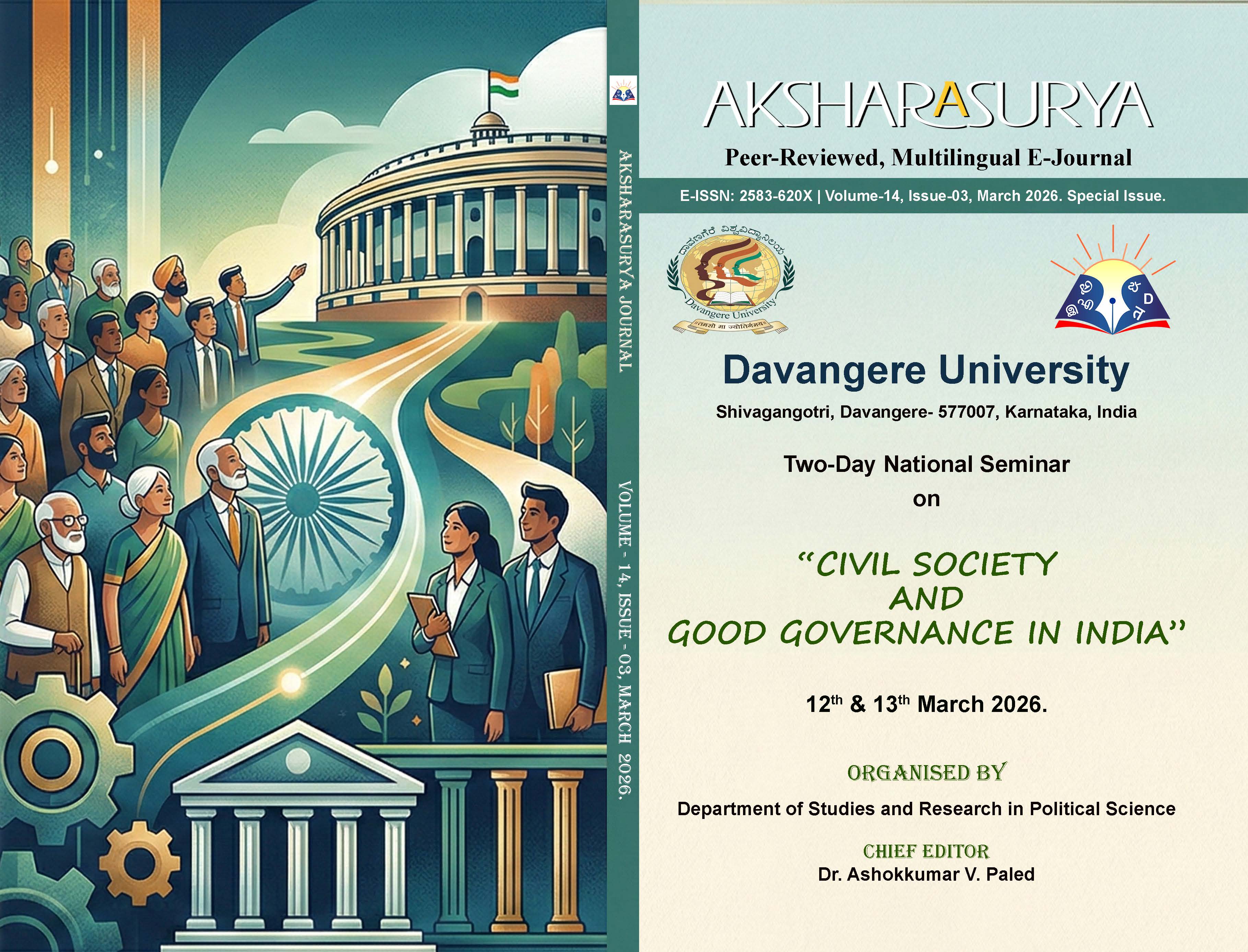
Main Article Content
Abstract
Democratic institutions derive their legitimacy and effectiveness from inclusive participation and accountable governance. In India, women’s political participation remained limited until the introduction of reservations through the 73rd Constitutional Amendment Act, 1992. This article examines how public participation mechanisms-particularly Panchayati Raj Institutions (PRIs), Gram Sabhas, participatory planning processes, and women’s Self-Help Groups (SHGs)-have contributed to women’s political empowerment and the strengthening of democratic institutions. Using India as the contextual framework, with specific reference to Karnataka and comparative insights from Kerala and Rajasthan, the study analyses the relationship between women’s participation, empowerment outcomes, and institutional performance. Drawing on participatory democracy theory and Amartya Sen’s capability approach, the article conceptualizes empowerment as a multidimensional process involving representation, agency, and transformative capacity. Based on secondary data from government reports and peer-reviewed studies, the analysis shows that women’s participation enhances institutional legitimacy, improves responsiveness in welfare delivery, and strengthens accountability. The study concludes that democratic deepening in India requires moving beyond numerical representation toward meaningful, capacity-supported participation.
Article Details
Section

This work is licensed under a Creative Commons Attribution-NonCommercial-ShareAlike 4.0 International License.
How to Cite
References
Baviskar, B. S., & Mathew, G. (2009). Inclusion and exclusion in local governance. Sage Publications.
Chattopadhyay, R., & Duflo, E. (2004). Women as policy makers: Evidence from a randomized policy experiment in India. Econometrica, 72(5), 1409–1443. https://doi.org/10.1111/j.1468-0262.2004.00539.x
Deshpande, S., & Deshpande, L. (2002). New economic policy and women. Sage Publications.
Fung, A., & Wright, E. O. (2003). Deepening democracy: Institutional innovations in empowered participatory governance. Verso.
Government of India. (1950). The Constitution of India. New Delhi.
Government of India. (1992). The Constitution (73rd Amendment) Act. New Delhi.
Government of India. (2013). Panchayati Raj Institutions and women’s empowerment. Ministry of Panchayati Raj.
Government of Karnataka. (2019). Gram Swaraj and participatory planning report. Bengaluru.
Heller, P., Harilal, K. N., & Chaudhuri, S. (2007). Building local democracy: Evaluating the impact of decentralization in Kerala, India. World Development, 35(4), 626–648. https://doi.org/10.1016/j.worlddev.2006.07.001
Kabeer, N. (1999). Resources, agency, achievements: Reflections on the measurement of women’s empowerment. Development and Change, 30(3), 435–464.
Manor, J. (1999). The political economy of democratic decentralization. World Bank.
Pateman, C. (1970). Participation and democratic theory. Cambridge University Press.
Sen, A. (1999). Development as freedom. Oxford University Press.
UNDP. (2016). Human development report: Gender equality and democratic governance. United Nations Development Programme.
UN Women. (2018). Women’s political participation and leadership. United Nations.
World Bank. (2017). Empowering women through rural livelihoods in India. World Bank.