
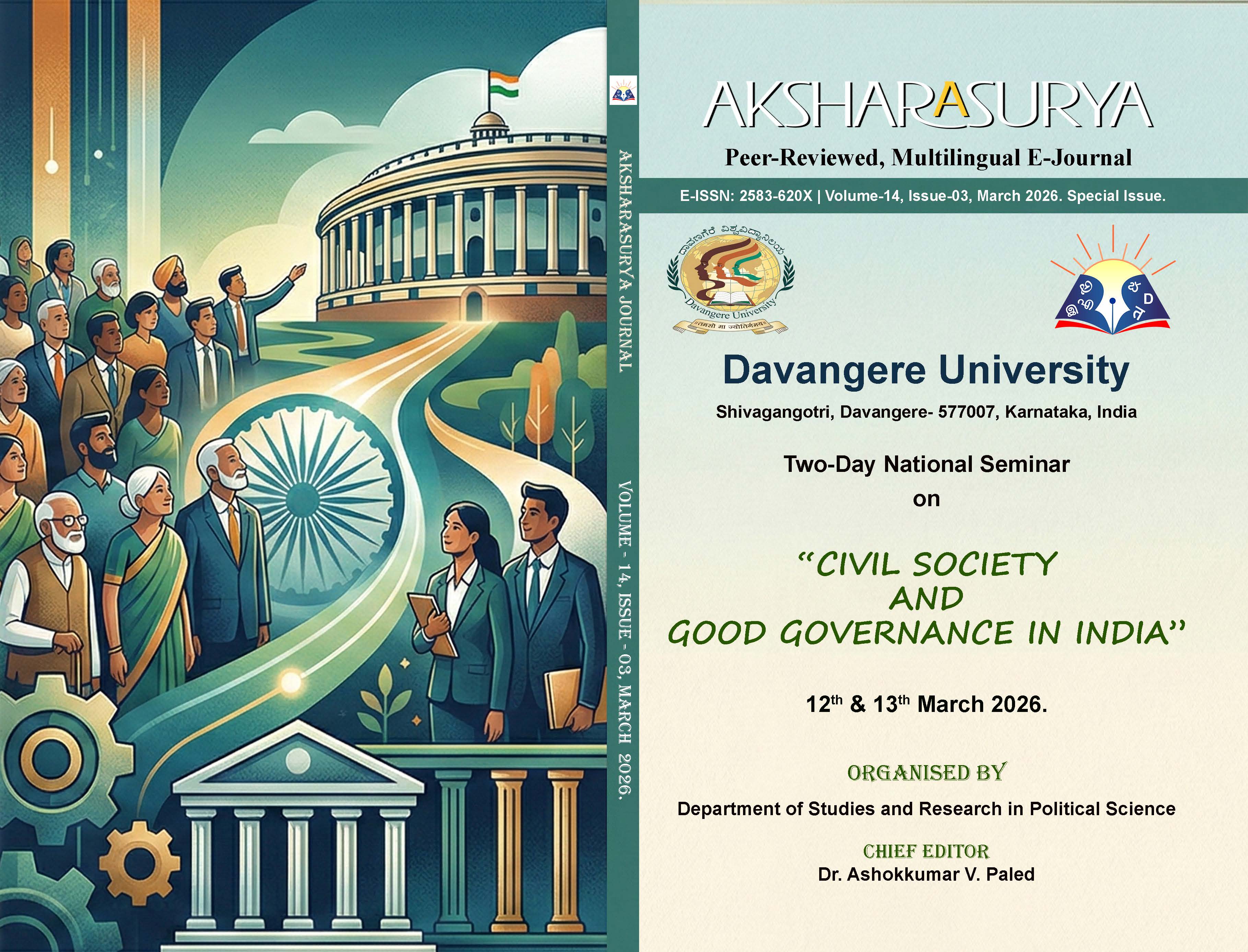
Role of Civil Society in Strengthening Good Governance: Challenges and Opportunities
Article Sidebar
Main Article Content
Abstract
Civil society has emerged as a critical actor in contemporary governance by complementing state institutions and strengthening democratic processes. This study examines the role of civil society in strengthening good governance, with particular emphasis on accountability, transparency, democratic participation, and its intermediary function between citizens and the state. Adopting a descriptive and analytical qualitative approach, the study is based on secondary data drawn from scholarly literature, policy documents, and reports of international organizations and civil society institutions. The analysis highlights that civil society contributes to good governance through watchdog functions, participatory engagement, rights-based advocacy, and collaborative governance arrangements. However, the study also identifies significant challenges that constrain civil society effectiveness, including funding insecurity, restrictive regulatory environments, organizational and capacity limitations, sectoral fragmentation, and shrinking civic space. At the same time, emerging opportunities such as decentralization reforms, transparency and accountability mechanisms, digital governance tools, increased civic awareness, and state–civil society partnerships have expanded avenues for civic engagement. The study concludes that while structural and political constraints limit the potential of civil society, enabling legal frameworks, institutional support, and strengthened organizational capacity can significantly enhance its contribution to accountable, inclusive, and effective governance.
Article Details
Section

This work is licensed under a Creative Commons Attribution-NonCommercial-ShareAlike 4.0 International License.
How to Cite
References
Bebbington, A., Hickey, S., & Mitlin, D. (Eds.). (2008). Can NGOs make a difference? The challenge of development alternatives. Zed Books.
Chauhan, G. S. (2020). Civil society in India and aspects of good governance. Madhya Pradesh Journal of Social Sciences, 25(1), 45–58.
CIVICUS. (2023). State of civil society report 2023. CIVICUS.
Diamond, L. (1999). Developing democracy: Toward consolidation. Johns Hopkins University Press.
Edwards, M. (2009). Civil society. Polity Press.
Fung, A., & Wright, E. O. (2003). Deepening democracy: Institutional innovations in empowered participatory governance. Verso.
Goetz, A. M., & Jenkins, R. (2001). Hybrid forms of accountability: Citizen engagement in institutions of public-sector oversight in India. Public Administration and Development, 21(4), 363–383. https://doi.org/10.1002/pad.178
Pierre, J., & Peters, B. G. (2020). Governance, politics and the state (2nd ed.). Red Globe Press.
Putnam, R. D. (1993). Making democracy work: Civic traditions in modern Italy. Princeton University Press.
UNDP. (1997). Governance for sustainable human development. United Nations Development Programme.
UNDP. (2012). Governance and civil society: Policy brief. United Nations Development Programme.