
Influence of Social Media on Language
Article Sidebar
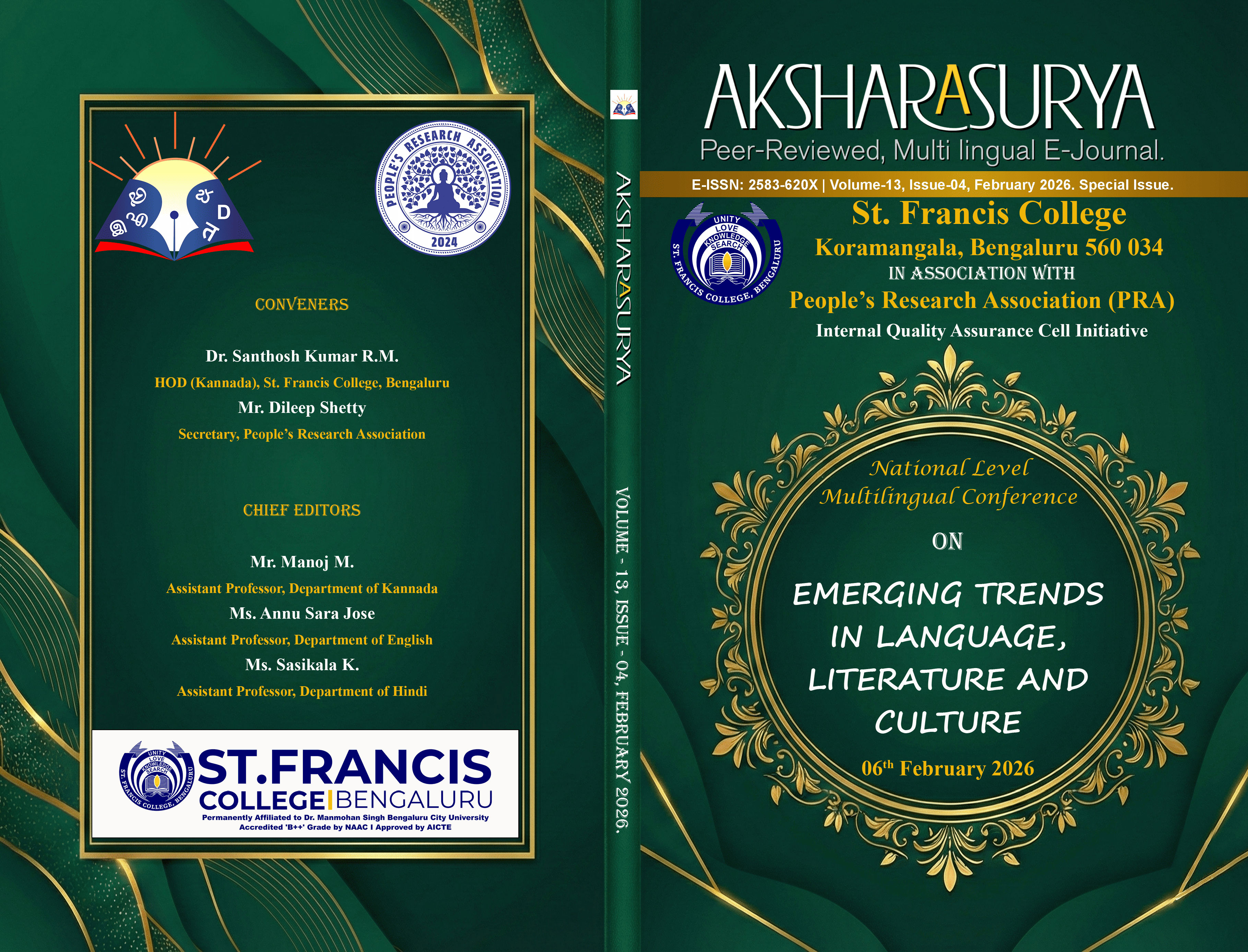
Main Article Content
Abstract
The rapid expansion of social media has brought about significant changes in the way language is used, shaped, and transmitted across societies, particularly among young people. Platforms such as WhatsApp, Instagram, Facebook, X (Twitter), and YouTube have become central to everyday communication, influencing not only what people say but also how they express themselves. This study explores the influence of social media on language, focusing on its impact on vocabulary, grammar, communication style, and overall linguistic behavior.
The study employs a descriptive research approach using questionnaires, classroom observations, and informal interactions with students. The data reveal that social media has introduced new linguistic patterns characterized by abbreviations, acronyms, emojis, hashtags, memes, and hybrid expressions created through code-mixing of languages. These features encourage brevity, creativity, and emotional expression, making communication more engaging and dynamic. At the same time, they have gradually entered students’ academic and formal writing, leading to frequent grammatical inaccuracies, reduced sentence complexity, and diminished attention to conventional language rules. Furthermore, the study observes that continuous exposure to digital communication has blurred the boundary between formal and informal language. Students increasingly prefer conversational and simplified structures even in academic contexts. While social media promotes confidence in expression, peer interaction, and rapid information sharing, it also encourages dependency on digital shortcuts that weaken spelling accuracy and writing discipline.
The paper concludes that social media plays a powerful dual role in modern language development. It functions as a catalyst for linguistic innovation and social connection while simultaneously posing challenges to language accuracy and academic communication. The study emphasizes the need for educational institutions to promote responsible digital literacy, enabling students to harness the benefits of social media while preserving the integrity and effectiveness of formal language use.
Article Details
Section

This work is licensed under a Creative Commons Attribution-NonCommercial-ShareAlike 4.0 International License.
How to Cite
References
Thurlow, C., Lengel, L., & Tomic, A. (2004). Computer Mediated Communication: Social Interaction and the Internet. London: Sage Publications.
Baron, N. S. (2008). Always On: Language in an Online and Mobile World. Oxford: Oxford University Press.
Tagliamonte, S. A., & Denis, D. (2008). “Linguistic Ruin? LOL! Instant Messaging and Teen Language.” American Speech, 83(1), 3–34.
Androutsopoulos, J. (2014). “Computer-Mediated Communication and Linguistic Landscapes.” In The Handbook of Language and Digital Communication, Wiley-Blackwell.