
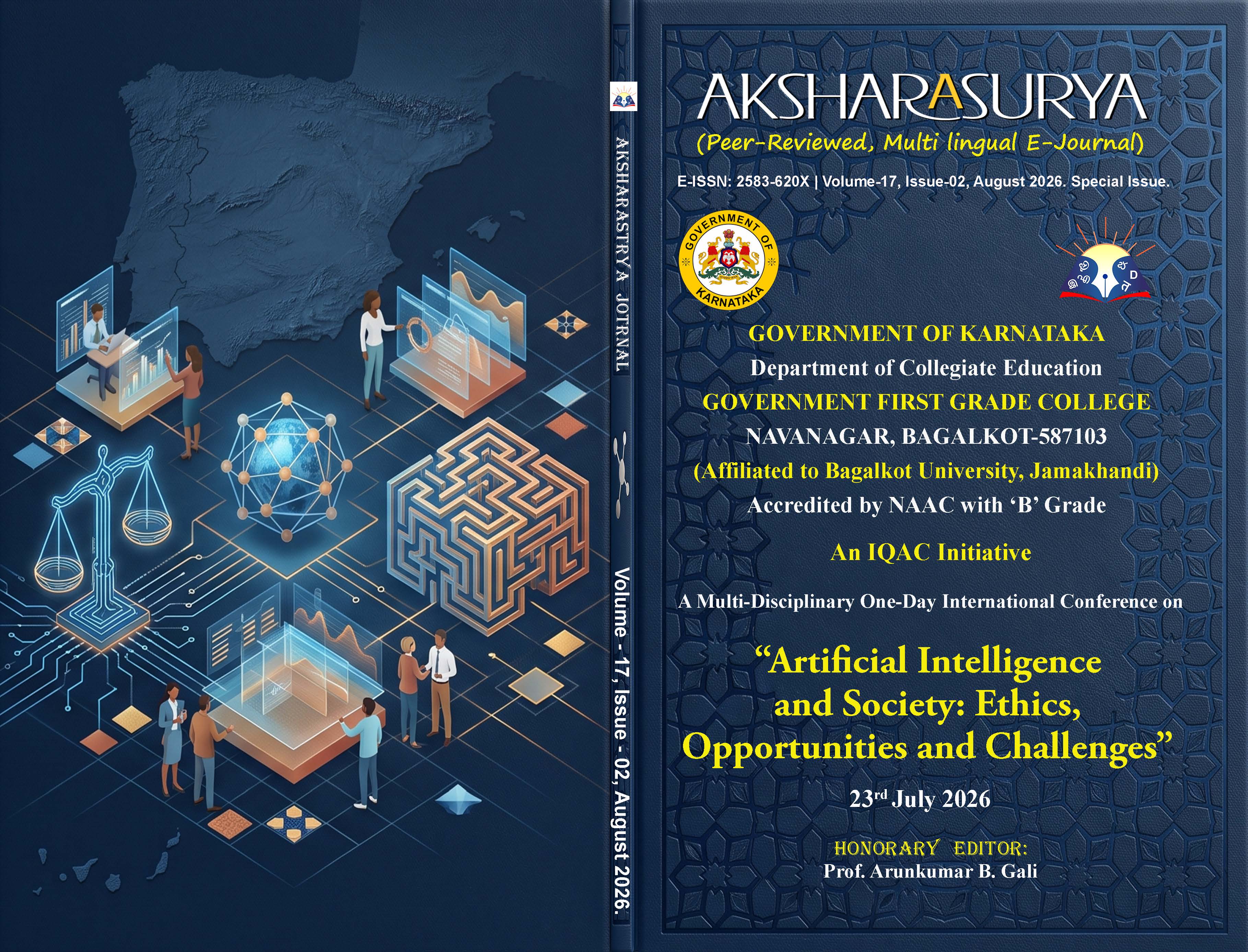
Artificial Intelligence and Society: Advanced Ethics Opportunities and Challenges - Digital Archaeology and AI Applications
Article Sidebar
Main Article Content
Abstract
Artificial Intelligence (AI) is swiftly reshaping the relationship among technology and society, raising profound moral, cultural, and epistemological questions. Beyond its monetary and business implications, AI is more and more influencing how knowledge is produced, interpreted, and preserved, especially in rising interdisciplinary domains consisting of digital archaeology. This study examines the societal dimensions of AI by using analysing its ethical implications, transformative opportunities, and structural challenges, with unique attention to AI-driven applications in digital archaeology. From an ethical point of view, AI systems introduce vital concerns surrounding data ownership, algorithmic bias, transparency, responsibility, and cultural representation. In history and archaeological contexts, these troubles come to be especially sensitive, as AI tools are regularly trained on incomplete, choppy, or culturally located datasets. Without careful governance, AI dangers reproducing historical biases, misinterpreting cultural artefacts, or commodifying heritage through automatic evaluation. For this reason, advanced ethical frameworks that combine technological duty with cultural sensitivity are essential. At the identical time, AI offers unparalleled opportunities for archaeological research and heritage upkeep. Machine learning, computer vision, and pattern recognition technologies permit speedy analysis of excavation records, automatic classification of artefacts, predictive modelling of site places, and high-resolution reconstruction of damaged or lost historical past. Those tools enhance research efficiency, expand analytical abilities, and democratise access to cultural know-how via virtual information and immersive technologies. AI-driven digital archaeology also fosters interdisciplinary collaboration, linking computational sciences with historical inquiry. But, the integration of AI into society and archaeology is not without challenges. Unequal technological access, methodological overreliance, interpretive obstacles, and ethical governance gaps remain chronic issues. This paper argues that AI’s societal function should be understood not merely as technological advancement however as a socio-technical transformation requiring essential reflection, regulatory oversight, and human-focused design. Responsible AI adoption can in the long run strengthen each scientific discovery and cultural stewardship.
Article Details
Issue
Section

This work is licensed under a Creative Commons Attribution-NonCommercial-ShareAlike 4.0 International License.
How to Cite
References
Jordan, M. I., & Mitchell, T. M. (2015). Machine learning: Trends, perspectives, and prospects. Science , 349(6245), 255–260. https://doi.org/10.1126/science.aaa8415
Floridi, L., & Cowls, J. (2019). A unified framework of five principles for AI in society. Harvard Data Science Review . https://doi.org/10.1162/99608f92.8cd550d1
Huggett, J. (2020). Artificial intelligence in archaeology. Internet Archaeology , 55. https://doi.org/10.11141/ia.55.4
Russell, S., & Norvig, P. (2021). Artificial Intelligence: A Modern Approach . Pearson.
Jumper, J., et al. (2021). Highly accurate protein structure prediction with AlphaFold. Nature , 596, 583–589. https://doi.org/10.1038/s41586-021-03819-2
Brynjolfsson, E., & McAfee, A. (2017). Machine, Platform, Crowd . Norton.
Pasquale, F. (2015). The Black Box Society . Harvard University Press.
Couldry, N., & Mejias, U. (2019). The Costs of Connection . Stanford University Press.
Agrawal, A., Gans, J., & Goldfarb, A. (2018). Prediction Machines . Harvard Business Review Press.
Esteva, A., et al. (2017). Dermatologist-level classification using deep neural networks. Nature , 542, 115–118. https://doi.org/10.1038/nature21056
Remondino, F., & Campana, S. (2014). 3D recording and modelling in archaeology. https://doi.org/10.1007/978-3-319-13695-0
UNESCO. (2021). AI and inclusion.
O’Neil, C. (2016). Weapons of Math Destruction . Crown.
Zuboff, S. (2019). The Age of Surveillance Capitalism .
Susskind, D. (2020). A World Without Work .
Kitchin, R. (2017). Data ethics. https://doi.org/10.1177/2053951716679673
Morgan, C. (2016). Digital archaeology ethics. https://doi.org/10.1007/s11759-016-9304-0
Huggett, J. (2015). Digital archaeology. https://doi.org/10.1007/978-1-4939-2470-2
Vincent, M. L. (2020). AI in conservation.
Wheatley, D., & Gillings, M. (2013). Spatial technologies in archaeology.
Lasaponara, R., & Masini, N. (2012). Remote sensing in archaeology. https://doi.org/10.1016/j.jas.2011.11.018
Forte, M. (2014). Cyber-archaeology. https://doi.org/10.1007/978-3-319-13695-0
Stokes, P. (2019). Computer-assisted paleography. https://doi.org/10.1093/llc/fqz012
Dell’Unto, N. (2014). 3D reconstructions. https://doi.org/10.1016/j.jas.2014.02.005
Jeffrey, S. (2015). Ethical digital reconstruction. https://doi.org/10.11141/ia.40.7
Ihde, D. (1990). Technology and interpretation.
Verbeek, P. P. (2011). Moralizing technology.
Smith, L. (2006). Uses of Heritage .
Doshi-Velez, F., & Kim, B. (2017). Explainable AI. https://doi.org/10.48550/arXiv.1702.08608
Bryson, J. (2018). Human-centered AI. https://doi.org/10.48550/arXiv.1810.02071