
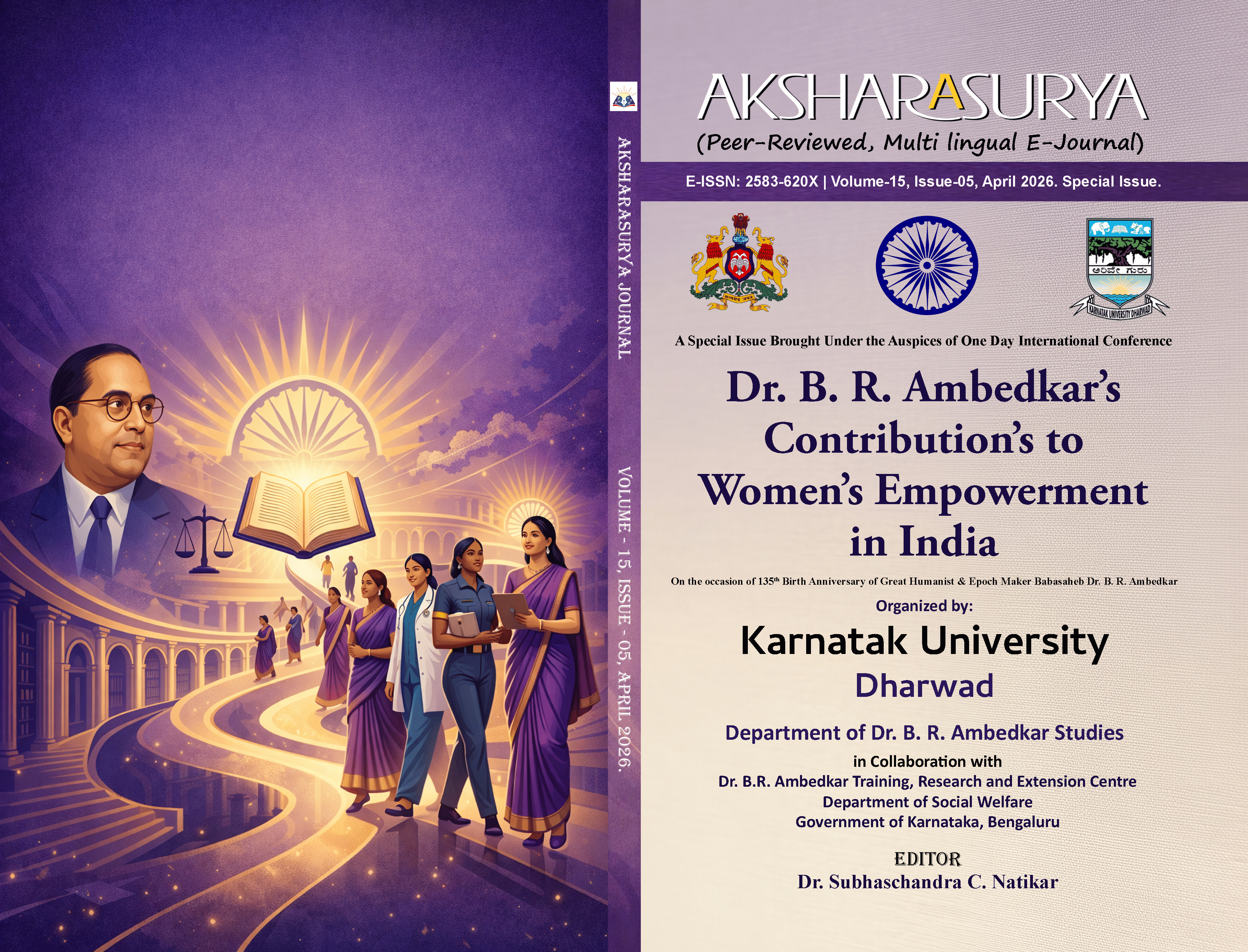
Dr. B.R. Ambedkar’s Contribution to Women Empowerment in India and Karnataka
Article Sidebar
Main Article Content
Abstract
Women’s empowerment in India was made possible by Dr. B.R. Ambedkar’s vision of social justice and equality. His contributions to the fight against patriarchal standards ingrained in social, economic, and cultural systems went beyond the legal system. Ambedkar believed that the fight against caste and economic oppression was inextricably linked to the freedom of women. His crucial contribution to the Indian Constitution’s construction guaranteed equality before the law, protection from discrimination based on gender, and fundamental rights. Ambedkar’s groundbreaking goal to recognize women as equal citizens by reforming marriage, inheritance, and property rights was reflected in his support of the Hindu Code Bill. His principles had a significant impact on the women’s and Dalit movements in Karnataka, encouraging changes in political engagement, work, and education. This study uses secondary sources to analyse Ambedkar’s legislative and philosophical initiatives and their ongoing significance in the twenty-first century, especially in the social context of Karnataka. It assesses how much his theories have influenced modern feminist discourses, empowerment initiatives, and gender legislation, contending that Ambedkar’s legacy is still crucial for attaining intersectional and inclusive gender justice in India.
Article Details
Section

This work is licensed under a Creative Commons Attribution-NonCommercial-ShareAlike 4.0 International License.
How to Cite
References
Anand, S. (2016). Ambedkar’s Feminism and the Politics of Equality. Oxford University Press.
Bagde, R. (2020). Gender and Law: Revisiting Ambedkar’s Hindu Code Bill. Sage Publications.
Deshpande, A. (2022). Caste, Gender, and Development in Karnataka. Routledge.
Guru, G. (2014). Caste and Gender in India: Ambedkar’s Vision of Intersectionality. Economic and Political Weekly, 49(13), 45–53.
Mishra, P. (2017). Labour, Law and Women’s Empowerment in India. Indian Journal of Social Research, 58(4), 112–126.
Omvedt, G. (2001). Ambedkar: Towards an Enlightened India. Penguin Books.
Pawar, U., & Moon, M. (2008). We Also Made History: Women in the Ambedkarite Movement. Zubaan.
Rege, S. (2013). Against the Madness of Manu: B.R. Ambedkar’s Writings on Brahmanical Patriarchy. Navayana.
Sharma, R. (2018). The Constitutional Feminism of B.R. Ambedkar. Journal of Gender Studies, 25(2), 67–84.
Teltumbde, A. (2019). Republic of Caste: Thinking Equality in the Time of Neoliberal Hindutva. Navayana.