
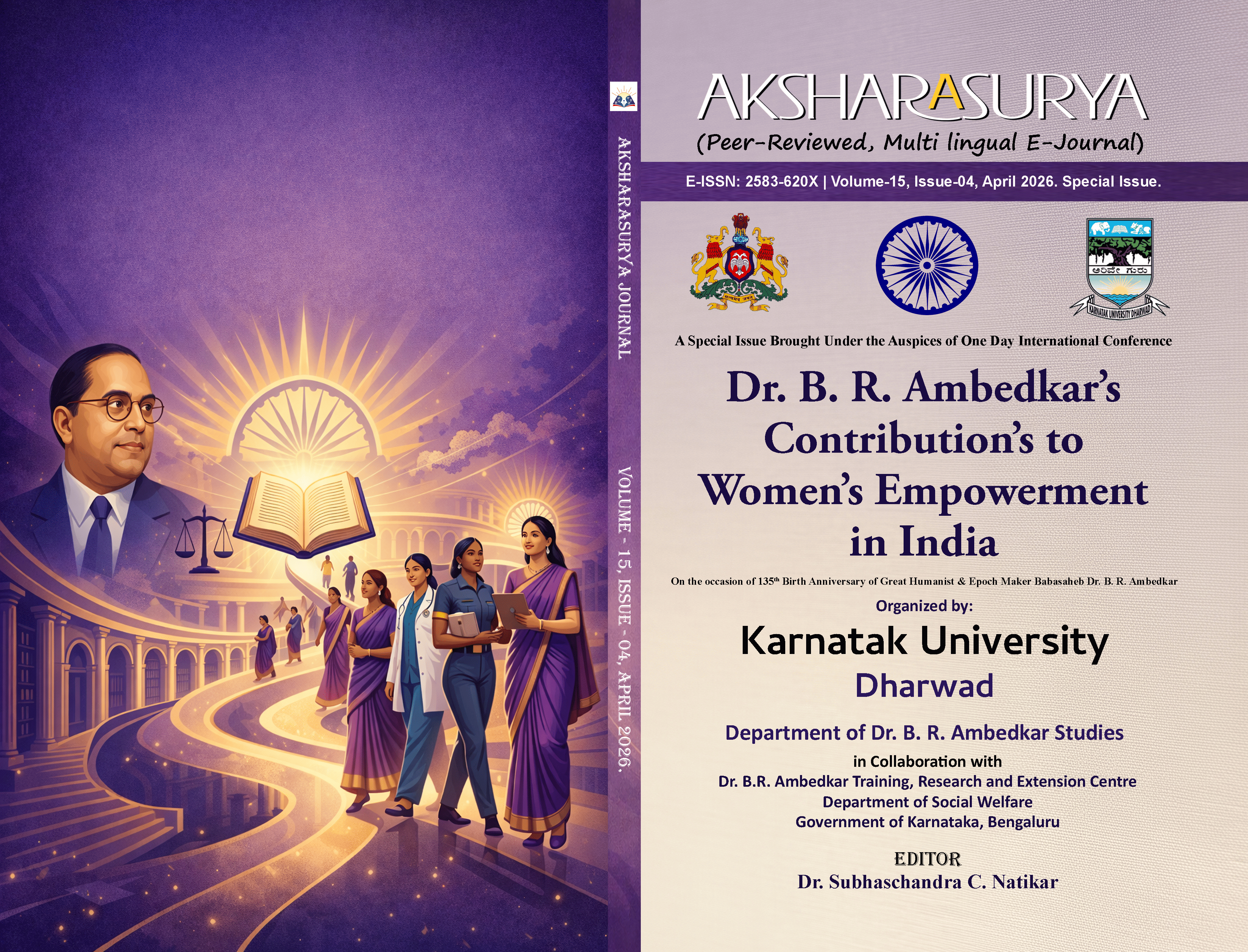
Quintessential Ambedkar’s Contribution to Women Empowerment
Article Sidebar
Main Article Content
Abstract
Dr. B. R. Ambedkar was a great leader and an epoch maker of modern India. He was born in a poor family from the Mahar community, where people faced untouchability and discrimination. From his childhood, he saw pain, humiliation, and unfair treatment. This made him strong and determined to fight for justice. Dr. B.R. Ambedkar believed in dignity, equal opportunities, and respect for everyone. He worked hard to empower women and the poor people of society. He said that the progress of a society is measured by the progress of women. He understood that books like Manusmriti had unfair rules that kept women weak and dependent, which led to gender discrimination. So, he protested against such ideas. He also tried to bring new laws like the Hindu Code Bill to give women equal rights in family, property, and marriage. Even though people opposed him, he never gave up. He believed women and men are equal and should live with mutual respect and dignity.
Article Details
Section

This work is licensed under a Creative Commons Attribution-NonCommercial-ShareAlike 4.0 International License.
How to Cite
References
Ambedkar, B. R. Annihilation of Caste. Navayana, 2014.
Ambedkar, B. R. The Rise and Fall of Hindu Women. Dr. Babasaheb Ambedkar Writings and Speeches, Vol. 3, Government of Maharashtra, 1987.
Ambedkar, B. R. Dr. Babasaheb Ambedkar: Writings and Speeches. Vol. 14, Government of Maharashtra, 1995.
Ambedkar, B. R. The Hindu Code Bill (Draft). 1948. Government of India.
Keer, Dhananjay. Dr. Ambedkar: Life and Mission. Popular Prakashan, 2019.
Rege, Sharmila. Against the Madness of Manu: B. R. Ambedkar’s Writings on Brahmanical Patriarchy. Navayana, 2013.