
The Role of Education in Promoting Social Justice and Women Empowerment
Article Sidebar
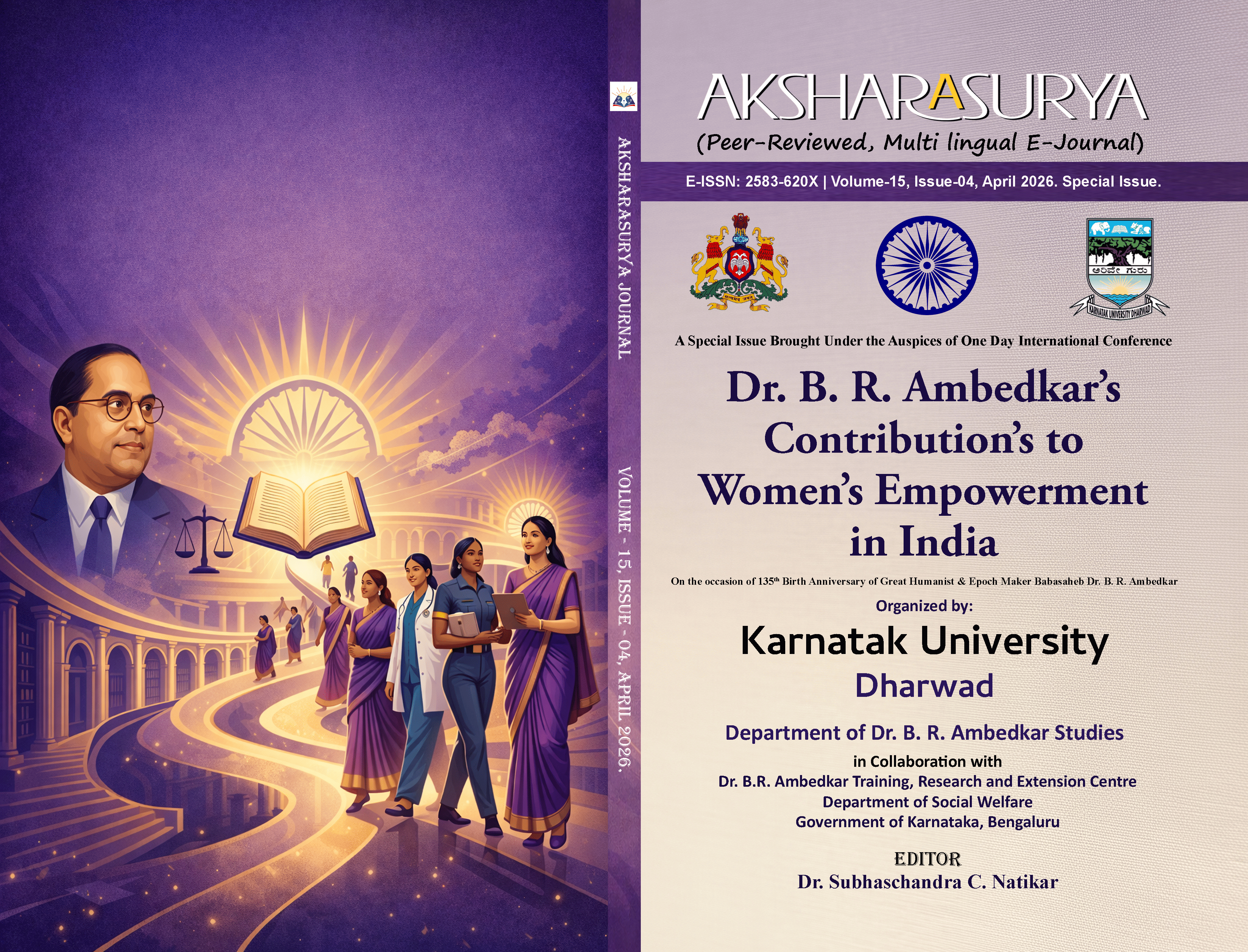
Main Article Content
Abstract
Education is a powerful instrument for transforming societies by promoting equality, justice, and empowerment. It plays a crucial role in dismantling social hierarchies, reducing inequalities, and enabling marginalized groups to achieve autonomy and dignity. This article examines how education contributes to social justice and women empowerment, drawing insights from the ideas of Dr. B. R. Ambedkar. The study also includes primary data analysis to understand the perception of education’s role in achieving these goals. The findings highlight that education enhances awareness, economic independence, and social participation, thereby strengthening democratic values and inclusive development.
Article Details
Section

This work is licensed under a Creative Commons Attribution-NonCommercial-ShareAlike 4.0 International License.
How to Cite
References
Ambedkar, B. R. (1936). Annihilation of Caste. Navayana Publishing.
Ambedkar, B. R. (1945). What Congress and Gandhi have done to the untouchables. Thacker & Co.
Ambedkar, B. R. (1948). The untouchables: Who were they and why they became untouchables. Amrit Book Company.
Government of India. (2009). Right of Children to Free and Compulsory Education Act, 2009. Ministry of Law and Justice.
Government of India. (2020). National Education Policy 2020. Ministry of Education.
Hulakunda, Prashant (2026), Social Research and Statistics, Sri Siddhalingeshwar Prakashana, Kalaburagi.
Hulakunda, Prashant (2025), Social Thinkers, Sri Siddhalingeshwar Prakashana, Kalaburagi.
Kabeer, N. (1999). Resources, agency, achievements: Reflections on the measurement of women’s empowerment. Development and Change, 30(3), 435–464.
Kingdon, G. G. (2007). The progress of school education in India. Oxford Review of Economic Policy, 23(2), 168–195.
Nussbaum, M. C. (2000). Women and human development: The capabilities approach. Cambridge University Press.
Rawls, J. (1971). A theory of justice. Harvard University Press.
Sen, A. (1999). Development as freedom. Oxford University Press.
Sharma, S. (2018). Education and women empowerment in India. International Journal of Research in Social Sciences, 8(3), 245–252.
Subramanian, S. V. (2005). Education and social inequality in India. Social Science & Medicine, 61(8), 1901–1912.
Tilak, J. B. G. (2002). Education and poverty in India. Journal of Human Development, 3(2), 191–207.
UNDP. (2019). Human development report 2019. United Nations Development Programme.
UNESCO. (2015). Education for all 2000–2015: Achievements and challenges. UNESCO Publishing.
UNICEF. (2020). Gender equality: Global annual results report 2020. UNICEF.
World Bank. (2018). World development report 2018: Learning to realize education’s promise. World Bank Publications.
Agarwal, B. (1994). A field of one’s own: Gender and land rights in South Asia. Cambridge University Press.
Desai, S., & Kulkarni, V. (2008). Changing educational inequalities in India. Demography, 45(2), 245–270.
Drèze, J., & Sen, A. (2013). An uncertain glory: India and its contradictions. Princeton University Press.