
Empowerment of Women in Pastoral Communities: Revisiting Ambedkar Thought
Article Sidebar
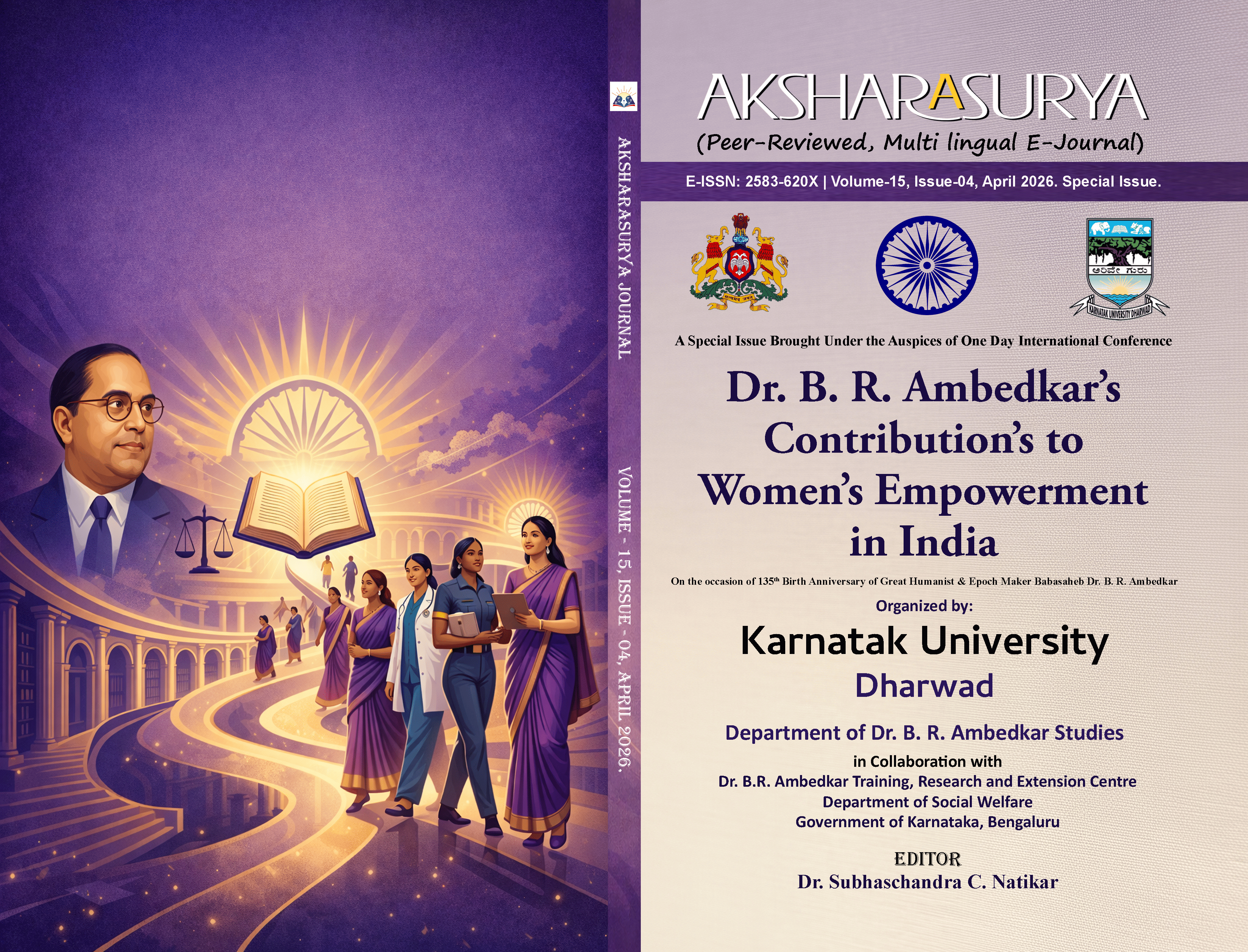
Main Article Content
Abstract
Out here, where herds move with seasons, people live between memory and neglect. Though farming once leaned on their way of life, laws rarely see them clearly. For women in these shifting homes, hardship wears two faces. Caste marks one edge, tradition the other - shaping how far they can go, what work finds them, who speaks for their bodies, which benefits reach their hands. Into this quiet struggle steps an old but restless idea. The writings of Dr. B. R. Ambedkar stir again, pulled forward by questions few asked before. Thought meets ground when his vision is tested against lives lived on wheels and hooves. From Ambedkar’s sharp take on caste flows a way to see how power stacks up against those already pushed aside. Pastoral women land at tangled crossings - birth rank, work type, money lack, womanhood - all tightening their limits. One idea pulls another along: when dignity is denied by law, it sticks around in daily life. Close reading of Annihilation of Caste, States and Minorities, and The Buddha and His Dhamma shows how old scripts still shape today’s rules. Court rulings echo them too. So do state plans - even if quietly. A patchwork of texts reveals patterns nobody can afford to ignore. Real change? It skips quick fixes. Instead, roots must shift. Liberty means little without space for mobile lives. Equality falters where herding knowledge counts for nothing. Fraternity fails when purity myths linger. Building anew begins not with aid but justice - with room made real through sight, sound, soil.
Article Details
Section

This work is licensed under a Creative Commons Attribution-NonCommercial-ShareAlike 4.0 International License.
How to Cite
References
Ambedkar, B. R. (1936). Annihilation of Caste. Bombay: Bharat Bhushan Printing Press.
Ambedkar, B. R. (1945). What Congress and Gandhi Have Done to the Untouchables. Bombay: Thacker and Co.
Ambedkar, B. R. (1948). The Untouchables: Who Were They and Why They Became Untouchables? New Delhi: Amrit Book Company.
Ambedkar, B. R. (1951). The Rise and Fall of the Hindu Woman. Jalandhar: Bheem Patrika Publications.
Ambedkar, B. R. (1957). The Buddha and His Dhamma. Bombay: Siddharth College Publications.
Ambedkar, B. R. (1987). States and Minorities. In Dr. Babasaheb Ambedkar: Writings and Speeches, Vol. 1. Bombay: Education Department, Government of Maharashtra.
Agrawal, A. (1999). Greener Pastures: Politics, Markets, and Community Among a Migrant Pastoral People. Durham: Duke University Press.
Deshpande, A. (2011). The Grammar of Caste: Economic Discrimination in Contemporary India. New Delhi: Oxford University Press.
Guha, S. (2012). Beyond Caste: Identity and Power in South Asia, Past and Present. Leiden: Brill.
Guru, G. (2012). Humiliation: Claims and Context. New Delhi: Oxford University Press.
Jaffrelot, C. (2005). Ambedkar and Untouchability: Fighting the Indian Caste System. New York: Columbia University Press.
Krishnamurthy, J. (Ed.) (1989). Women in Colonial India: Essays on Survival, Work and the State. New Delhi: Oxford University Press.
Manbiot, G., & Shah, A. (2010). The Pastoral Livelihood and Policy in South Asia. New Delhi: Academic Foundation.
Mosse, D., Gupta, S., & Shah, A. (2005). On the Margins in the City: Adivasi Seasonal Labour Migration in Western India. Economic and Political Weekly, 40(28), 3025–3038.
Naik, C. D. (2003). Thoughts and Philosophy of Dr. B. R. Ambedkar. New Delhi: Sarup & Sons.
National Commission for Denotified, Nomadic and Semi-Nomadic Tribes. (2008). Report of the National Commission for DNT, NT, SNT. New Delhi: Government of India.
Omvedt, G. (2004). Ambedkar: Towards an Enlightened India. New Delhi: Viking/Penguin Books India.
Rao, N. (2012). Rights, Policies, and Women Farmers’ Access to Land. In Gender and Land Rights Revisited: Exploring New Prospects via the State, Family and Market. Journal of Agrarian Change, 12(1), 4–29.
Shiva Kumar, A. K. (1992). Estimating Deprivation: A District Level Analysis of Maharashtra. Economic and Political Weekly, 27(48), 2615–2626.
Thorat, S., & Kumar, N. (Eds.) (2008). B. R. Ambedkar: Perspectives on Social Exclusion and Inclusive Policies. New Delhi: Oxford University Press.