
Viksit Bharat 2047: Pathways to a Developed, Inclusive and Sustainable India
Article Sidebar
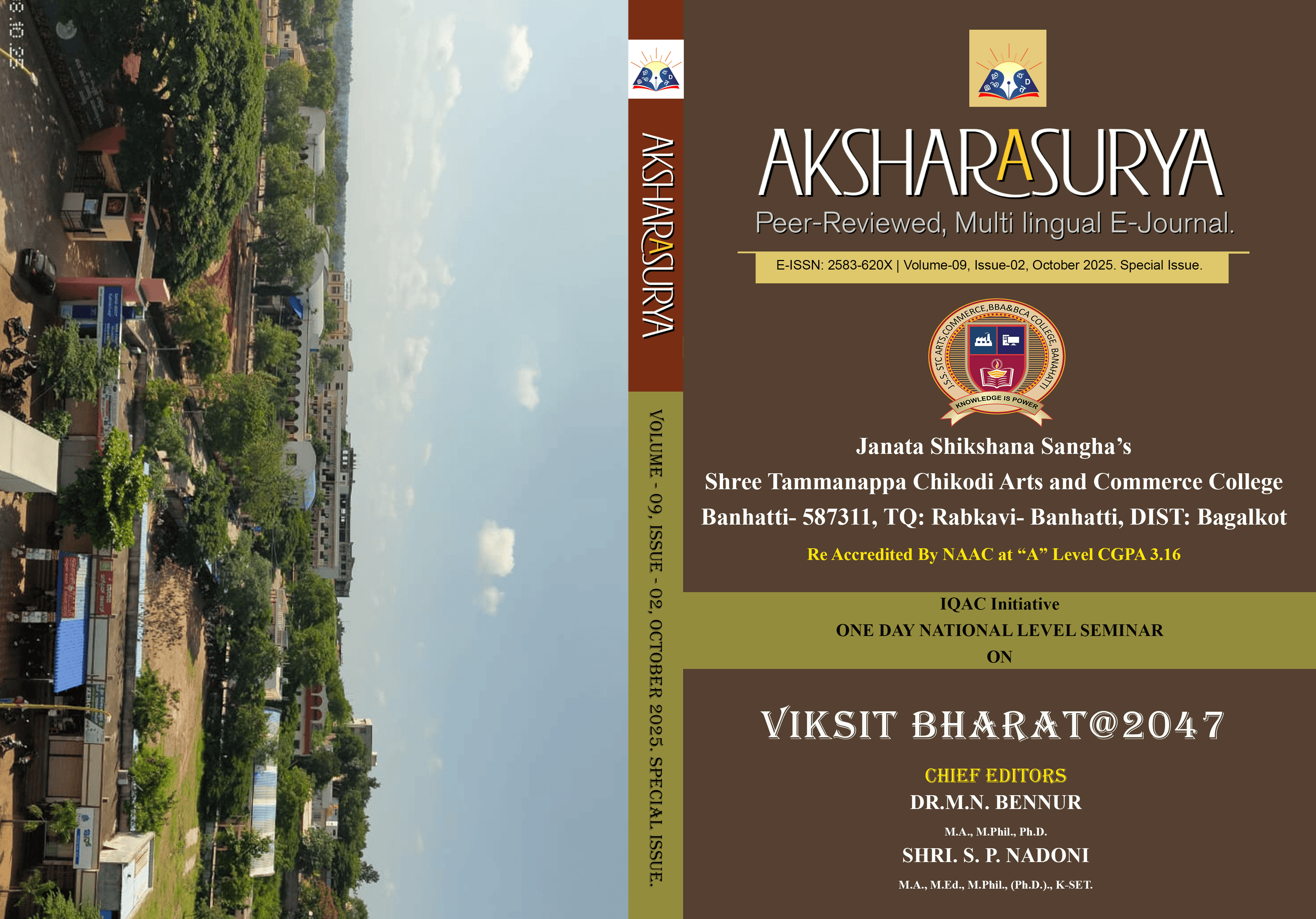
Main Article Content
Abstract
The vision of Viksit Bharat 2047—a developed India by the centenary of independence represents a multidimensional transformation of the nation’s social, economic, political, and cultural structures. It seeks to position India as a global leader rooted in its civilizational ethos and equipped with modern technology, inclusive growth, and sustainability. This paper analyses the conceptual foundations, historical trajectories, and policy frameworks that underpin this vision. It explores India’s journey from colonial exploitation to post-independence reconstruction and contemporary reforms. The discussion includes the role of education, governance, technology, and environmental sustainability as catalysts for holistic development. Using an analytical lens grounded in policy analysis and historical interpretation, the study identifies opportunities and challenges in realizing the Viksit Bharat 2047 goal. The paper concludes that achieving this vision requires an integrated approach combining traditional knowledge systems, digital transformation, equitable growth, and global cooperation.
Article Details
Section

This work is licensed under a Creative Commons Attribution-NonCommercial-ShareAlike 4.0 International License.
How to Cite
References
Government of India., (2023)Vision India@2047: Strategy Paper, NITI Aayog,
Ministry of Finance., Economic Survey 2023–24 (New Delhi: Government of India, 2024).
NITI Aayog, Viksit Bharat 2047 (2024) : Roadmap for Inclusive Growth,.
United Nations Development Programme (UNDP)., Human Development Report 2024.
Kautilya, Arthashastra, trans. R. Shamasastry (1915 ) (Bangalore : Government Press,).
Romila Thapar., (2002) Early India: From the Origins to AD 1300 (Berkeley: University of California Press,).
Bipan Chandra., 1988, India’s Struggle for Independence (New Delhi: Penguin,).
Jawaharlal Nehru, The Discovery of India (Bombay: Oxford University Press, 1946).
Gandhi M. K., ( 1938), Hind Swaraj., (Ahmedabad: Navajivan,).
Amartya Sen, (1999), Development as Freedom (New York: Knopf,).
World Bank., (2024) .India Development Update,
Ministry of Education., (2020), National Education Policy.
Indian Knowledge Systems Division., (2023) AICTE, IKS Handbook (New Delhi:).
UN-ESCAP., (2023) Asia-Pacific Sustainable Development Report,.
Reserve Bank of India., (2024) Handbook of Statistics on Indian Economy.