
Ecological Modernization and Inclusive Growth: Rethinking Development Paradigms for Viksit Bharat 2047
Article Sidebar
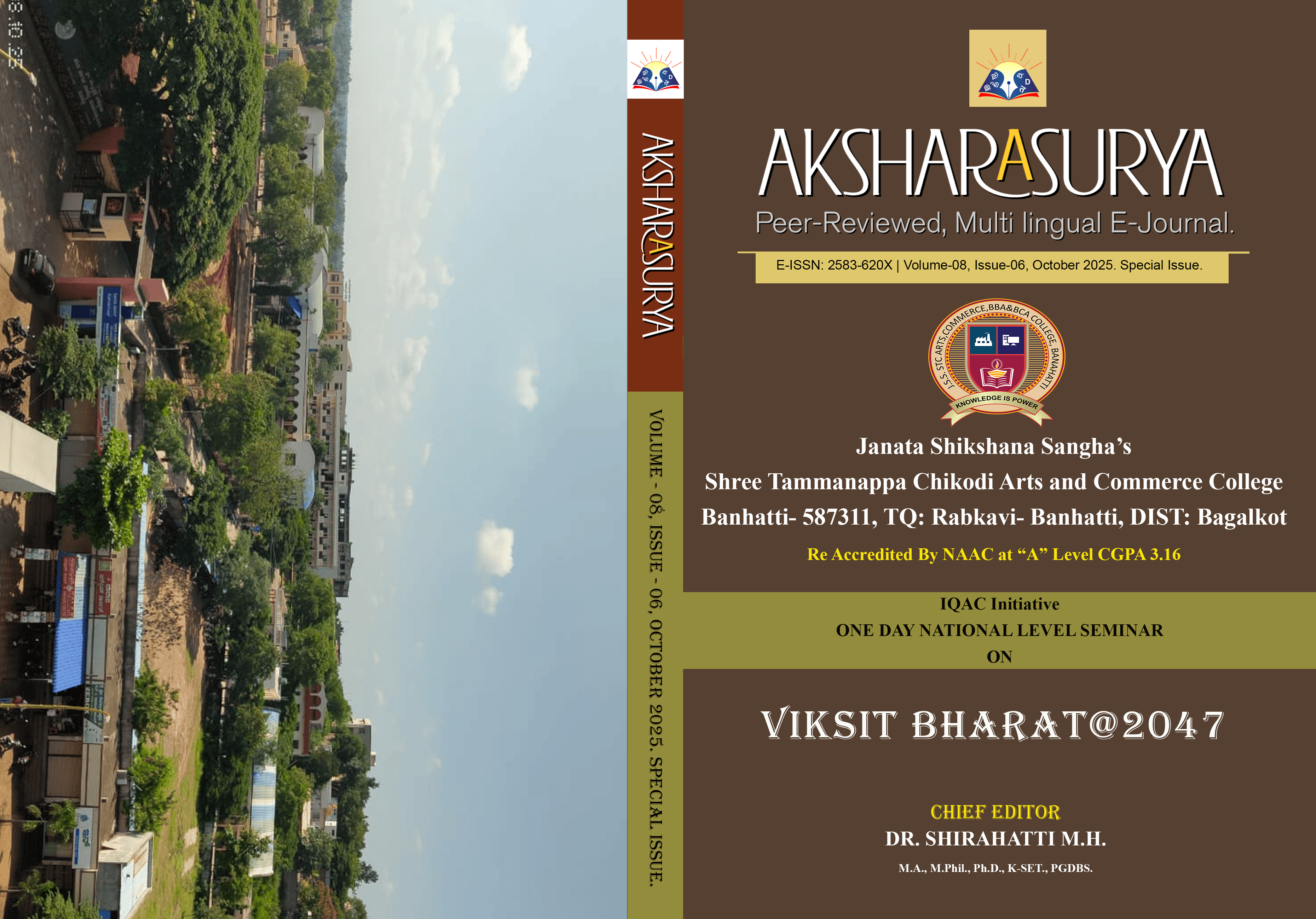
Main Article Content
Abstract
India’s aspiration of Viksit Bharat 2047 requires development strategies that balance rapid economic growth with environmental sustainability and social equity. This paper examines Ecological Modernization (EM) as a framework for achieving inclusive growth using secondary data drawn from academic literature, government reports, policy documents, and international case studies. EM reconceptualizes environmental protection not as a constraint but as an opportunity for technological innovation, institutional reform, and green industrial development. Analysis indicates that clean technologies, circular economy practices, and green infrastructure can enhance productivity, employment, and environmental quality. However, technology-led green transitions may exacerbate regional and occupational inequalities if social safeguards are absent. Skills development, social protection, and targeted regional interventions are therefore essential to ensure inclusivity. The study proposes a policy framework encompassing green industrial policy, inclusive labor measures, decentralized governance, and fiscal instruments that internalize environmental costs. Secondary data evidence suggests that EM, when integrated with pro-poor redistribution and participatory governance, can provide a development pathway that is both environmentally resilient and socially just. The findings offer actionable insights for policymakers, scholars, and development practitioners. Overall, this research highlights the potential of EM to guide India toward a sustainable and inclusive Viksit Bharat 2047.
Article Details
Section

This work is licensed under a Creative Commons Attribution-NonCommercial-ShareAlike 4.0 International License.
How to Cite
References
Dryzek, J. S. (2013). The Politics of the Earth: Environmental Discourses (3rd ed.). Oxford University Press.
Mol, A. P. J., & Spaargaren, G. (2000). Ecological modernization theory in debate: A review. Environmental Politics, 9(1), 17–49.
Sachs, J. D. (2015). The Age of Sustainable Development. Columbia University Press.
NITI Aayog. (2021). National Strategy for New India @75. Government of India.
World Bank. (2020). Inclusive Growth in India: Policy Priorities and Challenges. World Bank Publications.
UNEP. (2019). Global Environment Outlook – GEO-6. United Nations Environment Programme.
Singh, R. K., & Sharma, P. (2020). Green industrial policies and sustainable development in India. Journal of Environmental Management, 261, 110230.
OECD. (2019). Greening India’s Economy: Policies and Practices. OECD Publishing.
Bhattacharya, A., & Sharma, D. (2018). Renewable energy and employment generation in India: Prospects and challenges. Energy Policy, 121, 29–41.
Ministry of New and Renewable Energy, Government of India. (2022). Annual Report 2021–22. New Delhi: MNRE.
Agarwal, A., & Narain, S. (1991). Global Warming in an Unequal World: A Case of Environmental Colonialism. Centre for Science and Environment, New Delhi.
Giddens, A. (2009). The Politics of Climate Change. Polity Press.
Kaur, R., & Singh, J. (2021). Inclusive growth and green technology adoption in India. Journal of Cleaner Production, 305, 127348.
Ministry of Environment, Forest and Climate Change, Government of India. (2021). State of Environment Report 2020–21. New Delhi: MoEFCC.
German Advisory Council on Global Change. (2019). Towards Green Modernization: Lessons from International Experiences. Berlin: WBGU.