
Rewriting Myth and Womanhood: A Feminist Study of Shabari
Article Sidebar
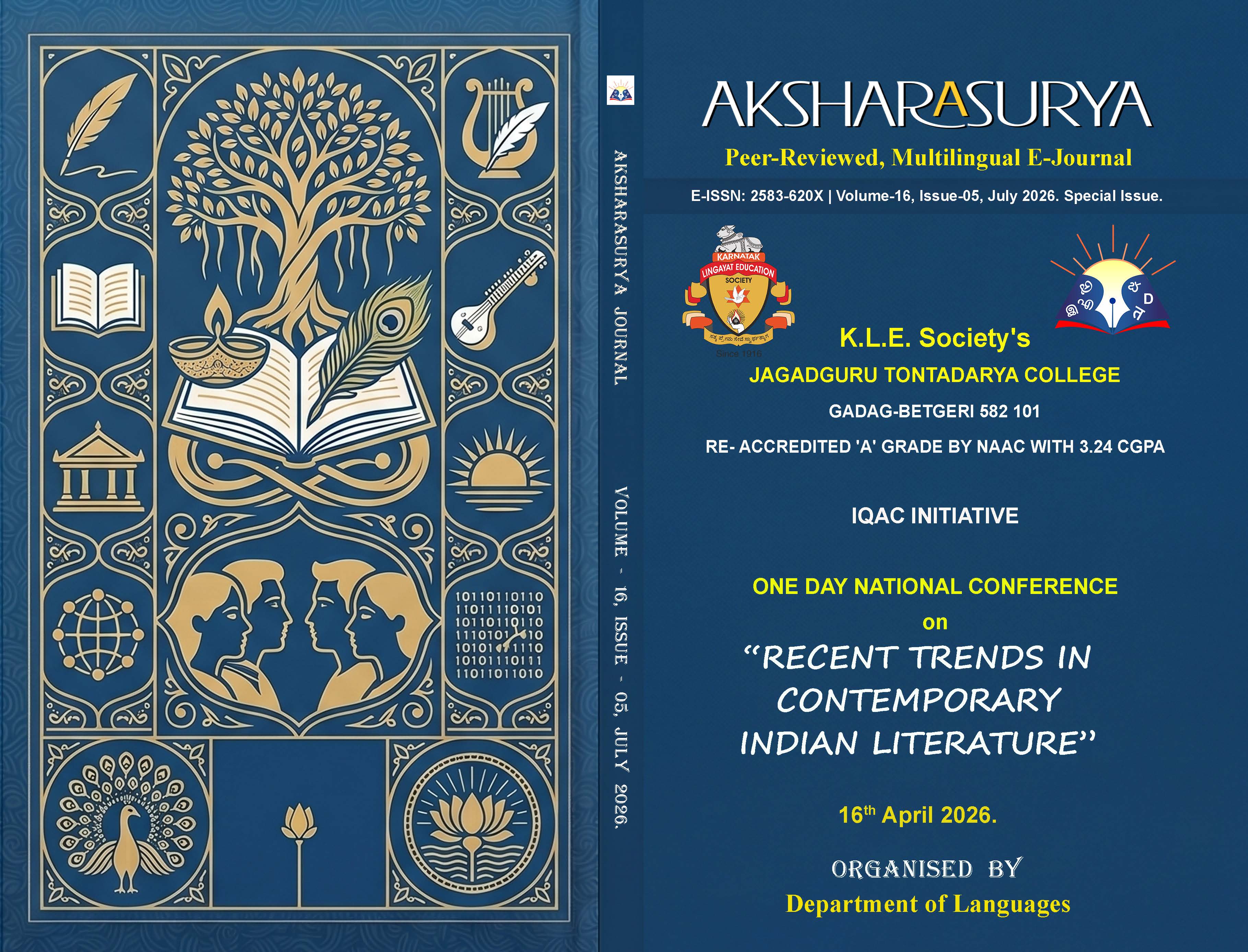
Main Article Content
Abstract
This paper explores Baraguru Ramachandrappa’s novel Shabari through a feminist lens, focusing on how it reimagines a wellknown mythological figure to foreground the experiences of a marginalized woman. The study examines the intersections of gender, caste, and devotion, revealing how Shabari challenges the rigid social and cultural expectations traditionally imposed on women in Indian literature. By portraying Shabari as an active, thoughtful, and morally strong individual, the novel resists conventional portrayals of women as passive devotees or silent observers of religious life. The paper situates the narrative within feminist and subaltern theoretical frameworks, demonstrating how Shabari’s voice disrupts dominant narratives and creates space for alternative perspectives on womanhood. Furthermore, the analysis highlights how the novel addresses issues of social hierarchy and exclusion, emphasizing the role of personal agency and moral integrity in challenging oppressive structures. Ultimately, Shabari presents a transformative vision of femininity that values dignity, resistance, and self-determination over submission or obedience. By bringing attention to the experiences and perspectives of marginalized women, the novel not only reinterprets a traditional myth but also contributes to broader discussions about gender, caste, and empowerment in contemporary Indian literature.
Article Details
Section

This work is licensed under a Creative Commons Attribution-NonCommercial-ShareAlike 4.0 International License.
How to Cite
References
Beauvoir, S. de. (1949). The Second Sex. Paris: Gallimard.
Spivak, G. C. (1988). Can the subaltern speak? In C. Nelson & L. Grossberg (Eds.), Marxism and the interpretation of culture (pp. 271–313). Urbana: University of Illinois Press.
Ramachandrappa, B. (Year). Shabari.
Valmiki. (n.d.). Ramayana.