
Role of Rani in Naga Mandala: A Feminist Study
Article Sidebar
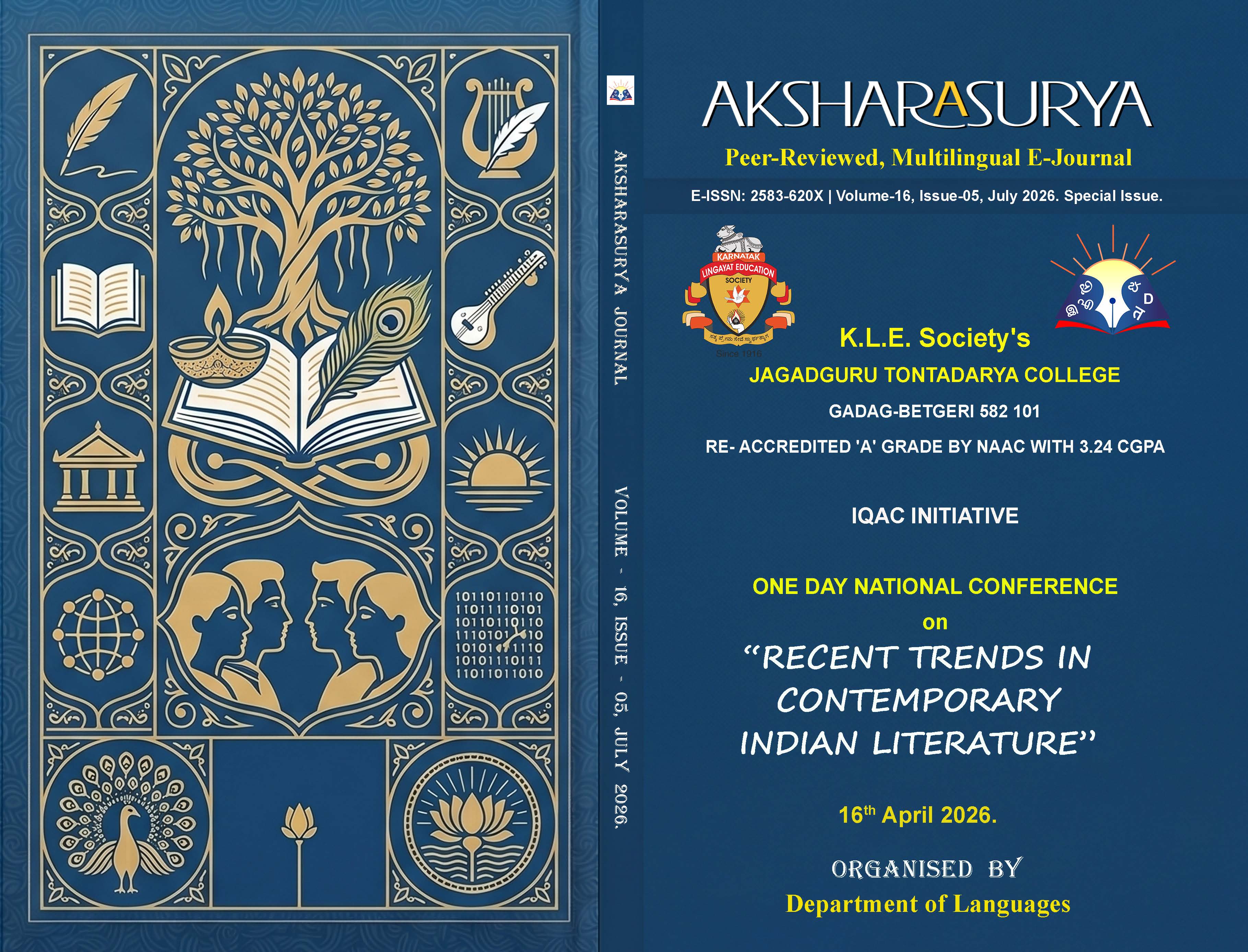
Main Article Content
Abstract
This paper examines the role of Rani from a feminist perspective and explores how her character reflects the problems of patriarchy, the suppression of the female voice, and the search for identity. Feminist criticism analyzes the position of women in society and how literature represents their struggles within patriarchal structures. In Nagamandala, Rani represents the condition of women in a male-dominated society. She is initially portrayed as innocent, silent, and obedient, yet her character gradually gains strength through her experiences. As the narrative progresses, Rani undergoes a significant transformation when she experiences love and care through the magical presence of the serpent. This encounter awakens her sense of self-worth, desire, and emotional fulfillment. Over time, she evolves from a passive victim into a more confident and assertive individual who subtly challenges societal norms.
Rani’s journey highlights themes of identity, desire, and the quest for dignity. By the end of the play, she attains respect and authority, not through open rebellion, but through a complex interplay of truth, illusion, and social beliefs. Through Rani’s character, the play portrays both the suffering and the inner strength of women. Her life reflects the harsh realities faced by many women, where silence and submission are expected virtues. Ultimately, Rani symbolizes the resilience of women and their ability to negotiate power within restrictive social structures.
Article Details
Section

This work is licensed under a Creative Commons Attribution-NonCommercial-ShareAlike 4.0 International License.
How to Cite
References
Karnad, Girish. Nagamandala: A Play with a Cobra. Oxford University Press, 1990.
Beauvoir, Simone de. The Second Sex. Translated by H. M. Parshley, Vintage Books, 1989.
Showalter, Elaine. “Towards a Feminist Poetics.” Women Writing and Writing about Women, edited by Mary Jacobus, Croom Helm, 1979, pp. 22–41.
Abrams, M. H. A Glossary of Literary Terms.
Butler, J. (1990). Gender Trouble: Feminism and the Subversion of Identity. Routledge.
Spivak, G. C. (1988). Can the Subaltern Speak? In C. Nelson & L. Grossberg (Eds.), Marxism and the Interpretation of Culture (pp. 271-313). University of Illinois Press.